
Removing complaints from legal directories such as Avvo, Justia and Martindale-Hubbell depends on proving a policy violation, not unfairness. The strongest opening move is usually evidence that no attorney-client relationship existed, submitted as a calm, narrow notice with intake and billing records attached. Denied requests are refiled with a stronger dossier, and litigation targets the poster, not the directory.
Key facts
- Avvo, Justia, Martindale-Hubbell, FindLaw and Lawyers.com each run different intake, verification and escalation processes.
- Section 230 usually shields US legal directories, so suing the directory rarely removes the complaint.
- DMCA notices apply only when the complaint copies your biography text, photographs or other copyrighted material.
- In the EU and UK, privacy and data protection arguments often carry more force than defamation claims.
Where ContentRemoval.com comes in. ContentRemoval.com works legal directory complaints platform by platform, preserving the record first, choosing the strongest ground, whether unverifiable client status, impersonation, copied material or a court-backed order, and pursuing de-indexing where the source stalls. Lawyers, managing partners and firm administrators usually make contact directly. A free 15-minute Exposure Scan maps what is removable across every directory and search surface, and the report is yours to keep. Get a Free, Confidential Exposure Scan or read how our content removal work is done.
You search your name or your firm at night because a client mentioned “something odd” on Avvo, Justia, or Martindale-Hubbell. There it is. A complaint, a hostile review, or a thread dressed up to look like a neutral professional record. By morning, partners, referral sources, journalists, opposing counsel, or a board member may have seen it.
Treat that moment correctly. Don’t argue with the post. Don’t threaten the platform in a burst of indignation. Don’t assume the same playbook used for Yelp or TripAdvisor applies here. Legal directories sit closer to the authority layer of search results. They look institutional, they rank well, and they borrow trust from the profession itself.
That is why generic advice fails. These platforms use directory-specific verification and moderation processes that most articles barely address. That gap is one reason the market remains poorly served, even though optimized profiles can reduce negative impact by 40-60% and a 2026 Clio report identified a 35% increase in removals for verified fakes in the legal sector, as discussed in analysis of fake law firm review removal. If you want to remove complaints from legal directories, you need a platform-specific strategy, a jurisdiction-aware escalation path, and disciplined evidence from the first hour.
The Unique Challenge of Complaints on Legal Directories
A complaint on a legal directory is more damaging than a bad consumer review because it doesn’t look like consumer chatter. It looks like part of the professional record. That distinction changes how judges, journalists, referral partners, general counsel, and high-value prospects interpret it.
A bad Yelp review can feel noisy. A hostile Avvo or Justia post feels official. That false aura of legitimacy is what makes these entries dangerous for public-facing lawyers, managing partners, founders, and high-profile individuals who rely on trust before the first call happens.
Why these platforms are harder to manage
Legal directories don’t all operate the same way. Avvo, Justia, Martindale-Hubbell, FindLaw, and Lawyers.com each have their own intake rules, profile structures, and moderation logic. A removal request that works on one may fail on another because the evidence threshold, reviewer verification process, and escalation channel differ.
That’s why broad online advice is often counterproductive. It tells you to “flag and wait,” or worse, to send legal threats too early. Aggressive legal action often fails because Section 230 shields platforms from liability for user content in the US, which is one reason experienced operators prioritize policy violations, profile control, and suppression strategy before litigation.
Practical rule: If the directory can classify the post as a legitimate opinion from a real client, your outrage is irrelevant. Your evidence is all that matters.
A second complication gets less attention. Many legal directories aren’t just review sites. They’re also ranking systems, profile databases, and authority signals inside Google’s results. That means one unresolved complaint can contaminate more than one surface at once. It can affect the directory page itself, branded search results, knowledge panels, and follow-on republication.
Why selection and verification matter
The way a directory builds credibility also shapes your removal options. If a platform presents itself as curated or professionally filtered, that often influences how it handles complaints, profile claims, and verification disputes. For context, review the criteria behind how legal directories select their members. Understanding that front-end selection logic helps you identify the back-end pressure points.
Here’s the blunt truth. Most failed removals start with the wrong objective. The client wants the complaint “gone because it’s unfair.” The platform asks a narrower question: is it fake, unverifiable, irrelevant, defamatory under a court order, or otherwise in breach of policy?
If you don’t answer that exact question, you’ll waste time, expose your emotional state, and create a record the platform can ignore.
The Triage Protocol Immediate Assessment and Evidence Collection
The first 24 hours decide whether this becomes a quiet cleanup or a prolonged reputational problem. Your job is to preserve evidence, identify the likely policy breach, and build a file that can survive scrutiny from a platform moderator, not to win an argument in public.
Start by freezing the scene.

Preserve everything before the post changes
Take full-page screenshots with visible timestamps. Save the URL, profile name, publication date, profile ID, cached versions if available, and any related search result snippets. Capture mobile and desktop views because formatting differences sometimes matter in later correspondence with the platform.
Then record the surrounding context. Is the complaint attached to your claimed profile, an unclaimed profile, a law firm listing, or a third-party directory entry built without your input? That distinction affects who can submit the strongest challenge and which account tools are available.
Use a simple incident log:
- Exact publication details
Save the directory name, page title, review text, date, and reviewer handle. - Possible identity clues
Note language patterns, references to a practice area, timing around a dispute, or facts only a competitor or opposing party would know. - Business impact
Record whether referral partners, clients, media contacts, or recruiters have already seen it. This won’t prove a policy violation, but it helps prioritize response speed.
Build a technical case, not a moral case
For Avvo and Justia, the strongest opening move is often proving that no attorney-client relationship existed. Evidence such as client records, billing invoices, matter intake logs, conflict checks, or communication records can establish that the reviewer was never a client. That matters because legal directories commonly require client reviews to come from actual clients or former clients, and on these platforms, removals for clear policy breaches such as fake client submissions succeed at roughly 20-30%, while 70% of initial flags are denied due to insufficient evidence, according to Justia’s discussion of reputation management and review disputes.
That number should shape your behavior. The average submission fails because it is emotional, thin, or speculative.
Use evidence with hierarchy. Strong evidence includes:
- Client intake records showing the person never retained you
- Billing or invoice data showing no matter existed
- Conflict logs or CRM entries showing only a consultation inquiry, or no record at all
- Email and call records disproving specific factual claims
Weaker material includes your personal belief that the reviewer “must be fake,” a vague memory from staff, or screenshots without a clear chain of context.
Preserve records as if opposing counsel will review them. That standard keeps your file disciplined.
Classify the complaint before you respond
Not every hostile post is the same problem. A fake client review requires one strategy. A real but exaggerated former client complaint requires another. A competitor posing as a client calls for a different evidentiary frame. An anonymous thread containing copied biography text, headshots, or case descriptions may open copyright or privacy pathways later.
A quick classification matrix helps:
| Complaint type | Core issue | Best opening argument |
|---|---|---|
| Fake client review | No attorney-client relationship | Verification failure under platform policy |
| Real client, negative opinion | Protected speech risk | Narrow challenge to factual inaccuracies or policy breach |
| Competitor or opposing party | Misrepresentation | False identity and bad-faith posting |
| Anonymous post using copied material | IP or privacy overlap | Preserve for later escalation |
Don’t contact the reviewer first unless counsel has advised it and the identity is already known. Early confrontation often teaches the poster what to delete, what to deny, and how to reframe the complaint before the platform investigates.
The Direct Approach Navigating Directory Takedown Policies
Most removals are won or lost in the first formal notice to the platform. Write that notice as if you’re reporting a compliance issue inside a regulated system. Polite, precise, unemotional. No speeches. No wounded pride. No threats you aren’t prepared to execute.

What the platform needs from you
Directories respond to technical violations, not personal distress. Your notice should identify the exact URL, the precise policy issue, and the evidence you can supply. If the issue is a fake client review, say that directly and tie it to the platform’s client-verification requirement. If the issue is impersonation, irrelevance, or copied material, identify that basis with equal discipline.
Keep the structure tight:
- Opening identification
State your full name, role, profile URL, and the offending content URL. - Policy-grounded allegation
Assert the narrowest, strongest violation. For example, that the reviewer cannot be verified as an actual client or former client. - Evidence summary
Refer to attached intake records, billing records, communication logs, or other business records. - Requested action
Ask for investigation and removal, not a debate.
This isn’t PR writing. It’s compliance writing.
A model opening that actually works
Use language like this as a starting point:
I am submitting a formal request for review and removal of the content published at [URL]. The post appears to violate your review policy because the author cannot be verified as a current or former client. Our records, including intake and billing documentation, show no attorney-client relationship with the named or implied reviewer. We request that your team investigate the authenticity of this submission and remove it if the reviewer cannot be verified under your policy.
That tone works because it leaves the platform room to act without feeling challenged. Moderators are more likely to process a clear policy file than a theatrical demand letter.
Platform behavior differs more than most people realize
Avvo, Justia, and other legal directories may all host attorney profiles, but their workflows vary. Some route disputes through support channels. Some push you into profile claim systems. Some want a short submission first and fuller documentation only after initial review. Martindale-Hubbell and Lawyers.com can also involve networked profile data issues, where a complaint sits next to syndicated firm information and becomes harder to isolate.
That is why copying one complaint into five portals usually underperforms. Tailor the framing to the directory’s review rules, submission form fields, and verification language.
If you want a broader model for drafting a disciplined review-removal request, this professional guide to removing a bad business review captures the structure well, even though legal directories require a more specialized overlay.
Practical distinction: The best removal request reads like an internal incident report. The worst reads like a furious client email.
Keep the matter private and avoid public sparring
Don’t post rebuttals while a takedown request is pending unless silence would create a larger business risk. Public replies can validate the post’s visibility, create searchable admissions, and complicate later legal positioning. The same principle appears in wider discussions around censored content where overreaction often turns a contained issue into a larger audience event.
Use a short internal checklist before filing:
- Check profile control so the right account holder submits the notice
- Match the evidence to the exact violation claimed
- Remove speculation about who wrote it unless identity proof is strong
- Set a follow-up schedule so the request doesn’t die in a queue
A calm, narrow, well-documented request gives the platform the easiest possible path to remove complaints from legal directories without forcing a public fight. That is the outcome you want.
Escalation Pathways When Direct Requests Are Denied
A denied request is information, not defeat. It tells you the platform didn’t see enough proof, didn’t agree with your framing, or decided the content sits inside protected opinion. Your next move should correct that specific failure. Anything else is noise.
The first escalation is usually internal. Refile with a stronger dossier, a narrower allegation, and a cleaner chronology. If the first request argued “false and harmful,” the second should argue “unverifiable as a client review,” “contains copied proprietary material,” or “conflicts with attached business records.”
Improve the dossier before you escalate
When firms escalate removal requests tied to Google Business Profiles and related reputation surfaces, initial flagging succeeds at roughly 25-35%, and that can rise to 60% with a detailed evidence portfolio submitted to Google Support. At the same time, 60% of rejections stem from vague complaints without specific evidence, according to Rocket Clicks’ breakdown of law firm review escalation. The lesson applies directly here. Your escalation file must be stronger than your original filing, not merely louder.
A stronger dossier usually includes:
- A documented timeline showing when the post appeared and when you discovered it
- Structured exhibits labeled clearly, rather than a pile of screenshots
- Witness statements from staff who handled intake or know no matter existed
- Cross-references between the complaint’s claims and your records
If the complaint also appears on complaint boards or watchdog platforms, the escalation logic in this strategic guide to removing a BBB complaint is useful because it treats escalation as a dossier problem, not a messaging problem.
When DMCA fits and when it doesn’t
DMCA notices are narrow tools. Use them only when the complaint incorporates your copyrighted material, such as copied website biography text, photographs, articles, or proprietary descriptions lifted from your own site or firm profile. Don’t misuse copyright language to attack criticism. That only weakens your credibility.
A proper DMCA-based escalation can be effective when the content package includes unauthorized reproduction. It won’t solve a pure reputation dispute by itself, but it can remove or de-index the copied material around the complaint and shrink the post’s authority.
Cease-and-desist letters can help, but they can also misfire
If you can identify the poster, a targeted cease-and-desist letter may pressure a withdrawal, correction, or preservation of evidence. It can also harden the poster’s position, prompt republication, or invite performative defiance. Use it when identity is reliable, the claims are provably false, and you’re prepared to act if ignored.
Don’t send a cease-and-desist letter to feel in control. Send it only when it advances a real legal or tactical objective.
The wrong letter creates three problems at once. It warns the poster, it creates a shareable artifact, and it can turn a little-read complaint into a story about attempted censorship. That risk rises when the subject is already high-profile.
Your escalation path should stay disciplined. Strengthen the evidence. Reframe the violation. Use copyright tools only where copyright exists. Reserve direct legal pressure for moments when the identity, facts, and downstream consequences are clear.
Advanced Recourse Court Orders and Jurisdictional Leverage
Your complaint is still live on Avvo or Justia. A prospective client, a referral source, or a regulator searches your name, sees the entry, and draws a conclusion before anyone speaks to you. At that stage, court action is not about outrage. It is about forcing a result in the right jurisdiction against the right party.
Don’t sue the directory if the goal is removal
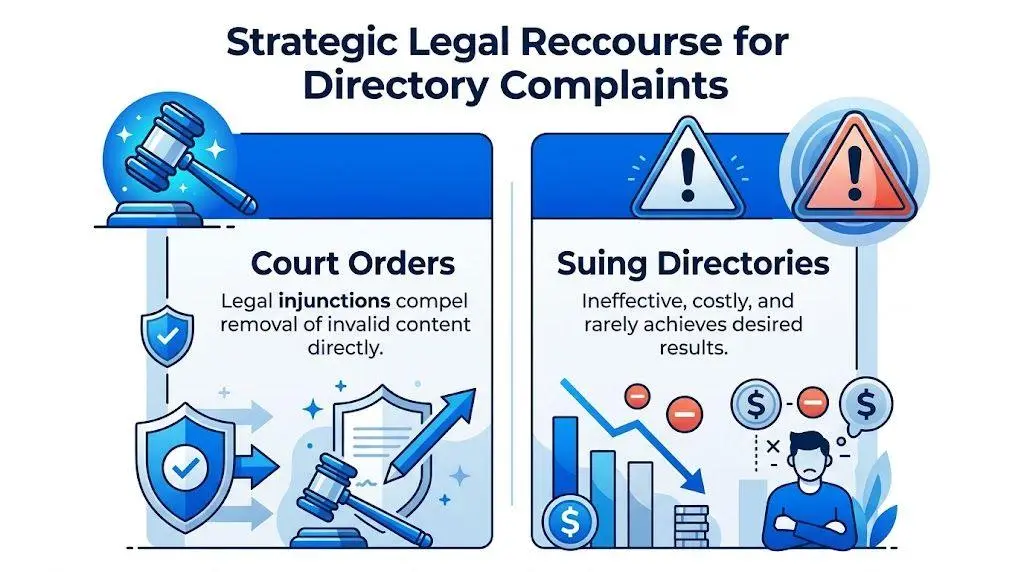
For US matters, suing Avvo, Justia, or Martindale-Hubbell directly is usually a waste of time. Section 230 often shields legal directories from liability for user-generated complaints. You spend money, create a public filing, and still fail to remove the page.
The better US target is the poster. If the author is anonymous, file against John Doe and move fast to preserve identifying records. A properly framed order against the speaker can support de-indexing requests, identity discovery, and later enforcement steps that matter in practice.
That distinction separates professional response work from performative litigation.
In the US, court orders often help search visibility more than source removal
US clients need to understand the actual endgame. In many directory cases, a court order does not force the platform to delete the complaint, but it can still reduce harm by pushing the page out of branded search results. For a high-profile lawyer or firm leader, that practical result often matters more than winning an abstract argument about fault.
Analysts discussing court-order strategy for online removals have noted that direct directory removal in the US is far less common than Google de-indexing after a plaintiff obtains a favorable order, especially where Section 230 blocks pressure on the platform itself. That is why the legal plan must match the technical objective from the start.
Use a layered objective:
- get a ruling against the poster
- convert that ruling into de-indexing where possible
- contain the remaining URL through stronger controlled assets
If you are deciding whether litigation will improve the search result, review this executive evaluation of online defamation lawsuits. It frames the core question correctly. Will a court order change what clients, boards, and counterparties see?
EU and UK complaints require a different playbook
Here, generic advice fails. Legal directories do not respond the same way across jurisdictions, and privacy rights change the pressure points.
In the US, the fight is usually about falsity, speaker identification, and search suppression. In the EU and UK, privacy, data protection, proportionality, and platform obligations often carry more force than a classic defamation theory. If a directory entry exposes personal data, sensitive allegations, disciplinary references taken out of context, or outdated accusations, an EU or UK complaint may have a stronger path than the same facts would have in a US filing.
That matters for internationally active lawyers, dual-qualified practitioners, and firms with offices or clientele on both sides of the Atlantic. A complaint that survives on a US-facing page may still be restricted, de-indexed, or removed in Europe under privacy-based arguments that do not exist in the same form in the United States.
Court orders are tools to gain position, not emotional releases
Aggressive legal action can widen the audience for a complaint that was previously obscure. Once a filing becomes public, journalists, bloggers, and trade rivals can turn a minor directory issue into a broader reputation event.
Use court action only when four conditions are met. The statement is clearly actionable. The poster can be identified or unmasked. The jurisdiction offers a realistic enforcement route. The expected search impact justifies the exposure and cost.
The strongest strategy is jurisdiction-specific. In the United States, use litigation selectively to identify posters and support de-indexing. In the EU or UK, use privacy rights and platform duties where the facts support them. That is how you remove complaints from legal directories with discipline, instead of turning one bad listing into a second crisis.
Proactive Defense and Long-Term Reputation Shielding
Individuals often make the same mistake after a successful removal. They stop. That is how the next complaint lands harder than the first.
A single takedown is incident response. Reputation protection is infrastructure. If your profile stack is weak, one hostile post can dominate the search page because there is nothing stronger around it.

Build assets that outrank the problem
Claim and optimize every legitimate professional profile you control. That includes bar-related records where editable, firm biography pages, speaking pages, publisher bios, chamber or association listings, conference pages, and well-maintained directory entries. The point isn’t vanity. The point is occupying branded search real estate with accurate, current, high-trust assets.
In this area, many legal professionals underperform. They leave half-built directory profiles online, ignore biography freshness, and fail to unify naming conventions. Then they’re surprised when a complaint sits beside stale or empty profile pages and draws the click.
Use a practical review:
- Consistency across name format, headshot, title, office, and practice description
- Completeness so thin profiles don’t look abandoned
- Authority signals such as publications, associations, and speaking credentials
- Freshness through regular updates rather than one-time edits
Don’t chase fake positivity
Manufactured reviews are reckless. The right answer is a controlled process for collecting authentic feedback from real clients where ethically and legally appropriate. The objective isn’t to flood the internet with praise. It’s to prevent one hostile item from becoming the dominant narrative.
A healthy review environment also improves your credibility when you challenge a fake. Platforms are more likely to take a structured business seriously when its profile history looks normal, claimed, and maintained.
A protected reputation isn’t spotless. It is resilient.
Monitoring has to be continuous
Legal directory issues often start subtly. An anonymous review appears on a Friday. A profile update republishes on Monday. By the time someone notices, the complaint is indexed, cached, and copied elsewhere. That delay is what turns a manageable problem into a search problem.
The solution is continuous monitoring across your name, firm name, practice brands, and high-risk variations. Watch the directories themselves, not just Google alerts. Track claim status on profiles. Save change logs. Review search snippets regularly. If you manage a high-profile practice, someone should own that process at all times.
Long-term shielding is simple in principle and demanding in execution. Strengthen the assets you control. Generate authentic positive proof. Monitor constantly. Act early. That is how you reduce the chance that you’ll ever need emergency removal again.
When to Engage Professional Removal Specialists
A complaint on Avvo, Justia, or Martindale-Hubbell can look manageable at 9 a.m. By noon, the wrong reply, the wrong form, or the wrong legal theory can harden the record and make removal harder. If your name drives referrals, media scrutiny, or client confidence, bring in specialists before anyone on your team starts experimenting.
This work is technical, platform-specific, and jurisdiction-sensitive. Avvo, Justia, and Martindale-Hubbell do not process disputes the same way, and the right approach in the U.S. is often the wrong one in the EU or UK. In the U.S., the strongest route may be a policy-grounded takedown request, a defamation review, or search de-indexing where source removal stalls. In the EU or UK, privacy, data protection, and misuse of personal data can change the pressure points and the order of operations.
Specialists earn their fee by setting the sequence correctly. They preserve evidence before edits or deletions erase context. They choose the strongest ground first, whether that is identity mismatch, unverifiable client status, privacy misuse, copyright infringement, or a court-backed order. They also know when silence is the better move because a weak complaint can draw attention to a post that was barely visible.
Detachment matters just as much as legal analysis. High-profile lawyers and firms often make the same mistake. They respond personally, sound offended, and create a record the directory can point to later. A removal specialist keeps the matter narrow, factual, and private.
Use outside help early if any of these are true: the complaint names a lawyer with a public profile, alleges misconduct, appears across more than one directory, involves a reviewer whose identity is unclear, or touches more than one jurisdiction. Bring in specialists immediately if the post is already appearing in branded search results or if internal staff are divided on whether to answer, report, or threaten action.
There is also a practical reason to act before the situation escalates. Once a bad submission history is attached to the matter, later requests face more skepticism. A clean first move gives you better odds.
If a legal directory complaint is threatening your reputation, ContentRemoval.com can assess the matter confidentially and map the fastest credible route to removal, de-indexing, or suppression. For executives, law firms, family offices, and high-profile individuals, the advantage is controlled action across the right platform, with the right evidence, in the right jurisdiction.
Frequently asked questions
Can I get a fake client review removed from Avvo?
Yes, if you can show the reviewer was never a client. Legal directories commonly require reviews to come from actual clients or former clients, so intake records, billing data, conflict logs or CRM entries showing no matter existed are the evidence that moves a moderator.
Should I reply publicly to a complaint on Justia or Martindale-Hubbell?
Not while a takedown request is pending, unless silence would create a larger business risk. Public replies can validate the post’s visibility, create searchable admissions and complicate later legal positioning.
What happens if the directory denies my removal request?
Treat the denial as information about what was missing. Refile with a stronger dossier, a narrower allegation and a cleaner chronology, and add structured exhibits, a documented timeline and witness statements from staff who handled intake.