
You cannot delete a business from Yelp; Yelp keeps every listing as a public record and allows three paths. If the business has closed, claim the page and mark it Permanently Closed. If it is open, report specific reviews or a fraudulent listing under Yelp’s policy categories with evidence. For severe defamation or impersonation, only a court order compels removal.
Key facts
- Marking a claimed listing Permanently Closed triggers a 5 to 7 working day Yelp review.
- Closing your Yelp for Business account does not remove the public listing.
- Yelp will not identify anonymous reviewers or remove content on a business’s defamation claim without a court order.
- Full listing removal is realistic mainly when the page is fake or impersonates a legitimate business.
Where ContentRemoval.com comes in. ContentRemoval.com takes on Yelp listings for brands and professionals when the page is fraudulent, impersonates the real company, or carries defamatory reviews that platform reporting has failed to clear. Owners, their marketing agencies and their legal teams usually make contact after a deletion request has gone nowhere. A free, confidential 15-minute Exposure Scan maps which of the three paths applies and what evidence each needs, and the report is yours to keep. Get a Free, Confidential Exposure Scan or read how our review removal work is done.
Most advice on how to remove a business from Yelp is wrong. It treats Yelp like a business directory you control. You don’t. Yelp treats your listing as part of its own public information system, and that single policy choice changes everything.
If you’re dealing with reputational harm, stop chasing the fantasy of a clean delete button. The key question isn’t whether you can erase the page. The question is which of the three actual paths applies to your situation: closure status, policy-based content removal, or a legally compelled takedown. If you choose the wrong path, you waste time, preserve the damaging content, and often make your position weaker.
The Myth of Deleting Your Yelp Business Page
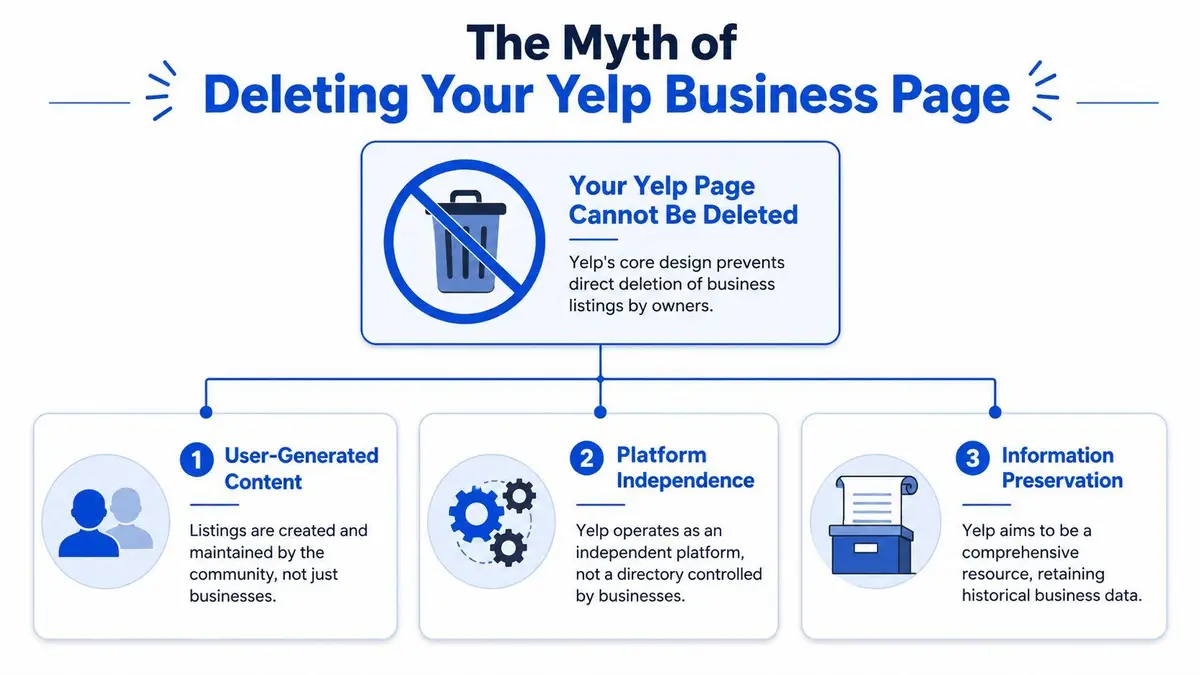
The phrase remove business from Yelp suggests a straightforward administrative task. It isn’t. Yelp’s structure is designed to resist owner-led deletion, including when a business has already shut down.
That’s why so many owners get trapped by bad guidance. A frequently underserved angle is the misconception that deleting a Yelp business listing is possible. Existing content fails to clarify that Yelp’s policy explicitly prohibits permanent removal, even for closed businesses, and only allows marking a page as Closed or Temporarily Closed, which suppresses visibility but retains the profile for historical and public record purposes. Data shows that 95% of business owners attempting deletion are misled by third-party guides claiming removal is possible, while Yelp’s own support center confirms no deletion option exists, only closure marking according to Alphr’s explanation of Yelp business deletion limits.
What Yelp actually allows
You need to separate three very different outcomes.
| Path | When it applies | What you can realistically achieve |
|---|---|---|
| Closure marking | The business has ceased operations | The listing stays live as a historical record, but shows closed status |
| Policy violation removal | Specific reviews or the listing itself break Yelp rules | Removal of particular content, not a blanket wipe |
| Legal compulsion | Severe defamation, impersonation, or unlawful content | Court-ordered or formal legal takedown relief |
Most owners collapse these into one objective and ask Yelp to “delete the page.” Yelp generally ignores that framing because it doesn’t fit its policy categories.
What to stop doing
Several mistakes repeat in high-stakes cases:
- Stop paying for vague deletion promises. Yelp’s own rules don’t support owner-preference deletion, so anyone selling that outcome as routine is overselling.
- Stop filing emotional complaints. “This is unfair” is not a policy category.
- Stop confusing profile control with platform control. Claiming the listing gives you management rights, not ownership of the page itself.
Practical rule: Don’t ask Yelp for what Yelp has already decided it won’t offer. Ask for the specific remedy its policy or the law actually permits.
That distinction is the difference between movement and stagnation.
The Closure Path Marking Your Business as Permanently Closed
If the company has genuinely ceased operations, the right move isn’t to argue for deletion. It’s to force the page into the correct status and reduce its practical visibility.
Yelp’s owner-facing option is narrow, but it exists. Yelp does not permit permanent deletion of business profiles by owners. The only owner-controlled option is to mark the listing as Permanently Closed via the Business Information dashboard. The step-by-step methodology requires claiming the listing first, navigating to Edit Business Information, selecting Mark Business as Closed, and designating Permanently Closed as the status, a process that triggers a 5 to 7 working day review window by Yelp’s moderation team. Success rates for closure markings are granted at a high rate once verification is complete as described in this video walkthrough on marking a Yelp business closed.
The exact sequence that matters
If you haven’t claimed the listing, do that first. Without control of the dashboard, you’re reduced to making low-priority public edit suggestions.
Then follow the internal route Yelp expects:
- Claim the page. Yelp will require ownership verification.
- Open Business Information. The status controls reside there.
- Select Edit Business Information.
- Choose Mark Business as Closed.
- Set the status to Permanently Closed.
- Wait through Yelp’s review process.
The operational point is simple. You’re not deleting the page. You’re converting it into a less commercially harmful record.
What owners often misunderstand
Closing your Yelp for Business account is not the same thing as changing the public-facing business listing. That confusion wastes time and leaves the listing untouched.
A closed-status page can still exist, still rank for branded searches, and still display historical reviews. But in many situations, “permanently closed” neutralizes the immediate risk better than a failed deletion campaign.
Here’s a visual walkthrough of the dashboard process:
When closure marking is the correct strategic answer
Use this path if the business is gone, sold, dissolved, or no longer operating at the listed location. Don’t use it if the business is still open and you’re merely trying to hide criticism. That invites rejection and weakens your credibility with moderators.
A closed-page designation is a containment tool, not an erasure tool.
If your actual problem is false reviews, impersonation, or a fraudulent page for an active company, closure status is the wrong remedy. Move to evidence and enforcement instead.
Removing Defamatory Content and Policy Violations
For an active business, the smarter objective is usually not to remove the business from Yelp at all. It’s to remove the content that shouldn’t be there.
Yelp’s moderation logic is narrower than most owners realize. Yelp’s automated content moderation systems filter out approximately 16% to 25% of all submitted reviews, but success for business-led removal requests depends entirely on proving a clear policy violation. The platform will not remove reviews solely for being negative. The statistical reality is that success is only possible if the content falls into narrow exclusionary categories, such as being posted by a competitor or an individual with a conflict of interest according to these published Yelp moderation figures and review filtering data.
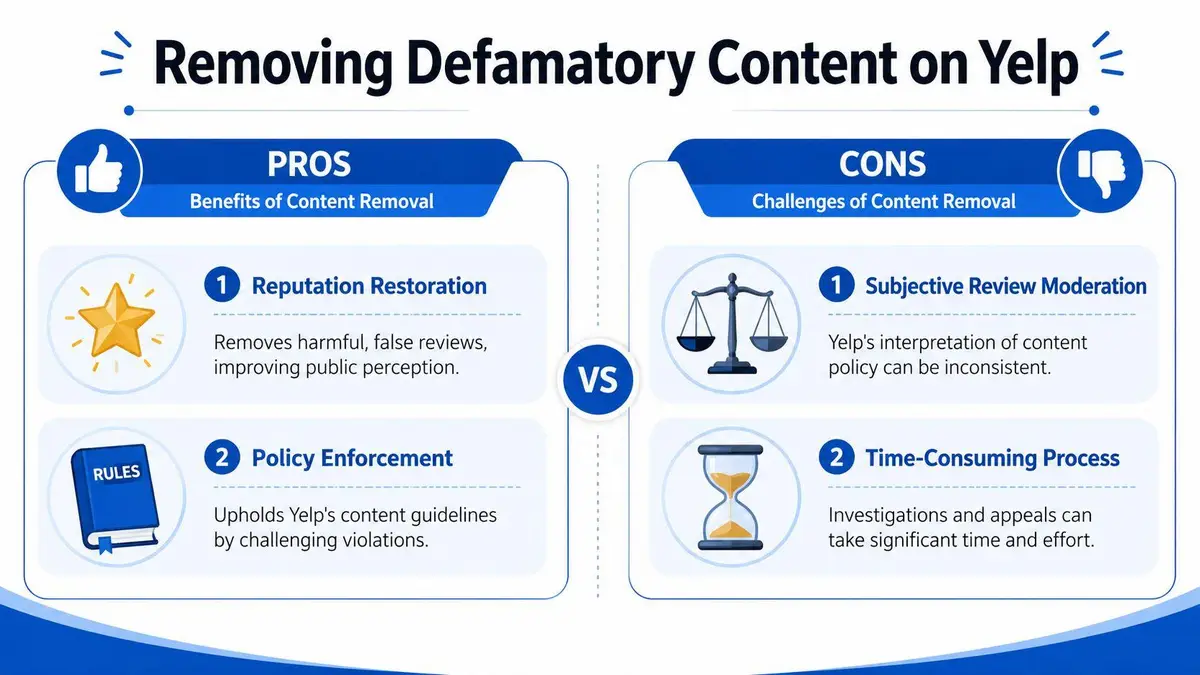
What Yelp may remove
The strongest removal requests usually fit one of these patterns:
- Non-customer reviews. The reviewer describes an experience that never happened, or there’s no record they were ever a client.
- Conflict-of-interest content. Former employees, competitors, vendors with disputes, or insiders posing as customers.
- Spam or fake entity abuse. Coordinated attacks, impersonation, or fabricated listing activity.
- Other rule-breaking material. Content that falls outside Yelp’s permitted review framework.
The trap is obvious. Owners argue truth and fairness. Yelp often cares more about category and evidence.
Build a case, not a complaint
If a review says your staff was rude, Yelp may leave it up even if you think it’s exaggerated. If the same review came from a former employee using a consumer identity, that’s a different issue entirely. The removal argument then becomes conflict of interest, not hurt feelings.
Use a disciplined audit:
| Review issue | Better argument | Evidence that helps |
|---|---|---|
| “This review is false” | Reviewer wasn’t a customer | Booking records, invoices, CRM logs, delivery data |
| “This person is attacking us” | Conflict of interest | Employment records, competitor links, public affiliations |
| “This page is fake” | Impersonation or fraudulent entity | Corporate records, trademark context, official site evidence |
Your submission should read like a compliance file. Short, precise, unemotional.
Don’t tell Yelp the review damaged your reputation. Tell Yelp exactly which rule was broken and attach proof that supports that category.
How to present the request
Use Yelp’s reporting tools and frame the issue in policy language. “We disagree with this review” is weak. “The reviewer appears to be a former employee and not a customer. Attached are employment records and a timeline showing no transaction history under the stated name” is stronger.
If the issue rises beyond an isolated review and starts to look like online defamation or a broader smear campaign, this strategic guide to removing defamatory content from the internet is the right reference point. Yelp is only one surface. Complex attacks rarely stay on one platform.
What usually fails
Three approaches routinely go nowhere:
- Demanding removal because the review is negative
- Writing long emotional narratives
- Submitting no documentary support
Yelp rewards alignment with its internal categories. It doesn’t reward outrage. If you want to remove business from Yelp search visibility in any meaningful sense while the company remains open, targeted content takedowns are often the only realistic platform-level play.
The Legal Escalation Path for Compelled Removal
Some cases don’t belong in a standard moderation queue. If the content is defamatory, the listing is fraudulent, or the identity misuse is severe, platform reporting may stall indefinitely. At that point, legal escalation isn’t an aggressive move. It’s the only serious one left.

The policy reality is blunt. Historically, the only proven legal mechanism to compel Yelp to remove a business listing or defamatory review has been a successful lawsuit resulting in a court order for injunctive relief. Yelp itself asserts that business owners cannot unilaterally remove their listings and will not identify anonymous reviewers or remove content based on a business’s claim of defamation unless a court issues such an order according to guidance summarizing Yelp’s legal position on compelled removal.
When legal escalation makes sense
This route is warranted when the facts are serious enough to justify cost, scrutiny, and evidentiary burden. Examples include a fake listing impersonating a real company, coordinated false allegations tied to extortion, or anonymous content causing measurable business and personal damage.
A lawyer or specialist firm will usually assess four questions first:
- Is the statement factual or opinion-based? Opinion is harder to remove through defamation theory.
- Can the speaker be identified or linked? Anonymous posters create procedural complications.
- Is there documentary proof? Courts care about records, not assumptions.
- Is the remedy worth pursuing? Injunctive relief is powerful, but it isn’t cheap or simple.
Evidence beats indignation
You need a file that can survive legal scrutiny. That means preserving screenshots, timestamps, archived URLs, transaction records, corporate filings, and identity evidence tied to the poster or the fake entity.
In some matters, especially where reviewer identity or competitor involvement is unclear, outside factual investigation matters before counsel files anything. That’s where properly scoped private detective services can become useful. Not for theatrics. For evidence development, attribution work, and corroboration that can support counsel’s next step.
Courts don’t remove Yelp content because a business feels wronged. Courts act when admissible evidence shows the legal threshold has been met.
Other legal theories with narrower use
Business owners often overestimate trademark complaints. A trademark registration doesn’t automatically force Yelp to delete a listing. The same goes for generic threats of “legal action” sent without a viable claim.
A more useful framework is issue-specific:
- Defamation claims can support injunctive relief if the statement is false, harmful, and provable.
- Impersonation matters can justify formal demands when the listing misrepresents identity or corporate existence.
- Copyright-based requests may apply if protected material appears in the listing or supporting content.
- Illegal content claims require documented proof and careful drafting.
For companies dealing with fake pages, identity misuse, or hostile replicas, this guide to legal options for online impersonation of a business is the more relevant legal framework than generic review advice.
What high-value clients should do first
Don’t send impulsive threats to Yelp. Preserve evidence, map the harm, identify the right cause of action, and decide whether the objective is removal, identification of the actor, or broader reputation containment across search and social surfaces.
That sequence protects advantage. Sloppy escalation destroys it.
Proactive Reputation Defense and Monitoring
The strongest Yelp strategy starts before the next hostile review appears. If you only react after damage is public, you’re already behind.
Claim the page. Keep every field accurate. Use current operating details, correct categories, and professional imagery. A neglected listing attracts confusion, misattribution, and weaker moderation outcomes because your own record looks incomplete.
Build a page that supports your position
A well-maintained profile does more than improve presentation. It gives you a factual baseline when you challenge false content.
Focus on three operating disciplines:
- Maintain data integrity. Hours, addresses, phone numbers, and service descriptions should match your official website and public filings.
- Document customer flow. Keep records organized so you can quickly test whether a reviewer was likely a real customer.
- Track sentiment patterns. One strange review is different from a coordinated pattern of identity abuse or competitor interference.
Monitoring is the real control layer
You won’t control Yelp’s platform policy, but you can control response time. Fast detection lets legal, operations, and communications teams assess whether a post is routine criticism, a policy violation, or the start of something larger.
For that reason, dedicated reputation monitoring isn’t optional for a high-exposure company. It gives decision-makers early warning, preserves evidence before edits or deletions occur, and helps separate ordinary customer friction from targeted attack behavior.
The businesses that handle Yelp well don’t wait for a crisis meeting. They run a standing monitoring process and escalate by category.
Reduce vulnerability before the next dispute
You should also standardize internal escalation. Customer service should know when to route a review to legal. Legal should know when to preserve evidence instead of replying. Leadership should know when a public response helps and when silence preserves options.
If you’re trying to remove business from Yelp in the broad reputational sense, resilience matters more than fantasy deletion. A business with a controlled profile, strong records, and active monitoring is far harder to damage than one relying on ad hoc reactions.
Common Questions on Yelp Business Removal
Can I close my Yelp account and make the listing disappear
No. A common pitfall is failing to distinguish between account closure and business listing deletion. Closing a Yelp for Business account via support and the request to delete personal information form does not remove the underlying business listing, which remains visible to the public. Expert insight confirms that the only viable path to removing a live, open business listing is to prove it violates Yelp’s content guidelines, not requesting removal based on owner preference as explained in this video covering Yelp account closure versus listing removal.
The practical effect is simple. You can give up dashboard access and the page can still remain live.
What if the business was sold to a new owner
The new owner should claim the listing and update operational information rather than trying to delete the page. Yelp treats the page as a record attached to the business identity and location history, not as disposable owner property.
If the listing is materially inaccurate after a sale, focus on correcting facts. If it’s a duplicate, fake, or impersonating the actual entity, use the reporting path tied to those specific violations.
Can Yelp remove an entire listing if it’s fraudulent
Yes, that’s one of the few scenarios where full listing removal can be realistic. But the key isn’t preference. It’s proof.
The strongest submissions show that the listed entity is fake, impersonating a legitimate business, or otherwise violates Yelp’s content rules. That means corporate records, official site evidence, branding mismatch, and clear documentation of the falsehood.
Should I respond publicly while I’m pursuing removal
Usually yes, but only if the response helps future readers and doesn’t compromise legal positioning. If the post looks like ordinary criticism, a calm response can limit damage. If the issue involves defamation, identity theft, or an active investigation, public engagement can create problems.
Use this quick filter:
| Situation | Public response | Better priority |
|---|---|---|
| Routine negative review | Usually yes | Show professionalism |
| Suspected fake customer | Limited, careful | Preserve evidence and report |
| Defamation or impersonation | Often no, or tightly controlled | Legal review first |
If the stakes are high, don’t improvise. Coordinated handling is faster than cleanup after a bad response.
If you need a discreet, evidence-led strategy to address Yelp listings, false reviews, impersonation, or broader search reputational harm, ContentRemoval.com provides confidential assessments and clear action plans for executives, brands, legal teams, and high-profile clients who need precision rather than generic advice.
Frequently asked questions
How do I mark my business as permanently closed on Yelp?
Claim the listing, open Business Information, select Edit Business Information, choose Mark Business as Closed and set the status to Permanently Closed. Yelp’s moderation team reviews the change over roughly 5 to 7 working days, and the page stays live as a historical record showing closed status.
Can Yelp remove an entire business listing?
Only in narrow cases, mainly where the listing is fake, duplicates a real business or impersonates it. You need proof such as corporate records, official website evidence and documentation of the falsehood, not a preference for the page to disappear.
What happens to the Yelp page when a business is sold?
The new owner should claim the listing and update the operating details rather than attempt deletion, because Yelp ties the page to the business identity and location history. Material inaccuracies should be corrected, and duplicates or impersonating pages reported under those specific violations.