
To remove bad reviews from Yelp, you must prove a violation of Yelp’s written policies, such as conflict of interest, no firsthand experience or harassment, rather than argue unfairness. Report it from the Yelp for Business dashboard with one violation category, quoted text and records. If denied, you get one reconsideration, and provably false facts may justify legal action.
Key facts
- Yelp removes or filters roughly 25% of submitted reviews, so a visible review has already survived initial screening.
- Yelp typically evaluates a flagged review within 3 to 7 business days.
- The denial email’s case number unlocks one reconsideration; repeated appeals can trigger penalties.
- Retaliatory reviews often show timing tied to a dispute and knowledge a real customer would not have.
Where ContentRemoval.com comes in. ContentRemoval.com handles Yelp matters for physicians, lawyers, founders and firms when a review is retaliatory, coordinated, tied to a former employee or competitor, or accuses the business of fraud or misconduct in search results. The practice manager, owner or their counsel usually makes contact after a report has been denied. A free, confidential 15-minute Exposure Scan maps which reviews fit a removable category and which need legal escalation, and the report is yours to keep. Get a Free, Confidential Exposure Scan or read how our review removal work is done.
A bad Yelp review has a way of ruining an otherwise normal day. You open your phone, see a one-star post, and within minutes you’re thinking about lost clients, board questions, referral fallout, and whether the reviewer is a real customer at all. If you’re a founder, physician, lawyer, or executive with a public-facing brand, the pressure is worse because the review doesn’t just hit revenue. It hits credibility.
The first mistake people make is treating Yelp like a fairness forum. It isn’t. Yelp is a policy platform. If you want to remove bad reviews from Yelp, emotion is useless and outrage is wasted energy. You need a structured case, the right violation category, disciplined evidence, and in some matters, legal escalation.
Understanding Yelp’s Removal Framework
The frustration is legitimate. Many Yelp reviews are exaggerated, selective, or openly malicious. That still doesn’t mean Yelp will remove them. Yelp protects consumer speech first, and businesses usually lose when they argue that a review is “unfair” instead of proving it violates a written rule.

There is one useful reality check. Yelp removes approximately 25% of all reviews submitted to its platform, meaning one in four never becomes visible to consumers, according to Boston University coverage of Michael Zervas’s research on Yelp review filtering. That tells you two things. First, Yelp is already aggressive about filtering questionable content. Second, a visible review has usually survived an initial screening layer, so getting it removed often takes more than merely flagging it and hoping.
What Yelp cares about
Yelp’s moderation logic is narrower than most business owners expect. A review usually needs to fit an objective violation category such as:
- Conflict of interest. A competitor, former employee, investor dispute, family member, or anyone with a hidden agenda.
- No firsthand experience. The reviewer is repeating someone else’s complaint, posting about a policy debate, or commenting on a situation they didn’t personally experience.
- Inappropriate content. Harassment, threats, private information, or content unrelated to a consumer experience.
- Demonstrably false framing tied to a policy violation. Not just “wrong,” but wrong in a way that supports a specific guideline breach.
If the review is harsh, opinionated, or one-sided, Yelp may leave it up.
Practical rule: Don’t ask whether the review is damaging. Ask whether you can prove a policy violation with documents.
What usually fails
Business owners often submit reports built around indignation. “This is false.” “This is defamatory.” “This customer is unreasonable.” Those arguments rarely work on their own. Yelp moderators are looking for a clean policy rationale, not a full dispute history.
A better mindset is clinical. Identify the single strongest violation. Ignore weaker arguments. If the review was posted by a fired manager, don’t waste the report arguing about tone, bias, and poor grammar. Lead with the conflict of interest and prove that relationship.
That shift matters if you want to remove bad reviews from Yelp efficiently. The platform doesn’t reward volume. It rewards precision.
The Standard Reporting Protocol for Violations
The mechanics are straightforward. The strategy isn’t. Most failed reports break down because the business selects the wrong violation category or writes a vague complaint instead of a targeted submission tied to Yelp’s own language.
Start in the business dashboard.
The exact reporting path
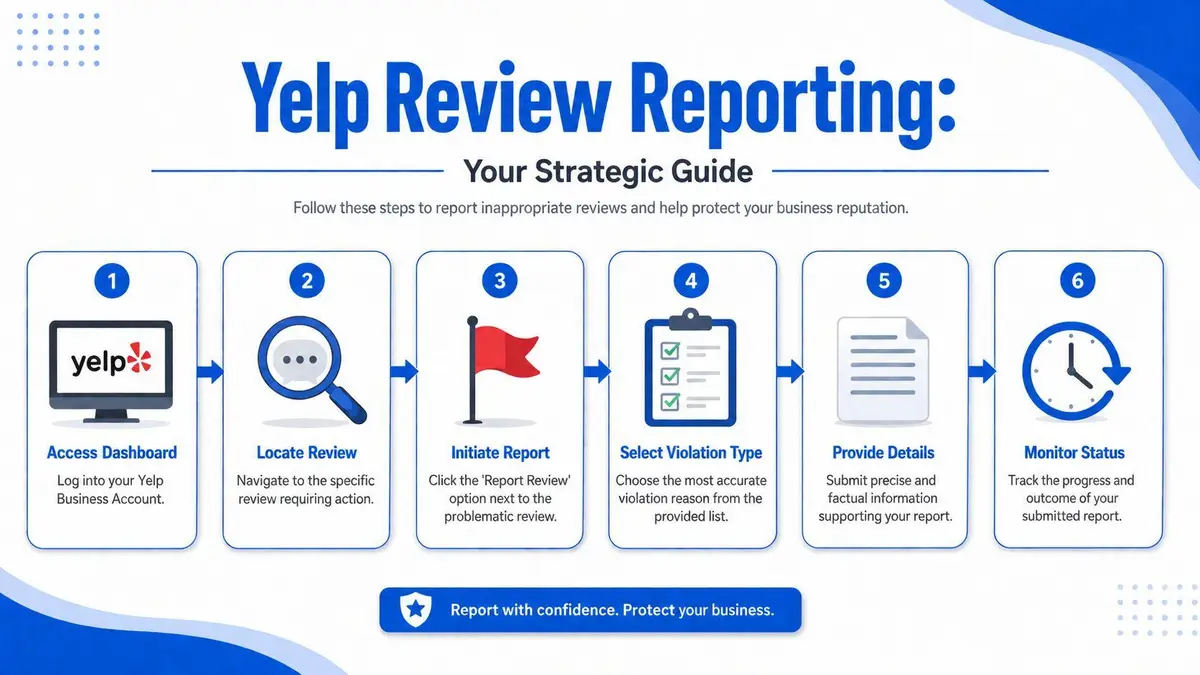
The required process is clear. You log into Yelp for Business, access the review, click “Report Review,” select the exact violation, and provide a detailed explanation citing the specific policy clause violated with quoted evidence from the review text, as described in this breakdown of the Yelp reporting workflow.
That sounds simple, but each step has a strategic purpose:
- Log into Yelp for Business so the report comes from the verified business account that controls the listing.
- Find the exact review and read it closely before taking action.
- Click the three-dot menu and choose Report Review.
- Select one violation category, not a pile of overlapping grievances.
- Write a concise explanation that quotes the review and ties that language to the violation.
- Attach supporting proof if the interface or follow-up process allows it.
A stronger understanding of fake and manipulated review patterns also helps. For a broader foundation, see this strategic guide to removing fake reviews for executives and founders.
Here’s the operational walkthrough in video form:
How to write the report text
Reviewers often write too much. Yelp moderators don’t need your frustration diary. They need a short factual argument.
Use this structure:
- Identify the rule. Name the violation category first.
- Quote the review. Pull the exact words that support your claim.
- State the contradiction or hidden relationship. Keep it factual.
- Reference your evidence. Mention the record, screenshot, or internal file that supports the report.
For example, if a reviewer claims a service interaction that never occurred, your report should say the review lacks firsthand experience and that no matching client record exists under the reviewer’s name, email, date, or described transaction. If the reviewer is a former employee, say that directly and support it.
Don’t tell Yelp the review is “obviously fake.” Show why it violates policy.
Choosing the right violation
Many businesses inadvertently sabotage themselves. They report a former employee review as “inaccurate” when the stronger category is conflict of interest. They report abuse as “false information” when the stronger category is harassment. Yelp is more likely to act when you use the category that best fits the conduct.
A weak filing sounds like this:
- Overloaded argument. “This is false, defamatory, unfair, and damaging.”
- Emotional framing. “This reviewer is trying to ruin our business.”
- No quoted evidence. The moderator has to guess what part matters.
A strong filing is narrower:
- Single theory. “Conflict of interest.”
- Quoted trigger language. The portion of the review showing insider knowledge, threats, or irrelevant employment commentary.
- Proof attached or referenced. Termination records, customer logs, or screenshots.
If you want to remove bad reviews from Yelp, think like counsel writing a short motion, not like an owner venting in a complaint box.
Appealing Denied Reports and Advanced Tactics
You get the denial email after doing everything the generic guides told you to do. The review stays up. Staff sees it. Prospects see it. If the post is retaliatory, the risk is no longer a routine moderation issue. It is a record-building problem, and your next move has to be sharper.
Yelp gives you one formal reconsideration path. If Yelp denies the initial report, the only formal appeal mechanism is a one-time reconsideration through the Yelp Questionable Content Page using the case number from Yelp’s denial email, and submitting multiple appeals can trigger penalties, as explained in this guide to Yelp reconsideration procedure.
How to use your one shot properly
Your reconsideration should read like a focused case summary. Lead with the strongest provable fact in the first sentence, then attach or reference the record that supports it.
A strong opening looks like this:
The reviewer is a former employee terminated before the alleged incident, and attached records show the post concerns an employment dispute rather than a customer experience.
That framing works because it gives Yelp a clear policy basis and a verifiable reason to act. It also keeps you out of the trap that sinks many second attempts. Repeating the same emotional argument with more adjectives.
Keep the appeal narrow. If one theory is supported and three are speculative, file the supported theory and cut the rest.
Retaliatory reviews require a different strategy
Some reviews are more than negative. They are punishment. They appear after a refund refusal, a firing, a chargeback dispute, a legal demand, or a failed extortion attempt. Those cases require more than a flag and a short explanation.
Yelp also uses automated recommendation and filtering systems to evaluate review trust signals, account history, and suspicious patterns, as described in Yelp’s explanation of recommended reviews and automated software. You cannot trigger that process manually, and you should not build your plan around hoping the system catches up later. Your job is to show policy violation, hidden motive, and corroborating pattern with enough precision that a moderator can act on it.
Look for indicators that change the case from “bad review” to “retaliatory campaign”:
- Timing tied to a dispute. The post appears right after a refund denial, collections notice, termination, or service refusal.
- Knowledge a real customer would not have. The review references staffing decisions, internal notes, billing codes, payroll issues, or private communications.
- Language repetition across accounts. Similar wording appears in multiple reviews, social posts, or complaint sites.
- Clustered activity. Several accounts post within a short period with overlapping accusations or pressure tactics.
At that point, handle it like a dispute file, not a customer service annoyance. Preserve every communication. Capture timestamps. Save voicemails, texts, platform messages, and transaction records. If the reviewer has threatened to post unless you pay, refund, rehire, or reverse a decision, document that threat word for word.
This is usually the line between a business owner handling the matter internally and bringing in counsel or a reputation firm. If the review is tied to a former employee, competitor, extortion threat, or pending legal dispute, professional intervention is warranted early. Delay usually makes the record worse.
The same appeal discipline appears in other denial contexts. Clear issue identification, tight documentation, and a restrained tone consistently outperform emotional rebuttals, which is also reflected in guidance from Haddad & Associates P.A. legal experts on denial appeals generally.
Building a Compelling Evidence Package
A Yelp report without evidence is just a competing story. Moderators see competing stories all day. You need to give them something they can verify quickly and trust.
Time matters. When businesses flag a review, Yelp typically evaluates the request within 3 to 7 business days, according to this explanation of Yelp review timelines and evidence preparation. That window is short enough that you should assemble your file immediately, not after internal debate and not after a week of angry emails.
What belongs in the file
Your evidence package should read like a clean internal memo with attachments. It doesn’t need drama. It needs coherence.
Use materials that directly support the violation theory:
| Violation Category | Primary Evidence Required |
|---|---|
| Conflict of interest | HR records, termination records, proof of competitor affiliation, internal relationship documentation |
| No firsthand experience | Customer transaction logs, appointment records, reservation history, service records showing no matching interaction |
| Harassment or inappropriate content | Screenshots of threats, abusive language, linked social posts, copies of messages sent to staff |
| Off-topic or irrelevant commentary | The review text itself, annotated to show it discusses employment disputes, politics, or unrelated matters |
| False identity or coordinated attack | Account pattern screenshots, repeated language across profiles, internal logs showing no matching customer identity |
Build it like a case file
A strong submission usually includes:
- A short summary page that states the requested action and the exact policy violation.
- A timeline showing when the alleged event supposedly happened and what your records show instead.
- Attachments labeled clearly so a moderator can review them without digging.
- A one-paragraph explanation per exhibit to show why the document matters.
If you’re dealing with a former employee, include only what proves the relationship and why the review falls into conflict of interest. Don’t dump an entire personnel file. If the issue is fabricated service, produce the absence of a transaction cleanly. Search records by name, date, and facts described in the review, then state that no corresponding interaction exists.
Treat the moderator like a busy judge. If they have to assemble your theory for you, you’ve already lost leverage.
What sophisticated clients do differently
High-value clients usually get into trouble when the reputational stakes are high and the internal team improvises. One executive assistant sends screenshots. General counsel sends a longer letter. Operations sends contradictory notes. Yelp gets noise instead of a unified record.
Avoid that. Assign one person to control the chronology, one person to collect documents, and one final reviewer to ensure the theory and evidence match. If the review claims a billing event, your evidence should prove or disprove billing. If the review alleges misconduct by a named staff member, your evidence should address that claim directly.
Precision wins. Volume doesn’t.
Pursuing Legal Pathways for Removal
A one-star Yelp review accuses your business of fraud, names an employee, and starts showing up in branded search results. At that point, flagging the post is no longer a sufficient response. You need to decide, fast, whether this is a platform dispute, a defamation matter, or part of a broader retaliatory campaign.
The legal question is straightforward. Yelp will usually leave opinions alone. Courts do too. Statements like “terrible service” or “I would never go back” are hard to remove because they read as personal judgment. A review crosses into legal territory when it asserts a verifiable fact that is false, damaging, and capable of proof. Allegations of criminal conduct, insurance fraud, record falsification, discrimination, assault, or fabricated billing demand a different playbook.

When legal intervention makes sense
Bring counsel in once three facts are present:
- The review states or strongly implies a factual claim
- Your records can prove the claim is false
- The business harm justifies formal action
If those elements line up, legal action becomes a strategic option, not an emotional reaction. The available tools depend on the facts. Counsel may send a tightly drafted demand letter, seek pre-suit discovery to identify an anonymous reviewer, or pursue a court order declaring the statement defamatory or otherwise unlawful. Yelp is far more likely to act when the issue has been framed with legal precision and backed by admissible evidence.
For executives dealing with review attacks that extend beyond Yelp, this strategic guide to removing defamatory internet content for executives is a useful companion resource.
Why legal review changes the outcome
The value of counsel is not just filing papers. It is issue framing.
A good lawyer or specialized reputation team will test whether the review fits a larger pattern. The same language may appear across platforms. The timing may line up with a terminated contractor, failed customer demand, competitor contact, extortion attempt, or pending employment dispute. The account itself may show identity problems, sudden posting activity, or connections to other attacks. Yelp may not tell you what its internal systems see, but a well-documented escalation that shows coordinated or retaliatory conduct gives the platform a clearer basis to act.
That is the difference generic guides miss. Complex reviews are rarely isolated events. They are evidence problems, pattern problems, and sometimes litigation problems.
If the review is retaliatory, treat it like a dispute with legal exposure, not a customer service complaint.
What clients should not do
Do not threaten to sue in your public reply. Do not contact the reviewer impulsively. Do not send a bloated cease-and-desist letter full of claims you cannot prove. Those mistakes create fresh screenshots, invite counterspeech, and make you look defensive.
Use a controlled process instead. Preserve the review, preserve supporting records, and have one decision-maker coordinate with counsel. Then choose the remedy that fits the facts. Sometimes that is a private legal demand. Sometimes it is subpoena practice. Sometimes it is a declaratory order. Sometimes it is parallel action, legal review, platform escalation, and quiet monitoring at the same time.
If the review involves extortion, impersonation, fabricated criminal accusations, or false statements causing real commercial harm, professional intervention is required. Handle it that way from the start.
Mitigation and Long-Term Reputation Defense
Not every review will come down. Some will survive because Yelp sees them as opinion, because the evidence is incomplete, or because the platform declines to act. When that happens, the objective changes from removal to containment.
Start with the public response. Keep it short, calm, and professional. Never write for the reviewer. Write for the next prospective client reading the page. A good response acknowledges concern, avoids admitting false claims, and invites offline resolution without sounding evasive.
What a strong public reply does
A strong reply usually has three traits:
- Measured tone. No sarcasm, no accusations, no legal chest-thumping.
- Controlled facts. Correct obvious inaccuracies without relitigating everything.
- Private off-ramp. Offer a direct channel to discuss the matter further.
If the review appears retaliatory or fake, resist the urge to say so in the public response unless you’re certain that statement won’t create more exposure. Often the wiser move is to keep the response neutral while your removal or legal track continues privately.
Reputation defense is ongoing work
Yelp problems rarely stay isolated. The same reviewer may post elsewhere. Search results may begin surfacing the complaint more prominently. Staff may start forwarding screenshots internally. This is why ongoing monitoring matters far more than most leadership teams realize.
A proper defense posture includes active alerts, documentation standards, coordinated response ownership, and watchlists for repeat abuse. For that operational layer, reputation monitoring systems are what separate one-off reactions from actual control.
You should also create conditions that reduce the impact of any single review. That means consistent service recovery, stronger complaint intake before disputes go public, and ethical encouragement of satisfied customers to share honest feedback through compliant channels. The aim isn’t to bury a legitimate complaint under fake positivity. The aim is to prevent one hostile post from defining your brand.
A bad review becomes dangerous when it sits alone and unanswered. It becomes manageable when it’s one data point inside a well-defended reputation.
The final judgment call is simple. If the review is merely unpleasant, your team can often handle response and documentation internally. If it’s false, retaliatory, coordinated, anonymous, or tied to legal exposure, stop improvising and bring in specialists.
If a Yelp review is threatening your business, name, or deal flow, ContentRemoval.com can assess the matter confidentially and map out the right path, from evidence-based platform removal to legal escalation and long-term monitoring. For high-net-worth individuals, executives, family offices, and counsel managing sensitive reputation threats, speed and discretion matter as much as the outcome.
Frequently asked questions
What kind of Yelp reviews will Yelp actually remove?
Reviews that fit an objective violation category: written by a competitor, former employee or someone with a conflict of interest; not based on firsthand experience; containing harassment, threats or private information; or off-topic commentary unrelated to a consumer experience. Harsh or one-sided opinions usually stay up.
What should I do if Yelp denies my request to remove a review?
Use the case number from the denial email to file one reconsideration through the Yelp Questionable Content page. Lead with the strongest provable fact in the first sentence, attach the record that supports it, and cut any speculative theories. Do not submit repeated appeals.
Should I reply publicly to a fake Yelp review while trying to get it removed?
Keep any reply short, calm and written for the next prospective client, not the reviewer. Avoid accusing the reviewer of being fake or threatening to sue in public, since that creates fresh screenshots and exposure while your removal or legal track continues privately.