
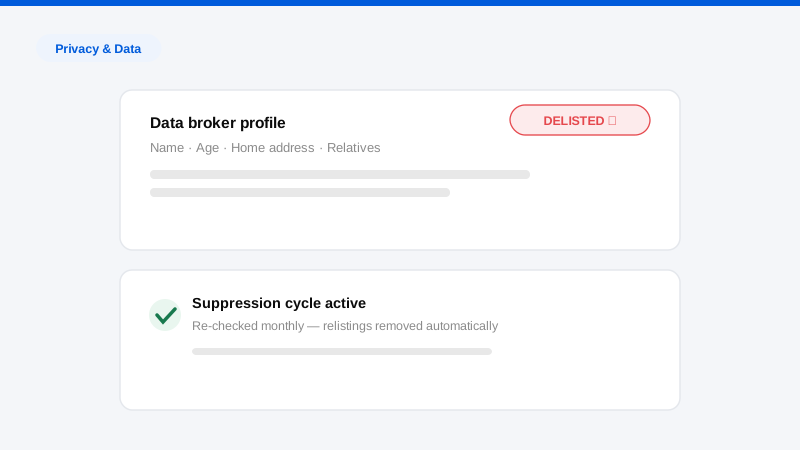
Type a Fortune 1000 executive’s name into Google and, within two clicks, you can usually find a home address, the names of a spouse and children, past addresses going back twenty years, and a cell phone number. Not because the executive was careless, because dozens of data broker sites compile and publish that information automatically, and nobody at the company was assigned to take it down. Professional personal data removal exists to close exactly that gap.
We file removal requests and broker opt-outs every day, and the pattern we see with executives is consistent: the more senior the person, the bigger the exposure, and the less time they have to deal with it. A CFO who signs off on wire transfers is a phishing target. A CEO who has ever laid people off is a physical-security concern. A managing partner’s home address is a due-diligence liability the moment a deal goes hostile.
This guide explains what personal data removal actually involves at the executive level, why the do-it-yourself route almost always stalls, and how to evaluate whether a professional service is doing real work or just running a script.
Why executives are disproportionately exposed
Data brokers do not know or care who you are. They ingest public records (property deeds, voter rolls, court filings, business registrations, marketing databases) and merge them into profiles they sell for a few dollars each. Executives get hit harder than average for structural reasons:
- More public records. Property purchases, LLC filings, board appointments, political donations, and SEC disclosures all generate records that brokers scrape and cross-reference.
- More reasons to be looked up. Journalists, short sellers, activist investors, disgruntled former employees, and opposing counsel all run searches on named executives. Broker sites rank near the top for those searches.
- Higher-value targeting. Business email compromise and executive impersonation scams depend on exactly the data brokers sell: home address, cell number, relatives’ names, past employers. That data is the raw material for a convincing pretext.
- Family spillover. Broker profiles list “possible relatives” and “associated addresses.” An executive who locks down their own footprint but ignores a spouse’s profile has locked the front door and left the garage open. This is why family offices increasingly treat privacy as a household-level project, not a per-person one.
None of this requires a breach or a leak. It is the ordinary output of the data broker economy, and it regenerates continuously.
What personal data removal actually covers
“Personal data removal” gets used loosely, so it is worth being precise about the layers involved. A serious program works across all of them.
Data broker and people-search sites
The core of the problem. Sites like Whitepages, Spokeo, BeenVerified, Radaris, and several hundred smaller ones publish searchable profiles. Each has its own opt-out process. Some are a web form, some demand a photo ID, some require a phone verification call, and some quietly ignore requests until you follow up. Data broker removal is the discipline of working through that entire ecosystem, not just the ten sites you have heard of.
Search engine results
Even after a broker deletes a profile, the cached Google result can linger. Suppression here means using Google’s own removal tools, its personal-information removal process and its outdated-content tool, so that the dead page stops appearing when someone searches your name. If your goal is that a name search comes back clean, removing yourself from Google is a distinct workstream from removing the underlying pages.
The long tail: forums, PDFs, and scraped copies
Broker sites are the visible surface. Underneath sit conference attendee lists in PDFs, old alumni directories, scraped copies of broker data on offshore mirrors, and forum posts that quote personal details. Automated tools do not touch any of this, because it is not on anyone’s fixed opt-out list. Finding and addressing the long tail is manual work, the kind covered in a full digital footprint cleanup.
Why DIY personal data removal stalls for busy people
You can absolutely opt out of data brokers yourself. The processes are public, and for most sites they are free. Here is what actually happens when an executive, or their assistant, tries:
The list is longer than expected. There are hundreds of active people-search and broker sites in the US. The recognizable brands are a small fraction. Most people opt out of ten to fifteen sites, see their Google results improve, and stop, leaving the majority of their profiles live.
Verification friction is deliberate. Some brokers require you to create an account to opt out. Some require a photo of your driver’s license. Some send verification emails that land in spam. Each point of friction is where a busy person abandons the process.
Listings come back. This is the part almost nobody expects. Brokers re-ingest public records on a rolling basis. A profile you removed in February can reappear in August with a new URL, because the underlying data source refreshed. One-time removal is a temporary state; recurring suppression, re-checking and re-filing on a schedule, is the actual fix.
Nobody is accountable. DIY removal has no owner, no verification step, and no reporting. Six months later, no one knows what was removed, what came back, or whether the family members were ever covered.
We are candid about this because it frames the real value of professional personal data removal: not secret access, but completeness, persistence, and verification.
Automated tools vs. managed removal
Subscription apps that automate broker opt-outs are genuinely useful, and for a private individual with a modest footprint they may be enough. Understand what they do and do not cover:
- Automated tools work from a fixed list of brokers with machine-submittable opt-out flows. They are fast and cheap across that list, and they re-check it. They do not handle brokers that demand ID verification or phone calls, they do not touch the long tail of non-broker exposure, and they do not exercise judgment about what matters.
- Managed removal combines automation for the fixed list with human analysts for everything else: the brokers that resist, the mirror sites, the PDF on a conference site, the profile that names your teenage children. Analysts also verify removals actually happened rather than trusting a confirmation email.
For executives, the difference is not academic. The exposures that create real risk (home address paired with family names, for instance) are disproportionately the ones that require manual handling. That is the reason we built our executive privacy program around analysts rather than around a script.
A practical removal sequence for executives
If you are doing this yourself, or evaluating whether a vendor’s process is sound, this is the sequence that works:
- Audit before you remove. Search your name, name plus city, name plus employer, and your cell number in quotes. Document every broker profile, every page exposing your home address, and every result you would not want an adversary to have. You cannot verify removal without a baseline. (Our free exposure scan automates this step.)
- Prioritize by risk, not by ranking. Home address plus relatives is priority one. Cell numbers second. Old addresses and age data third. A profile on page four of Google that lists your current address matters more than a page-one profile that only shows your name and state.
- File opt-outs with the major brokers first. Whitepages, Spokeo, Radaris, BeenVerified, Intelius, TruePeopleSearch, FastPeopleSearch and their sister sites account for most of the traffic. Follow each site’s specific process exactly; incomplete requests are silently dropped.
- Work the long tail. Search for your address and phone number directly, in quotes, to surface the smaller sites and non-broker pages the big list misses.
- Clean up search engines. File Google personal-information removal requests for pages exposing your home address or phone number, and outdated-content requests for pages already deleted at the source.
- Cover the household. Repeat the audit for your spouse and any adult children. Broker profiles cross-link relatives, so an uncovered family member re-exposes you.
- Re-check on a schedule. Quarterly at minimum. Re-file wherever listings have re-populated. This is the step that separates a cleanup from actual ongoing protection.
Budget honestly: the first pass across a full broker list is many hours of work, and the re-check cycle never really ends. That workload, not any secret technique, is what you are paying a professional service to absorb.
What professional personal data removal should include
If you engage a firm (ours or anyone’s), hold them to this standard:
- A documented baseline scan before work begins, so removal can be verified against something.
- Coverage numbers you can interrogate. How many brokers, which ones, and what happens with sites not on the list.
- Manual escalation. A named process for brokers that resist automated opt-outs.
- Verification, not confirmation emails. Analysts should confirm the profile is actually gone, including from search results.
- Recurring monitoring. Because listings re-populate, any “one-time cleanup” pricing is selling you a snapshot.
- Household coverage. Spouse and family profiles, because relatives’ listings leak your data back.
- Honest scope. No firm can remove public records themselves (your property deed stays at the county), and no one should promise a “100% clean internet.” Firms that promise that are describing marketing, not operations, and where content problems shade into legal questions (defamation, court records) a removal firm should say plainly that it is not a law firm and route you to counsel.
A comprehensive online privacy service will also look beyond brokers entirely: social media exposure, breach data, and the open-source intelligence picture an adversary could assemble.
What a realistic engagement timeline looks like
Set expectations by phase rather than by a single delivery date. In the first one to two weeks, expect the baseline scan, a prioritized exposure report, and the first wave of opt-outs filed across the major broker networks. Through weeks two to six, the bulk of mainstream listings come down as brokers process requests on their published timelines, while analysts work the resistant sites and file search-engine removals for pages exposing contact details. The long tail (mirror sites, PDFs, one-off pages) typically extends over the first quarter, because each item is a bespoke request rather than a form submission. After that, the engagement shifts into its steady state: scheduled re-scans, re-filed opt-outs for anything that re-populated, and alerts when something new appears. If a vendor’s proposal has no steady state, just a cleanup and a handshake, it is priced for the part of the problem that ends, not the part that continues.
Frequently asked questions
How long does personal data removal take?
The first wave of major-broker removals typically lands within days to a few weeks, since most large sites process opt-outs on published timelines. Stubborn sites and search-engine cleanup take longer. Expect meaningful improvement in your search results within the first month and continued cleanup over the following one to two, with monitoring ongoing after that.
Will my information stay removed?
Not permanently, no, and be skeptical of anyone who says otherwise. Brokers rebuild profiles from refreshed public-record feeds, so removed listings re-populate over months. The durable state is suppression: scheduled re-checks and re-filed opt-outs that keep your data down faster than it resurfaces.
Can you remove actual public records, like my property deed?
No one can. Deeds, court records, and corporate filings live with government custodians and stay there. What removal work does is break the pipeline between those records and the searchable, aggregated profiles brokers build from them, which is where nearly all the practical risk lives. Some executives also reduce future record exposure by titling property through entities; that is a question for your attorney, not for us.
Is this worth it for executives below the C-suite?
The calculus is about exposure, not title. Anyone who authorizes payments, manages sensitive terminations, holds a public-facing role, or has had any brush with controversy carries elevated risk. The audit step answers the question empirically: scan first, then decide based on what is actually out there.
See what’s exposed before you decide anything
Every engagement we run starts the same way: with evidence. Run a free exposure scan and get a concrete picture of which broker sites are publishing your home address, phone number, and family connections right now, then decide, with real data in hand, whether to handle it yourself or hand it to us.