
Privacy protection for a high net worth individual is risk control, not etiquette. Attackers assemble scattered public material such as property records, tagged photos and staff names into a targeting file, so protection covers digital, physical and reputational threats together: legal structures that hide ownership trails, technical controls that assume breach, trained household staff and rapid removal of leaks.
Key facts
- Spear-phishing built from board seats, travel and charity roles succeeds 30 to 50 percent more often than generic phishing.
- Campden Research found 38 percent of ultra-wealthy families and family offices had no cybersecurity plan.
- Trusts, LLCs and record discipline separate the principal from searchable property, aircraft and company records.
- Any banking change or payment instruction should be confirmed through a second channel and a known contact.
Where ContentRemoval.com comes in. ContentRemoval.com handles the content layer of a family’s privacy program: removing exposed addresses and family identifiers from broker sites and archived pages, taking down impersonation profiles, and de-indexing leaked personal material. Family office heads, chiefs of staff and private counsel usually make the approach. A free, confidential 15-minute Exposure Scan maps what an investigator could assemble about the household today and what is removable, and the report is yours to keep. Get a Free, Confidential Exposure Scan or read how our personal data removal work is done.
Your family office approves a villa rental for August. A child’s school crest appears in a photograph from a charity event. A pilot’s name is visible in a tagged post. None of this looks dangerous in isolation. Together, it gives a hostile actor a timetable, a location, and a route into your life.
That’s the mistake affluent families make. They treat privacy as etiquette when it should be treated as risk control. For a high-net-worth household, exposure doesn’t stay online. It moves into banking instructions, travel patterns, domestic staff, litigation strategy, and personal safety.
The right approach to privacy protection high net worth individual planning isn’t a collection of apps. It’s a coordinated program that combines legal structuring, technical controls, operational discipline, and rapid content intervention when something leaks. If you’re relying on consumer privacy settings and a good assistant, you’re underprotected.
Beyond Wealth Management The New Mandate for HNWI Privacy
The turning point usually comes subtly. An executive learns that her home address is trivial to locate through corporate filings and property records. A principal discovers that a relative’s social account reveals recurring travel habits. A family office notices a fraudulent message that references real counterparties and believable transaction details.
At that point, the issue is no longer convenience. It is strategic exposure.
Ultra-high-net-worth individuals with assets exceeding $30 million face targeted cyber attacks at rates 300% higher than the general population, and those with assets over $100 million are specifically targeted by organized criminal groups using military-grade intelligence gathering and surveillance techniques, according to Social Life Magazine’s reporting on how ultra-high-net-worth families protect privacy. That is the threshold where privacy stops being personal preference and becomes part of asset protection.
Wealth changes the attacker’s math
A person with substantial assets presents a different opportunity set to an attacker. The target may control company equity, sign off on transfers, move between jurisdictions, employ household staff, sit on charity boards, and maintain public visibility through media, philanthropy, or business leadership.
That mix changes both motive and method.
An attacker doesn’t need to “hack” in the cinematic sense. He can profile. He can impersonate. He can exploit a published biography, a conference appearance, a school fundraiser, or a yacht registry. The breach often starts with ordinary information arranged intelligently.
Privacy failure at this level rarely begins with secret material. It begins with scattered public material that no one bothered to consolidate.
Consumer tools are not enough
Password managers, antivirus subscriptions, and private browsing modes have their place. They are not a privacy architecture. They don’t address exposed ownership records, indexed personal profiles, leaked documents, impersonation pages, or the operational habits that give social engineers what they need.
High-net-worth households need to think the way institutions think. Which records are public. Which relationships create indirect access. Which searches reveal family members. Which images disclose locations. Which vendors hold sensitive files. Which online mentions need legal review or removal.
If that sounds closer to executive protection than ordinary cybersecurity, that’s because it is. Wealth concentrates attention. Privacy has to absorb it.
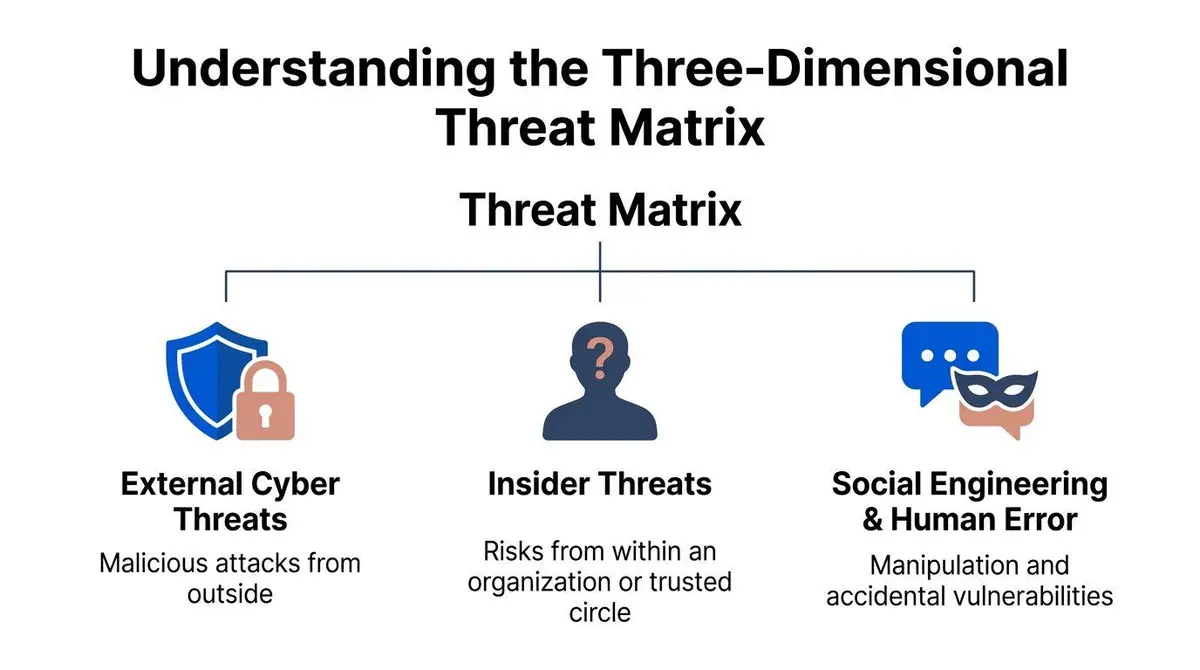
Understanding the Three-Dimensional Threat Matrix
The privacy problem becomes manageable once you stop treating it as one problem. I advise families to separate risk into a Three-Dimensional Threat Matrix. Not because the categories are academic, but because each one demands a different response.
Digital threats
Many begin here, and usually too narrowly. They think malware, passwords, and device theft. The core issue is targeted manipulation built from your public footprint.
High-net-worth individuals face increased spear-phishing risk because attackers use business affiliations, travel patterns, and charity donations to build highly personalized campaigns with success rates up to 30 to 50 percent higher than generic phishing, as described by Cyberproof’s analysis of tailored threat intelligence for HNWIs.
That matters because affluent targets are surrounded by plausible points of contact. Private banks. assistants. lawyers. household managers. art advisors. family office controllers. One convincing message in the right voice can produce a credential, a wire instruction, or a malicious click.
A serious digital threat review should account for:
- Public profile exposure: board seats, executive bios, deal announcements, and charity roles that help an attacker draft believable pretexts.
- Third-party concentration risk: law firms, accountants, travel services, and domestic vendors that may hold pieces of your data.
- Search visibility: indexed biographies, cached profiles, old addresses, leaked PDFs, and broker listings that enable reconnaissance.
Physical threats
Digital exposure becomes physical faster than most principals expect. A geotagged image suggests a routine. A property record reveals where a family sleeps. School affiliation, staff names, and vehicle details can narrow a hostile actor’s planning window.
Physical risk doesn’t always look dramatic. Sometimes it appears as harassment, stalking, uninvited approaches, or surveillance around travel and residences. Sometimes it’s worse. The mechanism is simple. The internet gives an adversary a targeting file, then the physical world supplies access.
Reputational threats
For wealthy individuals, reputation is an operating asset. It affects boards, counterparties, litigation posture, deal certainty, and family stability. That makes it a target.
Reputational attacks include impersonation profiles, false allegations, manipulated images, hostile forum threads, disclosure of private disputes, and coordinated publication meant to force a concession. The objective may be extortion, advantage in a private conflict, commercial sabotage, or public humiliation.
A privacy breach and a reputation attack are often the same event viewed from different angles.
Why this framework matters
Most failures happen because families defend one dimension and ignore the others. They buy security software but leave ownership records exposed. They harden devices but allow assistants to confirm itineraries by email. They hire PR after a leak but never remove the source material or de-index the search results.
A sound privacy program addresses all three dimensions at once. If one area remains soft, attackers will use it as the entry point.
Auditing Your Digital Vulnerability Surface
If you want to understand your actual exposure, stop thinking like an owner and start thinking like an investigator. Assume the adversary knows your name, your company, one family connection, and one likely city. That’s enough to build a useful profile.
A large share of wealthy families still haven’t done that work. A 2017 Campden Research study found that 38 percent of ultra-high-net-worth families and family offices, with average wealth of $1.1 billion, reported having no cybersecurity plan in place, according to RBC Wealth Management’s review of high-net-worth household cybersecurity. The gap isn’t resources. It’s discipline.

Think in terms of attacker assembly
Open-source intelligence works by aggregation. One item confirms another. A corporate biography links to a nonprofit board page. That page includes an event photo. The photo reveals family members, location habits, and social proximity. A public record fills in an address history. A people-search listing supplies a phone number. The profile becomes operational.
Run a self-audit across these categories:
- Identity markers: full name variations, former names, usernames, domains, and old email addresses.
- Relationship exposure: spouse, children, assistants, chiefs of staff, household staff, and trusted advisors named online.
- Asset signals: real estate records, aviation references, vessel registrations, company ownership trails, and litigation documents.
- Routine indicators: recurring travel, schools, clubs, gyms, events, and annual philanthropic appearances.
One practical exercise is to review your own discoverability the way an investigator would. A straightforward guide on how to do a background check online is useful here, not because you need a consumer report on yourself, but because it shows how little information is required to assemble a dossier.
The invisible problem is stale data
High-net-worth individuals often focus on obvious headlines and miss old residue. Legacy bios. Cached PDFs. Archived newsletters. Family trust references in local publications. Event sponsorship pages from years ago. Old phone numbers tied to current relatives.
Those fragments matter because attackers don’t need current perfection. They need enough truth to sound credible.
Practical rule: If a stranger can map your family structure, primary residence pattern, and business relationships from search results alone, your vulnerability surface is already too large.
What to do with the findings
Don’t dump the issue on an assistant and call it solved. Exposure needs triage. Some items need removal. Some need suppression. Some require legal analysis. Others call for changes in how entities, properties, and biographies are presented online.
A structured digital footprint cleanup process should prioritize content that reveals family identifiers, direct contact paths, address data, travel clues, and exploitable professional relationships. In this context, a targeted review such as <https://www.contentremoval.com/digital-footprint-cleanup> becomes relevant as a framework for identifying what should be removed first and what should be monitored.
The point of the audit isn’t curiosity. It’s to reduce the attacker’s ability to assemble a believable story about you.
Building Your Digital Fortress With Legal and Technical Defenses
Privacy protection fails when legal advisers and technical advisers work in parallel and never meet. The legal team structures ownership. The security team locks down devices. The family office assumes someone else is handling public exposure. That fragmentation is expensive.
The stronger model is a Digital Fortress. Legal structures reduce discoverability. Technical controls reduce exploitability. Content intervention reduces persistence when data appears online. Each layer covers the others’ blind spots.

Legal armor that changes what the public can see
Ownership should not be casually legible. If property, aircraft, or other significant assets sit in your personal name where public records make the connection easy, you’ve surrendered privacy before a cyber event even occurs.
The correct legal structures depend on jurisdiction and tax posture, but the strategic principle is simple. Separate the principal from the searchable asset trail wherever lawfully possible. That usually means careful use of trusts, LLCs, nominee arrangements where appropriate, and record-management discipline so the structure isn’t undone by sloppy filings, biographies, or local press disclosures.
Legal review should also address:
- Public record exposure: whether real property, litigation filings, or corporate records reveal more than they should.
- Contract language: whether NDAs, vendor terms, and staff agreements adequately cover confidentiality, image use, and data handling.
- Response rights: whether impersonation, defamation, leaks, or unauthorized publication can be challenged quickly through counsel.
A legal structure by itself won’t stop a phishing attack. It will, however, deprive an attacker of easy reconnaissance and make physical targeting harder.
Technical shields that assume breach pressure
Most family offices still overvalue perimeter tools and undervalue data design. The critical question isn’t whether a system might be touched. It’s what an intruder can understand or exfiltrate if that happens.
ShardSecure’s agentless file-level data sharding fragments sensitive files into encrypted shards distributed across multiple environments, making the data unintelligible to unauthorized parties, including cloud providers, and achieving 99.999% data resilience against ransomware, according to ShardSecure’s explanation of data security for high-net-worth environments. For families storing passports, trust instruments, cap table materials, and transaction files, that model is strategically attractive because it reduces the consequence of any single storage compromise.
That kind of architecture is more useful than cosmetic “privacy” settings because it addresses the core problem. Valuable data shouldn’t exist in one easily exploitable lump.
Other technical controls belong in the same fortress:
- Secure communications: separate sensitive approvals from ordinary messaging. Banking instructions, travel details, and legal matters should not move through casual channels.
- Role-based access: household staff, assistants, and advisors should only see what they need.
- Monitoring and response: exposed credentials, leaked documents, fake profiles, and indexed personal references need active review, not occasional checks.
For executives dealing with people-search sites and searchable personal records, a tactical starting point is this executive guide on removing yourself from broker databases: <https://www.contentremoval.com/how-to-remove-yourself-from-data-broker-lists-an-executive-privacy-guide>
Later in the stack, content and impersonation response becomes essential. One service category in this lane is ContentRemoval.com, which handles source removal, de-indexing, impersonation takedowns, and leak remediation when private material or false content appears across search, websites, or social platforms.
Integration matters more than any single tool
A trust structure won’t compensate for a staff member sending itineraries in plaintext. A sharded storage environment won’t help if event pages still identify children and schools. A takedown notice won’t solve the underlying issue if the same data remains exposed on broker sites and archived PDFs.
This brief overview is useful context for how layered defenses fit together:
The Digital Fortress works when every layer answers a different question. What can strangers find. What can intruders access. What can insiders misuse. What can be removed if published. That is how privacy protection high net worth individual planning should be built. Not as a gadget purchase, but as a coordinated defense program.
Mastering Operational Security The Human Element
The most expensive technical stack in the world can be defeated by one confident voice on the phone.
That’s the operational truth affluent families resist. They invest in systems and ignore habits. They sign engagement letters and neglect staff training. They harden devices and then allow routine exceptions for convenience. Attackers count on that inconsistency.
Cyber insurance exposes the point sharply. Policies often exclude or place low limits on social engineering wire fraud because an authorized insider executes the transfer, and attackers using AI-powered phishing and deepfakes drove a 40%+ rise in HNWI-targeted extortion in 2025, according to Risk & Insurance’s reporting on cyber monitoring and protection for wealthy households. If your controller, EA, or household manager can be manipulated into authorizing the wrong step, the insurance argument may start after the money is gone.

Build a human firewall
Operational security is not paranoia. It is repeatable procedure. Every person around the principal should know what cannot be discussed, what must be verified, and what is never approved on a single channel.
The strongest programs usually include rules like these:
- Travel discretion: no posting in real time, no casual sharing of villa names, no visible boarding documents, and no public discussion of return dates.
- Verification discipline: any banking change, payment instruction, account reset, or document request gets confirmed through a second channel and a known contact path.
- Social media restraint: children, schools, interior home details, vehicle identifiers, and recurring locations stay offline.
- Vendor control: contractors, domestic staff, and service providers receive limited information and clear confidentiality expectations.
The household and office must train together
One reason family offices stay exposed is that the office trains while the household does not. That split makes no sense. The attacker doesn’t respect your org chart. He will call whichever person sounds most helpful.
Executive assistants, chiefs of staff, estate managers, nannies, drivers, and travel coordinators all need protocol. They don’t need jargon. They need scripts and escalation paths. What to say when someone asks where the family is. What to do if a bank request arrives with urgency. When to stop the conversation and verify independently.
A useful companion perspective on digital asset risk and family privacy appears in Privacy and Security Concerns: The Digital Fortress, particularly for readers thinking about how personal digital exposure interacts with broader estate and asset planning.
If your team is rewarded for speed but not trained for verification, you’ve built the perfect environment for social engineering.
OPSEC is culture, not a memo
Principals set the tone. If the family patriarch insists on forwarding screenshots with account details, or if a founder posts location-rich images while insisting on confidentiality elsewhere, the rules collapse.
Operational security has to feel normal. That means short protocols, regular refreshers, and consequences for bypassing procedure. Not theatrical secrecy. Clean habits.
The families who handle this well treat privacy like aviation. Checklists. Briefings. Redundancy. No improvisation where the downside is unacceptable.
How to Choose Your Professional Privacy Partner
Most privacy vendors are built for the mass market. High-net-worth risk isn’t.
You’re not choosing a software subscription. You’re choosing how your family handles exposed records, impersonation, leaks, false content, doxxing, and search visibility when the stakes involve reputation, safety, counterparties, and sometimes litigation. The right provider depends on the level of threat, the need for discretion, and whether legal and technical issues are intertwined.
What to evaluate first
Before you hire anyone, ask four direct questions.
First, can they handle source removal, not just alerts. Monitoring without intervention creates a tidy inbox and very little protection.
Second, how do they deal with search visibility. Harmful content that stays indexed continues to damage even after the original post loses traction.
Third, can they operate with discretion and speed. Affluent families don’t need publicity around the problem.
Fourth, do they understand complex takedowns involving impersonation, defamatory content, leaked personal material, and hostile posts spread across multiple platforms and jurisdictions.
Comparing Professional Privacy Services
| Service Type | Primary Function | Best For | Limitations |
|---|---|---|---|
| Automated Data Broker Removal services | Opt-out requests and recurring scans across people-search and broker databases | Reducing basic discoverability and shrinking commodity exposure | Limited help with defamation, leaks, impersonation, search de-indexing, or urgent reputation events |
| Digital Risk Monitoring platforms | Alerts for mentions, exposed credentials, suspicious domains, and public web or dark web references | Family offices that already have internal security capacity and need visibility | Monitoring doesn’t remove content, negotiate with platforms, or manage legal escalation on its own |
| Bespoke Content Removal and Reputation Management firms | Source removal, de-indexing, impersonation takedowns, leak response, suppression strategy, and coordinated remediation | Executives, public figures, family offices, and legal teams facing material privacy or reputation threats | Requires case-by-case review and is more specialized than commodity tools |
Match the provider to the threat
If your main issue is people-search listings, an automated service may be sufficient for that narrow task. If your concern is broad exposure monitoring across domains, mentions, and leaks, a monitoring platform belongs in the stack. If the problem includes active impersonation, false allegations, leaked personal records, or private content ranking in search, you need a bespoke intervention model.
That distinction matters because many buyers overpay for dashboards and underinvest in action.
For executives evaluating service depth, this guide to <https://www.contentremoval.com/evaluating-professional-content-removal-services-a-guide-for-executives> is a useful checklist for comparing capability, discretion, and actual removal scope.
The wrong privacy partner tells you what they can track. The right one tells you what they can make disappear, what they can suppress, and what they can keep from resurfacing.
A mature privacy program may use more than one provider. That’s fine. What matters is that someone owns the whole picture and can coordinate response when a low-level exposure becomes a high-stakes event.
Implementing Your Bespoke Privacy Program First Steps
Privacy isn’t a project with an end date. It’s an operating program.
The first phase is confidential assessment and threat modeling. Identify what is publicly visible, which data points provide the greatest strategic advantage to an attacker, where ownership trails are too easy to follow, and which family or staff habits create avoidable exposure. This phase should produce a ranked list of risks, not a generic checklist.
The second phase is strategic remediation and hardening. Remove or suppress the highest-risk content. Tighten public records where legally possible. Reduce broker-site exposure. Harden communications and file access. Put verification protocols in place for financial instructions, travel, and sensitive approvals.
The third phase is continuous monitoring and response. New pages get indexed. Old data reappears. Impersonation accounts emerge. A former employee posts something reckless. A local publication republishes archival material. If no one is watching, the program decays.
For most principals, the hardest part is not technical. It’s deciding to treat privacy as a board-level issue in the personal sphere. That decision is overdue for many families. The attack surface has already expanded. Your response should be deliberate, discreet, and immediate.
A confidential review with ContentRemoval.com is a practical starting point if you need to assess exposed personal data, leaked material, impersonation risks, or search-visible content affecting your family office or household. The useful first step isn’t a sales call. It’s a private assessment that identifies what can be removed, what should be de-indexed, and where your present exposure is creating unnecessary risk.
Frequently asked questions
How do criminals target wealthy families online?
By aggregation rather than hacking. A corporate biography links to a nonprofit board page, an event photo reveals family members and locations, a property record supplies an address and a people-search listing adds a phone number. That profile then supports spear-phishing, wire fraud, impersonation or physical approach.
What should household staff of a high net worth family be trained on?
Short scripts and escalation paths: never confirm where the family is, verify any banking or document request through a second channel, keep children, schools, vehicles and interiors off social media, and post nothing about travel in real time. The household and the family office should train together because attackers call whoever sounds most helpful.
Do automated data broker removal services protect a family office?
Only for the narrow task of reducing people-search listings. They do not deal with defamation, leaked documents, impersonation accounts or private content ranking in search. Those need a bespoke intervention model, and a mature program often combines broker removal, monitoring and a specialist removal firm under one owner.