
A pre-emptive content removal service identifies and neutralizes vulnerable online content before it matures into a crisis, combining persistent monitoring, threat triage, source removal, de-indexing, suppression and recurrence tracking into one operating discipline. It belongs alongside executive protection and legal risk review: harmful material is far easier to remove while it is still obscure than after it has spread.
Key facts
- Content identified within 48 hours has an 87% higher source removal success rate than content older than seven days.
- Triage sorts items into immediate removal candidates, suppression candidates and escalation-sensitive matters.
- Poorly drafted notices or public challenges before mapping distribution can provoke wider republication.
- Prepare names, aliases, priority search terms, known URLs, screenshots and prior legal correspondence before the first call.
Where ContentRemoval.com comes in. ContentRemoval.com runs pre-emptive programs for executives, family offices and public figures approaching a financing round, board appointment or career move who want their search environment cleared before attention rises. General counsel, chiefs of staff and family office heads usually initiate the conversation. A free, confidential 15-minute Exposure Scan maps what is already discoverable and what can be removed quietly now, and the report is yours to keep. Get a Free, Confidential Exposure Scan or read how our content removal work is done.
A reputation problem rarely starts with a headline. It starts with a search result that shouldn’t be there, a personal address resurfacing on a broker site, a low-credibility blog post indexing for your name, or a fake profile gaining enough traction to be noticed by the wrong person. Most clients don’t call when the crisis begins. They call when they realize the internet has been gradually assembling one.
That’s the mistake. If you treat online exposure as a cleanup issue, you’re already late. A pre-emptive content removal service belongs in the same category as executive protection, cyber monitoring, and legal risk review. It’s not cosmetic. It’s a control system for reputational exposure before that exposure matures into a board issue, a financing issue, or a family security issue.
The market still behaves as if digital threats are exceptional. They aren’t. They’re persistent, searchable, and often cumulative. Yet public awareness remains weak. Only 6% of American adults currently use data removal services, and only 42% are even aware those services exist, according to Security.org’s data removal service usage study. That gap tells you two things. First, many individuals are still exposed. Second, many organizations still don’t have disciplined preventive infrastructure.
High-profile clients shouldn’t take comfort from that. They should see the opportunity to move before everyone else does.
Introduction Beyond Crisis Management
If you’re reading this, there’s usually a reason. A journalist has begun asking narrow questions. A competitor has started circulating material that isn’t yet defamatory enough for easy action but is clearly intended to frame a narrative. A relative’s home address appears in search. Or your general counsel has finally accepted that search visibility, leaked personal data, and impersonation risk belong in the same conversation.
That moment matters because it forces a choice. You can wait for an overt attack and spend the next months trying to reverse damage in public. Or you can build a system that identifies, contains, and neutralizes vulnerable content while it still has limited reach.
A proper pre-emptive content removal service is not standard online reputation management dressed up in sharper language. It combines monitoring, legal positioning, search suppression, de-indexing strategy, privacy enforcement, and evidence preservation into a single operating discipline. The work begins before anyone outside your circle notices a problem.
Why prevention changes the economics
Reactive response is expensive in every sense that matters. It consumes executive attention, creates inconsistent messaging, and forces outside advisers to work under compressed timelines. Prevention does the opposite. It gives you control over sequence, evidence, jurisdiction, and pacing.
Practical rule: If harmful content is still obscure, treat it as a removability problem. Once it’s widely circulated, it becomes a litigation, communications, and investor-relations problem.
That distinction is why serious clients should stop viewing removal work as a niche vendor service. It’s a strategic function. It preserves optionality.
The real vulnerability isn’t the post
The visible post, article, review, or profile is only the surface issue. The deeper problem is exposure architecture. Your weak points are usually a mix of searchable personal data, unmanaged legacy content, dormant domains, old legal records, image reuse, anonymous complaints, and fragmented authority over what ranks for your name or company.
Most bad situations aren’t caused by one devastating publication. They’re caused by several smaller assets that make the larger attack easier to believe.
The Architecture of Pre-emptive Defense
The cleanest analogy is a building’s fire suppression system. A firefighter arrives after ignition. A suppression system is already embedded in the structure, sensing heat, isolating risk, and acting before a small event becomes structural damage. That’s how a serious pre-emptive content removal service should operate.
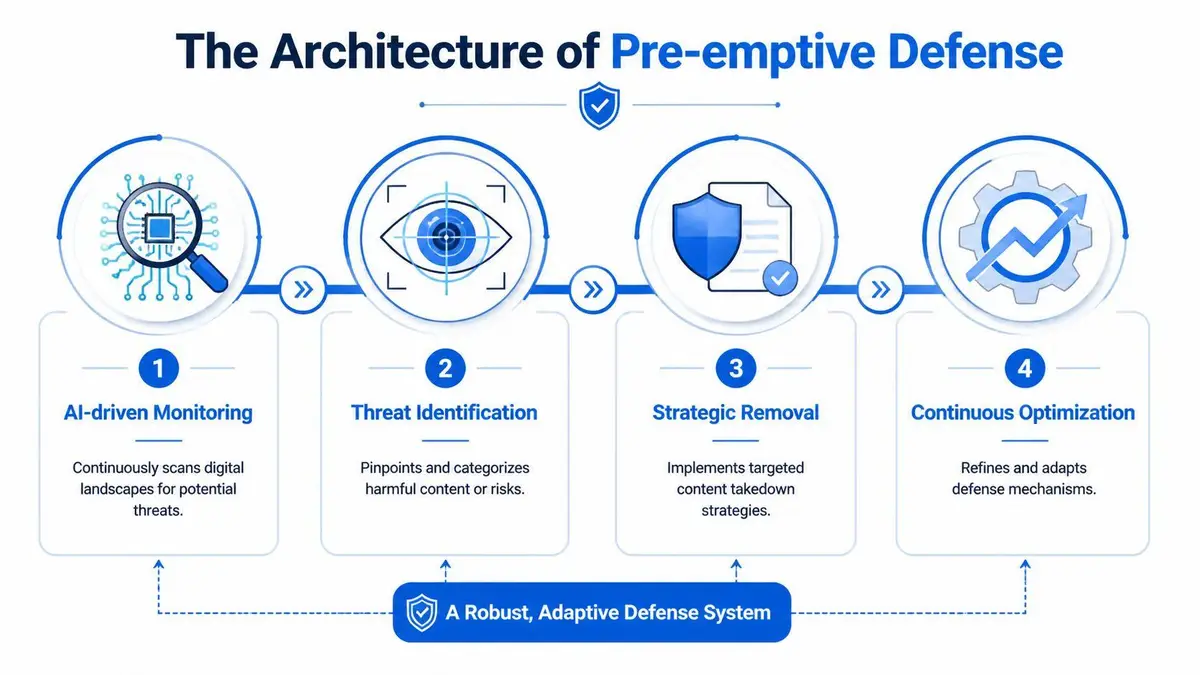
AI-driven monitoring
The first pillar is persistent surveillance across search, social platforms, forums, broker sites, news indexing, image reuse, and derivative reposts. This isn’t manual Googling. It’s pattern detection across a changing digital footprint.
According to this guide to content removal workflows, AI-driven monitoring systems can achieve detection rates of over 95% for harmful content within 24 hours of publication, and content identified within the initial 48-hour window has an 87% higher success rate for source removal than content older than seven days. The implication is obvious. Speed is not a service feature. It is the outcome driver.
For executives and principals, that’s why continuous reputation monitoring programs are materially better than ad hoc checks triggered by anxiety or a press event.
Threat triage and analysis
Detection alone is cheap. Judgment is not.
An expert team classifies each item by legal significance, search risk, amplification potential, personal security relevance, and likely adversary intent. A leaked home address requires different handling from a false review cluster. An old article with poor sourcing requires different treatment from a manipulated image or impersonation account. The task is not to react to everything. It’s to rank threats correctly before action creates unnecessary visibility.
A strong triage model usually separates issues into categories such as:
- Immediate removal candidates because the content violates platform policy, privacy rules, or intellectual property rights.
- Suppression candidates where removal is unlikely but ranking control is achievable.
- Escalation-sensitive matters where any direct move could alert the publisher, harden their position, or trigger wider distribution.
Proactive suppression and removal
This pillar is where weak providers expose themselves. They rely on generic complaint forms and vague promises. Serious practitioners choose the lever that fits the asset.
That can include privacy-based removals, platform policy submissions, de-indexing requests, targeted source complaints, or strategic suppression through stronger, better-governed content. Search management matters because public perception is often shaped by what ranks, not by what technically exists somewhere online.
The goal isn’t to win an abstract argument about truth. The goal is to control what stakeholders, journalists, investors, counterparties, and adversaries can easily find.
Continuous fortification
Removal without follow-through is temporary relief. Harmful material reappears through syndication, scraping, reposts, screenshots, mirror sites, and anonymous recycling. Fortification means preserving evidence, tracking recurrence, hardening search results, reducing exposed personal data, and tightening governance around executive identities and digital assets.
A professional system should feel architectural, not episodic. If your vendor only becomes active once a crisis has visibly broken, you do not have a defense program. You have an emergency number.
Calculating Strategic Value and Inherent Risks
Boards understand insurance because they understand downside concentration. They don’t always understand reputational prevention because too many advisers frame it as media optics. That’s the wrong frame. A pre-emptive content removal service protects enterprise value, transaction certainty, executive stability, and personal security.

What the ROI actually looks like
The sensible way to calculate preventive value isn’t to ask whether every piece of harmful content can be erased. It’s to ask what losses you avoid by reducing visibility, shortening exposure duration, and keeping a narrative from consolidating around page one of search.
That matters because pre-emptive reputation management data indicates 90% to 95% of negative stories can be prevented from ranking on the first page for key terms, and the same source notes 94% of consumers avoid businesses after one bad review. You do not need a dramatic scandal for value destruction to begin. A small cluster of visible negatives can be enough.
For a CEO in a financing process, the ROI may be cleaner diligence. For a founder planning an acquisition, it may be fewer credibility objections. For a family office, it may be the prevention of doxxing, stalking, or extortion attempts. For a public company executive, it may be the difference between a containable issue and a question that reaches the board.
The risk of doing it badly
Improper action can make things worse. Poorly drafted notices can provoke a publisher. Overaggressive legal threats can invite republication. Mass submissions without factual discipline can undermine credibility with platforms, and if you challenge content publicly before mapping its distribution, you can trigger the exact attention you were trying to avoid.
That’s why clients should insist on a strategy that distinguishes between source removal, de-indexing, suppression, and observation. Those are not interchangeable.
Consider the difference in adjacent legal matters. Someone trying to start the expungement process faces a structured legal pathway with jurisdiction-specific rules, timing constraints, and evidentiary requirements. Reputation protection works the same way in practice. The remedy depends on the forum, the record, and the relief available. Sloppy sequence creates avoidable exposure.
A practical investment lens
Use three questions:
- What’s the cost of delay? Delay usually means more indexing, more screenshots, more reposts, and harder negotiations.
- What asset is at risk? Revenue, financing, board confidence, licensing, personal safety, or family privacy.
- What’s the avoidable visibility? If the issue can be buried, de-indexed, or removed before broad discovery, prevention is almost always cheaper than crisis response.
The best time to spend on prevention is before the matter looks urgent. Once everyone agrees it’s urgent, the price of delay has already been paid.
Typical Workflows and Engagement Timelines
Clients under pressure don’t need jargon. They need to know what happens first, what can move quickly, and what takes patience. A disciplined engagement feels quiet, structured, and evidence-driven from the first conversation.
Confidential intake and asset mapping
The opening phase is narrow and controlled. Counsel, chief of staff, family office representative, or the principal shares the immediate concern and the broader context around it. A good adviser will ask about names, aliases, prior disputes, active litigation, old media exposure, review history, leaked data, known adversaries, and the assets that matter most in search.
This stage also identifies the terms that deserve protection. Sometimes the target isn’t just the client’s name. It may be a spouse’s name, a company mark, a product, a home address, or a combination search that a reporter or investor would naturally type.
Initial footprint audit
The next phase establishes the baseline. What’s live, what ranks, what has already spread, what is cached, what is mirrored, and what should not be touched yet. At this stage, weak operators waste time. They treat every result as equally urgent.
A specialist team prioritizes by removability, visibility, and consequence. If you want a realistic sense of timing, this overview of how long search result removal can take provides the right framing. Some actions move fast. Others require persistence, evidence development, and sequencing across multiple platforms or jurisdictions.
Prioritized execution
Execution usually runs in parallel rather than in a neat line. A team may pursue source removal on one asset, de-indexing on another, suppression on a third, and private monitoring on a fourth. Clients often expect one master switch. There isn’t one.
A typical priority order looks like this:
- Immediate exposure control for material that creates direct personal or business risk.
- Search and platform actions for content with high visibility and realistic removal pathways.
- Narrative hardening to displace weaker or misleading results.
- Recurrence controls to catch reposts and copycat accounts.
Reporting and ongoing monitoring
Serious clients don’t need noise. They need clear reporting that states what was found, what was actioned, what changed, and what remains under watch. The most useful updates are concise and candid. They distinguish between wins, pending matters, and assets that require strategic patience.
Good reporting answers one question above all others: are we reducing risk, or merely generating activity?
The timeline varies with the asset. Search engines, platforms, publishers, and broker sites all move differently. What matters is that your team starts with the easiest high-value wins, preserves optionality for harder matters, and keeps watch after the visible work is done.
Selecting a Specialist Firm A Decision Framework
Most providers in this space look competent until you ask them difficult questions. Then the differences become obvious. High-stakes clients shouldn’t choose a firm based on polished language, generic guarantees, or a dashboard demo. They should choose based on legal fluency, discretion, and execution quality under pressure.
What separates specialists from vendors
The first distinction is whether the firm understands the difference between online irritation and genuine strategic risk. A standard provider often treats all matters as customer service tickets. A specialist knows that a false review campaign during a transaction, a leaked address tied to a principal, and a legacy article resurfacing before board appointments are different classes of problem.
The second distinction is operational depth. You want to know who drafts notices, who evaluates cross-border legal options, who handles recurrence, and who has authority to escalate quickly. If the answer is vague, the firm is likely assembling your case in real time.
| Criterion | Standard Provider Attributes | Specialist Firm Attributes |
|---|---|---|
| Confidentiality | General privacy assurances | Controlled intake, need-to-know handling, discreet reporting protocols |
| Legal integration | Basic complaint-form familiarity | Jurisdiction-aware strategy tied to platform rules and legal remedies |
| Monitoring capability | Manual checks and generic alerts | Persistent surveillance, pattern recognition, recurrence tracking |
| Search strategy | Broad ORM language | Precise use of de-indexing, suppression, and authority-building assets |
| Adversarial judgment | Reactive handling | Escalation analysis before contact, evidence preservation, sequencing discipline |
| Client fit | Broad consumer market | Experience with executives, family offices, public figures, and counsel-led matters |
For executives comparing options, this guide to evaluating professional content removal services is the right starting point because it forces the conversation away from marketing language and toward actual risk management.
Questions worth asking before you sign
Don’t ask whether a firm “does removals.” Ask harder questions.
- Which remedies do you prioritize by asset type? You want a real answer, not “it depends” followed by sales language.
- How do you handle anonymous publishers or repeat uploaders? If they have no recurrence strategy, they’re selling events, not outcomes.
- What do you do when removal is possible but unwise? Knowledgeable teams know when direct action will provoke wider circulation.
- How is confidentiality managed internally? High-profile work fails through leakage as often as through poor legal judgment.
Pricing tells you how the firm thinks
Retainer models make sense when the risk is ongoing and the client has multiple attack surfaces. Project-based pricing may suit a contained issue with a clear removal path. Hybrid structures usually work best for clients managing varied challenges because they combine standing vigilance with special handling for acute matters.
What you should avoid is bargain pricing tied to unrealistic promises. Cheap providers depend on volume, templated workflows, and optimistic language. That model is incompatible with discreet, high-consequence work.
Navigating Jurisdictional and Legal Complexities
A global online problem does not yield to a single legal theory. The right move depends on where the content is hosted, where the audience sits, where the client resides, what the content contains, and whether the issue is privacy, defamation, impersonation, intellectual property misuse, or outdated indexing. Anyone who claims otherwise is simplifying the problem because they don’t know how to solve it.

Why one-size-fits-all fails
In the United States, providers often rely on platform policies, privacy arguments, intellectual property claims, or targeted negotiation because substantive legal shields can limit direct publisher liability. In the European Union, privacy rights may offer stronger pathways in certain cases, especially where indexing, outdated relevance, or personal data exposure is central. A competent strategy starts by choosing the right lever, not by firing all of them at once.
That is especially relevant because analysis of the current content removal market shows the industry still focuses heavily on crisis response while offering little guidance on proactive prevention or clear ROI frameworks for executives of $100M+ companies. In practice, that gap often appears as legal overreach in the wrong jurisdiction and underuse of preventive tools in the right one.
The legal and technical tracks must work together
Successful removal work is rarely purely legal or purely technical. Search suppression may be more efficient than litigation. De-indexing may be more realistic than source deletion. A privacy-based request may succeed where a defamation theory would stall, and some assets require technical recurrence monitoring after the initial removal to catch reposts, mirrors, or slight variants.
Use this order of thinking:
- Identify the governing environment. Platform policy, search engine process, host-level abuse review, or court-backed remedy.
- Match the claim to the content. Privacy, impersonation, copyright, harassment, falsity, or outdated relevance.
- Sequence the actions. Preserve evidence first, then decide whether direct notice helps or hurts.
- Plan for recurrence. If the adversary is motivated, the first removal is only the opening move.
Jurisdiction is not a detail. It determines which arguments matter and which ones waste time.
What clients should insist on
You want a team that can explain, plainly, why one route is stronger than another. You also want restraint. The strongest advisers know that not every offensive item should be challenged immediately, and not every technically removable item should be pursued in the same way.
That judgment is what separates tactical takedown work from strategic protection.
Real-World Applications and Use Cases
The value of pre-emption becomes obvious when you look at situations that are still recoverable. The common thread is timing. The issue isn’t yet a public catastrophe, but the conditions for one are already present.

The CEO before a funding round
A chief executive notices a cluster of hostile review content, a few forum references, and a low-authority article repeating allegations that were never substantiated. None of it looks fatal in isolation. Together, they create a pattern that diligence teams will notice.
The right approach is not to threaten everyone involved. It’s to classify which assets can be removed, which should be de-indexed or suppressed, and which need to be monitored for coordination. The objective is to stop a messy digital record from becoming a shorthand character judgment during a transaction.
The family office with a privacy breach
A family office often faces a different problem. Personal data surfaces across broker sites, cached pages, people-search databases, and secondary mentions that make principals easier to locate and target. The exposure may extend to relatives, residences, travel patterns, and staff.
This kind of work is less about reputation in the narrow PR sense and more about attack surface reduction. A pre-emptive content removal service can help reduce searchable personal data, identify recurring privacy leaks, and establish watch protocols around names, images, and addresses. The result is not perfect invisibility. It’s a much narrower path for hostile actors.
The public figure changing roles
A public figure preparing for a major career move often discovers that old material returns the moment interest rises. An outdated article, a misleading headline, a recycled image, or a years-old dispute can start ranking again because attention has resumed.
That’s where pre-emption is strongest. Before the announcement, the team audits what’s likely to surface, identifies what can be challenged, improves what should rank instead, and monitors for anonymous amplification once news breaks.
The best use cases are rarely dramatic. They are moments when the client still has time to act quietly.
The common lesson
These scenarios look different, but the discipline is the same. Move before outsiders frame the story for you. Protect the search environment, reduce exposed personal information, and assume that minor digital liabilities become persuasive when aggregated.
Most clients don’t need more public relations. They need less preventable exposure.
Frequently Asked Questions for High-Profile Clients
Is “permanent removal” ever realistic
Sometimes. But clients need precision. Source removal means the material is taken down from the originating website or platform. De-indexing means it may still exist at the source but becomes much harder to find through search. Permanent outcomes are strongest when source removal is secured and recurrence is monitored. Without follow-through, harmful material can return through reposts or mirrors.
What if the attacker is anonymous
Anonymous actors are common. That doesn’t make them untouchable. In many cases, the practical route is not immediate identification but disruption. Remove or suppress the assets they rely on, preserve evidence, monitor reuse patterns, and build a record. If the matter escalates, that groundwork supports later legal action and platform escalation.
How is this different from ordinary ORM
Standard ORM often focuses on publishing positive content and hoping it outranks the bad. That can help at the margins, but it’s not enough for high-profile matters. A pre-emptive content removal service starts earlier and works closer to the source. It combines monitoring, legal analysis, privacy strategy, removals, de-indexing, suppression, and recurrence control. It is narrower, more aggressive, and more discreet.
Should we wait until the issue is bigger so we know it matters
No. That instinct usually reflects uncertainty, not strategy. If the content is discoverable, attributable, and potentially damaging, the better question is whether action now is likely to be quieter and more effective than action later. In most serious matters, the answer is yes.
Can’t our PR firm or outside counsel handle this
They may handle parts of it. PR firms manage messaging. Law firms manage legal rights. A specialist removal team manages the operational intersection between platform rules, search behavior, privacy exposure, and takedown mechanics. For high-stakes matters, those capabilities need to work together. One rarely replaces the others.
What should we prepare before the first confidential call
Prepare names, aliases, priority search terms, known URLs, screenshots, dates, prior legal correspondence, and any indication of who may be behind the issue. Also identify the business or personal event you’re trying to protect. That context affects strategy more than most clients realize.
If you need a discreet assessment of an emerging online threat, ContentRemoval.com can review the exposure, identify the strongest removal and suppression pathways, and deliver a clear action plan built for executives, public figures, family offices, and legal advisers. The right time to act is before the issue becomes public, searchable, and expensive.