

The PeopleFinders opt out runs through the public record removal option at peoplefinders.com/opt-out, then a two-stage verification: a CAPTCHA on the form, a confirmation email whose link expires after 24 hours, and a second page with another CAPTCHA. PeopleFinders quotes up to 72 hours to process. The removal is temporary, because new public records regenerate profiles automatically.
Key facts
- Locate the exact detailed profile URL, not a generic search results page, before submitting
- The verification link expires after 24 hours; a missed email voids the request and restarts the process
- PeopleFinders claims access to over 120 billion US public records drawn from courts, voter rolls, property filings, and social media
- A home sale, voter registration change, court filing, or license renewal can regenerate a removed profile
Where ContentRemoval.com comes in. ContentRemoval.com goes beyond the single-site opt-out: a purge across the broker network, legal demand letters when a broker ignores a request, de-indexing of stale search results, and continuous monitoring that catches the profile the moment it regenerates. Executives, public figures, and family offices usually make contact through an assistant or security lead after an address has surfaced. A free 15-minute Exposure Scan maps what is removable, and the report is yours to keep. Get a Free, Confidential Exposure Scan or read how our data broker removal work is done.
Finding your personal details on a data broker site like PeopleFinders is not a minor privacy annoyance; it is an immediate and active threat. For our clients (executives, public figures, and high-net-worth families) the information these platforms gather becomes a ready-made toolkit for launching reputation attacks, committing identity theft, or planning a physical security breach. A PeopleFinders opt out is a critical first step toward regaining control and neutralizing this vulnerability.
The Threat of Data Exposure on PeopleFinders
Discovering your personal file on PeopleFinders is a tangible security vulnerability that places you, your family, and your assets in the crosshairs. Data brokers operate on a simple business model: they collect and sell your digital footprint, transforming your private life into their public product.
For executives and public figures, whose reputation is a primary asset, this exposure is corrosive. The dossiers compiled by PeopleFinders often include current and past addresses, phone numbers, and names of relatives, creating a direct line for antagonists. This data can fuel harassment campaigns, enable sophisticated social engineering schemes, or provide the logistical details required for physical stalking.
The issue is not merely that your information is available online. The danger is that it has been collected, cross-referenced, and sold as a convenient package, making it exceptionally easy for malicious actors to target you. A single PeopleFinders report connects disparate public data points that would otherwise require immense time and effort to compile.
How Your Data Becomes a Liability
PeopleFinders positions itself as a top Data-as-a-Service (DaaS) provider, claiming access to a repository of over 120 billion US public records. The company achieves this by systematically scraping and consolidating information from countless sources, effectively creating a profile on nearly every adult in the United States.
Consider the sources from which they pull your data:
- Public Court Records: Filings, judgments, and other legal documents are aggregated and added to your profile.
- Voter Rolls: Your registration provides your name, address, and sometimes political affiliation.
- Social Media Scraping: Public information from social profiles is collected and indexed.
- Property and Business Filings: Public ownership records create a detailed map of your assets and locations.
This large-scale data harvesting engenders a profound sense of powerlessness. A recent survey found that 81% of American adults feel they have very little to no control over their personal data, a statistic that underscores the urgency of this problem.
Understanding this system clarifies that your data’s appearance on these sites is not a personal failing. It is the result of a systemic industry practice. This reality informs the global conversation around data control, where understanding various data privacy regulations like GDPR and Israeli Privacy Law highlights the legal and ethical ground for action. Removing your data is not just about reclaiming privacy; it is about re-establishing security and control in a digital environment designed to exploit your identity.
Executing the Manual PeopleFinders Opt Out Process
Attempting to remove your information from PeopleFinders yourself is a frustrating exercise. The platform has specific choke points designed to cause the process to fail, leaving your sensitive data exposed. This is not a simple “unsubscribe” function; it is a detailed procedure where a single misstep can invalidate your entire effort.
Your first task is to locate your exact profile and its unique URL. PeopleFinders holds millions of records, and this is a common point of failure. Many individuals attempt to opt out a generic search results page instead of their detailed profile: the one listing addresses, phone numbers, and relatives. You must identify that specific page.
Locating the Correct Submission Portal
Once you have secured your profile URL, navigate to the correct portal. Do not waste time with general contact forms or customer service emails, as these routes lead to dead ends or significant delays.
Proceed directly to the opt-out portal at www.peoplefinders.com/opt-out.
There, you will be presented with several choices. To scrub your personal information, you must select the option for public record removal. This is the only path that initiates the specific workflow for removing your profile from their database.
The entire problem begins with data collection, which leads to exposure on sites like PeopleFinders, and ultimately creates real-world risks for you and your family.
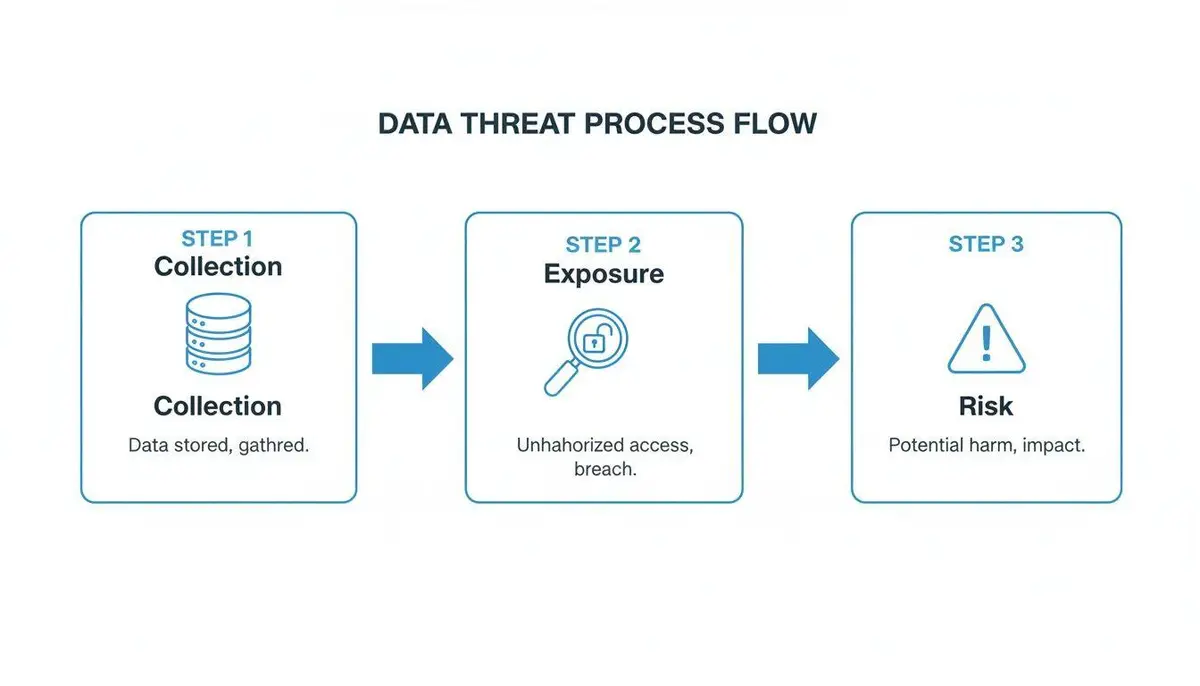
This diagram highlights how quickly aggregated data becomes a direct security vulnerability once published online.
Navigating the Dual CAPTCHA and Verification Sequence
This is where most manual attempts fail. You will enter your information and solve a CAPTCHA. This is only the first one. After submitting this form, PeopleFinders will dispatch an automated email to the address you provided.
The verification email is the single most critical point of failure in this process. The link inside it expires after 24 hours. If you do not click that link within a day, your removal request is automatically cancelled, and you must start over.
This tight deadline is a deliberate obstacle. For busy professionals, it is easy to miss this narrow window, leaving their private data exposed for weeks or months longer. I have seen numerous cases where a client believed the process was complete, only to discover their request had expired without ever being processed.
Clicking the verification link takes you to a second page. Here, you must confirm your information again and solve another CAPTCHA before finally submitting the request. This two-step verification, intended to stop bots, also doubles the chances for human error. Provide only the bare minimum information required to identify your profile. Do not furnish them with any additional data.
If you are interested in how these tactics apply to other data brokers, our guide on how to remove yourself from data collection sites offers broader context.
The manual process is fragile. It relies on a time-sensitive email and multiple steps where a single mistake resets the clock, prolonging your exposure. For any individual requiring guaranteed results without the risk of failure or delay, this manual method is insufficient.
So, you have completed the PeopleFinders opt-out process and received the confirmation email. This moment of relief is often a false sense of security.
Getting your information off PeopleFinders is not a one-time event. The reality is far more complex.

While PeopleFinders officially states a removal can take up to 72 hours, our experience shows it is typically much faster, often less than 24 hours. The problem is not the initial removal; it is maintaining that removal.
Upon receiving confirmation, you must verify the removal. Return to the PeopleFinders website and search for yourself. Also, use an incognito browser window to search your name on Google to see if the old listing has been de-indexed. This provides a temporary assurance.
Why Your Data Always Returns
The fundamental flaw of any manual opt-out is that your data will eventually reappear. It is a matter of when, not if. Data brokers like PeopleFinders are built on a model of continuous, automated scraping of public records. Their system is not designed to remember your privacy request; it is built to collect data.
This process is perpetual. The platform’s algorithms are always scanning for new and updated information. This occurs when:
- You buy or sell a home: New property and deed registrations create fresh public records.
- You update your voter registration: A change of address feeds new information back into their system.
- A court filing appears: Any new legal record, civil or criminal, is scraped and connected to your name.
- You renew a professional license: State licensing boards often list personal details publicly.
Any of these life events can trigger the system to see you as a “new” entity and automatically generate a new profile. Your previous opt-out is instantly nullified. This is not a system bug. It is the system functioning as designed.
The Problem of Digital Whack-A-Mole
Opting out manually reveals a harsh truth: even after a successful removal, your data reappears in 100% of cases over time. PeopleFinders is one of the largest owners of US public records, constantly refreshing its 120 billion records with new arrests, property filings, or voter data.
The address or record you worked to remove today can be back online tomorrow. This endless cycle of discovery, removal, and re-checking is unsustainable.
Let’s compare the timeline for handling this yourself versus using a dedicated service.
PeopleFinders Manual Opt Out vs. Professional Removal Timeline
| Stage | Manual Opt-Out Process | Professional Service (e.g., ContentRemoval.com) |
|---|---|---|
| Initial Removal Request | 15-30 minutes per request | 5 minutes for setup |
| Initial Removal Timeline | 24-72 hours | 24-48 hours |
| Verification | Manual searches required weekly | Automated, continuous monitoring |
| Data Reappearance | Guaranteed within weeks or months | Prevented by ongoing scanning & re-submissions |
| Long-Term Effort | A constant, recurring task | “Set it and forget it” after initial setup |
The manual approach is a temporary fix demanding constant vigilance. It addresses a single symptom but leaves the underlying cause untouched.
This cycle of removal and reappearance is precisely why a manual opt-out is insufficient for anyone who requires absolute and lasting privacy. It places the burden of continuous, lifelong monitoring squarely on your shoulders.
For our clients, whose time is a finite asset and whose privacy is non-negotiable, this is an unacceptable risk. The manual PeopleFinders opt out is a reactive tactic, not a durable strategy. True digital privacy requires a persistent, proactive defense that a one-off manual effort cannot provide.
Automated Services vs. Professional Intervention
You have succeeded in removing your information from PeopleFinders. While a positive step, the task is incomplete. Seeing your data reappear days or weeks later is not a system glitch; it is the system functioning as intended.
PeopleFinders is one head of a hydra, part of a massive, tangled web of data brokers constantly scraping, buying, and selling your personal information. Focusing on one site is an unsustainable fight for any individual to undertake manually.
This is why many turn to automated removal services. These tools are built to send opt-out requests to dozens, or even hundreds, of data brokers simultaneously, offering a scale an individual cannot match.
These services can be effective for general cleanup, often achieving an 89% removal success rate across more than 180 data brokers within the first 30 days. This represents a significant improvement over manual efforts, where a record might repopulate a week after removal.
However, a vast difference exists between this automated cleanup and true strategic intervention. While these services cast a wide net, they cannot handle the serious, high-stakes threats that executives, public figures, or high-net-worth individuals face.
Where Automation Falls Short
At their core, automated services execute one function: they dispatch standardized removal requests based on the information you provide. They are a robotic proxy for the manual opt-out process, operating at scale. To understand their function, consider how general automated service software is used in other industries; it is about volume and standardized transactions.
This model has severe limitations, especially when real security is at stake:
- No Legal Authority: If a data broker ignores a request, an automated tool has no recourse. It cannot issue a legal demand letter or escalate the matter. It lacks the authority to compel compliance.
- Inability to Address Google Results: Removing a profile from a data broker does not remove a negative news article, a damaging review, or a leaked document from Google search results.
- Powerless Against Active Threats: These services are not designed to combat defamation, online impersonation, or the spread of non-consensual intimate imagery (NCII). Such situations require a completely different tactical approach.
For a CEO whose home address has been exposed, placing their family at risk, or a public figure fighting a coordinated smear campaign, an automated service only addresses a symptom, data exposure, but fails to fix the underlying vulnerability.
Professional Intervention: A Strategic Necessity
This is where professional intervention becomes necessary. A firm like ContentRemoval.com operates on an entirely different level. We combine proprietary technology with legal expertise to achieve what automated tools cannot. We do not just send requests; we build a complete defensive strategy around the specific threats you face.
The full scope of our internet removal service offerings demonstrates the level of protection we provide.
Our work extends far beyond data broker profile takedowns. We focus on suppressing negative search results, using legal channels to de-index defamatory content, and employing continuous, intelligent monitoring to neutralize threats before they materialize.
A single data leak can fuel extortion, intellectual property theft, and severe reputational damage, threats an automated service is unequipped to handle. Our role is not merely privacy management; it is asset protection, security assurance, and legacy preservation.
Beyond PeopleFinders: Building a Lasting Digital Defense

After opting out of PeopleFinders, a nagging suspicion remains: “Is this truly resolved?” The answer is no. Your information will almost certainly reappear, either there or on one of the hundreds of other data broker sites.
This constant cycle of finding and removing your data is unsustainable. For our clients (executives, public figures, and individuals whose personal safety is paramount) reacting to each new exposure is not a viable strategy. True privacy is not about plugging one leak; it is about building a system that prevents them.
A real defense is built on three integrated pillars. When in place, they form a powerful shield against the online exposure that leads to harassment, identity theft, or professional damage.
First, a Full-Spectrum Data Broker Purge
Your data is not just on PeopleFinders. It is scattered across a vast, interconnected network of data brokers, each holding a different piece of your personal puzzle. A serious strategy begins with a wide-ranging purge across this entire ecosystem.
This requires knowing where to look and how to navigate the intentionally confusing removal process for each site. The goal is to scrub the easily accessible information that makes you a prime target. A comprehensive digital footprint cleanup is the non-negotiable first step.
Next, Proactive Reputation Management
Once the obvious data is gone, the work shifts to managing what people find when they search for you online. This is not about hiding; it is about controlling your own narrative.
This pillar focuses on ensuring that positive, accurate, and authoritative information about you dominates your search results. For anyone in the public eye, controlling the first page of Google is as important as securing their physical office. You are effectively pushing any misleading or lingering negative information so far down it becomes irrelevant.
Finally, Continuous AI-Powered Monitoring
The internet never sleeps. Data brokers constantly scrape new information, and old profiles can reappear without warning. The final, and most crucial, component of a lasting defense is a system for perpetual monitoring.
This is what transforms a one-time cleanup into a permanent shield. Our systems constantly scan the web, from public sites to the deep and dark web, for any mention of our clients’ information.
This 24/7 monitoring is what truly secures your privacy. It means we can spot a profile reappearing on a site like PeopleFinders or an entirely new threat and handle it immediately, often before you are even aware of it.
This three-pronged approach (a wide-scale purge, active reputation management, and constant monitoring) is the only way to escape the reactive cycle. It moves you from a game of digital whack-a-mole to a proactive state of control. When your reputation is one of your most valuable assets, a discreet and reliable defense is a necessity. The goal is to turn your digital presence into a fortress, not an open book.
Frequently Asked Questions
Navigating the PeopleFinders opt-out process often raises more questions than it answers, leading to understandable frustration with how personal information is handled.
Here are direct answers to the most common questions we receive.
How Long Does the PeopleFinders Opt Out Take?
PeopleFinders states their process can take up to 72 hours. Our experience handling countless removals shows it is typically much faster, often within 24 hours. However, there is a significant catch.
The primary bottleneck is not their processing time but the verification email they send. It contains a confirmation link that expires after 24 hours. If you miss that email or fail to click the link in time, your request is voided, and you must restart the entire process.
Furthermore, “removed” does not mean permanent removal. It is a temporary solution at best.
Does Opting Out of PeopleFinders Remove Me from Other Sites?
No, it does not. Opting out of PeopleFinders only removes your profile from their website.
Your information is almost certainly distributed across dozens, if not hundreds, of other people search sites and data brokers. Each is a separate entity requiring its own unique and often convoluted removal process.
A comprehensive privacy strategy must address the entire data broker ecosystem. Removing your information from one site while leaving it on a hundred others is like locking your front door but leaving all the windows wide open.
Will My Information Reappear on PeopleFinders After Opting Out?
Yes, it almost certainly will. Data brokers like PeopleFinders are not static databases. They are constantly crawling the web and public records, ingesting new information to automatically create or update profiles.
Your profile can be republished when their system finds a new piece of data linked to you, such as:
- A change in your voter registration
- A new address from a property deed
- A recently filed business license
This is the fundamental flaw of one-time opt-outs. It is why ongoing monitoring is not a luxury but a necessity for real privacy.
What Are My Legal Options if PeopleFinders Ignores My Request?
It is incredibly frustrating when you follow all procedures and your profile remains live. Attempting to force compliance as an individual, even with privacy laws like the CCPA/CPRA in California, can feel futile.
The most effective method for compelling a data broker’s attention is professional escalation. A formal legal demand letter sent by a firm on your behalf fundamentally changes the dynamic. Citing specific privacy laws and demonstrating serious intent achieves results where a standard customer service ticket rarely does.
The constant cycle of data exposure makes handling removals yourself an exhausting and ultimately losing battle. At ContentRemoval.com, we offer a permanent solution. We utilize proprietary technology and legal expertise not only to remove your private information but to ensure it stays down. If you require guaranteed privacy and a real defense against data brokers, start with a confidential assessment of your online presence today. Learn more at ContentRemoval.com.