
Online privacy protection for executives is about containment, not invisibility. It runs as a protocol: an adversarial audit of what is visible and what can be inferred, a defense stack that secures the home network, hardens logins with hardware keys and unique email aliases, and reduces leakage, then active monitoring, a sequenced takedown workflow, and a standing crisis posture.
Key facts
- Audit in two layers: visible exposure in search, social, and brokers, then inferred exposure such as routines and family links
- IronCore Labs’ checklist favors app-based authenticators or hardware keys over SMS because of SIM-swap attacks
- Match the notice to the hook: privacy channels for personal data, identity channels for impersonation, rights enforcement for copyright
- Post-removal steps: confirm source restriction, review search indexing, sweep for reposts, follow up with brokers
Where ContentRemoval.com comes in. ContentRemoval.com handles the remediation layer of this playbook: privacy-related takedowns, de-indexing, impersonation complaints, and reupload monitoring across search engines, websites, and social platforms. A chief of staff, the family office’s security lead, or the principal’s counsel usually makes contact once an address, phone number, or family detail is already circulating. A free 15-minute Exposure Scan maps what is removable, and the report is yours to keep. Get a Free, Confidential Exposure Scan or read how our personal data removal work is done.
Your phone number is circulating in group chats you’ve never seen. A family member’s address is visible on a broker site. An old corporate bio, a tagged photo, and a leaked email credential now connect your home, your travel pattern, your employer, and your inner circle. That’s the point where generic privacy advice becomes useless.
If you’re a public figure, executive, founder, investor, or family office principal, online privacy protection isn’t about browsing in incognito mode and tweaking cookie banners. It’s about containment, strategic action, and response speed. You are not trying to disappear. You are trying to stop exposure from becoming access, harassment, extortion, impersonation, or reputational damage.
Redefining Online Privacy for Public Figures
Many still treat privacy as a settings problem. That’s the wrong model for anyone with a visible profile, meaningful assets, or a recognizable name. The crucial point is what happens after your data is already exposed, copied, indexed, reposted, and connected across platforms.
The gap is obvious in the public guidance. A U.S. NTIA study cited by Global Guardian’s analysis of digital privacy protection found that 73% of internet-using households reported significant concern about online privacy and security risks, and 35% said those worries caused them to hold back from some online activities. Yet most advice still focuses on prevention, not remediation. For high-risk people, privacy has already become a containment problem.

Privacy is control, not invisibility
If you’re already in the public record, online privacy protection doesn’t mean hiding every trace of your existence. It means controlling which details remain easy to find, easy to verify, and easy to weaponize.
That distinction matters. An exposed email address is not just an inbox risk. It can become the recovery point for other accounts, the anchor for breach correlation, and the starting point for impersonation. A home address is not just a data point. It can be used to confirm family relationships, map properties, identify routines, or pressure an employer.
Public visibility isn’t the real threat. Actionable visibility is.
That’s why standard consumer checklists don’t go far enough. They rarely address doxxing, coordinated smear campaigns, impersonation profiles, executive targeting, family exposure, or hostile compilation of otherwise legal public data.
The public figure standard is higher
Your adversary doesn’t need a hack. They need patience. They’ll combine social profiles, old press mentions, broker entries, archived websites, donor records, conference bios, cached images, and leaked credentials until they have a workable profile.
That’s the operating reality behind a serious strategic guide to protecting your online privacy as a public figure. The standard is higher because the consequences are higher. A regular consumer might face spam. You might face investor concern, board scrutiny, family safety issues, or targeted extortion.
Use this rule going forward:
- Treat privacy as an executive risk issue. It belongs with legal, reputation, physical security, and communications.
- Assume exposed data will be reused. Once a detail appears online, expect it to be copied elsewhere.
- Measure risk by harm potential. Focus first on what can enable access, pressure, location tracking, or narrative distortion.
If your information is already circulating, you are no longer in the prevention stage. You are in active risk management.
Assessing Your Digital Attack Surface
Start with the ugly question: if someone wanted to map your life in a weekend, what could they assemble without speaking to you once?
That is how a proper audit begins. Not as a compliance exercise. As adversarial reconnaissance.
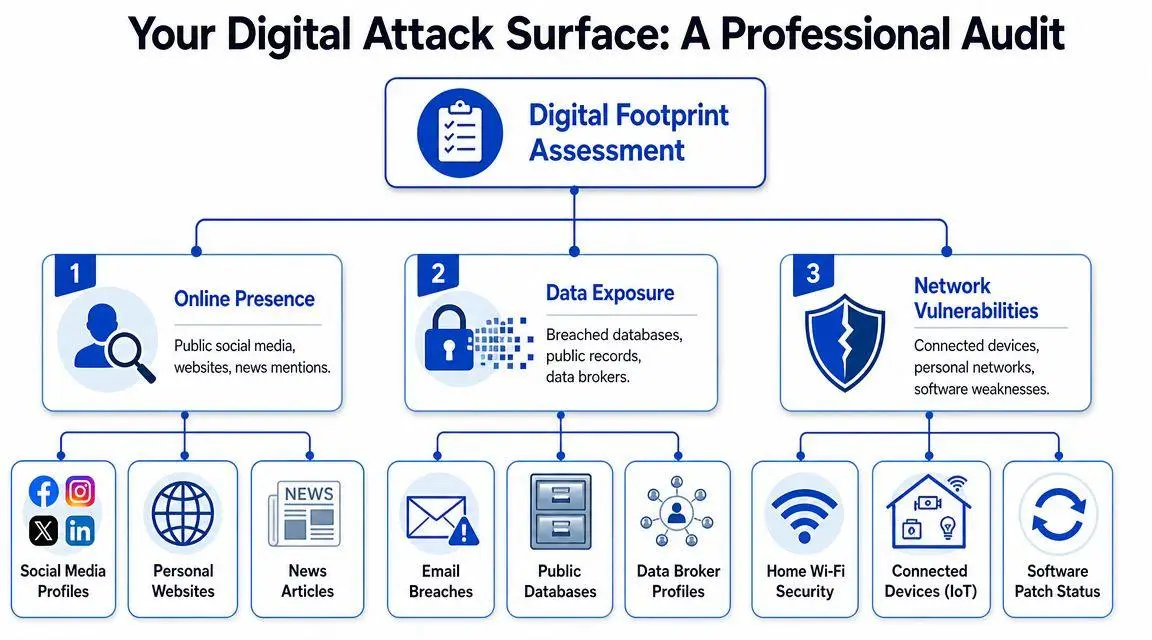
Audit what is public, then audit what is inferable
Most executives look at what’s openly visible and stop there. That misses the harder problem. Data doesn’t need to sit in one place to be dangerous. It only needs to be connectable.
As Anonyome’s guide to online privacy explains, AI-driven and cross-platform data reuse makes basic privacy settings far less effective than people think. Incognito mode only limits local history storage. It doesn’t stop websites, social platforms, ad systems, or connected services from inferring identity and behavior from broader account activity.
So audit in two layers:
| Audit layer | What you check | Why it matters |
|---|---|---|
| Visible exposure | Search results, social profiles, broker listings, public records, cached pages | This is what an adversary sees immediately |
| Inferred exposure | Relationships, routines, locations, assets, travel, children, staff links | This is what an adversary builds from separate clues |
Run the attack-surface review in a strict order
Don’t jump around. Work top down.
- Search your name variants. Include full legal name, common short forms, maiden names, company associations, and image searches. Capture every result that reveals identity markers, location markers, or family links.
- Map all social platforms. Review active accounts, dormant accounts, fan pages, unofficial pages, and tagged media. The danger often sits in old accounts you forgot, not the one your assistant actively manages.
- Review broker and aggregator exposure. Home addresses, prior addresses, phone numbers, relatives, and age ranges often appear in compiled profiles. If you need a framework, this guide to what data brokers are and why executives should care is a practical starting point.
- Check corporate spillover. Executive bios, team pages, SEC-related disclosures, archived speaker pages, and marketing collateral often expose more than intended. One outdated conference bio can disclose city, employer, and niche role all at once.
- Audit the inner circle. Your spouse, children, assistant, chief of staff, household staff, and business manager can expose your location, travel, schedule, school links, and residences without realizing it.
If your family and staff aren’t part of the privacy review, you don’t have a privacy program. You have a personal preference.
Focus on linkage points
Some data points matter more than others because they connect systems.
- Primary email addresses connect breaches, account recovery, and phishing.
- Mobile numbers connect messaging apps, broker listings, and identity verification flows.
- Personal domains and vanity sites connect hosting records, contact forms, and archived content.
- Profile images enable impersonation and reverse-image discovery across platforms.
Public figures get blindsided. They think each fragment is harmless in isolation. It isn’t. The attack surface is the sum of what can be correlated, not just what can be seen.
The Proactive Defense Protocol
Once you know what’s exposed, lock down what can still be controlled. Don’t overcomplicate this. A serious defense stack starts with the infrastructure you rely on every day. If that foundation is weak, every later privacy move is cosmetic.
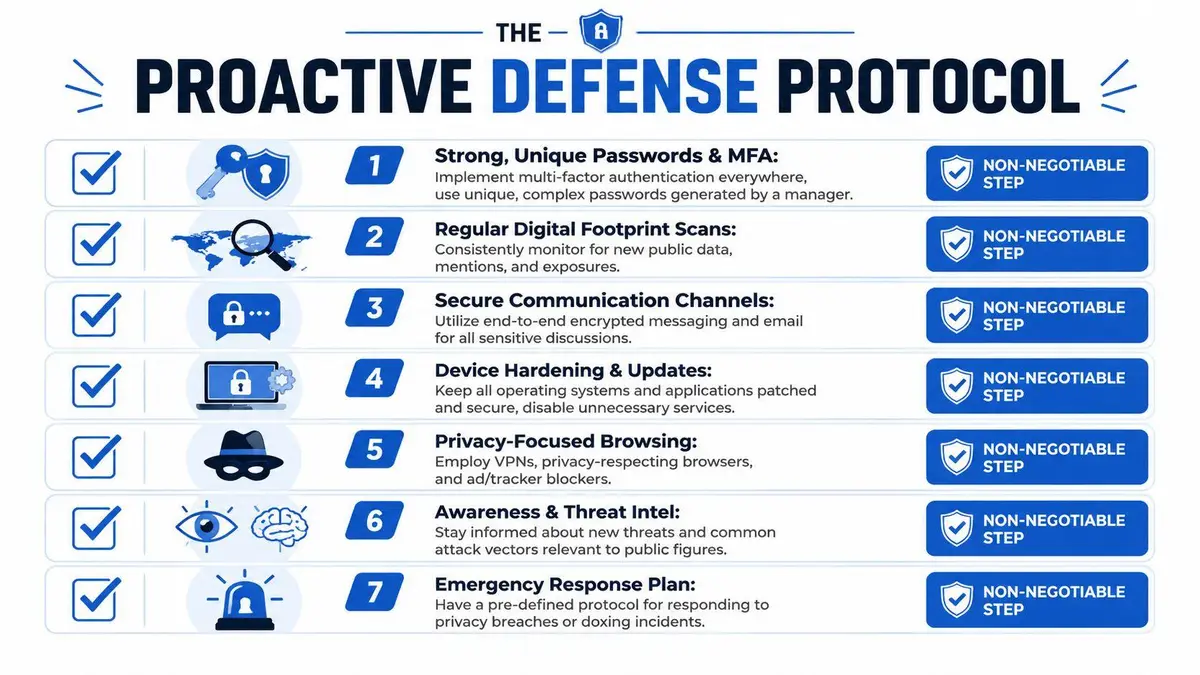
The sequence matters. According to IronCore Labs’ security experts data privacy checklist, a high-reliability privacy stack should start by securing the network, then hardening logins, then reducing data leakage. That same guidance recommends unique email aliases, multi-factor authentication, and WPA-2 or WPA-3 on home networks, with a preference for app-based authenticators or hardware keys instead of SMS because SIM-swap attacks can bypass text-message codes. It also calls out a common executive failure point: not proactively monitoring whether your email addresses have already appeared in breaches.
Step one is the network
Executives often focus on passwords first. That’s backwards if your home network is weak. Your residence is now part of your threat perimeter. Guests, contractors, family devices, media systems, cameras, printers, and smart home equipment all create exposure.
Use a current Wi-Fi security standard. Segment personal devices from household devices where possible. Do not let the same network environment carry sensitive work activity, unmanaged IoT devices, and casual guest access without separation.
Step two is login hardening
Your logins need compartmentalization, not convenience. Reused addresses and reused credentials turn one compromise into many.
Use this baseline:
- Create unique email aliases for banking, legal matters, travel, personal shopping, and public-facing communications. Don’t use one primary address everywhere.
- Replace SMS MFA with stronger factors. Use an authenticator app or, better, hardware security keys where supported.
- Review recovery methods on critical accounts. Backup emails, recovery phone numbers, and trusted devices are often the weak link.
Practical rule: if an attacker gets control of your main email account, they shouldn’t be able to pivot cleanly into your banking, storage, social accounts, and travel records.
A breach-notification service should monitor every active and legacy email address tied to you. That’s not optional. If an address is already exposed, treat it as a managed liability, not a trusted identity anchor.
Here’s the embedded overview many clients use as a basic briefing for household and executive teams before implementation:
Step three is leakage reduction
Once the network and logins are secure, shrink the amount of data you leak through normal use. For this, discipline beats software.
A short operational checklist works better than vague principles:
- Strip app permissions. If an app doesn’t need contacts, microphone, camera, photos, or location, deny it.
- Reduce tracker exposure. Browser privacy tools help, but don’t mistake them for anonymity.
- Separate devices by role. Public posting, sensitive communications, and family use should not all happen on the same phone.
- Use a VPN on public networks. But understand the limit. Encrypting the connection does not solve cookies, trackers, or account-level profiling.
What executives get wrong
Most failures come from inconsistency, not lack of tools. The partner secures his phone but not his spouse’s. The founder uses a hardware key on one account and SMS on the account that controls recovery. The assistant manages public posting from a device cluttered with personal apps.
That’s why this has to be run as a protocol. Not advice. Not preferences. A protocol.
If you need outside execution support for removals and ongoing exposure management, services such as ContentRemoval.com handle privacy-related takedowns, de-indexing, and monitoring across search engines, websites, and social platforms. But even with outside support, your internal controls still have to be disciplined.
Active Threat Monitoring and Intelligence
Waiting for someone else to tell you your data is out is amateur hour. By the time a platform notice arrives, the material has already been copied, indexed, screenshotted, forwarded, and discussed.
That’s why passive defense fails. Firewalls, account settings, and periodic checks are necessary, but they don’t give you warning. They give you posture. What you need on top of posture is detection.
Watch for signals, not just events
High-risk individuals rarely get hit by one dramatic incident out of nowhere. The pattern is usually quieter. A new username appears with your headshot. An old address reappears in a people-search entry. A breached credential tied to a legacy domain starts showing up in criminal chatter. A private image moves from one obscure forum to a searchable surface.
You need monitoring that looks for weak signals early:
- Name mentions tied to new URLs or unusual contexts
- Unauthorized image reuse across platforms and cloned accounts
- Impersonation profiles using your biography, likeness, or company affiliation
- Leaked credential references attached to active or legacy addresses
- Doxxing indicators involving family, residence, school, or travel details
Privacy-preserving monitoring is possible
Some clients resist monitoring because they don’t want more sensitive data pooled into another system. That concern is legitimate. It’s also solvable if the workflow is designed properly.
As Decentriq’s explanation of privacy-enhancing technologies notes, a proper PETs workflow identifies sensitive fields, minimizes collection, uses synthetic data for analytics where possible, and applies differential privacy by adding calibrated noise to query outputs so individual records can’t be inferred. The point isn’t to sprinkle in random noise and call it privacy. The point is to preserve useful threat analysis without exposing raw personal records.
You want intelligence without creating a second privacy problem.
For executives, that matters. Monitoring should help identify patterns that suggest a threat, while limiting unnecessary access to the underlying personal data. If your provider can’t explain how they minimize exposure inside the monitoring process, they’re giving with one hand and taking with the other.
Build an escalation ladder
Monitoring only works if alerts trigger action. Otherwise you’re buying a dashboard, not a defense capability.
A workable escalation ladder looks like this:
| Trigger | Immediate action | Owner |
|---|---|---|
| New exposure of home, phone, or family data | Preserve evidence and begin takedown review | Legal or privacy lead |
| Impersonation or account cloning | Report platform abuse and secure verified accounts | Brand or communications lead |
| Credential exposure tied to active systems | Rotate access, review recovery paths, notify affected stakeholders | Security lead |
| False narrative gaining search traction | Prepare suppression, response, and removal strategy | Reputation and legal team |
Google Alerts alone won’t carry this load. Basic alerts are fine for low-stakes monitoring. They’re not enough when delay increases legal, reputational, and personal risk.
The Remediation and Takedown Workflow
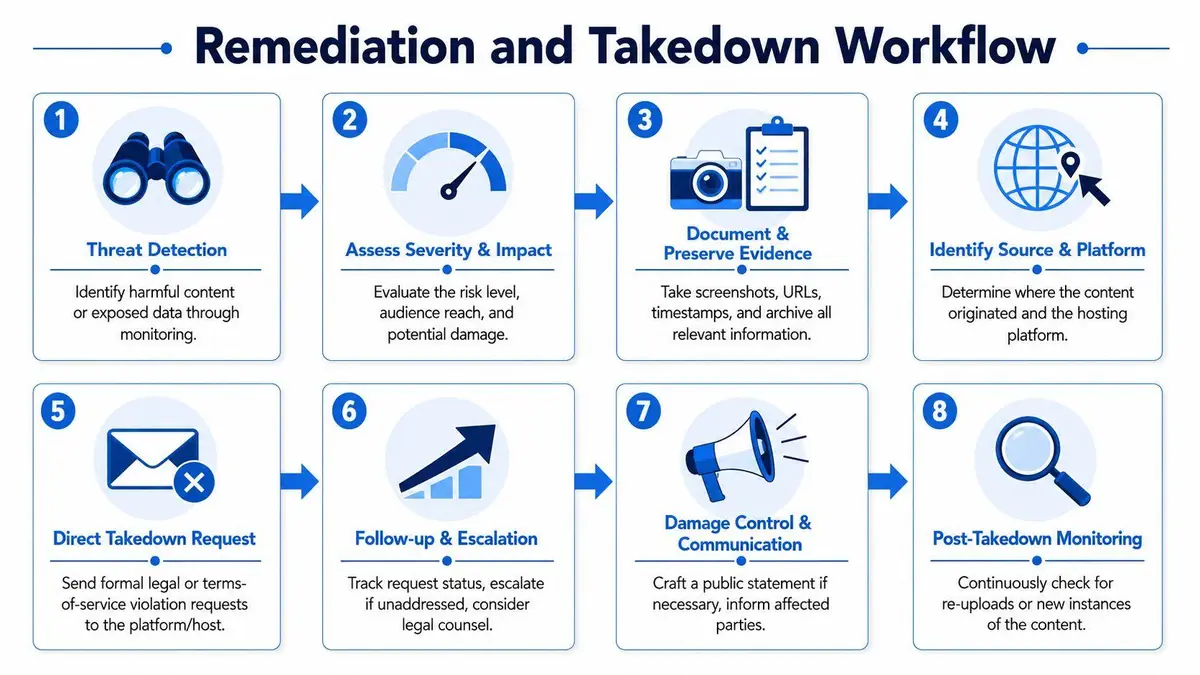
Once harmful content is live, speed matters. So does sequence. If you improvise, you’ll preserve the wrong evidence, send the wrong notice, or escalate on a weak theory and lose your advantage early.
The workflow below is the one that holds up under pressure.
First secure the record
Before you contact anyone, preserve the evidence. Capture screenshots, URLs, timestamps, visible account details, search result appearances, and any repost chains you can identify. Archive the content if appropriate. If you skip this and the material disappears temporarily, you may lose proof needed for platform escalation, legal review, or search removal requests.
Then classify the threat. Don’t treat every exposure the same.
| Content type | Primary risk | First-line tactic |
|---|---|---|
| Leaked personal information | Doxxing, stalking, account compromise | Privacy complaint, host request, de-indexing review |
| Impersonation profile | Fraud, reputational confusion, social engineering | Platform impersonation report, account verification support |
| Defamatory or false content | Investor, customer, employer, or public harm | Legal review, falsity analysis, removal or suppression path |
| Leaked images or sensitive media | Extortion, humiliation, rapid reposting | Emergency platform reporting, source removal, search containment |
Match the tactic to the platform and the law
People lose time by arguing broad principles with platforms that only act on specific policy hooks. Don’t write emotional complaints. Write targeted notices.
If the issue is private information, use privacy and personal-data channels. If it’s impersonation, use identity and fraud channels. If it’s copyrighted material, use rights enforcement. If it’s defamatory, get legal review before you overstate your position.
A useful reference point here is the current enforcement climate. By the end of 2024, data protection laws covered 6.3 billion people, equal to 79% of the global population, and more than 140 countries had data protection laws in force by early 2025. The same Usercentrics privacy statistics summary notes that GDPR fines have exceeded EUR 4 billion since May 2018, with the EU imposing EUR 2.1 billion in GDPR fines in 2024 alone. That matters because removal arguments now carry regulatory weight in many cases. Privacy enforcement is no longer a soft norm. It is backed by serious penalties.
Platforms move faster when your request is framed as a concrete privacy, policy, or regulatory issue rather than a vague objection.
Choose the right operator for the problem
A PR firm can shape narrative response. It cannot usually remove the source. A law firm can assess claims, draft formal demands, and escalate litigation. It may not run fast-moving cross-platform takedowns efficiently. A specialist removal team can often manage source removal, de-indexing, impersonation complaints, and repeat-upload monitoring at operational speed.
That’s where a tactical guide such as how to remove content from a website for executives becomes useful. The key is role clarity.
Use this split:
- Use PR when the content will remain public and you need counter-messaging.
- Use legal counsel when the facts support formal demand, court action, or rights enforcement.
- Use technical removal specialists when the priority is source removal, de-indexing, platform action, and reupload containment.
Escalate, then monitor for recurrence
A single takedown is rarely the end. Harmful content reappears on scraper sites, mirror domains, low-moderation forums, and copycat accounts. That means remediation must include recurrence control.
Your post-removal process should include:
- Confirmation of source removal or restriction
- Search review for residual indexing
- Platform sweep for reposts and mirrors
- Broker and aggregator follow-up if personal data was involved
- Communication plan if stakeholders may already have seen the material
If the issue touched home address, phone number, family identity, or employer details, widen the review. The first visible post is often only the first discovered post.
Long-Term Resilience and Crisis Posture
The mistake most public figures make is treating privacy like a cleanup project. They run a few takedowns, tighten a few settings, and move on. Then the next exposure arrives through a family member, an archived page, a reused email alias, or a stale profile no one remembered.
That cycle only stops when privacy becomes an operating posture.
Build repeatable controls
Your defenses have to survive travel, staff turnover, media activity, litigation, and normal human laziness. That means scheduled audits, recurring review of account recovery paths, and strict control over who can publish, respond, or disclose information on your behalf.
Use a standing cadence for three areas:
- Identity hygiene for aliases, recovery methods, and verified profiles
- Exposure review for broker listings, public mentions, search results, and dormant accounts
- Household and staff discipline for posting rules, travel disclosure, school references, and device use
A family office principal with excellent personal habits can still be exposed by a nanny’s tagged image, a chief of staff’s calendar screenshot, or a child’s sports roster page. Resilience requires trained people around you, not just a careful you.
Prepare the crisis workflow before the crisis
If you wait to decide who handles what after a doxxing event, impersonation campaign, or leaked-media incident, you’ve already lost time you won’t recover.
Define this in advance:
| Scenario | Primary lead | Secondary lead |
|---|---|---|
| Doxxing or exposed personal data | Privacy or legal lead | Physical security |
| Impersonation or fraud profile | Communications or brand lead | Security |
| Defamatory content spike | Legal lead | Reputation team |
| Sensitive media leak | Legal lead | Removal specialist |
The strongest privacy posture is boring. It relies on routine, not adrenaline.
Keep the objective clear
You are not trying to win every argument on the internet. You are trying to reduce accessibility of harmful data, cut off escalation paths, protect family and staff, and preserve decision-making room during a reputational event.
That is what effective online privacy protection looks like at the executive level. Not perfect secrecy. Not magical anonymity. Controlled exposure, rapid detection, and disciplined response.
If your name, address, images, phone number, employer details, or family links are already circulating, this is not the moment for casual fixes. Run the audit. Harden the stack. Monitor aggressively. Remove what you can. Then keep the posture in place.
If you need a confidential assessment of exposed data, impersonation, search visibility, or harmful content already in circulation, ContentRemoval.com can help you evaluate the threat surface and build a focused removal and remediation plan.
Frequently asked questions
How do I find out what personal information about me is online?
Search every name variant including maiden names and company associations, run image searches, map active and dormant social accounts, review data broker and aggregator listings for addresses and relatives, check corporate spillover such as old speaker bios, and audit the inner circle of family and staff. Then look at what those fragments reveal when connected.
Is a VPN or incognito mode enough to protect my privacy as an executive?
No. Incognito mode only limits local history storage, and a VPN encrypts the connection without solving cookies, trackers, or account-level profiling. For someone already in the public record, the work is controlling which details remain easy to find and weaponize, not hiding browsing activity.
Who should handle a doxxing incident: PR, lawyers, or a removal firm?
Use legal counsel when the facts support formal demand or rights enforcement, technical removal specialists when the priority is source removal, de-indexing, and reupload containment, and PR only when content will remain public and needs counter-messaging. Preserve evidence and classify the threat before any of them act.