
Local listings management, for executives and high-net-worth individuals, is a reputation defense function rather than a marketing task: auditing every profile tied to your name, business and locations, claiming and verifying the ones you should control, keeping name, address and phone data consistent, removing duplicates and fraudulent listings through the correct channels, and monitoring for unauthorized edits.
Key facts
- Search operators such as your street address minus your own site reveal directories that scraped your data.
- Listings are triaged as claimed and accurate, unclaimed, duplicate, or fraudulent, with fraudulent ones treated as urgent.
- Google often requires a continuous video showing signage and company documents to verify ownership.
- Fraudulent listings go through Google’s Business Redressal Complaint Form, not Suggest an edit.
Where ContentRemoval.com comes in. ContentRemoval.com handles the adversarial end of local listings for executives, family offices and their counsel: fraudulent profiles impersonating a CEO or brand, listings hijacked by a former employee or agency, and reviews that breach platform policy. The general counsel, operations lead or an executive’s chief of staff usually makes contact once a first-tier report has failed. A free 15-minute Exposure Scan maps every listing that is removable or recoverable, and the report is yours to keep. Get a Free, Confidential Exposure Scan or read how our content removal work is done.
When “local listings management” is mentioned, many envision a marketing team tweaking business hours on a map. For high-net-worth individuals, executives, and their legal counsel, that perspective is dangerously outdated. This is not marketing; it is a critical component of your reputation defense and security strategy. It is the methodical process of taking firm control of your digital footprint to preemptively neutralize misinformation, impersonation, and direct attacks.
Why Local Listings Are Your New Frontline

For a private individual, family office, or corporate leader, online listings represent a significant and often completely unmanaged vulnerability. Platforms such as Google Business Profile, Yelp, and Bing are not merely digital address books. To the public, your clients, and your partners, they are the arbiter of truth. An unmanaged or compromised listing is an open invitation for malicious actors and a direct threat to your reputation.
The risk extends far beyond an incorrect phone number. These listings function as unlocked digital entry points to your personal or professional brand.
The Strategic Threat of Unmanaged Listings
Any third party can co-opt an unclaimed profile. A disgruntled former employee, a competitor, or a scam artist can seize control and begin impersonating you or your entity. They can change your address to a vacant lot, update your hours to “Permanently Closed,” or populate the profile with defamatory images. The damage is instantaneous and proliferates as hundreds of other directories scrape and republish the false data.
This is not a hypothetical scenario. We have managed cases where attackers created fraudulent listings to divert high-value clients to sham operations, causing significant financial loss before our client was even aware of the impersonation.
Your exposure is amplified by the concentration of search traffic. Google Business Profile alone drives an estimated 68% of all local search traffic, creating a powerful single point of failure. One compromised listing on that platform can inflict catastrophic damage on your public perception. When data shows that 76% of people who search for a local business will visit it within 24 hours, the imperative to control that first impression becomes clear. A full analysis of the local search market shift reveals the full scope of this threat.
In this environment, neglecting your local listings is the digital equivalent of leaving the front door of your office unlocked. It is a forfeiture of control over a core asset that directly shapes your credibility and trustworthiness.
Moving Beyond Marketing to Active Defense
Proper local listings management is not concerned with chasing five-star reviews or optimizing for keywords. For our clients, it is a defensive strategy built on three core principles.
First is Control: asserting verified ownership of every digital profile connected to your name, your family, and your operations. Second is Accuracy: ensuring every piece of information, from your headquarters’ address to professional credentials, is precise and consistent across all platforms. Third is Security: establishing a system for continuous monitoring and immediate response to neutralize threats before they inflict material harm.
This guide provides a blueprint for treating your local listings with the seriousness they command. We will dispense with generic marketing advice and provide the specific, actionable processes required to audit, secure, and defend your digital presence. The objective is to construct a fortified perimeter around your reputation.
Conducting Your Digital Footprint Audit

Before you can control your online presence, you must first document its full extent. This requires more than a cursory Google search for your business name. A proper audit involves building a complete inventory of every digital asset tied to your business, your key personnel, and your locations.
The purpose is not just to find expected profiles but to uncover the unexpected: legacy profiles, auto-generated listings, and inaccurate data scraped by third-party sites. This audit is the foundation of your entire local listing strategy. Proceeding without it is akin to constructing a building on an uninspected foundation.
Advanced Search and Discovery Techniques
A professional audit employs specific search commands to compel search engines to yield precise information. These queries are designed to uncover listings on major platforms, obscure data aggregators, and niche directories where misinformation often persists.
Initial discovery relies on powerful search operator combinations:
"Your Business Name" + "Your City""Your Executive's Name" + "Title" + "Company Name""Your Street Address" -site:yourwebsite.com
These commands filter extraneous results. The third operator is particularly effective for identifying third-party websites that have scraped your address, moving beyond basic brand monitoring to a comprehensive digital footprint analysis.
Granularity is essential. Consider the real-world impact of bad data: 29% of consumers report finding a business did not have a product in stock that its online listing claimed was available. A single error erodes trust. Multiplied across dozens of incorrect listings, this becomes a significant reputation problem with direct financial consequences.
Building Your Listing Inventory
As you uncover these profiles, you must document each one in a master spreadsheet. This document is not merely a list; it is a strategic map detailing every potential vulnerability. The objective is to identify every profile on the top local listing sites and any relevant industry-specific directories.
For every listing, document its status and key details. This triage process converts raw data into an actionable plan.
The goal of an audit isn’t just to find listings, but to classify them by threat level. An unclaimed profile is a security risk; a fraudulent one is an active attack. Each requires a distinct and immediate response.
This inventory will become your command center, guiding every action taken to secure your brand’s digital footprint.
The Listing Status Triage Matrix
To impose order on the data, we use a framework to categorize and prioritize every discovered listing. This matrix dictates which items demand immediate attention and which can be addressed through routine optimization.
Structure your triage process according to this framework.
| Listing Status | Immediate Threat Level | Required Action | Priority Level |
|---|---|---|---|
| Claimed & Accurate | Low | Monitor for unauthorized changes. | Routine |
| Unclaimed | Medium | Immediately claim and verify ownership. | High |
| Duplicate | Medium | Identify the authoritative listing; merge or delete others. | High |
| Fraudulent/Impersonation | Critical | Document evidence and initiate immediate takedown. | Urgent |
By categorizing each profile in this manner, your spreadsheet transforms from a simple list into a powerful, actionable plan. You will quickly discern that a fraudulent profile impersonating an executive requires a fundamentally different, and far more aggressive, response than a legacy listing with an incorrect phone number.
With your audit complete and your triage matrix populated, you possess the intelligence to shift from a reactive to a proactive defense. You have a comprehensive map of your digital presence, enabling you to systematically assert control, neutralize threats, and protect your reputation from future attacks.
Taking Ownership of Your Digital Footprint
Your audit has mapped every digital mention of your business. The next phase moves from reconnaissance to action. This is not about tidying up a few online profiles; it is a systematic takeover of every legitimate digital asset tied to your name and brand.
The objective is to transform each listing from a potential point of failure into a controlled, authoritative source of information, effectively converting liabilities into fortified assets.
Your first action should target the highest-value properties. For nearly every entity, this means starting with the Google Business Profile, given its outsized impact on public perception. If a listing for your business exists but is not under your control, claiming it is your highest priority. This involves proving your identity through a process intentionally designed to thwart bad actors.
Navigating the Verification Process
Claiming a major business listing requires more than a polite request. Platforms like Google and Yelp operate on trust signals, and you must provide concrete evidence of ownership. Vague attempts are systematically rejected.
Be prepared to supply specific documentation. Official business registration documents are required, clearly showing the exact business name and physical address. Utility bills or bank statements must display the business name and service address matching the listing; personal bills are not accepted. Google, in particular, now frequently requires a continuous video recording, in which you must show physical evidence of your location, such as storefront signage and branded equipment, and then prove access to official company documents on camera.
If another party (a former employee, a rogue agency) has already claimed your profile, the situation becomes more complex. You must file a formal request for an ownership transfer and prove the current owner is not affiliated with your business. Meticulous documentation and persistence are paramount. This is often where a professional firm provides decisive value, utilizing established channels to present a dispositive case for rightful ownership.
Fortifying Your Profiles for Reputational Defense
Once you secure ownership, you must fortify the property. This is a matter of reputational security, not marketing. Every field must be populated with absolute precision, leaving no ambiguity for later exploitation. An incomplete profile is an inherent vulnerability.
The foundation of this effort is NAP (Name, Address, Phone Number) consistency. Any variation, however minor, “St.” versus “Street” or “Co.” versus “Company”, creates data conflicts that erode the trust search algorithms have in your business and confuse your audience.
A fortified profile is an unambiguous one. Your business description should be as clear as a legal document, your service categories carefully chosen to prevent misuse, and your photos curated to project authority.
This level of detail is non-negotiable. Your business description must be a concise, executive-level summary, not a marketing pitch. Select service categories with precision. A high-net-worth wealth management firm should avoid a broad category like “Financial Services,” which attracts irrelevant inquiries, and instead use specific categories like “Investment Management” or “Family Office Services.”
Maintaining accurate contact information across dozens of platforms is a significant challenge, especially for businesses with multiple locations. A tool like a Company Address API can be invaluable for ensuring foundational NAP data is perfectly consistent from the outset. This is a critical component of any serious local listings management strategy. You can explore this topic further in our guide to creating safe online business listings.
Finally, curate your visual assets. All imagery must be professional and high-resolution, including official headshots, clean office photography, and approved brand logos. Low-quality or user-generated photos diminish your brand’s authority and must be flagged for removal and replaced. By methodically executing these steps, you transform a weak digital outpost into a powerful and controlled part of your public reputation.
Taking Control of Inaccurate and Malicious Listings
With the audit complete, the remediation phase begins. This involves a systematic cleanup of the issues uncovered, from simple inaccuracies to malicious attacks. Each problem requires a distinct and strategic plan of action.
Identifying a fraudulent listing or duplicate profile is one thing; removing it is another. Success requires methodical execution, proper documentation, and an understanding of each platform’s unique remediation protocols.
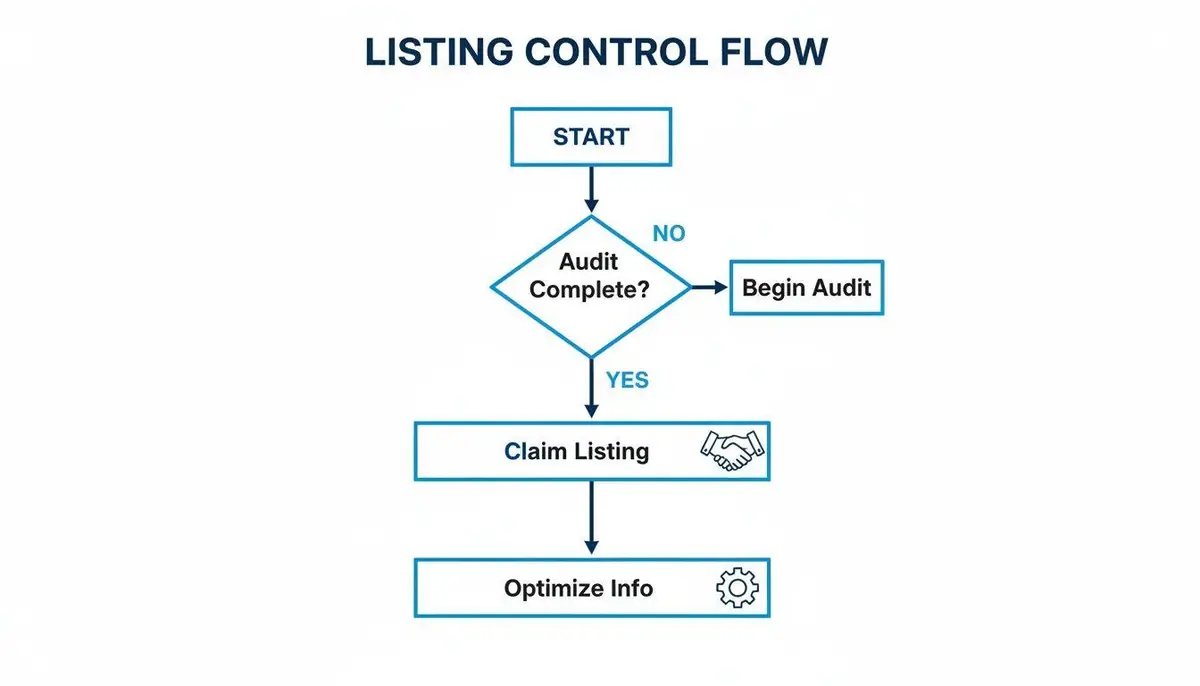
This flowchart illustrates the core process we follow in professional local listings management. Post-audit, we immediately move to claim and optimize legitimate profiles while systematically eliminating threats. This workflow ensures all assets are secured and all risks are neutralized.
Eliminating Duplicate Listings
Duplicate listings present a greater problem than is commonly understood. They not only confuse potential customers but also actively damage your search rankings. When Google encounters multiple profiles for the same business, it cannot determine which to trust. This phenomenon, known as “authority dilution,” splits your ranking power and scatters reviews and customer interactions across different profiles, weakening your primary, authoritative listing.
The first step is to designate a “primary” listing to serve as the single source of truth. This is typically the oldest, most complete profile or the one with the most reviews. Once designated, the objective is to either merge all other duplicates into it or have them removed entirely.
For a Google Business Profile, you can initiate this process by using the “Suggest an edit” feature on the duplicate listing, marking it as a “Duplicate of another place,” and providing the URL to your official profile. This process can be protracted, especially if the duplicate has its own reviews and photos.
Reporting and Removing Fraudulent Listings
A fraudulent listing created to impersonate you or your business constitutes a direct attack. These profiles are not merely incorrect; they are malicious, designed to steal clients, hijack your brand, or tarnish a reputation. In these instances, standard reporting tools are often too slow to be effective.
To initiate a takedown, you must prove two things: that you do not own the fraudulent profile and that it was created with malicious intent. This requires meticulous documentation.
- Gather Evidence: Take timestamped screenshots of the entire fraudulent profile, capturing the URL, all false information (address, phone number), and any defamatory content, such as fake reviews or inappropriate photos.
- Prove Identity: Collect official documents confirming your identity or business ownership, such as business registration papers, professional licenses, or domain ownership records that predate the fraudulent profile’s creation.
- Utilize Proper Channels: Do not rely solely on “Suggest an edit.” For Google, use the Business Redressal Complaint Form. This channel is specifically designed for reporting fraud and anticompetitive conduct. For platforms like Yelp or Bing Places, you must locate their dedicated trust and safety or legal reporting portals.
When dealing with impersonation, you are not a customer service ticket; you are a security incident. Your report must reflect this urgency. Frame it as a legal and reputational threat that requires immediate action to prevent further harm.
If a platform’s first-tier support fails to act swiftly, professional intervention is critical. A specialized firm knows how to bypass standard queues and can submit a legally sound takedown demand directly to higher-level contacts, dramatically accelerating the removal process.
Contesting Defamatory Reviews and Content
Addressing defamatory reviews, photos, or Q&A sections is arguably the most challenging aspect of local listings management. Success hinges on demonstrating a clear violation of the platform’s terms of service. A negative opinion, even if it feels unfair, is generally protected as speech and will not be removed.
Removal is only an option if the content violates a specific policy. Your task is to identify that violation. Common grounds for removal include:
- Conflicts of Interest: The review was posted by a competitor, a disgruntled ex-employee, or another party with a demonstrable bias.
- False Information: The post contains claims that are factually incorrect (e.g., stating a business is closed when it is open).
- Hate Speech or Harassment: The content targets an individual based on a protected characteristic or constitutes a direct personal attack.
- Private Information: The post discloses personal phone numbers, home addresses, or other non-public data.
When reporting a review, be specific. Cite the exact term of service that was violated and provide a concise, factual argument supported by evidence. If your initial request is denied, persist. A denial often means the first-level reviewer missed the violation. Experts excel in these situations by reframing the request, identifying an alternative violation, and escalating the case until it reaches an adjudicator who understands the platform’s own policies. Should the platform still refuse to act on a clear case of defamation, the final recourse is to obtain a court order compelling removal, a definitive measure.
Establishing Continuous Monitoring and Defense
Securing your local listings is not a one-time project. It is the establishment of a permanent security function for your online brand. After completing the initial remediation of fraudulent profiles and inaccurate data, you must operate under the assumption that new threats will emerge. The focus must pivot from cleanup to building a durable, always-on system for monitoring and rapid response.
This is not a passive task. A strong defense ensures you are the first to know about a problem, not the last. For high-profile executives or public figures, where discretion and speed are paramount, this requires automated alerts and a clear protocol for addressing threats the moment they appear.
Implementing Automated Threat Detection
Effective monitoring at scale is only possible through automation. Manually checking dozens, let alone hundreds, of listings daily is an inefficient and unreliable method that guarantees critical events will be missed. Professional-grade monitoring tools are no longer a luxury; they are an operational necessity.
These systems act as digital sentinels, continuously scanning the web for mentions of specific names, addresses, or other defined keywords. The instant a change is detected or a rogue listing surfaces, you receive an alert. It is the digital equivalent of a security alarm.
Your monitoring should be configured to flag specific, high-risk events:
- New Unauthorized Listings: Any new profile on Google, Yelp, or industry-specific directories that you did not create.
- Malicious Edits: Unauthorized changes to your business hours, website URL, or phone number on a profile you control.
- Defamatory Content Uploads: The appearance of negative user photos, misleading videos, or hostile Q&A content on your listings.
These alerts provide time, the most valuable asset in neutralizing a threat before it can inflict significant reputational or financial harm.
Structuring Your Internal Response Protocol
Receiving an alert is only the first step. The subsequent actions are what separate a minor issue from a full-blown crisis. A pre-defined internal response plan is non-negotiable. It eliminates ambiguity and ensures all stakeholders act swiftly and decisively.
This plan must delineate precise responsibilities.
An alert without a clear action plan is just noise. Your response protocol must designate a specific individual or team to immediately verify the threat, assess its severity, and initiate the correct remediation path, whether that’s a standard platform report or immediate escalation to legal or a professional takedown firm.
For example, a minor edit to a business description on a low-traffic directory may be handled by a marketing assistant. However, a fraudulent Google Business Profile impersonating your CEO requires immediate escalation to legal counsel or a dedicated response firm. You can explore our insights on professional reputation monitoring services to learn more.
Your protocol should function as a simple decision tree:
- Verification: The designated point person receives the alert and immediately confirms it as a real threat. Is the new listing genuinely unauthorized? Is the edit malicious?
- Triage: Based on the verification, the threat’s severity is categorized: low, medium, or critical.
- Action: The pre-approved action for that threat level is triggered. This could range from flagging a review for a terms of service violation to engaging a crisis response team for an active impersonation attack.
By treating local listing management as an ongoing security function, you build a resilient defense that not only cleanses your digital presence but actively protects it from future threats.
Frequently Asked Questions About Local Listings
When your brand’s integrity or an executive’s reputation is under attack online, you require direct answers, not administrative delays. Here is how we address the high-stakes questions that frequently arise from leadership and legal teams confronting these digital threats.
What Is the Immediate Response to a Fraudulent Listing?
Discovering a fraudulent Google Business Profile impersonating your CEO or brand is a security incident, not a customer service problem. Your response must be immediate and methodical.
First, report the profile directly to Google as fraudulent. Document everything: take screenshots of the listing, copy its URL, and capture all false information it promotes. Concurrently, your legal or reputation team must assemble proof of your legitimate business registration and identity.
While you can use the public-facing “Suggest an edit” feature, this is insufficient. You must also file a report using Google’s business redressal complaint form, the official channel for reporting such malicious activity. If the profile is being used in an active scam, the response must be even more aggressive. A professional firm can escalate the case to higher-level contacts at Google, presenting a complete package with the legal justification for an immediate takedown to stop further damage.
Can We Permanently Remove a Defamatory Review?
Permanently removing a defamatory review from a platform like Yelp or Google is achievable, but the basis for removal is not your disagreement with the review. It is whether the content specifically violates the platform’s terms of service. A negative opinion, however harsh, is generally protected speech and difficult to remove.
You have a strong case for removal, however, if the review crosses a policy line. Look for violations such as:
- Hate speech, threats, or clear personal harassment
- Obvious conflicts of interest (e.g., posted by a disgruntled ex-employee or a competitor)
- Disclosure of private, non-public information
- Claims that are demonstrably false, not merely subjective opinions
The process begins with a detailed report to the platform, providing evidence of the specific violation. If an initial request is denied, do not abandon the effort. A specialist can re-examine the review, identify alternative violations to argue, and utilize established escalation paths. For clear-cut defamation, the most effective recourse may be legal action to secure a court order, which platforms are legally compelled to obey.
Is Fixing Dozens of Old Incorrect Listings Worth the Effort?
Yes, it is a critical component of both your online security and your visibility. While small, outdated directories may receive little direct traffic, larger platforms, including Google itself, scrape their data. This is how data decay begins, creating a ripple effect of incorrect information that weakens your control over your most important listings.
This digital confusion not only frustrates potential clients but also actively harms your search rankings. Search engine algorithms reward consistency. When they encounter conflicting NAP (Name, Address, Phone) data scattered across the web, it signals a lack of authority.
Beyond that, abandoned profiles are a significant vulnerability. Scammers or rivals can claim these dormant listings to post false information, redirect your customers, or launch reputational attacks. The effort isn’t about getting a few clicks from a forgotten directory; it’s about plugging security holes in your brand’s digital foundation.
Using data aggregators or a professional local listings management service enables you to correct these errors at scale. This action creates a consistent, defensible online footprint that safeguards your brand’s integrity.
When your reputation is on the line, you cannot afford a passive approach. The team at ContentRemoval.com specializes in rapid, discreet, and decisive action to reclaim control of your digital presence. If you are contending with fraudulent listings, defamatory content, or impersonation, contact us for a confidential assessment. Take control of your online reputation today.