
Intelius removal runs through PeopleConnect’s suppression system: enter the privacy pathway, verify your email, submit your legal name and date of birth, match the correct record, confirm identity by email or phone, and save a suppression setting, then check after about 72 hours. Suppression hides the known profile, but the data can resurface within six months.
Key facts
- A successful suppression can also apply across PeopleConnect brands including TruthFinder and Instant Checkmate.
- Executives often have multiple records under name variants or old addresses, each needing its own request.
- PeopleConnect operates a separate privacy email route for federal judges and their immediate relatives.
- Screenshots of the matched record and confirmation screen shorten escalation if the listing stays live.
Where ContentRemoval.com comes in. ContentRemoval.com handles Intelius and the wider PeopleConnect network for executives, family offices and public figures whose home address and relatives have been packaged into a searchable dossier. A security adviser, counsel or chief of staff usually reaches out after a first suppression has been undone. A free 15-minute Exposure Scan maps every variant listing and the adjacent brokers holding the same data, and the report is yours to keep. Get a Free, Confidential Exposure Scan or read how our content removal work is done.
You search your own name, expecting the usual clutter. Instead, Intelius presents a dossier. Home address. Phone numbers. Age range. Relatives. Prior locations. Enough detail for a stranger to triangulate your household, your routines, and your family network in minutes.
For an executive, that isn’t a privacy annoyance. It’s an exposure event.
If you oversee a public company, manage substantial assets, lead a controversial business, or sit near litigation, activist pressure, or media scrutiny, a people-search listing creates a clean pathway to unwanted contact and targeted pressure. The immediate instinct is to get the page down fast. That instinct is right. But speed without strategy usually produces a temporary win followed by reappearance.
Intelius removal should be handled like a discreet risk containment exercise. Start with the official suppression process. Then assume that process alone won’t hold. The firms and individuals who handle this well treat PeopleConnect’s network as one node in a broader data broker problem, not the entire problem.
Your Private Data on Public Display
The first moment usually looks the same. A chief executive forwards a screenshot late at night. The listing includes a current or recent home address, names of relatives, and enough identity detail that a hostile former employee, obsessive customer, reporter, or activist no longer needs to do any work. Intelius has done it for them.
That’s why I don’t frame this as simple privacy hygiene. I frame it as personal security and reputational exposure. When a broker assembles scattered public-record fragments into one easy-to-read profile, it lowers the effort required for someone to find your household and map your personal network. That’s the danger.
Why executives get hit harder
A high-profile person generates more public exhaust than an ordinary consumer. Corporate filings, property records, professional biographies, campaign donations, licensing records, litigation references, and old directory entries leave a trail. Data brokers package that trail into a product.
If you want a strategic breakdown of how that ecosystem works, this overview of data brokers and executive privacy is a useful baseline. The central point is simple. These sites don’t need a breach to create a problem. They just need enough lawful fragments to build a profile that feels invasive because it is.
Public data becomes a private threat when someone aggregates it, labels it, and makes it searchable by name.
The business risk behind the listing
For senior leaders, the damage rarely stays personal. Once an address or family connection is indexed publicly, it can feed harassment campaigns, pretexting attempts, hostile outreach, and reputational smears designed to force reaction. Security teams then waste time cleaning up a problem that should have been contained at source.
A concise way to think about Intelius exposure is this:
| Risk area | How the listing creates leverage |
|---|---|
| Family security | It exposes relatives and prior locations that help outsiders identify your household |
| Executive targeting | It gives critics and opportunists direct pathways for contact or intimidation |
| Corporate pressure | It can be used to personalize activist, legal, or media campaigns |
| Reputation management | It turns fragmented records into one easily shareable profile |
An initial reaction is often shock. Strategic clients move straight to containment. That means initiating Intelius removal immediately, documenting what was exposed, and assuming follow-up will be required.
Executing the Official Opt-Out Process
The official route matters, even if it won’t be enough on its own. Intelius runs through PeopleConnect’s suppression system, so the objective isn’t to delete an account. The objective is to initiate a suppression request correctly and avoid procedural errors that cause delay.

The exact sequence that usually works
Start on Intelius and proceed to its privacy or data-rights pathway. Most recent workflows direct users into the PeopleConnect suppression system. Once there, expect a verification-driven sequence rather than a simple webform.
The typical process requires you to provide your email address, verify through a link, submit your legal name and date of birth, identify the correct matching record, complete identity confirmation by email or phone, and then select a suppression setting before saving the request. Most guides instruct users to wait about 72 hours before checking whether the listing has disappeared, as described in this walkthrough of the Intelius removal workflow.
Execute it with discipline
Treat this like a legal filing, not casual web browsing.
- Find the privacy pathway. On Intelius, look for the privacy-rights or “Do Not Sell or Share My Personal Information” entry point that routes into PeopleConnect’s suppression tools.
- Use a controlled email address. The system relies on email confirmation. Make sure the inbox is secure and accessible during the request window so the verification link doesn’t expire before you act.
- Match the record carefully. High-profile individuals often have multiple records, name variants, or stale addresses. Select only the record that belongs to you, then repeat the process if additional matching records appear.
- Choose suppression deliberately. The goal is to save the request with the correct suppression behavior, not merely begin the form.
For a more complete removal framework beyond one site, this guide to removing yourself from data broker lists helps place Intelius in the broader ecosystem.
Practical rule: Save screenshots of each stage, including the matched record and the final confirmation screen. If the profile remains live, documentation shortens the escalation path.
One detail matters for protected categories. The same Intelius workflow source notes a separate privacy email route for federal judges or immediate relatives, which tells you something useful. PeopleConnect doesn’t treat all requests the same way. It uses a tiered handling model for certain users and circumstances. If your exposure has a clear security dimension, that should shape how you escalate.
A quick demonstration can help if you’re delegating the task to staff or counsel:
What to expect after submission
Don’t keep refreshing the page every hour. Let the request run its course, then verify after the processing window. If the profile is still visible after that period, assume one of three things happened. The record wasn’t matched correctly, another duplicate record exists, or the suppression didn’t complete cleanly.
Often, people stop too early. They submit once, the page disappears, and they think the matter is closed. It usually isn’t.
The Suppression Fallacy Why Your Listing Reappears
The word “removal” is the problem. It implies finality. What Intelius commonly provides is suppression, and suppression is a very different outcome.
Security.org states that Intelius opt-out requests are handled through PeopleConnect’s suppression system and that, once a profile is successfully suppressed, the removal can also apply across related PeopleConnect brands including Intelius, PeopleConnect, Truthfinder, and Instant Checkmate. The same source also notes that the data may resurface within six months because Intelius continuously scrapes new public records and databases, which is why follow-up monitoring matters, as explained in Security.org’s guide to opting out of Intelius.
What suppression actually means
A suppression request typically acts on a known profile. It hides or suppresses that record from public display. It does not guarantee that the underlying ecosystem has forgotten you. If PeopleConnect later ingests a fresh public-record source, a newly formatted address, another phone association, or a slightly different identity variant, the system can generate a visible record again.
That’s why clients feel blindsided. They completed the official process. The listing vanished. Then it came back.
Why the reappearance cycle is built into the model
Intelius and related people-search brands are built on aggregation. Their value comes from collecting, normalizing, and presenting identity data at scale. A one-time suppression request doesn’t change that operating model. It merely interrupts visibility for one known profile at one point in time.
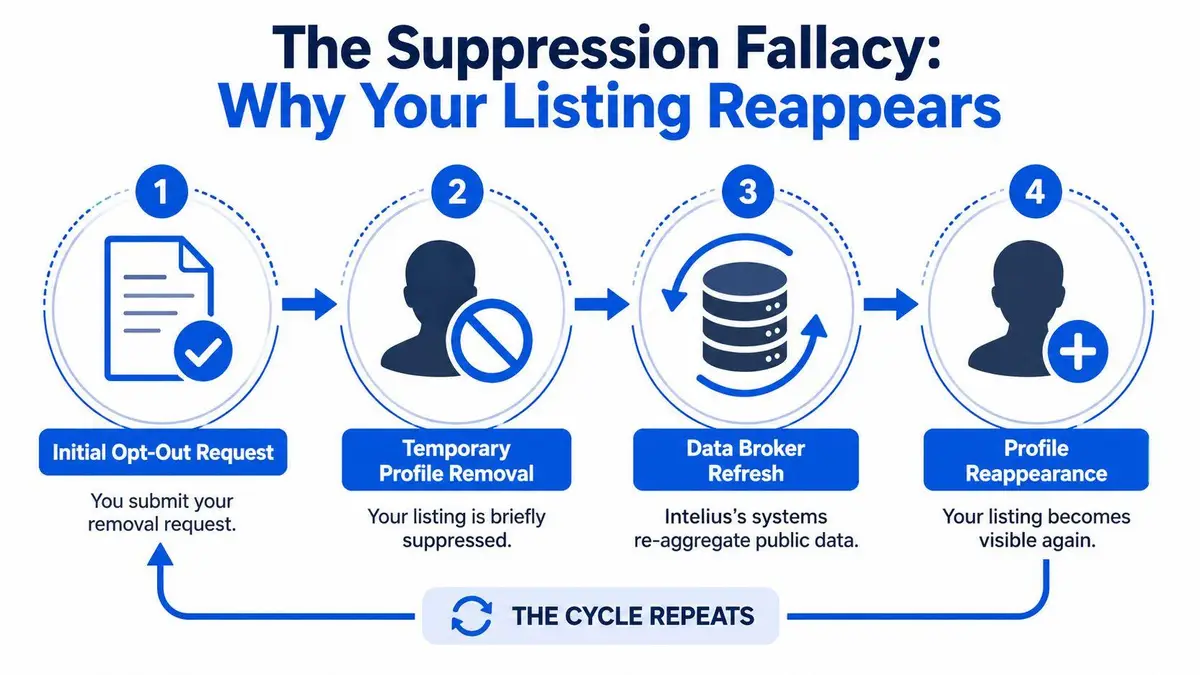
Think of the cycle like this:
- Initial request. You identify a live profile and submit suppression.
- Temporary success. The visible listing drops.
- Data refresh. The broker ingests newer or differently structured public data.
- Profile regeneration. A new listing appears, sometimes with overlap, sometimes with changed details.
A successful first opt-out is often the start of the work, not the end of it.
Why basic guides leave people exposed
Most online guidance focuses on the first opt-out because that’s what readers want. A simple sequence. A quick fix. But the hard part isn’t submission. The hard part is controlling recurrence in a system designed to keep collecting.
For a public figure or executive, this distinction changes the operating posture. You’re no longer solving a page-level nuisance. You’re managing a recurring suppression problem across a commercial data network. Once you understand that, the right response becomes obvious. Stop treating Intelius removal like a one-time consumer task and start treating it like ongoing exposure management.
Advanced Protection for High-Profile Individuals
The standard workflow was built for ordinary consumer traffic. It wasn’t designed around executive protection, family office discretion, litigation sensitivity, or threat-management protocols. If your profile creates real-world risk, you need a tighter response.

When DIY stops being sensible
If the exposed record includes a residence tied to your family, or if your name already attracts targeted attention, don’t hand this to a junior assistant and hope for the best. DIY suppression is acceptable for low-risk profiles. It’s weak for anyone facing organized harassment, adversarial litigation, political hostility, media attention, or increased physical security concerns.
The reason is straightforward. The public form only addresses the visible listing. It doesn’t package the request in a way that reflects legal sensitivity, documented security context, duplicate-profile risk, or the need for continued oversight.
A more serious protocol
For high-profile clients, I recommend a layered approach:
- Begin with the official suppression request so there’s a documented attempt within the standard system.
- Map all related identity variants. That includes full legal name, shortened forms, prior states of residence, business addresses that may have bled into personal records, and household links.
- Have counsel or a family office submit a formal follow-up demand that explains the security rationale for sustained suppression attention.
- Check adjacent PeopleConnect properties after the initial request, because network-level visibility matters more than one domain.
- Escalate quickly if family members are exposed. Spouse, adult children, and prior household addresses often create the actual vulnerability.
A professional service can sit inside that process. For example, ContentRemoval.com handles privacy-related removal matters through a human-reviewed workflow, which is the relevant feature when a standard consumer opt-out isn’t enough.
What legal counsel should communicate
Lawyers don’t need theatrics here. They need precision. The message should establish identity, specify the exposed records, describe the security implications, request suppression across relevant PeopleConnect properties where appropriate, and ask for confirmation once action has been taken.
Counsel template
We represent [Client Name], whose personal information is currently displayed in public-facing people-search results associated with your network. The exposed information includes identifying and location-related data that creates material privacy and security concerns for our client and members of the client’s immediate family.
We request immediate review and suppression of all records reasonably associated with [Client Name], including duplicate or variant listings that may appear under prior addresses, aliases, or related household associations. This request is made on the basis of personal privacy, family security, and risk mitigation.
Please confirm receipt of this request, identify the records reviewed, and confirm the suppression action taken.
What sophisticated clients do differently
They don’t stop at one URL. They preserve evidence, centralize communication, and track each record as if they were managing a legal matter. They also separate tactical tasks from strategic control.
A concise internal workflow often looks like this:
| Priority | Action |
|---|---|
| Immediate | Capture screenshots and profile URLs before suppression |
| Same day | Submit the standard PeopleConnect request |
| Short term | Escalate through counsel if exposure carries security or family risk |
| Ongoing | Monitor for duplicate listings, variant records, and related broker visibility |
If your household security plan is detailed but your data broker exposure is unmanaged, the weak point isn’t at the gate. It’s online.
Proactive Monitoring and Long-Term Defense
The gap in most Intelius removal advice is obvious. It tells you how to file the first request, then leaves you with the false impression that the job is done. MePrism notes that most guides explain the initial opt-out but fail to explain why records reappear and what to do next, creating a knowledge gap that leaves users in a temporary state of suppression rather than lasting control, as outlined in its guide to removing your data from Intelius.
For executives, the answer is not more optimism. It’s a monitoring discipline.
Build a repeatable review cycle
Digital privacy works more like compliance than cleanup. You set a cadence, assign responsibility, log findings, and act when a record returns. Done properly, this prevents the familiar cycle in which a profile reappears unnoticed and sits live until someone hostile finds it first.
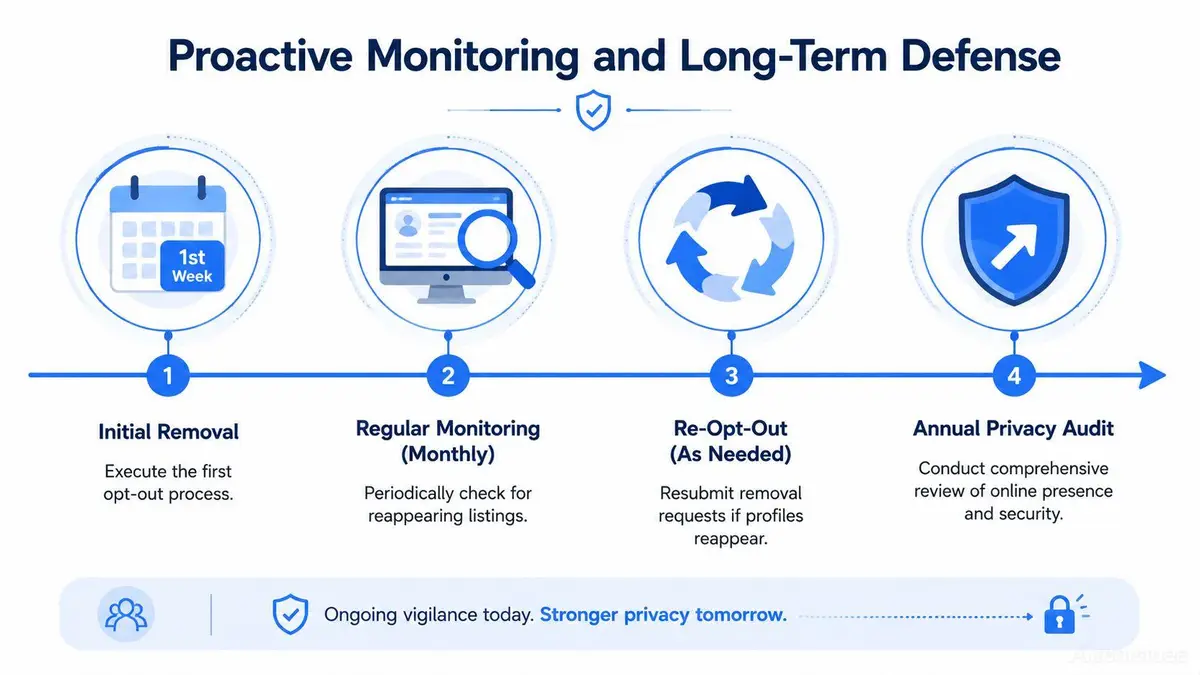
A sensible operating rhythm includes:
- Initial verification after the first suppression window has passed, to confirm whether the visible listing dropped.
- Regular checks across the PeopleConnect environment and other high-risk broker properties, because one domain rarely exists in isolation.
- Re-submission on reappearance with archived evidence from prior requests.
- Periodic broader review of the executive’s digital footprint, especially after relocation, litigation, major press, or corporate transactions.
Monitor without creating unnecessary noise
If staff are checking these sites casually from personal devices and logged-in browsers, they create a sloppy record and often miss duplicates. Assign the task to one controlled workflow. Use consistent search logic, track aliases and prior jurisdictions, and preserve screenshots of every reappearance.
If this work needs to be institutional rather than improvised, a formal reputation monitoring process gives structure to what otherwise becomes scattered administrative effort.
Operating principle: Treat each reappearance as evidence of a system that needs management, not as a surprise exception.
Intelius is only one front
Many otherwise capable people tend to lose perspective at this point. They become fixated on Intelius because that’s where they found the problem first. In reality, Intelius is one expression of a larger market for people-search exposure.
The better model is portfolio thinking. One record appears. That suggests adjacent records may already exist elsewhere, or will appear later through the same public-data trail. Your privacy posture improves when you manage the category, not just the symptom.
A mature defense program usually includes a named owner, documented searches, escalation criteria for legal review, and an annual review of the executive’s wider online footprint. That sounds formal because it should be. The risk is formal.
Taking Control of Your Digital Footprint
Intelius removal is necessary. It is not sufficient.
The official suppression route is worth doing because it can remove visible records and reduce immediate exposure. But if you’re an executive, public figure, or high-net-worth individual, relying on that one action is a mistake. The system is built around aggregation, not your privacy, and the practical result is that visibility can return.
That changes the right question. It’s no longer “How do I remove this page?” It’s “How do I control recurring exposure across a network of data sources and public-facing brokers?” That question leads to a more competent response. Formal documentation. Ongoing checks. Counsel involvement where appropriate. Coverage that extends beyond one listing and one brand.
There’s also a related point that perceptive clients understand quickly. Privacy risk and intelligence risk often overlap. If you’re evaluating what your own digital trail reveals, it can be useful to study adjacent OSINT-style search tools and reverse-image ecosystems. A careful guide for discreet partner searches is relevant here not because your situation is the same, but because it shows how easily fragmented signals can be assembled into a profile by a determined third party.
You don’t need panic. You need process.
If the exposure touches your residence, family, litigation posture, or public reputation, you need that process managed with the same seriousness you’d apply to any other executive risk issue.
If you need a confidential path forward, ContentRemoval.com can assess the exposed listings, identify where suppression is likely to be temporary, and outline a discreet action plan for ongoing privacy protection.
Frequently asked questions
Why did my Intelius listing come back after I opted out?
Intelius provides suppression of a known profile, not deletion from the underlying data. When PeopleConnect ingests a fresh public-record source, a reformatted address or a slight identity variant, the system can generate a visible record again, and the article notes this can happen within six months.
Does removing myself from Intelius also remove me from TruthFinder and Instant Checkmate?
It can. Once a profile is successfully suppressed through PeopleConnect’s system, the suppression may apply across related brands including Intelius, TruthFinder and Instant Checkmate. Check those properties after the processing window rather than assuming the network is clear.
Should a lawyer send the Intelius opt-out for a high-profile client?
For anyone facing harassment, litigation, media attention or physical security concerns, a formal follow-up from counsel or a family office is recommended after the standard request. The letter should establish identity, list the exposed records, explain the security implications, ask for suppression across relevant PeopleConnect properties including variant listings, and request confirmation of the action taken.