
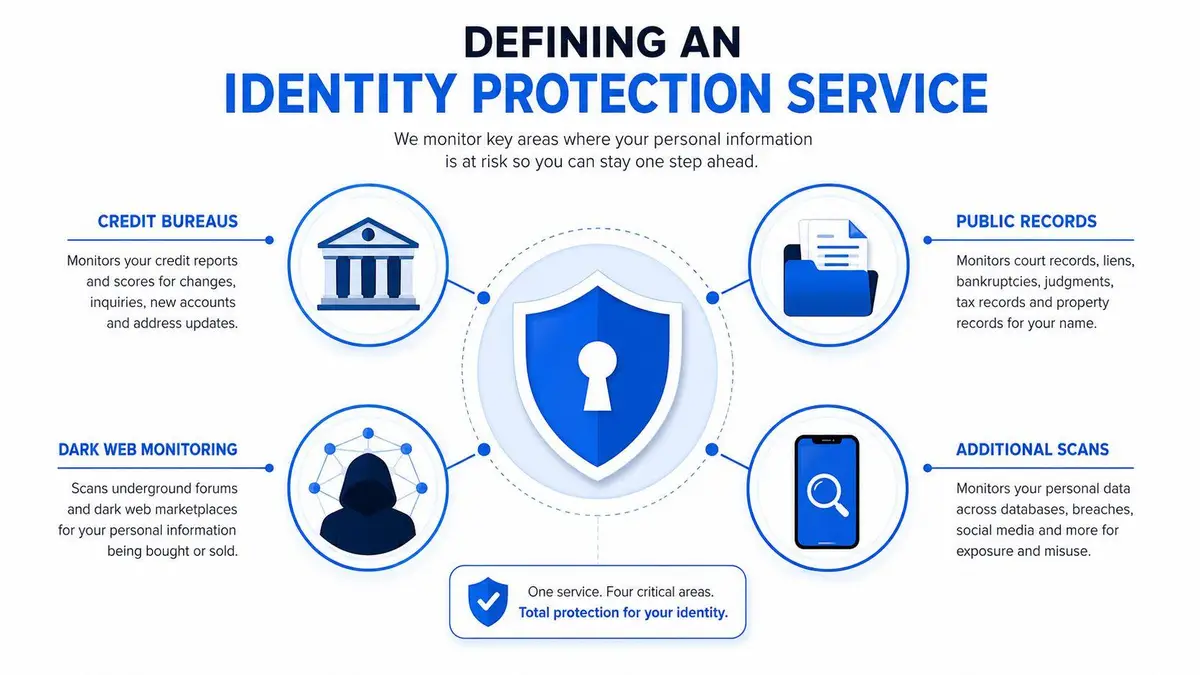
An identity protection service is a subscription product that monitors credit bureaus, public records, the dark web and sometimes social platforms for signs of misuse, then alerts you and helps with restoration. It detects and cleans up after fraud rather than preventing it, and it does not remove harmful search results, impersonation accounts, mugshot listings or leaked content.
Key facts
- The GAO found identity protection services have limited ability to stop fraud before it happens.
- Credit alerts are weak against synthetic identity abuse that blends real and fabricated data.
- Dark web surveillance is a detection layer; someone still has to decide what to do with the exposure.
- Enterprise tools such as Microsoft Entra ID Protection control access; consumer services only watch and alert.
Where ContentRemoval.com comes in. ContentRemoval.com is the removal-first layer that consumer monitoring does not provide: source takedowns, de-indexing, impersonation and leaked-content removal for founders, executives and family offices whose exposure is public and searchable. The security lead or family office manager usually makes contact once an alert has confirmed the problem but nothing has come down. A free 15-minute Exposure Scan maps what is removable, and the report is yours to keep. Get a Free, Confidential Exposure Scan or read how our content removal work is done.
Most identity protection services are reactive monitoring and restoration products, not prevention. That matters because the U.S. Federal Trade Commission received 1.1 million identity theft complaints in 2022, and identity theft reports reached 1.4 million in 2023, a 12% year-over-year increase Business Research Insights. The core question for a founder, executive, or public figure is not whether alerts are useful, it’s whether an alert service is enough when the exposure is public, searchable, and already circulating.
The Promise and the Limits of Identity Protection
The sales pitch is simple. An identity protection service watches for misuse, sends alerts, and helps clean up after the fact. The problem is that cleanup is not prevention, and the U.S. Government Accountability Office was blunt about that limitation, these services can help detect misuse and support restoration, but they have limited ability to stop fraud before it happens GAO.
That distinction matters more at the executive level than it does for an ordinary consumer. If your exposure is a credit file, a mainstream monitoring product may be enough to give you early warning. If your name is public, your image is searchable, or your organization is a target, alerts alone will not solve the actual problem. They tell you the damage is visible, not that it has been contained.
The buying mistake founders and executives make
Founders, executives, and public figures often compare brands as if they are buying the same thing with different packaging. They are not. Consumer identity protection is built to watch for signals across personal data, then route you into restoration. It does not remove harmful material from search, impersonation accounts, mugshot sites, or leaked content once it is out in the open.
Practical rule: Buy monitoring for detection. Buy content removal for visibility control.
That is why the right question is not “which service has the longest feature list.” The right question is whether you need monitoring, restoration, or active removal at the source. For a founder or public-facing executive, that answer usually changes fast once a leak, false story, or impersonation account appears.
Defining an Identity Protection Service
An identity protection service is a subscription product that watches for signs of misuse across personal data sources, then alerts the subscriber and helps with recovery. In consumer form, that usually means coverage across credit bureaus, public records, the dark web, and sometimes social platforms or device-linked data. The service is useful when the damage is still traceable and the response can be organized quickly.
The market is no longer niche. IBISWorld estimates that the U.S. Identity Theft Protection Services industry generated about $5.7 billion in revenue in 2025, with 4,897 businesses operating in the sector after a 5.7% CAGR from 2020 to 2025 IBISWorld. That scale matters because it explains the clutter. This is a mature category with overlapping offers, not a loose collection of startup experiments.
A useful internal rule is to separate monitoring from cleanup. If you want a practical example of cleanup, see data broker removal services, which target the exposed listings and records that monitoring alone will not erase. Consumer identity products watch for indicators. They do not remove bad material from search, impersonation accounts, mugshot sites, or leaked content once it is already public.
Consumer monitoring and enterprise identity defense are different products
Enterprise identity protection works on a different battlefield. Microsoft Entra ID Protection says it uses AI and machine learning trained on trillions of signals to score identity risk and then enforce adaptive access policies in real time, including blocking access, prompting MFA, or remediating risk across password and passwordless authentication methods Microsoft. That is access control, not consumer alerting.
Proofpoint describes a similar operational model for security teams, discovering and prioritizing risky identities in Active Directory, Entra ID, and Okta, then supporting one-click response actions such as suspending compromised accounts and reversing attacker-created mailbox rules Proofpoint. Consumer services may help after misuse is detected. Enterprise tools are built to intervene inside the identity system itself.
Executives need to read that distinction correctly. Consumer identity protection watches your footprints. Enterprise identity defense watches the doors. If your risk is public visibility, impersonation, or reputational exposure, monitoring is only the first layer.
Core Features and Where Each One Helps
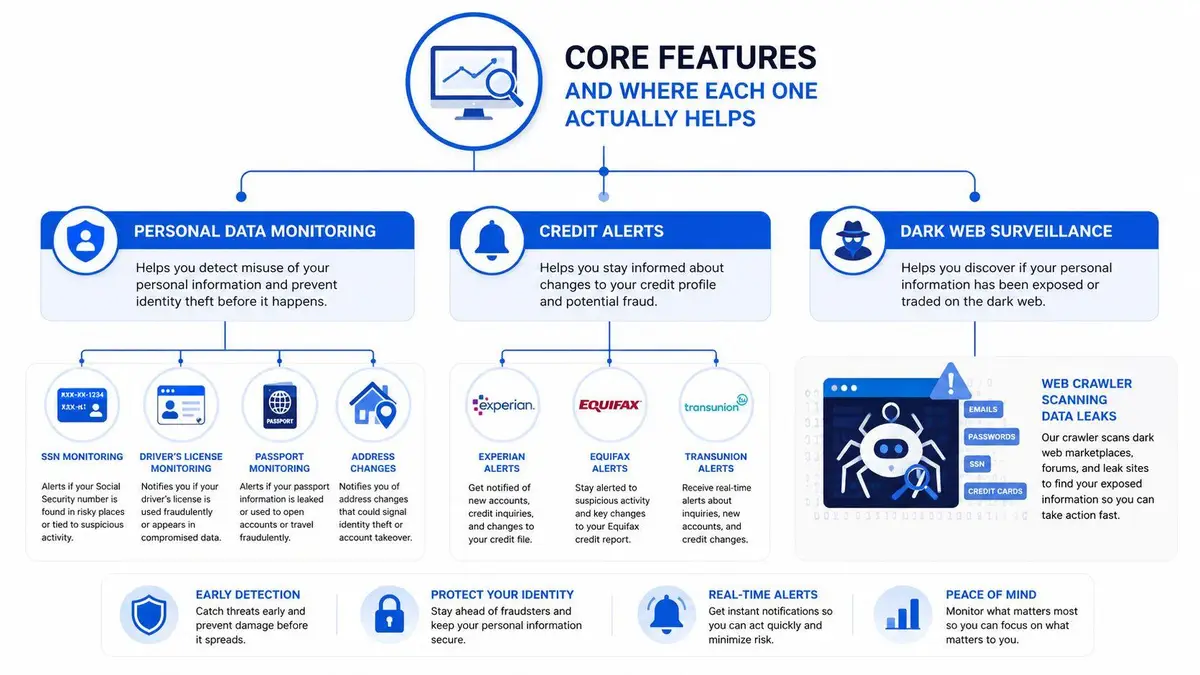
The feature list looks similar until a real incident hits. Then the gaps show. Personal data monitoring is useful for tracking SSNs, driver’s license numbers, passport details, and address changes because those are the signals that often trigger early alerts. It helps with exposure, not removal. If the misuse happens through a social account, a fake article, or an image repost, the alert may never fire. If the problem is tied to brokered personal records, data broker removal is the cleaner fix than waiting on another notification.
Credit alerts are the most familiar layer, and they help when someone opens an account, changes a line of credit, or attempts a loan under your name. They are weaker against synthetic identity abuse, which blends real and fabricated data into something that may not show up as a standard consumer credit event. That mismatch is where buyers lose time and money.
Dark web surveillance helps when credentials, identifiers, or personal records appear in breach dumps or underground marketplaces. It is a detection layer, not a cleanup layer. You still need a human or a response team to decide whether the exposure matters and what to do next.
The newer layer is reputation and digital takedown work. Search de-indexing, source removal, false review removal, leaked image removal, mugshot suppression, and impersonation takedowns belong here. Consumer products usually do not do that work well, if they do it at all. For public-facing people, that layer is often the core problem, not the alert.
Traditional credit monitoring was never built for account takeovers, synthetic identities, or public-fingerprint abuse. If the threat is multi-channel, a credit-first service gives partial coverage only.
| Capability | Consumer Identity Service | Specialist Reputation Firm (ContentRemoval.com) |
|---|---|---|
| Personal data monitoring | Watches for misuse signals and alerts the subscriber | May support cleanup around exposed personal data, but the core work is removal |
| Credit alerts | Tracks suspicious credit activity and restoration steps | Not the primary service line |
| Dark web surveillance | Flags leaked credentials and identifiers | Can use monitoring to find harmful material that needs removal |
| Source removal | Usually limited or absent | Focuses on removal at the source, including search de-indexing and takedown work |
| Impersonation accounts | Often outside scope | Handles takedown requests and follow-up |
| Leaked images and false content | Not built for this problem | Built for this exact problem |
Consumer monitoring tells you where the smoke is. Specialist removal work tries to put out the fire. For ongoing visibility checks tied to takedown work, the firm’s reputation monitoring page shows how that process fits together.
How an Identity Protection Service Works Day to Day
Enrollment starts with identity verification, then the provider sets a baseline for what it is supposed to watch. NIST’s identity-proofing standard says providers must keep personal-data collection limited to what is needed for validation, fraud mitigation, and authorization, and it requires privacy training for personnel and third parties who can access sensitive identity-service information NIST. That matters because the provider ends up holding sensitive evidence on your behalf.
The normal workflow is slower than the marketing copy
Day to day, the process is straightforward and slow. The system scans sources, flags a mismatch or a possible exposure, and sends it to a human reviewer. If the event is real, the provider helps file disputes or restoration requests. If the issue is serious, the user may also place fraud controls with bureaus or other institutions.
Operational truth: The service moves at the pace of the slowest outside institution it depends on.
NIST’s SP 800-63A also says identity proofing at IAL1 requires one piece of FAIR evidence that can be digitally validated or includes a facial portrait or other biometric, or alternatively STRONG or SUPERIOR evidence NIST. For remote biometric collection, NIST says presentation-attack detection must achieve an impostor attack presentation accept rate of less than 0.07, with testing conforming to ISO/IEC 30107-3:2023. The point is simple. These systems are built around controlled verification, not casual convenience.
Alert fatigue slows people down. Bureau processes are inconsistent. Platform takedowns are fragmented. During a live incident, a subscriber can still sit exposed while the case moves through separate systems that do not talk to each other. If the event involves public content, a consumer service may leave the harmful material visible while the paperwork moves.
For that reason, monitoring is only the first layer. If the exposure is public, searchable, or tied to a repeated attack pattern, the day-to-day work has to include content removal and follow-up, not just alerts. For ongoing visibility checks tied to that kind of cleanup, reputation monitoring shows how the process fits together.
Consumer Monitoring Versus Specialist Reputation Firms
A consumer identity service is built to observe, notify, and restore. A specialist reputation firm is built to remove harmful material from circulation. That’s a harder job, and it’s the one many executives need when the exposure is public, searchable, or reputationally damaging.
| Capability | Consumer Identity Service | Specialist Reputation Firm |
|---|---|---|
| Watches for misuse | Yes | Yes, but as part of a cleanup strategy |
| Alerts on suspicious activity | Yes | Yes, if relevant to the removal case |
| Restores compromised identity records | Often | Sometimes, depending on the issue |
| Removes search results at the source | Rarely | Yes |
| Takes down false review, impersonation, or leaked content | Usually not | Yes |
| Handles mugshot and arrest record suppression | Usually not | Yes |
| Coordinates with counsel on defamation or NCII | No | Yes, when needed |
That divide matters because visibility creates harm even when the underlying event is old. A consumer service may tell you an old image resurfaced. A specialist firm works to make it harder to find, copy, or reindex. Those are different jobs.
For founders, family offices, and public figures, that distinction is usually decisive. Their threat surface isn’t limited to credit misuse. It includes impersonation accounts, leaked photos, misleading articles, hostile reviews, and doxxable public records. Consumer services can support awareness. They can’t be the main response when reputation itself is under attack.
A structured government model reflects the same reality. The U.S. General Services Administration’s Identity Protection Services program is tied to formal ordering guidance and requirements documents, which shows that identity protection is treated as a defined service with procurement rules and standardized scope in the federal market GSA. That’s a useful reminder that serious identity work is governed, scoped, and operational, not improvised.
Who Actually Needs Which Type of Service
A mid-career professional with limited public exposure can usually start with a mainstream monitoring product and be reasonably covered. That’s because the threat is still mostly tied to personal-data misuse, not public visibility. The product’s alerting and restoration functions match the risk.
A founder, executive, family office principal, or public figure sits in a different category. Their name is searchable, their media footprint is persistent, and their exposure can include leaked images, impersonation accounts, false reviews, news coverage, and public records that don’t disappear just because a bureau alert fired. In that environment, a consumer service is secondary.
The clean framework is risk tier, not price. If the issue is a credit file, buy monitoring. If the issue is public visibility, buy removal and suppression work first, then add monitoring around it. If the issue is both, build a layered response and don’t let procurement pretend one product can do both jobs well.
Public exposure changes the math. The more searchable the person, the less useful generic monitoring becomes on its own.
That’s why specialist content removal belongs in the conversation for executives and public figures, sometimes instead of consumer monitoring and often alongside it. ContentRemoval.com is one option for that removal-first layer, with work that includes de-indexing, source takedowns, impersonation removal, leaked content removal, and related remediation. Consumer services don’t replace that function.
First-Hour Response When an Incident Happens
The first hour decides how much of the problem spreads. Preserve evidence first, screenshots with timestamps, archived URLs, account names, and any confirmation from the platform or creditor. Then place fraud controls and lock down the compromised channel before the attacker uses it again.
Use the reputation management after a data breach playbook if the event is public, because breach response and reputation response are not the same thing. One deals with containment. The other deals with visibility.
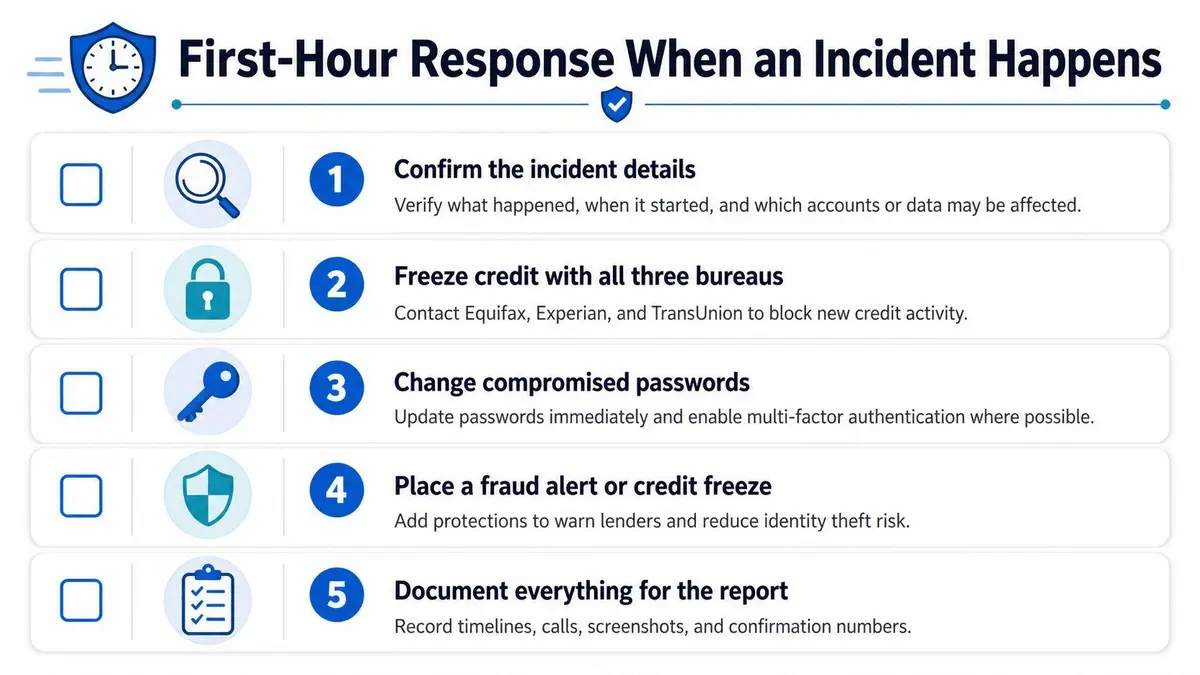
The sequence should be disciplined. Freeze credit, file the platform or bureau dispute, change passwords on affected accounts, and document every step for counsel or the case file. If defamation, leaked imagery, or impersonation is involved, escalate immediately to a specialist firm that can start source removal and de-indexing while the evidence is still fresh.
Continuous monitoring still matters after the first takedown. Reuploads happen, and a one-time cleanup that isn’t watched will come back. That’s why the right response combines containment, removal, and follow-up, not reassurance.
If you’re dealing with leaked content, impersonation, false search results, or a public identity breach, ContentRemoval.com handles source takedowns, de-indexing, and ongoing monitoring with strict confidentiality. If you need the harmful material removed rather than merely watched, start with a confidential assessment and get a removal-first plan built around your exposure.
Frequently asked questions
Is an identity protection service worth it for an executive or public figure?
As a secondary layer, yes, because credit and dark web alerts still give early warning of data misuse. As the main response, no. A searchable name, persistent media footprint, impersonation accounts and leaked images are not things an alert service removes, so the article’s framework is to buy removal and suppression first and add monitoring around it.
What is the difference between identity monitoring and content removal?
Monitoring observes personal data sources, notifies you of suspicious activity and helps restore compromised records. Content removal works at the source to take down search results, false reviews, impersonation accounts, leaked content and mugshot listings so they stop circulating. One tells you where the smoke is; the other puts out the fire.
What should I do in the first hour after an identity incident?
Preserve evidence with timestamped screenshots, archived URLs and account names, then freeze credit, file the bureau or platform dispute, change passwords on affected accounts and document every step. If defamation, leaked imagery or impersonation is involved, start source removal and de-indexing while the evidence is fresh, and keep monitoring for reuploads afterward.