
Writing a credible, legally defensible review means defining the objective first, limiting the scope to what you experienced and the subject could control, then using a four-part structure: a neutral opening, an evidence body with specifics and any positives, analysis of why the facts matter, and a restrained verdict. Opinion grounded in disclosed facts is far safer than accusations.
Key facts
- Written defamation is libel; opinion based on disclosed facts is safer than asserting misconduct as fact.
- A review should cover only what the writer personally observed and the subject could control.
- Google readers want a concise firsthand account; Amazon readers reward feature-specific detail.
- Phrases like they are crooks or they stole my money invite legal challenge; state the dispute instead.
Where ContentRemoval.com comes in. ContentRemoval.com acts for executives, physicians, founders and firms when a review crosses from harsh opinion into false factual claims, fabricated experiences or coordinated attacks. The business owner, practice manager or their lawyer typically reaches out after the platform’s report tool has returned nothing. A free 15-minute Exposure Scan maps which reviews are removable on policy or legal grounds and which need a different response, and the report is yours to keep. Get a Free, Confidential Exposure Scan or read how our review removal work is done.
You’re probably holding a draft review right now that reads like a warning shot. A consultant missed deadlines. A vendor overpromised. A luxury service provider treated your office like a nuisance. You want to say so publicly, partly to warn others and partly because silence feels like surrender.
That impulse is understandable. It’s also dangerous.
A review is not a private vent. It’s a public statement with search visibility, screenshot risk, and legal consequences. Once posted, it can be copied, quoted, indexed, and reframed by people who have no interest in your nuance. For an executive, investor, physician, founder, or public figure, the risk isn’t limited to whether the review is “accurate enough.” The risk is whether your wording creates avoidable exposure while failing to achieve your real objective.
Most advice on how to write review content is unserious. It treats the task like a customer service exercise. In practice, a review is closer to a reputational filing. It should be scoped, evidenced, and written as if opposing counsel may eventually read it. If you’ve seen how online commentary can mutate into a broader reputational event, you already know why online reputation management after customer feedback turns public matters.
The Modern Review as a High-Stakes Public Statement
A badly written review usually fails in two ways at once. It weakens your credibility, and it gives the subject an opening to attack your motives. If your criticism is vague, emotional, or overstated, readers discount it. If it contains factual assertions you can’t support, lawyers notice.
That’s why you should stop thinking of a review as self-expression. Treat it as strategic public communication. Your review has an audience beyond the business you’re criticizing. Prospective customers may read it. Journalists may find it. Competitors may weaponize it. Your own board, partners, or clients may see it and draw conclusions about your judgment.
What makes a review high risk
The danger usually comes from three habits:
- Overclaiming facts. “They defrauded me” is not the same as “I was billed for work I dispute.”
- Publishing anger instead of evidence. Readers trust chronology, specifics, and restraint.
- Ignoring permanence. Even if a platform later removes content, screenshots can outlive the original post.
Public criticism carries more weight when the writer sounds measured. It carries more risk when the writer sounds eager to punish.
The practical question isn’t whether you’re entitled to your opinion. You are. The practical question is whether your wording turns a legitimate complaint into a reputational liability for you.
The right mindset before you post
The safest and most persuasive reviews are written by people who can separate what happened, what they can prove, and what they believe the experience means. Those are different categories. Collapse them into one, and you invite trouble.
If your objective is advantage, write with discipline. If your objective is warning others, write with precision. If your objective is retaliation, don’t publish. Retaliatory writing is usually the easiest to challenge and the least useful to readers.
The Strategic Blueprint for an Effective Review
A common starting point is the incident. That’s the wrong starting point. Start with the strategy.
A frequently missed angle in how to write review advice is that purpose and scope should be defined before criticism begins, especially where fairness depends on limiting comments to aspects the subject can control, as discussed in UC Riverside’s practical guide to better review writing.
Define the objective first
Before you type a sentence, answer this: What outcome are you trying to produce?
You may want a refund, a correction, a visible warning to future buyers, or a record of a failed engagement. Those are different objectives, and they require different wording. A review written to pressure a response should be concise and hard to dispute. A review written to inform future customers should give context and concrete observations. A review written to preserve your outrage usually does neither job well.
If you can’t state your objective in one sentence, you’re not ready to publish.
Limit the scope ruthlessly
A review becomes dangerous when it sprawls. Don’t review the company’s ethics, leadership, culture, staffing, and business model because one project went badly. Review the specific service you used, the timeline, the deliverables, the communications, and the result.
Use this scoping test:
- Can the subject control it
Comment on billing practices, response times, deliverable quality, or support handling. Avoid broader attacks on character unless you’re prepared to defend every factual implication. - Did you personally observe it
Firsthand experience is far stronger than hearsay. “My office received three unreturned emails” is stronger than “everyone says they ignore clients.” - Does it matter to the reader’s decision
Include what helps another person evaluate risk. Exclude gossip, humiliation, and theatrical detail.
Practical rule: If a sentence exists mainly to embarrass the subject, cut it.
Identify the audience before the prose
The same experience should be described differently depending on where and for whom you’re writing. A public Google review serves one audience. A professional forum post serves another. A private memorandum to counsel serves a third.
Ask yourself:
- Who needs this information
- What do they need to know to evaluate credibility
- How much context will they tolerate before they stop reading
A disciplined review doesn’t try to say everything. It says enough to be credible, enough to be useful, and nothing that creates unnecessary exposure.
Structuring Your Review for Credibility and Impact
If your review reads like a rant, readers assume you’re the problem. If it reads like a file note written by a careful adult, readers pay attention.
A rigorous review workflow starts with defined scope, audience, and criteria, then moves through evidence gathering, comparison, and final judgment. Effective reviews also document strengths and weaknesses and end with feasible recommendations, as outlined in UXTweak’s guidance on expert review methods.
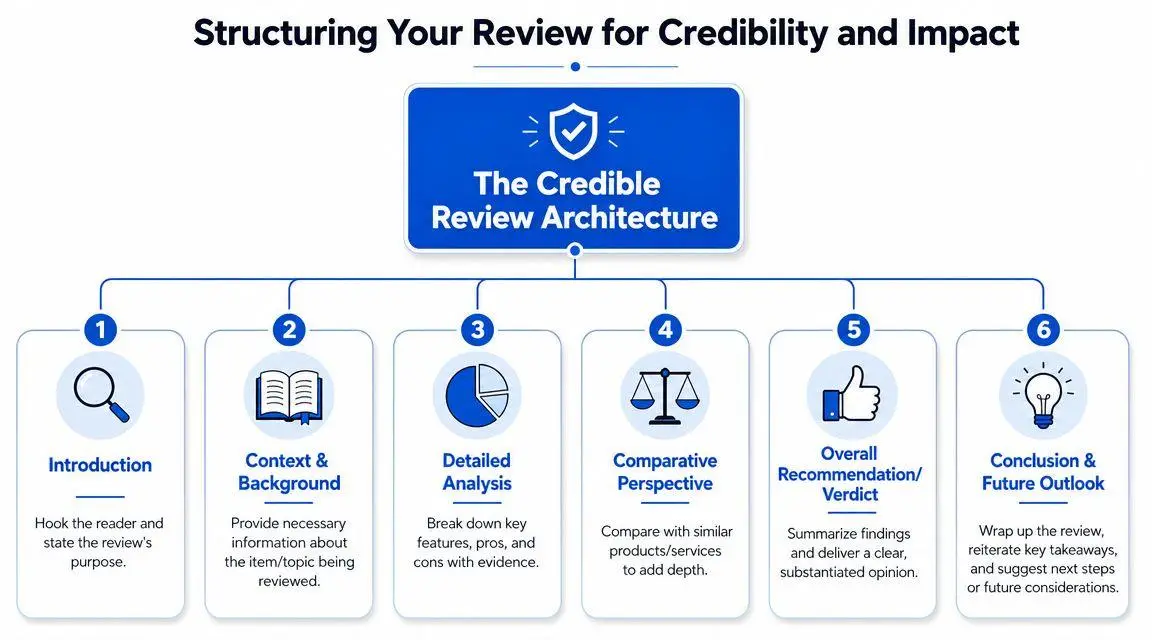
Use a four-part architecture
You don’t need literary flair. You need structure.
Part one is the neutral opening. State what you purchased or engaged, when the experience occurred, and the relevant context. Keep it sterile. “Our firm engaged this vendor for calendar coordination and workflow support over a defined test period” is useful. “I trusted them and regret it greatly” is not.
Part two is the evidence body. List your observations with specifics. Mention what worked as well as what didn’t. If there were delays, say how they appeared in your experience. If support was responsive at first but declined later, say that. Balance is not weakness. It’s credibility.
Part three is analysis. In this part, you explain why the facts matter. Missed deadlines matter because they disrupted an executive workflow. Poor onboarding matters because the service required repeated correction. If you’re reviewing productivity software, a comparison resource like this guide to Mac time management apps shows how readers often assess tools by features, fit, and practical tradeoffs, not by emotional intensity.
Part four is the verdict. Give a final judgment tied to your evidence. “I wouldn’t recommend this for time-sensitive executive use” is stronger than “Avoid at all costs.”
Evidence, not emotion: The more serious your criticism, the calmer your wording should become.
What to include and what to leave out
Use details that another person could reasonably understand and assess:
- Context of use. What service or product you used, and under what circumstances.
- Observable issues. Delays, defects, broken promises, billing disputes, communication failures.
- Any positive points. Initial responsiveness, competent staff, partial delivery, or useful features.
- A reasoned conclusion. Whether the service fit a particular type of buyer or failed a particular use case.
Leave out accusations that require proof you don’t have. Leave out insults. Leave out speculation about motive.
A simple credibility check
Before posting, ask whether a skeptical reader could answer these questions from your review:
| Question | What your review should provide |
|---|---|
| What happened | A concise chronology |
| How do you know | Firsthand observations |
| Why does it matter | Practical impact on use or outcome |
| Is the writer fair | Both strengths and weaknesses |
| What’s the judgment | A restrained, clear recommendation |
That’s how to write review copy that survives scrutiny.
Adapting Your Approach for Different Platforms
A review that works on one platform can fail badly on another. Length, tone, and level of detail all need adjustment. Platform culture matters, but so does reader expectation.
If you’re reviewing a book, film, consultant, or professional service, a thematic approach often works better than a point-by-point inventory. The University of Toronto’s writing guidance says strong reviews are usually organized around a thesis, synthesizing what is known and not known while avoiding a source-by-source march through material, as explained in the University of Toronto’s literature review advice.
Review platform characteristics
| Platform | Primary Audience | Optimal Format | Key Success Factor |
|---|---|---|---|
| Prospective local customers | Concise, experience-based narrative | Immediate credibility | |
| Amazon | Buyers comparing products | Feature-specific analysis with use context | Practical detail |
| Yelp | Consumers evaluating service quality | Sharp but grounded service summary | Believable firsthand experience |
| Professional forums | Peers and specialists | Context-rich, thematic critique | Informed judgment |
| App stores | Users deciding whether to download or renew | Short issue-focused review | Clarity about performance and usability |
What Google wants versus what Amazon rewards
Google reviews are read quickly. Readers want to know whether the service was competent, responsive, and worth the risk. Long scene-setting hurts you there. A concise account with one or two concrete examples usually lands better.
Amazon and other product-heavy marketplaces reward specificity. Readers expect commentary about setup, durability, fit, support, and real-world use. If you reviewed a gift-selection service or curated product list, readers would expect practical use context similar to how consumer guides like top-rated gifts for men organize judgment around relevance and recipient fit rather than abstract praise.
Professional and creative reviews need synthesis
If you’re reviewing advisory work, a book, a course, or a creative product, don’t stack disconnected complaints. Build an argument. What was the central promise. Where did the work deliver. Where did it fail. What tension or contradiction defines the experience.
That thematic method matters because discerning readers aren’t looking for a diary entry. They want a coherent assessment. If you’re serious about how to write review content that influences decision-makers, platform adaptation isn’t cosmetic. It’s the difference between being read and being ignored.
Understanding the Legal Boundaries of Public Criticism
This is the line that matters most. You can write a harsh review and still stay within legal boundaries. You can also write a careless review that creates avoidable exposure even if your underlying frustration is legitimate.
Opinion is safer than false fact
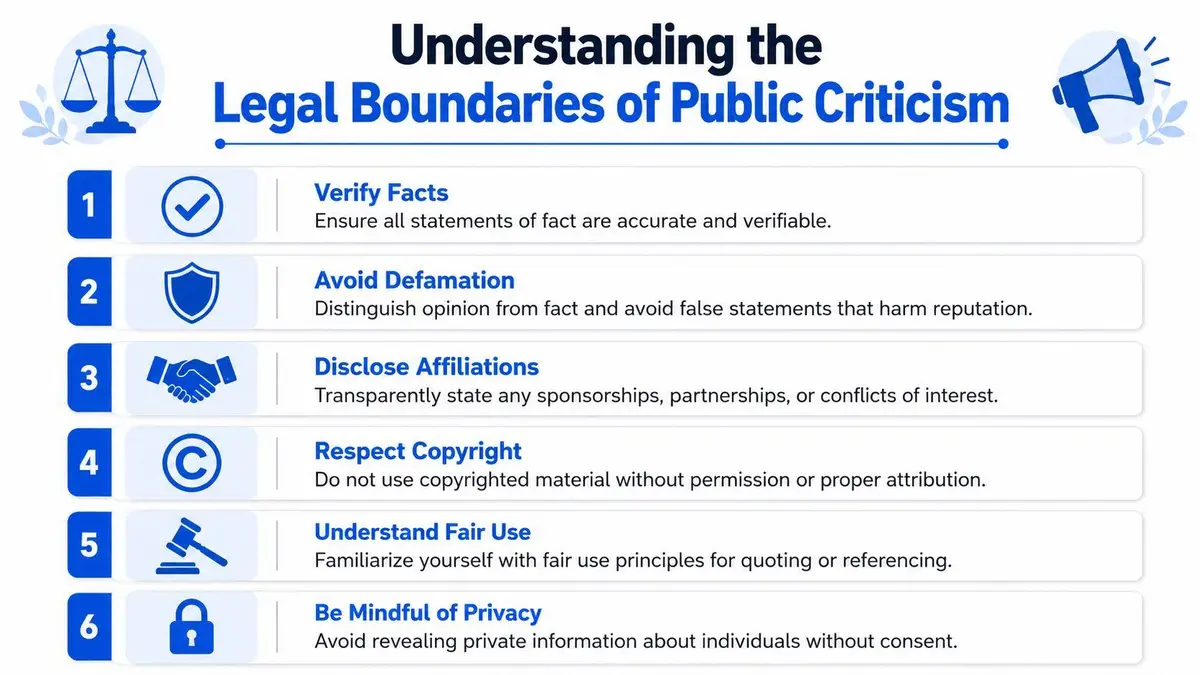
Start with a basic distinction. Defamation generally concerns false statements that harm reputation. Written defamation is commonly called libel. Spoken defamation is commonly called slander. In online review disputes, written statements are the issue.
Your strongest protection is disciplined phrasing. Opinion grounded in disclosed facts is usually safer than asserting serious misconduct as fact.
Compare these:
- “I found the software clunky and difficult to rely on for executive scheduling.”
- “In my experience, support responses became inconsistent after onboarding.”
- “I dispute the value delivered for the fee charged.”
Those are evaluations.
Now compare these:
- “This company scams clients.”
- “The founder lies to customers.”
- “They commit fraud.”
Those are accusations of fact with legal teeth. If you can’t prove them, don’t write them.
Strong criticism survives when the reader can see the factual basis for the opinion.
Build a defensible structure before the language hardens
Modern review writing benefits from process discipline. A peer-reviewed 2024 article recommends mapping the body conceptually, including with mind-mapping, and testing the work against four questions: what is new, why it matters, how well it is done, and so what, as discussed in this scientific review-writing article. That framework is useful outside academia because it forces you to separate evidence, significance, and conclusion.
Use that discipline before posting public criticism:
- List what you can verify
Dates, deliverables, messages, invoices, product defects, support interactions. - Mark what is inference
Your interpretation of reliability, competence, or value. - Delete motive claims
You rarely know why the other side acted as it did. - Check privacy and collateral harm
Don’t publish personal contact details, medical details, private family information, or internal names unnecessarily.
Here’s a practical explainer that reinforces the point:
Phrases to avoid and better replacements
Use substitution, not self-censorship. You can still be candid.
| Risky phrasing | Safer alternative |
|---|---|
| “They are crooks” | “I would not trust this provider based on my experience” |
| “They stole my money” | “I dispute the charge and don’t believe the service delivered equivalent value” |
| “They fake reviews” | “I can’t verify the authenticity of the positive reviews, but my experience was materially different” |
| “The doctor was incompetent” | “I was not confident in the care process and sought treatment elsewhere” |
If you’re already facing a dispute over published allegations, this overview of written defamation and libel-related content removal options is the right place to start. In active matters, preserve records before editing anything.
One operational note matters here. If a review about you crosses from opinion into false factual attack, firms such as ContentRemoval.com handle removal workflows involving defamatory posts, fabricated reviews, and related online content. That isn’t a substitute for legal analysis. It’s part of the response stack.
The Permanent Record and Protecting Your Reputation
Every review creates two reputational records. One belongs to the subject you’re criticizing. The other belongs to you.
That’s why disciplined commentary matters. A well-written review signals judgment, fairness, and self-control. A reckless review signals volatility. Discerning readers notice the difference immediately, especially when the writer is an executive or public-facing professional.
Write for the screenshot, not the moment
Assume your review will be detached from context. Assume only one paragraph will circulate. Assume someone hostile will quote the harshest sentence and omit the rest.
That assumption changes how you write. You keep the chronology tight. You avoid theatrical adjectives. You make every serious conclusion traceable to something observable. If the language still reads well when isolated in a screenshot, it’s probably disciplined enough to publish.
The internet doesn’t preserve your mood. It preserves your wording.
If the target becomes you
At some point, many high-visibility people end up on the other side of the problem. A competitor posts a false review. A former client exaggerates. An anonymous account mixes opinion with invented facts. Then the question shifts from how to write review content to how to contain one.
Your response should be as strategic as the review should have been. Preserve evidence. Avoid impulsive public rebuttals. Assess whether the post is merely negative, or whether it crosses into factual falsity, privacy invasion, impersonation, or coordinated abuse. If your name, company, or family is affected across search results, a broader digital footprint cleanup strategy may be necessary rather than a single takedown request.
That broader perspective matters because reviews don’t exist in isolation. They feed search results, AI summaries, brand perception, and future due diligence. If you’re thinking seriously about the long-term consequences of public commentary, resources on identity positioning, such as ClipCreator.ai’s guide to building a brand, are useful because they frame reputation as an accumulated public record, not a series of disconnected posts.
The correct standard is simple. Write only what you can stand behind. Write it in a form that helps the reader. Write it as if it may later need to defend itself.
If you’re dealing with defamatory reviews, false allegations, impersonation, or harmful search visibility, ContentRemoval.com can assess the matter confidentially and help determine whether removal, de-indexing, monitoring, or a broader reputation protection strategy is the right next step.
Frequently asked questions
Can I get sued for writing a negative review?
Defamation concerns false statements of fact that harm reputation, so a review is at risk when it asserts things like fraud, theft or lying that you cannot prove. Evaluations such as I dispute the value delivered for the fee are opinions grounded in disclosed facts and are far safer.
How long should a Google review be compared with an Amazon review?
Google reviews are read quickly, so a concise account with one or two concrete examples of competence and responsiveness works best. Amazon and other product marketplaces reward specificity about setup, durability, fit, support and real-world use.
What should I do if someone posts a false review about my business?
Preserve the evidence, avoid an impulsive public rebuttal, and assess whether the post is merely negative or crosses into factual falsity, privacy invasion, impersonation or coordinated abuse. Only the latter categories support removal, and if the problem spans search results a broader cleanup may be needed rather than a single takedown.