
Removing your information from Whitepages starts with the official suppression request: find every profile variant, click View Details rather than View Full Report, paste the profile URL into the opt-out form, select the privacy reason and verify by phone with a burner number. The listing usually drops within 24 hours, but Whitepages refreshes from public records, so it can return.
Key facts
- Each Whitepages profile URL needs its own suppression request; one submission does not clear related records.
- Whitepages requires phone verification by automated call, so use a burner or VoIP number, never your real one.
- Google’s Remove outdated content tool clears the cached search snippet once the profile is deleted.
- California residents can send formal deletion demands under the CCPA and CPRA when the opt-out fails.
Where ContentRemoval.com comes in. ContentRemoval.com removes Whitepages profiles and the aggregator records feeding them for executives, high-net-worth families and legal professionals who need the listing gone and kept gone. A family office, security adviser or assistant usually makes the first contact after a manual opt-out has been undone. A free 15-minute Exposure Scan maps every broker holding your data and what is removable, and the report is yours to keep. Get a Free, Confidential Exposure Scan or read how our data broker removal work is done.
Removing your information from Whitepages is not a simple matter of submitting a suppression request. While that is the official process, it is a fundamentally flawed solution. Because Whitepages and other data brokers perpetually harvest public records, your information is almost guaranteed to reappear. Real, lasting privacy demands a more sophisticated strategy that neutralizes the data at its source.
Why Standard Whitepages Removal Is Insufficient
The exposure of personal information on a massive public database like Whitepages is not a minor annoyance; it is a significant security vulnerability. For executives, public figures, and high-net-worth individuals, this exposure creates direct physical threats, reputational risks, and conduits for corporate espionage.

Simply requesting that the site delist your profile is an exercise in futility. It is analogous to patching a single leak in a dam while ignoring the immense pressure of the reservoir behind it. The data (your residential address, phone number, and relatives’ names) does not originate with Whitepages. It is scraped from a vast, interconnected network of sources.
The Illusion of a One-Time Fix
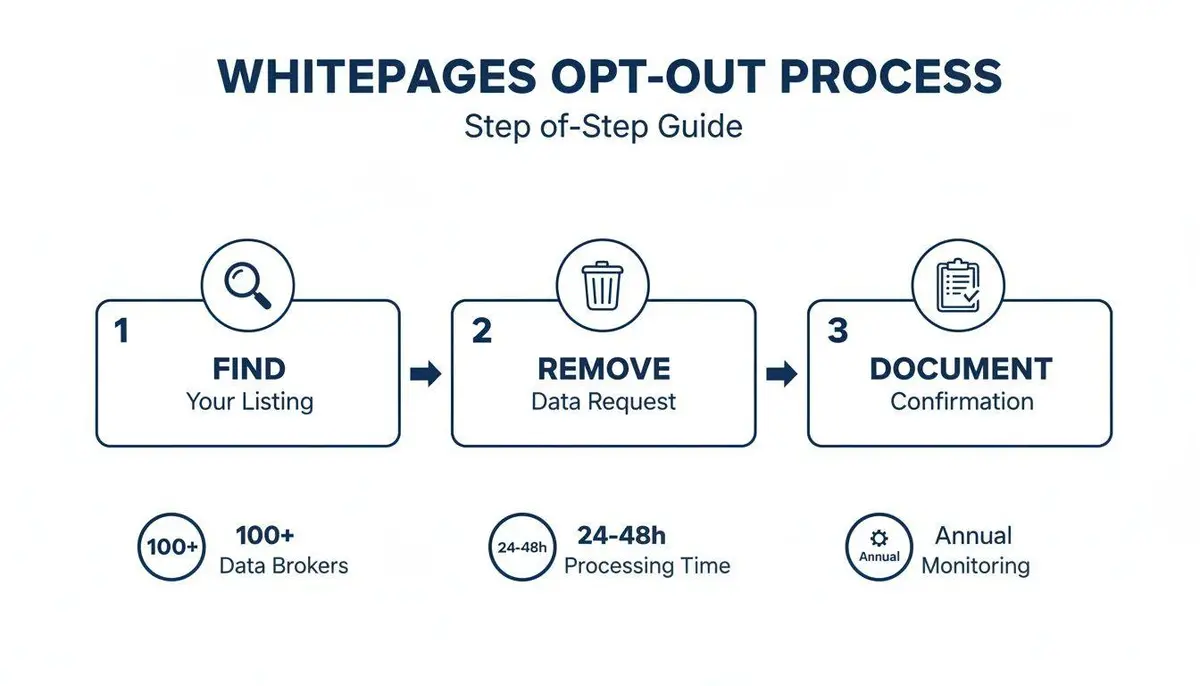
The standard Whitepages opt-out procedure provides a false sense of security. You locate your listing, submit the removal request, and it may indeed disappear within 24-48 hours. That victory is temporary.
Whitepages is one of the largest data brokers globally, holding records on over 200 million U.S. residents and receiving between 40 to 50 million visits monthly. It constructs these profiles by aggregating information from innumerable feeder systems: public property records, telecommunication companies, credit bureaus, and smaller data vendors. Its business model depends on the constant refreshment of this data, meaning your “removed” profile can be republished in as little as a week. A more detailed examination of their methods is available in this comprehensive guide on Incogni.com.
This relentless data repopulation is precisely why most DIY removal efforts fail. A 2023 study by Consumer Reports highlighted this exact deficiency, discovering that even paid removal services only managed to delete 35% of a subject’s data after four months. Manual attempts performed marginally better but could not achieve comprehensive erasure.
For a high-profile individual, a 70% success rate is a 30% failure rate, an unacceptable risk when your family’s privacy or personal safety is at stake. The residual data is more than sufficient for a determined adversary to exploit.
Tracing the Data Supply Chain
To truly resolve the issue, you must understand the provenance of your Whitepages listing. This information is not created ex nihilo; it is the end product of a complex data supply chain that often originates with routine activities.
Consider these common data entry points:
- Public Records: Property deeds, voter registration lists, and court filings form the bedrock of these databases.
- Commercial Transactions: Completing a warranty registration, entering a contest, or subscribing to a publication all contribute your details to commercial data pools.
- Other Data Brokers: A vast, opaque marketplace exists where smaller brokers buy, sell, and trade data packets. Eventually, giants like Whitepages acquire and consolidate them.
This network ensures that even if you succeed in scrubbing your profile from Whitepages, the same data remains active at its source. It is only a matter of time before their automated web crawlers rediscover it and republish your listing. This passive data aggregation creates a persistent threat, which we analyze further in our article on the mechanics of passive data collection.
Achieving genuine digital privacy requires a proactive defense that dismantles this entire supply chain, not merely its most visible endpoint.
The Correct Procedure for an Initial Takedown
Addressing the initial opt-out with Whitepages is your first tactical move. Consider it less a final solution and more an establishment of an official record. It is a critical first step that mitigates the most immediate exposure before you proceed to sever the data at its source. Executing this step correctly is essential for any subsequent legal or procedural action.
Your objective here is to find and remove every single variant of your profile. This extends beyond the primary, detailed listing. You must identify fragmented, incomplete records that often escape notice, as well as any profiles concealed behind the Whitepages Premium paywall. Each is a potential vector of exposure that must be neutralized.
Locating and Flagging Your Profiles for Removal
Begin by methodically searching for your information on the Whitepages site. Do not limit your search to a single name query. Use every conceivable variation: nicknames, common misspellings, and particularly any former cities or states of residence. A motivated adversary will employ these same techniques; you must preempt them.
Upon finding a matching profile, you will see a prominent “View Full Report” button. Do not click it. That leads to their paid service. Instead, locate the smaller “View Details” button. Click that to access the standard listing page.
Now, copy the URL directly from your browser’s address bar. This unique web address is the key to removing that specific profile.
Proceed to the Whitepages opt-out form. You will paste the copied profile URL into their form and confirm it is your information. The system will then ask for a reason for the removal.
Select the option: “I just want to keep my information private.” It is the most direct rationale and does not invite follow-up inquiries. This frames your request as a straightforward assertion of privacy rights, which is the precise legal posture you wish to establish.
You must repeat this for every single profile you identify. This is a common point of failure. The assumption that one request will purge all associated data is incorrect. Each URL represents a discrete entry in their system and requires its own removal request.
Navigating the Phone Verification Trap
The most problematic part of the process is the mandatory phone verification. After submitting the form, Whitepages compels you to enter a phone number to receive an automated call with a verification code. This is a classic privacy paradox, to have your data removed, you must provide more of it.
Never use your personal or primary business phone number. Doing so only confirms that your main contact number is active and links it directly to your removal attempt, increasing its value to data brokers.
The correct method is to use a secure, disposable number. Two sound options exist:
- Burner Phone Applications: This is the superior method for maintaining anonymity. Services like Burner or Hushed provide a temporary number capable of receiving the verification call.
- VoIP Services: A secondary number from a service like Google Voice can also function. Be aware, however, that some verification systems are beginning to block certain VoIP numbers, making a burner app more reliable.
Once you enter the code from the automated call, your request is officially submitted. Whitepages states it typically takes approximately 24 hours for the listing to be removed.
Document Everything, Without Exception
From inception to completion, you must maintain a detailed log of every action taken. This is not optional. This documentation is your evidence.
For every single removal request, your log must include:
- The exact URL of the profile submitted for removal.
- A screenshot of the profile page before you submitted the request.
- A screenshot of the final confirmation page after you entered the code.
- The date and time of the submission.
- The temporary phone number used for verification.
This evidence constitutes your leverage. If the profile reappears, a common occurrence, or if Whitepages fails to act, this log is the foundation for any escalation, whether a formal legal takedown notice or direct professional intervention. Without it, you are forced to begin again from a position of weakness.
Beyond Whitepages: A Strategy for True Digital Erasure
Let us be direct: Whitepages is not the root problem. It is merely the retail front. Think of it as the most visible franchise of a vast, covert network of data brokers perpetually buying and selling your personal information. Attempting to remove your profile from Whitepages alone is a futile exercise in digital whack-a-mole. You suppress one listing, and another emerges because the data source remains active.
To achieve any measure of lasting privacy, you must attack the supply chain. This means identifying and systematically targeting the major data aggregators that supply sites like Whitepages. In short, you must cut off their inventory at the source.
Why Manual and Automated Removals Fail
The common advice to simply “opt-out” is flawed. It is a strategy predicated on an incomplete understanding of the data broker ecosystem and sets you up for failure.
A 2023 study by Consumer Reports tracked volunteers who attempted to manually remove their own data. Their success rate was a mere 70%. For an executive or public figure, a 30% failure rate represents an unacceptable risk, leaving critical details like addresses and family information exposed.
Paid automated services often perform even worse. The same study revealed these services deleted only 35% of personal data after four months. They make expansive promises but fail to navigate complex identity verification steps or, more critically, prevent the information from being re-ingested from another source. The specifics of these challenges are detailed in this detailed Surfshark analysis.
The difficult truth is that for every profile you successfully remove, another is already being constructed. Data brokers constantly refresh their databases. Without a strategy that anticipates this cycle, any removal you achieve is temporary.
When considering how to address this, it is instructive to compare the real-world effectiveness of different approaches. Industry data paints a clear picture of the limitations of DIY methods versus a professional, strategic campaign.
Effectiveness of Data Removal Methods
| Method | Short-Term Success Rate | Long-Term Prevention of Re-listing | Average Time Commitment |
|---|---|---|---|
| Manual Opt-Out (DIY) | 60-70% (initial removal) | Very Low (~10-15%) | 100+ hours initially, plus ongoing monitoring |
| Consumer Automated Service | 30-40% (at best) | Low (~20-25%) | Minimal, but results are poor |
| Professional Removal Service | 95%+ | High (with monitoring) | Initial consultation, then handled by experts |
As the data shows, while you can invest significant time in manual removals, the information almost invariably returns. Professional services are engineered to address the root cause, not just the symptoms, yielding a much higher and more permanent success rate. More analysis is available through industry insights on removal effectiveness.
Targeting the Source: A Superior Strategy
An effective strategy shifts focus from retail sites like Whitepages to the wholesale aggregators that supply them. These are powerful, often obscure companies that purchase raw data directly from public records offices, credit bureaus, and marketing databases before selling it to people-search sites.
Executing this correctly involves a tiered plan of attack:
- Step 1: Neutralize Top-Tier Aggregators. These are the giants whose databases feed hundreds of smaller sites. Removing your profile here creates a domino effect.
- Step 2: Address Second-Tier Brokers. Once top-tier removals are confirmed, you target the brokers who draw data from them, cutting off another layer of the supply chain.
- Step 3: Purge Niche and Specialty Brokers. Finally, you address smaller brokers holding specific information, such as property records or professional licenses.
This is a complex undertaking. The opt-out procedures for these major aggregators are intentionally obfuscated and designed to induce failure. It is here that the limitations of a DIY approach become starkly apparent.
This is where a firm like ContentRemoval.com provides decisive value. We have already mapped the entire data broker ecosystem, understand the data flows, and have established protocols to compel compliance. While a manual request might languish in a queue for 30-45 days with no guarantee of success, our team initiates action within 24-48 hours.
For our clients (executives, high-net-worth families, and legal professionals) the objective is not a one-time removal but permanent suppression. We achieve this by dismantling the data supply chain at its source and employing continuous monitoring to ensure your information never reappears. It is the only methodology that transforms a temporary fix into a permanent privacy shield.
When Polite Requests Fail: Legal Escalation
You have submitted a removal request to Whitepages, and the information has either reappeared or was never removed. This is not merely frustrating; it is a clear signal that their public-facing, automated channels are inadequate.
At this point, we cease making requests. It is time to transition from a user making a request to an individual asserting legal rights. This is not about sending an angry email into the void; it is about deploying targeted legal instruments that demand attention and compel action.
Leveraging State-Level Privacy Laws
If you reside in a state with robust privacy legislation, you possess a powerful lever. The California Consumer Privacy Act (CCPA) and its successor, the California Privacy Rights Act (CPRA), are transformative. They grant residents the unequivocal right to demand that businesses like Whitepages delete their personal information.
When a standard request fails, the next step is a formal takedown demand sent directly to the data broker’s legal or privacy department. Disregard their website form. This is a formal, written communication that cites the specific articles of the CCPA/CPRA being invoked, includes documentation of your previous failed attempts, and officially puts them on notice of non-compliance.
This single action carries significant legal weight. Data companies are acutely focused on how to prevent privacy fines under CCPA and GDPR. A formal letter, particularly from a legal representative, demonstrates knowledge of their obligations and a readiness to enforce them.
A demand letter citing specific statutory violations changes the dynamic entirely. Your request is no longer relegated to a low-level customer service queue. It lands on the desk of a legal team that fully understands the financial and regulatory risks of non-compliance.
The DMCA Takedown for Copyrighted Imagery
In a more specific but highly effective scenario, we can invoke the Digital Millennium Copyright Act (DMCA). While primarily for copyright issues, it becomes a potent tool when Whitepages uses your photograph without permission.
If Whitepages or one of its data sources has scraped a professional headshot, a family picture, or any other photograph to which you hold the copyright, you can issue a formal DMCA takedown notice. This is not a request. It is a legal directive that compels them to remove the copyrighted material to avoid liability.
This strategy is effective for several reasons:
- It is legally binding. A properly filed DMCA notice creates a legal requirement for the platform to act expeditiously.
- It strikes a key part of the profile. Removing the photograph makes the listing far less recognizable and damaging.
- It creates an additional legal complication for them. It signals that you are serious and exploring every available legal avenue.
Even if your name and address linger temporarily, removing your image from the profile is a significant victory. It immediately dismantles the most recognizable element of the listing and reduces the risk of casual identification.
When to Engage Professional Counsel
When a data broker resists even these formal demands, it is time for direct, professional intervention. This is the point where our firm typically engages, escalating the matter from strongly worded letters to direct communication with their legal counsel. It is a private, assertive process backed by the full weight of privacy and copyright law.
Our team knows precisely which pressure points to apply and how to navigate these escalations. For our clients, including executives and public figures, this decisive action is essential for reclaiming their privacy. You can learn more about our process for complex cases by reviewing our services for legal content removal.
Finalizing the Removal: De-Indexing and Monitoring
Securing the removal of your profile from Whitepages is a significant step, but it is incomplete. For weeks, sometimes longer, your personal data can persist in search engine caches, a “ghost” profile that leaves you exposed.
This lingering digital footprint necessitates a second, equally critical action: forcing search engines like Google to update their records and purge the obsolete link. This process, known as de-indexing, is absolutely essential for achieving a clean slate.
The Imperative of De-Indexing
When you successfully remove a profile from Whitepages, you have only altered the information on their server. You have not notified Google, Bing, or any other search engine of the change. Their web crawlers operate on their own schedules, and it can take weeks or even months for them to discover the page has been removed.
In the interim, anyone searching your name may still see the old Whitepages result. Although the link leads to a defunct page, the search snippet itself often reveals the very information you sought to protect: your address, age, and phone number can remain publicly visible.
To accelerate this process, you must directly petition the search engines. Google’s “Remove outdated content” tool is designed for this exact purpose. You must provide the exact URL of the now-deleted Whitepages profile to prove the information has been taken down. A firm grasp of the technical aspects is beneficial; understanding search engine indexing provides a solid foundation for why these ghost listings persist.
Consider de-indexing less as a request and more as a technical correction. You are alerting the search engine that its index is inaccurate and providing the proof required to rectify it. This step can reduce a month-long waiting period to a matter of days, effectively closing the window of exposure.
This is a meticulous, link-by-link procedure. If you removed several different profiles from Whitepages, you must submit each corresponding search result for de-indexing individually. Overlooking even one can leave a significant vulnerability.
The Necessity of Perpetual Monitoring
True digital privacy is not a one-time project; it is an ongoing defense posture. Even after successfully removing your data from the source and scrubbing it from search engines, the risk of its reappearance is constant. Data brokers are relentless, and without continuous vigilance, your information will almost certainly be republished.
This is where AI-powered monitoring becomes the cornerstone of any serious privacy strategy. Manually checking hundreds of data broker sites for your name daily is not a feasible or scalable solution.
A professional monitoring service operates on a different level entirely:
- Comprehensive Scanning: Our systems do not just check Whitepages. They perpetually scan the entire data broker network, including thousands of feeder sites and dark web marketplaces.
- Instantaneous Alerts: The moment a new profile matching your data appears, our team receives an alert.
- Immediate Action: We do not wait. As soon as a new listing is detected, our established removal protocols are activated to suppress it before it can propagate or be indexed by search engines.
This proactive shield is what distinguishes a temporary fix from a permanent solution. It directly counters the data broker business model, which relies on the constant refreshment of its data. Our methodology ensures that once your information is removed, it remains so.
For executives, public figures, and anyone for whom reputation and security are paramount, this level of vigilance is not a luxury. It is a necessity. You can see how this continuous protection functions for high-profile individuals by learning more about our advanced reputation monitoring systems. We transform privacy from a reactive burden into a managed, ongoing defense.
Your Questions on Whitepages Data Removal Answered
When attempting to remove your personal information from a platform like Whitepages, you require clear, authoritative answers, not vague assurances. Here are direct responses to the most common questions we address, based on extensive experience navigating the data broker ecosystem.
How Long Does a Whitepages Removal Take?
The removal of your listing from the Whitepages website itself is typically rapid. After successfully navigating their opt-out process and phone verification, your profile is usually removed from their site within 24 hours.
However, that is only the initial step. The more significant challenge is compelling search engines like Google to de-index the old, cached link, a process that can take days or weeks. This should be viewed as an ongoing campaign, not a singular action, as the data sources that supply Whitepages remain active.
Will My Information Reappear After Removal?
Almost certainly, yes, if you rely solely on the standard Whitepages opt-out form. The entire business model of data brokers is predicated on the constant refreshment of their datasets. They scrape public records and purchase data from other commercial entities, so your “removed” profile can easily be repopulated within weeks or even days when their system reacquires your information from a different source.
This is the primary point of failure for individuals attempting to manage this process themselves. To make a removal permanent, you must pursue a dual strategy: remove the current listing, then implement continuous monitoring to suppress it the moment it reappears.
Is It Mandatory to Provide a Phone Number to Opt Out?
Yes, which presents a frustrating dilemma. Whitepages requires verification of your removal request via an automated phone call and code entry. This is a deliberate obstacle designed to discourage opt-out submissions.
Under no circumstances should you use your real personal or business phone number for this verification. Doing so merely confirms the number is active and associated with you, increasing its value as a data point. The only secure method is to use a burner phone number from a trusted application to complete the verification step without compromising your privacy.
Is It Worth Engaging a Professional Removal Service?
The data removal industry is populated with services that make broad promises but often deliver substandard results. A 2023 study by Consumer Reports found that many popular automated tools had alarmingly low success rates. They are simply not equipped to keep pace.
The fundamental problem is one of scale. The ecosystem comprises over 420+ data brokers. Attempting to manually remove your information from each one is an untenable task for any busy professional. While you might succeed in having Whitepages remove your profile, their data suppliers will simply provide it to them again.
For executives, public figures, or any individual for whom privacy is critical, a professional service is not a luxury. It is a strategic investment in achieving a permanent and verifiable result.
What Differentiates a Professional Service?
A professional firm does not simply execute the perfunctory task of filling out opt-out forms. The approach is fundamentally different and is built upon several key pillars:
- A Strategic Framework: Instead of reacting to individual listings, we map the entire data supply chain. We target the primary data aggregators first, thereby disrupting the flow of information to hundreds of smaller sites like Whitepages.
- Legal Leverage: We do not send polite requests. Our team issues formal legal demands citing privacy laws like the CCPA or copyright infringement under the DMCA. These are notices that data brokers are legally compelled to act upon.
- Perpetual Vigilance: Our work is not concluded when a listing is removed. We use proprietary technology to constantly scan the web for any reappearance of your information. If it emerges, we suppress it immediately, ensuring that “removed” means permanently removed.
For our clients, the value is not convenience. It is the certainty and control over their personal and professional digital footprint.
When your privacy and reputation are at stake, you cannot afford temporary fixes or ambiguous outcomes. ContentRemoval.com provides a definitive, strategic solution that delivers lasting results. Our team combines legal expertise with advanced technology to remove damaging online content at its source and ensure its permanent suppression.
It begins with a confidential assessment of your online footprint and a clear plan of action. Take back control of your digital identity by visiting us at ContentRemoval.com.
Frequently asked questions
Why is my Whitepages listing back after I opted out?
Whitepages rebuilds profiles from public records, telecom data, credit bureaus and smaller brokers, so a suppressed listing is republished once its crawlers reacquire the same data from another source. The article notes this can happen within weeks or even days, which is why removal has to reach the upstream aggregators and be monitored.
Do I have to give Whitepages my phone number to remove my profile?
Yes, verification is by an automated call with a code, and there is no way around it. Never use your personal or business number, because that confirms it is active and ties it to you. Use a temporary number from a burner app or a VoIP service, noting that some VoIP numbers are now blocked.
How do I get the old Whitepages result out of Google after the profile is removed?
Submit the deleted profile URL to Google’s Remove outdated content tool, which checks the page is gone and drops the cached snippet, often within days rather than weeks. Each removed profile needs its own submission, and the same applies to Bing and other engines.