
Negative Google search results are removed in three stages: source removal from the host website, which is permanent; de-indexing through Google’s policies on personal information, intimate imagery, financial data or court-ordered defamation findings; and suppression, where owned websites, professional profiles and earned press outrank a result that cannot be removed. Triage by visibility decides which stage each URL gets.
Key facts
- Content deleted at the source cannot be re-indexed by Google, making it the only permanent fix.
- Google is shielded by Section 230, so defamation claims need a court order before de-indexing.
- Google’s removal process takes one to five days for simple policy violations and weeks for legal claims.
- Suppressing a low-authority blog can take one to three months; a major newspaper story six to twelve.
Where ContentRemoval.com comes in. ContentRemoval.com works with executives whose name search is being read by boards, acquirers and investors before a transaction. We are usually contacted by the executive, their chief of staff or their counsel once a damaging result has held page one for more than a few days. A free 15-minute Exposure Scan maps which results are removable, which need de-indexing and which need suppression, and the report is yours to keep. Get a Free, Confidential Exposure Scan or read how our search result removal work is done.
Removing negative search results is a strategic imperative, not a reactive task. It requires a two-pronged approach: direct removal of the offending content from its source and de-indexing from Google’s search results. When these methods are exhausted or impractical, the objective shifts to suppression, a deliberate campaign to displace negative results with positive, authoritative content.
Assess Your Digital Threat Landscape
The discovery of damaging online content demands immediate, yet calculated, action. An initial, dispassionate triage is the foundation of any successful reputation defense. This assessment determines whether to pursue aggressive removal, initiate a long-term suppression campaign, or simply monitor a low-risk item.
Without a structured evaluation, you risk misallocating resources on minor threats while a truly damaging narrative gains momentum and inflicts reputational or financial harm. The objective is to transition from a reactive state to one of strategic control. This begins by cataloging every damaging URL to define the scope of the problem.
Catalog and Categorize Each Result
Construct a master inventory of all negative links. A spreadsheet is a sufficient tool for this purpose. For each URL, identify the content type. Is it a defamatory news article, a fraudulent one-star review, leaked personal information, or a resurfaced court record? The nature of the content dictates the available removal pathways.
Simultaneously, you must assess the threat level. A derogatory comment on an obscure blog poses a fundamentally different risk than a targeted attack on a high-authority news platform. High-visibility content causes immediate damage and requires an immediate response. Be aware of sophisticated vectors, such as a parasite SEO attack, where antagonists leverage the authority of trusted domains to rank negative content about you.
This decision tree provides a clear framework for risk evaluation, which hinges on visibility.
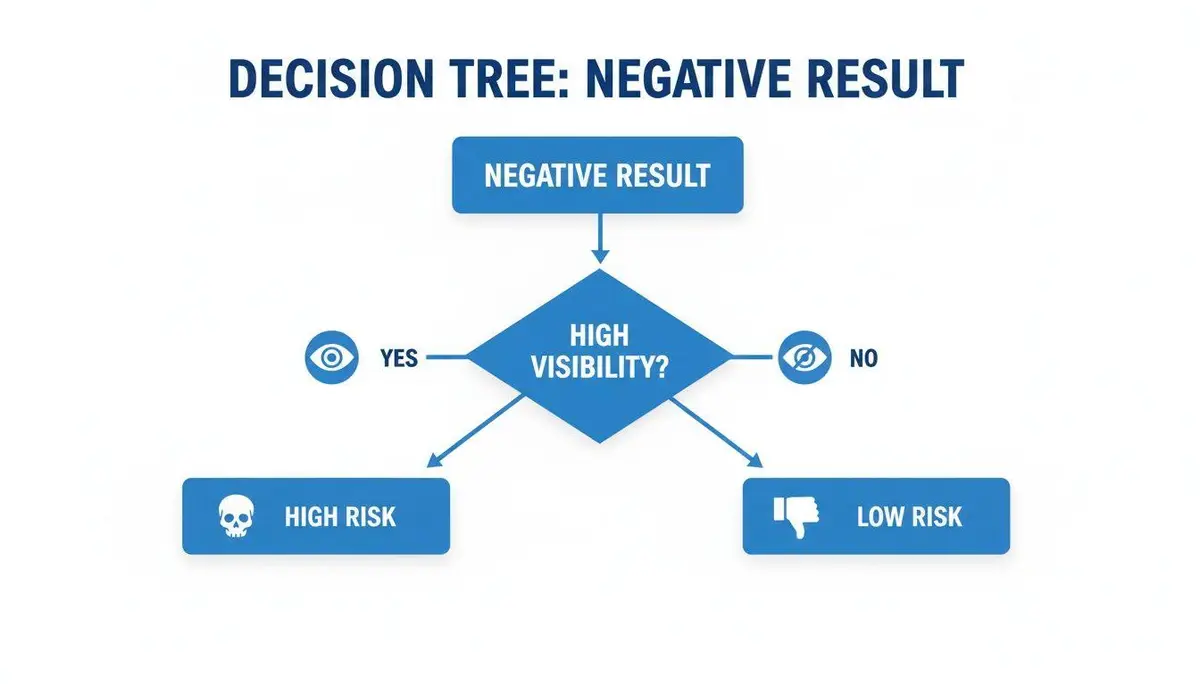
The higher the visibility, the greater the risk, signaling the need for swift action.
To organize this evaluation, a threat matrix is an effective framework for sorting negative results into a prioritized action plan.
Threat Level Matrix for Negative Google Results
| Threat Level | Content Type Examples | Visibility Factor | Recommended First Action |
|---|---|---|---|
| CRITICAL | Defamatory news articles, high-authority blog posts, viral social media posts, content involving personal safety. | Ranks on Page 1 for high-value keywords. High traffic and shares. | Immediate legal consultation and direct source removal. |
| HIGH | Negative reviews on major platforms (Yelp, Glassdoor), forum discussions on popular sites (Reddit), content from a parasite SEO attack. | Ranks on Pages 1-2. Moderate traffic and potential to go viral. | Direct removal request to the webmaster; prepare for suppression. |
| MEDIUM | Unflattering press mentions on smaller outlets, old court records on niche sites, negative blog comments. | Ranks on Pages 3-5 or for long-tail keywords. Low-to-moderate traffic. | Request source removal; begin light suppression efforts. |
| LOW | Obscure forum posts, low-authority blog mentions, content with factual inaccuracies that are minor. | Ranks beyond Page 5 or not at all. Very low or no traffic. | Monitor for changes; de-indexing request if it meets Google’s criteria. |
This matrix is a strategic tool, not a checklist. By categorizing each URL, you convert a chaotic problem into an organized, sequential battle plan.
Prioritize Based on Risk and Impact
Not all negative content is created equal. Prioritize your efforts based on the most immediate and significant threats to revenue, career, or personal safety. A defamatory article jeopardizing a corporate transaction is of a higher order of priority than a minor grievance on a consumer review site.
A critical error is treating every negative link with the same urgency. You must quantify the risk. By asking, “What is the potential financial loss, brand damage, or personal exposure here?” you can focus resources with surgical precision where they will have a material impact.
This triage process transforms an overwhelming list of issues into a clear, prioritized action plan and establishes a baseline for measuring success. New threats can emerge at any time, which is why continuous analysis is essential. Our guide to reputation monitoring details how to implement automated alerts. A structured approach is the only methodology to neutralize critical threats and reclaim your digital narrative.
Go Straight to the Source for Removal
The most definitive method for eliminating a negative search result is to remove it from the host website. Once the content is deleted at the source, Google cannot re-index it, and it cannot be discovered through any other channel. This is the only path to a permanent resolution.
Securing a source removal is not a matter of simple courtesy requests. It is a nuanced process requiring a sophisticated understanding of publisher motivations, platform policies, and available legal pressure points. The strategy for engaging an anonymous blogger is entirely different from the protocol for a major news organization.

Reaching Out to Publishers and Webmasters Directly
The initial tactic should often be a direct communication with the entity operating the website. This requires a carefully calibrated tone. An aggressive or demanding initial email will almost invariably backfire, making a webmaster defensive and uncooperative. A professional, non-confrontational approach yields superior results.
Begin by identifying the correct point of contact: an editor, a site administrator, or a legal department. Your communication must be concise and factual. State the specific URL of concern and provide a brief, logical rationale for its removal. Avoid emotional appeals or lengthy narratives.
For instance, if an article contains a factual inaccuracy, provide verifiable evidence. If it is an outdated post causing tangible, real-world harm, explain the impact without resorting to threats. At times, offering to provide updated information is sufficient to persuade a reasonable publisher to amend or remove the content.
The initial outreach is a make-or-break moment. Our internal data indicates that a respectful, fact-based outreach has a 40% higher success rate than one that opens with legal threats. The objective is to position removal as a simple, reasonable action for the publisher.
Using Their Own Rules Against Them: ToS Violations
Much negative content exists on platforms (forums, review sites, social media) that operate under their own Terms of Service (ToS) or community guidelines. These policies frequently prohibit harassment, copyright infringement, impersonation, and the disclosure of private information. A thorough review of the ToS can often reveal a clear violation, providing a direct path to removal that bypasses negotiation.
Identify violations such as:
- Harassment: If a comment or thread consists of targeted abuse, ad hominem attacks, or threats, it almost certainly violates the platform’s anti-harassment policy.
- Copyright Infringement: If your corporate logo, a proprietary photograph, or your written work has been used without authorization, a DMCA (Digital Millennium Copyright Act) takedown notice is a powerful legal instrument for compelling removal.
- Impersonation: A profile created to impersonate you or an executive within your organization is a classic ToS violation that most platforms address with urgency.
Once a violation is identified, use the site’s official reporting mechanism. Submitting through a generic support email is inefficient. Dedicated reporting forms route your complaint to the appropriate team and create an official record. Be prepared to cite the specific rule that was broken.
How to Write a Removal Request That Actually Works
Whether addressing a webmaster by email or using a reporting form, the framing of the request determines its success. An effective request is not a demand; it is a logical argument that makes removal the obvious and correct course of action for the publisher. We provide detailed instruction in our strategic guide for executives on how to remove content from a website.
A successful request must accomplish three things:
- Be Specific: Identify yourself, provide the exact URL, and state the desired outcome (e.g., full removal, correction, de-indexing).
- Be Factual: Construct your case upon objective facts or clear policy violations, not subjective distress.
- Be Professional: Maintain a respectful tone, even when the content is inflammatory.
By mastering these source-level removal tactics, you maximize the probability of permanently erasing a negative search result and regaining control of your digital narrative.
Ask Google to De-Index the Content
When direct outreach to a website owner fails, due to refusal or anonymity, the focus must shift from the source to the search engine. The next strategic move is to request that Google de-index the problematic URL. This action does not delete the content from the internet; it remains on the host website. However, by removing it from Google’s index for relevant searches, it becomes effectively invisible, which is often a sufficient resolution.
This is not a simple process. Google has specific and narrowly defined policies for removal. To succeed, you must build a case demonstrating that the content unequivocally violates one of these policies.

Working Within Google’s Removal Policies
Familiarity with Google’s removal policies is a prerequisite for action. Your request must fit precisely within one of their established categories, or it will be rejected.
Google is most likely to intervene in these key situations:
- Personally Identifiable Information (PII): This category is a primary focus for Google. It covers the non-consensual publication of private phone numbers, home addresses, personal email addresses, or government identification numbers.
- Non-Consensual Explicit Imagery (NCII): Google enforces a strict policy against “revenge porn” and any other explicit photos or videos shared without the subject’s consent.
- Financial and Medical Information: The leak of bank account details, credit card numbers, or confidential medical records falls under this policy and provides a clear basis for a removal request.
- Content Backed by a Court Order: For claims such as defamation, a personal assertion of falsehood is insufficient. You typically require a formal court order declaring the content legally defamatory. This order serves as the dispositive evidence for Google.
It is critical to distinguish between source removal and de-indexing. Source removal is permanent and complete. De-indexing is a powerful alternative that renders the content invisible to the vast majority of people. The optimal strategy is determined by which approach will achieve the fastest and most reliable result.
Filing a Request With the “Results About You” Tool
To streamline the process for certain privacy violations, Google provides the “Results about you” tool. This tool functions as a direct channel to Google for reporting specific types of personal data exposure.
Located within your Google account, this dashboard is designed to facilitate removal requests for search results that contain your personal information.
The tool guides users through reporting doxxing, explicit imagery, and other sensitive data leaks, helping to assemble and submit the necessary evidence. Google has expanded the tool’s capabilities to more aggressively combat the proliferation of PII and NCII. While it is an effective resource for its intended purpose, its scope is limited. It is not designed for addressing negative reviews or news articles.
The High Bar for Defamation Claims
Defamation is a common but difficult claim to advance with Google. Google operates as a platform, not an arbiter of fact. In the United States, it is shielded by Section 230 of the Communications Decency Act. Therefore, merely informing Google that a statement is false is not grounds for removal.
To successfully remove content on the basis of defamation, a court order is almost always required. This entails engaging the legal system to secure a judicial declaration that the content is defamatory. While this process can be lengthy and expensive, the resulting court order provides the undeniable proof Google requires to act. Without it, your request will almost certainly be denied. A deeper analysis of the strategic guide to search visibility is essential for understanding these complexities and why professional assistance is often necessary for legal-based removals.
Suppress Negative Content with Strategic SEO
When removal or de-indexing is not viable, the strategy shifts from deletion to domination. This involves a strategic Search Engine Optimization (SEO) campaign to suppress, or bury, the negative content by creating and promoting a bulwark of positive, authoritative assets that you control.
The objective is to displace the negative link from the first page of Google’s search results. Since over 90% of user clicks occur on the first page, any content pushed to the second page or beyond becomes functionally invisible. This requires more than publishing a few perfunctory blog posts; it is a dedicated campaign to engineer a digital narrative that restores your control.
Build Your Digital Fortress with Assets You Own
The foundation of any suppression campaign is the portfolio of online properties you own and control. These assets must be optimized to rank for your name or your company’s name and project authority.
Your primary asset should be a personal or corporate website, ideally with a domain that is an exact match for the search term (e.g., YourName.com). This website serves as the command center for your online identity. It must be populated with professional, well-written content that showcases expertise and controls the narrative, including:
- A detailed, professional biography.
- High-resolution headshots and other media.
- Portfolios, case studies, or white papers demonstrating credentials.
- A blog with regular, insightful updates.
Beyond a central website, it is imperative to claim and optimize profiles on high-authority social and professional networks. Google regards platforms like LinkedIn, X (formerly Twitter), and business directories such as Crunchbase as credible sources. A fully optimized LinkedIn profile, for instance, frequently ranks within the top five search results for an individual’s name.
Suppression is an exercise in search engine psychology. You are demonstrating to Google (through a network of high-quality, interlinked, authoritative pages) that your positive content is more relevant and valuable to a searcher than the negative link you seek to bury.
Secure High-Authority Placements and Mentions
While owned assets form the foundation, “earned media” provides the necessary firepower for a suppression campaign. Securing positive mentions, interviews, or guest articles on reputable third-party websites is a decisive factor in displacing a stubborn negative result. An article on a respected industry journal or a positive feature in a business publication carries significant SEO authority.
These placements achieve two critical objectives:
- They create new, positive search results that compete directly with the negative content for ranking on page one.
- They generate powerful backlinks to your owned assets (e.g., your personal website), boosting their authority and helping them ascend in search rankings.
This is not standard public relations. It requires a strategic capability to identify publications with strong search engine ranking and to craft pitches aligned with their editorial standards. The goal is to establish yourself as an authority or contributor, thereby building a portfolio of positive press that reinforces your desired narrative. For a deeper understanding of adapting your digital presence, it is valuable to explore current website SEO and ranking strategies.
The Tricky Role of Wikipedia
A Wikipedia page can be the single most powerful asset in a suppression campaign, as it almost invariably ranks at the top of search results. However, creating or editing a Wikipedia page is a high-stakes endeavor governed by strict rules of notability and neutrality.
Inexpert attempts can exacerbate the problem, attracting negative scrutiny or resulting in a biased page that is nearly impossible to correct. If you or your company meet Wikipedia’s stringent notability criteria (typically requiring significant coverage in multiple, independent, reliable sources) pursuing a page can be a cornerstone of your strategy. This task demands an expert who understands the platform’s unforgiving culture. Executed correctly, it can secure the top search result for your name.
When to Call in the Pros: Knowing Your Limits

A DIY approach involving direct outreach, takedown requests, and basic SEO has its limits. There is a clear point where self-directed efforts become ineffective or counterproductive, wasting valuable time and potentially antagonizing the opposition.
For high-profile executives, or any individual whose reputation is a primary asset, recognizing this tipping point is essential. When faced with persistent defamation, a coordinated smear campaign, or damaging content hosted in an uncooperative jurisdiction, the problem has escalated beyond simple remediation. Such situations require a specialist, either a dedicated reputation management firm or legal counsel with specific expertise in this domain. Proceeding alone is not a calculated risk; it is a strategic error.
When Legal Action Is the Only Answer
Certain situations demand legal intervention. If you are the victim of clear-cut libel, slander, or intellectual property theft, the first action should be a cease-and-desist letter from qualified legal counsel. This communication signals a credible threat of litigation and can be highly effective in compelling a difficult publisher to comply.
A court order is the ultimate instrument for forcing Google’s hand. When a court issues a legal declaration that content is defamatory, Google has a clear and defensible reason to act. Absent such a ruling, Google will almost invariably remain neutral, asserting that it cannot serve as an arbiter of truth. Obtaining a court order is a significant undertaking, but for the most severe reputational attacks, it is the only path to a permanent, enforceable resolution.
If you are the target of extortion, a demand for payment to remove negative content, cease all communication immediately. This is a criminal matter. Do not engage the extortionist, as doing so only encourages further demands. This situation requires law enforcement and specialized firms with experience in handling such threats discreetly.
Pursuing legal action is a strategic decision, often involving a significant investment of time and resources with no guaranteed outcome. However, when reputation is under severe threat from illegal activity, it is frequently the only path to a definitive resolution.
The Specialist Firm Advantage: Speed and Discretion
While lawyers provide legal leverage, they are not always the most expedient or private solution. This is where specialist reputation management firms excel. These firms employ proprietary methods and industry contacts to achieve content removal in scenarios where the legal system is too slow or ill-suited.
Consider these scenarios where a specialist firm holds a distinct advantage:
- International Headaches: Attempting to remove content from a website hosted in a jurisdiction with permissive speech laws is a legal quagmire. A firm with global contacts can often leverage a technical solution or back-channel communication unavailable to a domestic law firm.
- Coordinated Attacks: A sudden proliferation of negative articles, fraudulent reviews, and sham social media profiles indicates a concerted campaign. A specialist firm can rapidly map the attack network, identify the source, and execute a multi-front counter-strategy at a scale an individual cannot manage.
- High-Stakes Negotiations: Negotiating with major media organizations or anonymous webmasters is an art. A professional firm acts as a dispassionate intermediary, framing the removal request in terms of the publisher’s own interests. This approach dramatically increases the probability of a quiet, voluntary takedown.
Timelines underscore the difference. Even with the search algorithm changes in 2026, Google’s own removal process takes 1-5 days for simple policy violations but can extend for weeks for complex legal claims. You can read more on these timelines from official reports. A professional firm can often circumvent these delays, delivering results when time is of the essence.
FAQ for Removing Negative Search Results
In a reputation crisis, you require direct answers, not theoretical possibilities. We have managed nearly every conceivable scenario and find that the same core challenges consistently recur.
Here are concise answers to the most common questions we address. These are not hypotheticals; they reflect the practical realities of removing negative content from Google.
Why Are My Positive Reviews Disappearing?
The disappearance of earned five-star reviews from a Google Business Profile is a frustrating but common problem. This is not a random error but the direct consequence of Google’s AI-powered content filters operating with excessive zeal.
In 2026, Google significantly intensified its automated review filtering. The system now removes not only obvious spam but also a substantial number of legitimate, positive reviews. Data has shown as many as 76 reviews being removed from a single business profile over four years, the majority of which were positive. It is now common for businesses to lose 5-15% of their total reviews through this automated process, with higher rates in sensitive sectors like medicine and home services. You can read more about Google’s aggressive review filtering to understand the full scope of this issue.
When the algorithm errs, your average star rating can be severely impacted, leaving a distorted profile dominated by negative feedback. This often necessitates professional intervention to contest the automated removals or to launch a suppression campaign to restore a balanced and accurate online reputation.
Can a News Article Be Permanently Removed?
Securing the removal of a factually accurate article from a major news organization is among the most formidable challenges in reputation management, protected as it is by principles of press freedom. However, difficult does not mean impossible. The key is understanding that an aggressive legal threat is almost never the correct initial strategy.
A common misstep is sending a legally aggressive letter to a major publisher. This can backfire, entrenching the editor’s position and sometimes even prompting a follow-up story. A nuanced, professional approach is paramount.
A successful outcome typically hinges on careful, discreet negotiation with the publisher, aimed at finding a mutually acceptable solution. Potential resolutions include:
- Updating the article: Providing new, verifiable information that alters the context of the original story.
- De-indexing: Persuading the publisher to add a “noindex” tag to the webpage, which removes it from Google’s search results while leaving the article online.
- Anonymizing the content: Reaching an agreement to remove your name and other personal identifiers from the story.
If the article is demonstrably false or malicious, a legal strategy may be necessary to compel a retraction. In most cases involving legitimate journalism, a well-resourced suppression campaign is the most reliable strategy, systematically burying the negative article with positive, authoritative content that you own and control.
How Long Does a Suppression Campaign Take?
There is no standard timeline. Any firm that promises immediate results is misrepresenting the nature of the work. The duration of a suppression campaign is determined almost entirely by the search engine authority of the website hosting the negative content.
Displacing a negative post on a low-authority blog or an obscure forum might require 1-3 months of focused SEO work. Such content possesses minimal “SEO weight” and is therefore easier to outrank with new, positive assets.
Conversely, attempting to suppress a negative story from a powerhouse like The New York Times or The Wall Street Journal is a major undertaking. This can require 6-12 months or longer and demands a significant investment in the creation and promotion of high-authority content. Success depends on constructing a network of digital properties so powerful that Google’s algorithm ultimately deems them more relevant and trustworthy than the damaging article.
When facing a coordinated attack, content from uncooperative jurisdictions, or an intransigent news article, there is no margin for error. ContentRemoval.com provides the specialized expertise and guaranteed results that high-profile individuals and executives demand. If you require a swift, decisive, and confidential solution to protect your reputation, begin your confidential assessment with us today.
Frequently asked questions
How do I prioritize which negative search results to deal with first?
Catalog every URL in a spreadsheet, note the content type and where it ranks, then sort by visibility. A defamatory article on a high-authority site ranking on page one for your name is critical and needs immediate action, while an obscure forum post beyond page five can simply be monitored.
Will a polite email to a webmaster really get a page removed?
It often does more than a legal threat. The article states that a respectful, fact-based request has performed noticeably better than one opening with legal threats, because the publisher is not put on the defensive. Identify the right contact, name the exact URL, give a factual reason and state the outcome you want.
What can I do about a negative news article that will not be removed?
Negotiate for an update with new verifiable facts, a noindex tag that keeps the article online but out of Google, or anonymization that removes your name. If none of those is available, a suppression campaign built on owned sites, LinkedIn and earned press is the most reliable way to move the story off page one.