
Handling a false accusation starts with operational silence: no contact with the accuser, investigators, HR or the public until specialist counsel is retained. Preserve every device, account and message without deleting anything, then build a dated timeline and evidence file. Legal countermeasures, a restrained media position and cleanup of the accusation in search then run as one coordinated response.
Key facts
- A zero-communication protocol with the accuser and investigators applies until counsel is secured.
- Evidence work runs in three phases: secure digital artifacts, build a factual timeline, submit a formal rebuttal.
- Pre-charge intervention by defense counsel can sometimes prevent a prosecution from being filed.
- Digital cleanup runs on three tracks: source removal, de-indexing and suppression with credible content.
Where ContentRemoval.com comes in. ContentRemoval.com handles the digital side of a false accusation for executives and public figures: removing or de-indexing the articles, posts and mirrored copies that keep the allegation on page one after counsel has dealt with the legal file, and watching for reposts. The client’s lawyer or chief of staff usually makes contact once the allegation is visible in search. A free, confidential 15-minute Exposure Scan maps what is removable, and the report is yours to keep. Get a Free, Confidential Exposure Scan or read how our content removal work is done.
A false accusation rarely arrives in a controlled setting. It shows up as a call from HR, a message from a journalist, a police inquiry, a board alert, or a text from someone saying your name is already circulating. If you’re an executive, founder, investor, or public figure, the immediate risk isn’t only legal exposure. It’s loss of control.
That’s a common initial mistake. They try to explain, reassure, negotiate, or “clear things up.” They hand the other side words, timing, and reactions they can use. If you want to know how to handle false accusations, start with a hard rule: your first job is to stop making the situation easier for the accuser.
The second job is building a response that treats this as one integrated crisis. Legal defense without digital cleanup is incomplete. Public messaging without evidentiary discipline is reckless. Private vindication without search result remediation still leaves damage sitting in plain view for employers, investors, journalists, and counterparties.
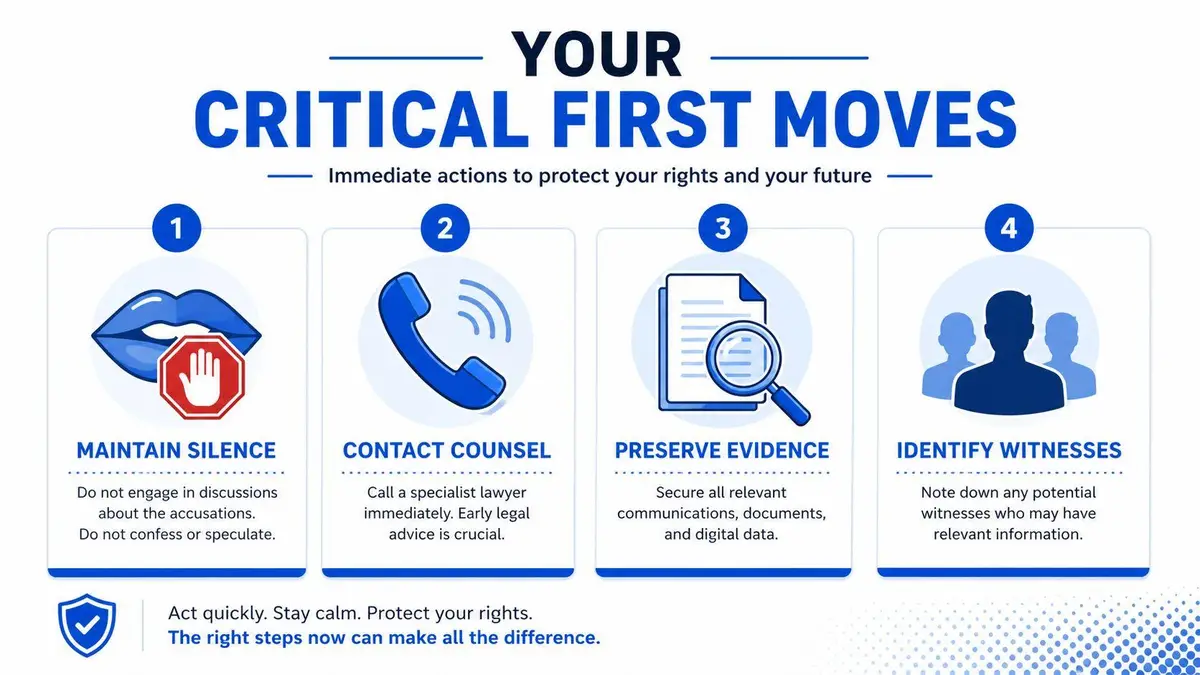
The First Hour Your Critical First Moves
You are under pressure the moment the accusation surfaces. That pressure pushes smart people into stupid moves. They call the accuser. They text colleagues. They post something defensive. They try to sound cooperative with investigators. All of that can hurt you.
Your first hour determines whether this becomes a managed crisis or an uncontrolled one. Act accordingly.
Lock down communication
Your first move is silence. Not symbolic silence. Operational silence.
According to guidance on defending against false accusations, expert legal defense mandates an absolute “zero-communication” protocol with the accuser and investigators until counsel is secured. Any unsupervised dialogue, including text messages or social media posts, can be weaponized. Individuals who engage socially or directly with accusers face significantly higher rates of case escalation.
That means no direct reply to the accuser. No “I have no idea what you’re talking about.” No apology drafted to calm things down. No private explanation to HR before your lawyer has framed the response. No Instagram story. No statement to staff.
Practical rule: If a message would make sense to send in ordinary life, it is probably the wrong move in a false accusation case.
If law enforcement is involved, understand your rights before you say a word. A plain-English resource like Atascocita defense lawyer explains Miranda is useful because people often confuse “being polite” with waiving protections they need.
Call the right lawyer, not the nearest one
This is not the time for your usual corporate counsel if they don’t handle accusation-driven crisis matters. You need a lawyer who understands false allegations, pre-charge intervention, evidence preservation, defamation exposure, and media containment.
Use this short triage checklist:
- Stop all outbound communication: Freeze texts, emails, direct messages, and social posting related to the allegation.
- Retain specialist counsel immediately: If the matter touches criminal, employment, family, or public allegations, get the correct specialist fast.
- Preserve your devices and accounts: Keep phones, laptops, cloud accounts, and work platforms intact. Don’t delete anything.
- List possible witnesses: Write down names while details are fresh, but don’t contact them yet without legal advice.
Secure your immediate environment
You also need practical containment. Change passwords on core accounts. Turn on stronger account security. Tell one trusted assistant or chief of staff, if necessary, that all inbound requests on the issue must route through counsel. If you’re arrested or detained, request counsel immediately and comply with procedure rather than improvising.
The goal in this first hour is simple. Create a clean pause. No new admissions. No defensive chatter. No digital mess. Just legal control, evidence preservation, and disciplined silence.
Building Your Evidentiary Fortress
Once you’ve stopped the bleeding, start building. Most false accusation defenses fail because the accused relies on memory and emotion while the other side relies on a documented story. Memory is weak under stress. Records aren’t.
Build records before you build arguments
The strongest immediate method is a documented evidence protocol. According to this three-phase workplace evidence framework, a successful defense methodology requires a three-phase evidentiary protocol: first, secure all digital artifacts to prevent spoliation claims; second, construct a granular personal timeline using declarative language (“I know,” “I saw”); third, submit a formal rebuttal containing a direct denial and an explicit evidence list.
Start with collection, not storytelling. Pull together emails, texts, Slack logs, calendar invites, rideshare receipts, building access logs, call records, travel confirmations, CCTV requests where available, and location history if your lawyer advises preserving it. Save them into organized, password-protected folders. Keep original filenames and dates intact.
You are not trying to prove your innocence in one dramatic reveal. You are giving your legal team a stable factual archive they can test and use.
Write a timeline like a witness, not a novelist
Your personal timeline should be specific and dull. That’s a strength.
Use language such as:
- “I was at” the office at a specific time.
- “I sent” an email at a specific time.
- “I saw” a named person in a meeting.
- “I left” using a car service shown in a receipt.
Avoid motive theories and speculation.
| What to include | What to avoid |
|---|---|
| Dates, times, locations | Guesses about why the accuser acted |
| Named documents and screenshots | Emotional commentary |
| Exact communications | Broad character attacks |
| Identified witnesses | “Maybe,” “I think,” “probably” |
Facts persuade lawyers and investigators. Theories about the accuser’s psychology usually don’t.
Protect the record from self-inflicted damage
Don’t delete messages that look awkward. Don’t edit screenshots. Don’t “clean up” your phone. Destroying or altering material can create a separate legal problem. Guidance on beating false accusations legally warns that destroying evidence can lead to obstruction consequences. Even if a document feels unhelpful, your lawyer needs the whole record, not a curated one.
If this is a workplace matter, ask HR for the exact allegation, date, time, and location through counsel or in a controlled written process. Vague complaints produce vague responses. Specific allegations can be tested.
Your objective here is not rhetorical. It’s architectural. You’re building an evidentiary structure that can withstand HR review, criminal scrutiny, civil discovery, and media pressure.
Deploying Legal Countermeasures
Silence and documentation buy you time. A strong lawyer uses that time aggressively.

Why specialist counsel changes the outcome
The core legal point is straightforward. According to guidance on handling false criminal accusations, in criminal contexts, retaining an experienced defense attorney immediately is absolutely necessary. Proactive intervention before charges are filed can prevent prosecution entirely, a measure an individual cannot manage alone. This is critical as any innocent comments made to law enforcement without counsel can be twisted and used against you.
That’s why generic representation is often a false economy. You need someone who can do at least four things at once:
- Control contact with investigators: Counsel becomes the buffer between you and anyone trying to lock you into a statement.
- Run a pre-file strategy: In the right case, lawyers can present exculpatory evidence before charges harden into a formal position.
- Coordinate parallel exposure: Employment, board, investor, family, and media consequences often move faster than the legal file.
- Evaluate counterclaims: Defamation, malicious prosecution, harassment, breach of confidentiality, or misuse of company data may all be in play.
If you’re trying to understand how charges can be challenged procedurally in another jurisdiction, a resource on understanding criminal charges in Ontario is a useful example of why local procedure matters. Legal advantage often turns on forum-specific mechanics, not abstract innocence.
Legal force should be targeted
Not every false accusation should trigger the same legal response. Good counsel chooses pressure points carefully.
A cease-and-desist letter makes sense when a former partner, employee, or third party is spreading factual claims that are false and damaging. A litigation hold may be necessary when key records could disappear. A private investigator may be justified if witness credibility, timeline contradictions, or fabricated materials need testing. If the accusation sits online in article form, specialist internet defamation counsel may be necessary, which is why a focused resource like this strategic guide for executives facing internet defamation issues matters.
Use law as a shield and as a signal
A legal response also communicates seriousness. That matters. False accusers and opportunistic publishers often push hardest when they think the target will panic, negotiate informally, or avoid confrontation. A disciplined legal position changes that calculus.
A controlled legal response tells every observer the same thing: the record will be tested, the process will be contested, and unsupported claims will carry consequences.
If you’re in India, the available countermeasures may include filing for anticipatory bail or seeking to quash a false FIR through the High Court under the mechanism described in this discussion of false case remedies. If you’ve been arrested, invoke counsel immediately and follow procedure, rather than trying to talk your way out in real time.
The right lawyer doesn’t just defend you. They narrow the battlefield.
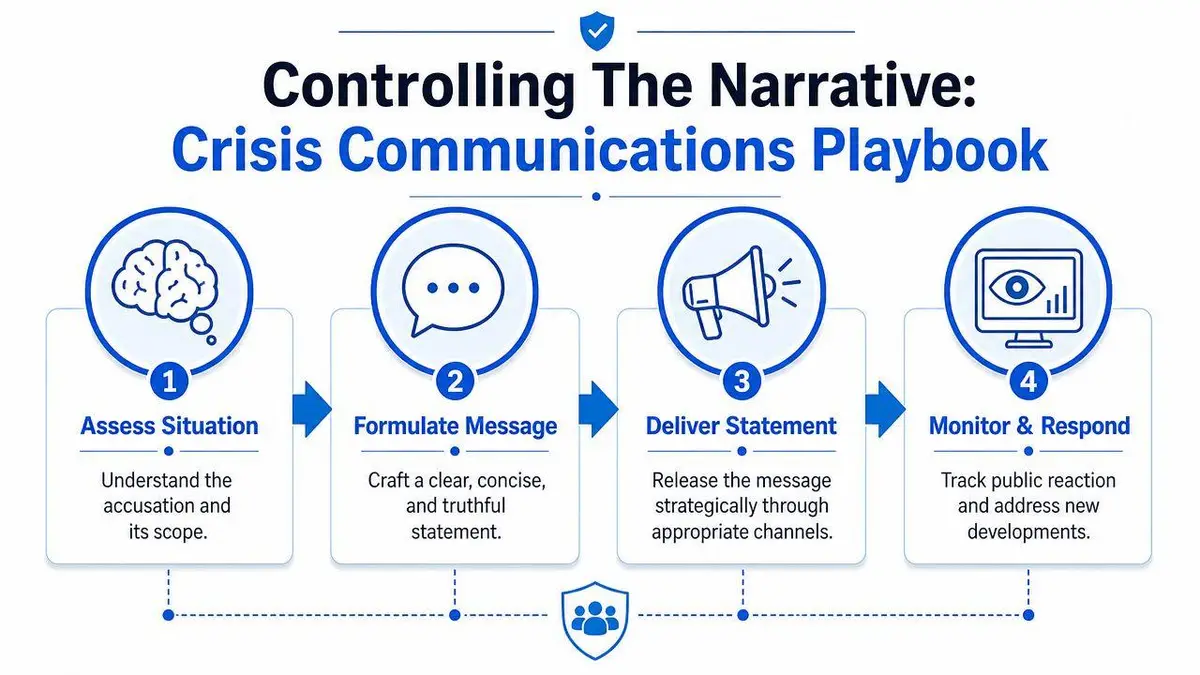
Controlling The Narrative And Media Strategy
A public allegation creates two cases at once. One is formal. The other is reputational. The formal case runs on evidence and procedure. The reputational case runs on attention, repetition, search indexing, screenshots, and selective framing. They interact, but they aren’t the same.
Decide whether to speak
You do not owe the public a stream of updates. You do owe yourself a deliberate decision.
The underlying stakes are substantial. According to the End to Domestic Violence report on false allegations costs, the financial and personal costs of false accusations are staggering, with legal defense costs in the US reaching approximately $500 million annually. The severe reputational damage, often categorized as defamation, can destroy careers for public figures, making narrative control a critical component of the defense.
That doesn’t mean “always issue a statement.” It means treat communications as part of the defense.
Use this decision framework:
| Situation | Better move |
|---|---|
| Law enforcement contact but no public visibility | Stay silent publicly. Let counsel handle the file. |
| Internal workplace complaint with rumor risk | Use a narrow, process-focused statement if needed. |
| Media inquiry already circulating publicly | Prepare a concise denial through counsel or crisis team. |
| Viral social allegation with fabricated material | Combine legal notices, platform reporting, and a controlled statement. |
What a useful statement does
A good public statement is short. It denies the false allegation clearly, avoids extra facts, avoids attacks on the accuser, and points to process. It does not freelance. It does not speculate. It does not promise vindication on a timeline you don’t control.
A bad statement usually has one of three problems. It says too much. It sounds emotional and inconsistent. Or it tries to litigate every detail in public, which only creates more language for opponents to mine.
Here is the governing principle: say less than you want, and say it with precision.
To see how communications cadence affects perception across channels, even outside legal crises, a practical resource like this social media management cost guide is useful because it highlights the operational reality behind posting, monitoring, and response management. In a crisis, those functions need legal review layered on top.
A quick visual framework helps when pressure is building:
Coordinate legal and communications teams
Most self-inflicted reputational damage happens when PR and legal work separately. PR wants speed. Legal wants caution. You need both, but under one command structure.
- Counsel should clear language: Every statement must be reviewed for legal exposure.
- Communications should control distribution: Not every channel deserves a response.
- Monitoring should be active: Watch press, social mentions, search results, and impersonation risks.
- Surrogates should be limited: Friends, staff, and allies often create new problems when they improvise.
The best media strategy often looks restrained from the outside. That’s fine. The goal isn’t to look energetic. The goal is to avoid making the accusation more searchable, more quoteable, and more believable through your own overreaction.
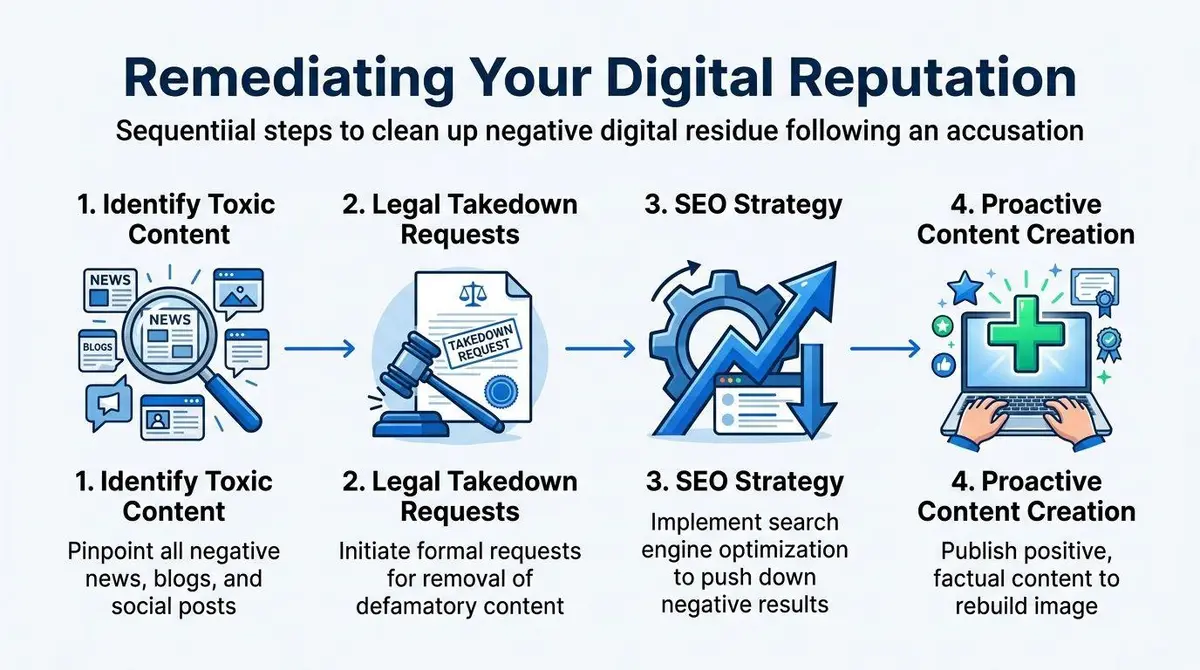
Remediating Your Digital Reputation
Winning legally doesn’t erase the accusation from the internet. It gives you a stronger basis to attack the residue.
That residue matters because search engines don’t care about fairness. They index what exists, what got attention first, and what other sites keep repeating. If the original allegation was dramatic and the correction was quiet, the allegation often stays more visible.
The problem most lawyers leave behind
There is a 6 to 18 month digital reputation lag, and 73% of employers check search engines before hiring, which means false allegations can keep causing harm long after legal vindication. That same verified data notes that this digital echo can produce a measurable drop in income or client trust even after the accusation is publicly debunked.
For executives, this is often the difference between “we won” and “the damage continues.” Boards search. Journalists search. Investors search. Clients search. New counterparties search before they ask you a single question.
Legal vindication closes a file. It does not clear page one of search results.
The cleanup has three separate tracks
A serious remediation plan usually runs on parallel tracks rather than one tactic.
- Source removal: Attack the material where it lives. That may involve legal takedown demands, platform complaints, privacy arguments, impersonation claims, or direct negotiation with publishers.
- De-indexing: Where removal isn’t possible, reduce visibility in search through search engine processes and qualifying requests.
- Suppression and replacement: Publish factual, credible, high-authority material that can compete with or outrank stale accusation content.
Each track solves a different problem. Source removal is the cleanest result. De-indexing reduces discoverability. Suppression changes what people see first.
Audit before action
Do not begin with random reputation work. Start with a map.
Create an inventory of:
- Search results by name variation
- News and blog references
- Social posts, reposts, and quote screenshots
- Data leaks, impersonation pages, and mirrored content
- Autocomplete and related search associations
If the false accuser was an insider or former employee, the risk profile is worse because the issue may include leaked documents, copied emails, or fabricated material built from internal access. In that situation, digital containment needs to move at the same speed as legal work.
One practical route for source-level and search-level remediation is a specialist service such as content removal for harmful online material, which addresses removal pathways, de-indexing, and related remediation options. That work is distinct from ordinary PR because the problem isn’t just sentiment. It’s the persistent visibility of false material.
The central mistake here is delay. The longer false content sits, the more it gets crawled, cited, cached, reposted, and treated as established history.
Long-Term Prevention and Reputation Monitoring
A false accusation changes your risk model. It should also change your operating model.
The durable lesson is not “be more careful.” It’s “build systems.” High-profile people need documented boundaries, secure communications practices, tighter internal access controls, and cleaner escalation protocols for complaints, leaks, and personal disputes. If former employees, partners, or contractors can access sensitive material or impersonate internal communications, your exposure is higher than most standard legal advice assumes.
Turn crisis lessons into standing policy
Start with contracts and process. Review NDAs, separation terms, device return procedures, access revocation, and document retention rules. Tighten who can speak for you or the company when allegations surface. Make sure assistants, chiefs of staff, and communications personnel know that accusations trigger counsel review, not ad hoc reassurance.
Then add monitoring. Reputation threats rarely begin at full scale. They begin as a post, a forum mention, a copycat account, a niche blog entry, a leaked screenshot, or a subtly indexed page that no one notices until it ranks.
A board-level framing helps here, especially if you need internal budget or executive buy-in. This resource on convincing your board to invest in reputation monitoring is useful because it treats monitoring as operational risk management rather than vanity.
Stay ready, not rattled
If you’ve already been through one accusation, don’t assume the next threat will look the same. Prepare a standing response file with counsel contacts, communications approvals, evidence preservation procedures, and an escalation list. That turns panic into execution.
The people who handle false accusations best aren’t calmer by nature. They are better prepared.
When false allegations threaten your career, family, or public standing, speed and precision matter. ContentRemoval.com helps executives, public figures, and legal teams address the digital side of crisis response, including harmful content removal, de-indexing, impersonation issues, and ongoing monitoring. Start with a confidential assessment and get a clear action plan built around your specific exposure.
Frequently asked questions
Should I respond to someone who has falsely accused me?
No. Any direct reply, text or social post can be used against you and tends to escalate the matter. Route all contact through counsel, freeze outbound communication on the subject, and tell one trusted assistant that inbound requests go to your lawyer.
Should I delete messages that look bad before an investigation?
Never. Destroying or editing evidence can create a separate obstruction problem and undermines your defense. Keep phones, laptops, cloud accounts and work platforms intact with original filenames and dates, and give your lawyer the whole record rather than a curated one.
Does winning the case remove the accusation from Google?
No. Legal vindication closes a file but leaves the original coverage, reposts and screenshots indexed, and the article notes a digital lag of 6 to 18 months. Clearing search requires separate work: source removal, de-indexing where removal is not possible, and credible content that outranks the stale allegation.