
Delisting from Google is two tasks: removing the result from search and neutralizing the page so it cannot return. If you control the site, use Google’s Removals tool for a fast block, then delete, password-protect or noindex the page. If a third party controls it, the route runs through the publisher, platform policy, a DMCA notice or defamation process.
Key facts
- Google states there is no universal delist button; the path depends on where the content lives.
- The Removals tool blocks an owned URL within about a day, but only for about 6 months.
- Google’s Results about you workflow shows eligibility and lets users request a refresh after page changes.
- Delisting is not removal: a page stays live unless the site owner takes it down.
Where ContentRemoval.com comes in. ContentRemoval.com manages delisting as a coordinated operation for executives, investors and family offices: evidence, source removal, Google legal requests, publisher negotiation and recurrence monitoring run together rather than in sequence. Contact usually comes from the individual or their general counsel while a board vetting, financing or transaction is under way. A free, confidential 15-minute Exposure Scan maps which results are removable and by which route, and the report is yours to keep. Get a Free, Confidential Exposure Scan or read how our search result removal work is done.
A damaging Google result usually appears at the worst possible moment. A board candidate is being vetted. A lender is reviewing diligence materials. A client’s general counsel is doing a routine search. You type your name, your company, or your family office into Google and see the problem sitting there in plain view.
Treat that as a reputation defense event, not a nuisance. If the result exposes private information, republishes stolen material, or frames a false allegation as fact, delay is expensive. Panic is also expensive. The first response should be controlled, documented, and sequenced.
In the first hour, do three things. First, preserve the evidence. Capture screenshots of the search result, the live page, the cached snippet if visible, and the full URL path. Second, identify where the content lives. The strategic path changes completely depending on whether the page is on a site you control, a third-party publication, a forum, or a social platform. Third, decide whether you need suppression, source removal, or both. Those are different objectives, and confusion here wastes time.
Those searching for how to delist from Google are really asking two separate questions. They want the result gone from search, and they want the underlying content neutralized so it doesn’t resurface. Those are related tasks, but they aren’t the same. If you miss that distinction, you can win a temporary reprieve and still lose the matter.
A sound briefing starts with search removal mechanics, then moves outward to source control, publisher negotiation, and legal escalation. If you need a sharper distinction between search suppression and source takedown, review this guide on de-indexing as a strategic search result removal method. It frames the issue correctly. Google is one battlefield. The web page itself is another.
Introduction The Strategic Imperative of Content Control
If the result is active now, your immediate objective isn’t perfection. It’s containment.
Digital first aid in the first hour
Start with a short operational checklist:
- Lock the evidence
Save the result exactly as it appears in search. Save the live page. Save the page title, date, and URL. If the content changes later, your record becomes an advantage. - Classify the threat
Ask one blunt question: is this harmful because it’s private, false, infringing, outdated, or merely unhelpful? Each category points to a different remedy. - Separate owned assets from external assets
If the content is on your own website, you can move fast. If it’s on someone else’s site, your power depends on policy, law, and negotiation.
Practical rule: Never begin by sending emotional emails to editors, bloggers, or webmasters. Preserve evidence first. Then decide the correct removal channel.
Executives often lose time because they search for a universal off switch. There isn’t one. Google removal depends on context, eligibility, and source control. That means your first decision is strategic, not technical. You need to know whether you’re stabilizing exposure, forcing a takedown, or building a longer campaign against a persistent threat.
What good strategy looks like
A disciplined response has four characteristics:
- Fast temporary containment when the result is causing immediate harm
- Permanent source remediation where you control the asset
- Targeted outreach or legal process where you don’t
- Monitoring and recurrence control so the same issue doesn’t return through duplicate URLs or reposts
If your reputation, personal safety, or deal process is on the line, improvisation isn’t good enough. Handle the first moves with precision. Then escalate based on the nature of the content, not your level of frustration.
Immediate Actions for Content Triage
The first operational question is simple. Do you control the page? If the answer is yes, act immediately through Google’s search removal tools and through the page itself.
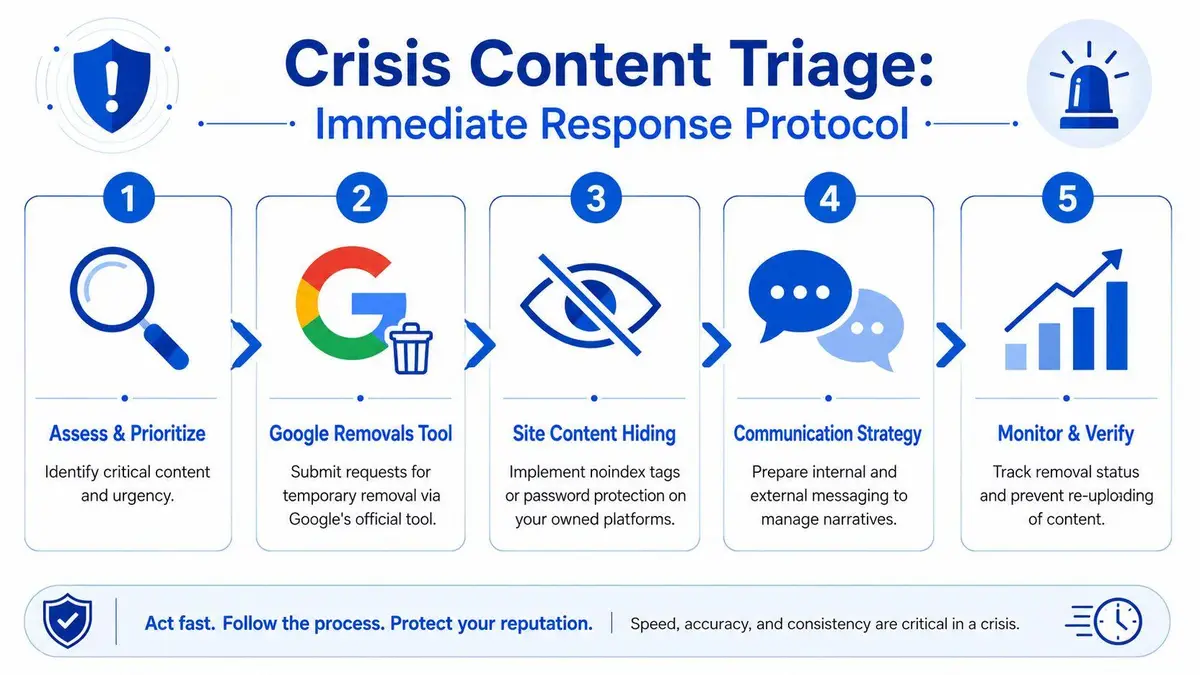
Google states that there is no single universal “delist from Google” button, and that removal depends on where the content lives. For pages on your own site, Google says you can use the Removals tool for a quick removal from Search within about a day, but the block lasts only about 6 months unless the underlying page is removed or blocked from indexing, as explained in Google’s documentation on removing information from Google Search.
When you control the website
This is the cleanest scenario, but it still requires discipline. Use a triage sequence:
- Submit the URL through Google’s Removals tool to suppress visibility quickly in search results.
- Change the page itself so Google has a permanent reason not to index it again.
- Check URL variants such as alternate paths, parameters, staging copies, and printable versions.
The Removals tool buys time. It doesn’t solve the underlying problem. If you stop after the request submission, you’ve delayed the issue, not resolved it.
What to collect before you file
Google reviews specific URLs. That means vague descriptions are useless. Prepare:
- The exact offending URL and any duplicate versions you can find
- Evidence of the page content in case it changes during review
- Your ownership access to the site if you’re acting on your own property
- A record of the page changes you make after filing
A temporary disappearance from search can create false confidence. The correct question isn’t “Did it vanish today?” It’s “Can it come back on recrawl?”
That distinction matters in every executive crisis. Search suppression is a breathing-space maneuver. Permanent removal comes from source control.
Cached pages and stale search entries
A recurring complication is outdated search presentation. The page may be changed or removed, yet Google still shows an old title, snippet, or cached trace. In those cases, you need a separate cleanup process. This guide on removing a cached page from Google is useful because stale search remnants often prolong a reputational problem after the underlying page has already been fixed.
If the page is not yours, don’t waste this early window pretending you can solve everything through Google alone. Stabilize what you can. Then move directly to source strategy.
Securing Your Owned Digital Assets
Most self-inflicted reputational problems aren’t caused by malicious publishers. They’re caused by poor control over owned websites, old microsites, forgotten staff bios, abandoned blogs, public file directories, and duplicate URLs left exposed.

If you own the asset, don’t negotiate with Google first. Fix the asset. Google has become easier to work with from the search side, but durable control still starts at the source.
Choose the right permanent remedy
Use this decision table for owned pages:
| Situation | Best action | Why |
|---|---|---|
| Page should no longer exist | Remove the page entirely | Eliminates the source rather than masking it |
| Page must remain private | Password-protect it | Access control prevents public indexing |
| Page should stay live but out of search | Add a noindex tag | Preserves usability while blocking search inclusion |
Google’s newer removal workflow matters here. Google says its redesigned Results about you experience lets users click the three dots next to a result, see whether content is eligible for removal, submit a request with fewer clicks, and request a refresh so Google can recrawl updated information, as described in Google’s post about the new Results about you design.
That redesign helps with execution, but it doesn’t replace asset management. If your site architecture is sloppy, you’ll keep creating the same exposure under slightly different URLs.
Your internal protocol should be stricter than your public policy
Run a direct audit of every digital property you control:
- Executive profiles on corporate, conference, and portfolio sites
- Media libraries containing downloadable files and image attachments
- Archived press releases that expose personal details or outdated allegations
- Subdomains and campaign pages that no one has reviewed in years
If your organization hasn’t done basic cyber hygiene, reputational cleanup gets harder because leaks, mirrored files, and unauthorized uploads spread faster. A practical non-legal complement is to protect your business from cyber attacks so you reduce the volume of preventable exposures that later require takedown work.
After you’ve changed the asset, support that change with monitoring.
Use monitoring as an executive control function
Don’t wait for a journalist, competitor, or school parent to discover a problem before you do. Enter the identifiers that matter to you in Google’s monitoring workflow, then review alerts with the mindset of a risk manager. Phone numbers, email addresses, home addresses, and similarly sensitive identifiers should be watched continuously if personal safety or extortion risk is in play.
When harmful material sits on a third-party site, your next move is no longer technical housekeeping. It becomes a communication problem.
Protocol for Contacting Website Owners
When the content sits on a third-party website, your target isn’t Google. Your target is the publisher, administrator, or host with actual control over the page. Google can sometimes remove the result from search under policy conditions, but the page itself remains live unless the site owner takes it down. Google also makes clear that this process is narrow and requires specific URLs, as explained in Google’s help page on removing personal information from Search.
That is the dividing line many people miss. Delisting is not the same as removal.
Whom to contact first
Don’t fire off requests to generic inboxes unless you have to. Find the person with authority to act:
- Editor or publisher for articles and blog posts
- Compliance or abuse team for platforms and marketplaces
- Privacy contact for doxxing or personal data exposure
- Counsel or registered agent if the operator is evasive
If the site is small, the owner may also be the author. If it’s a larger publication, editorial staff may have no authority to remove anything without legal review.
How to write the request
The right tone is factual, brief, and difficult to ignore. Most voluntary takedowns happen because the request is clear enough to process, not because it’s theatrical.
Use a structure like this:
| Element | What to include |
|---|---|
| Identification | Exact URL and page title |
| Basis | Why the content is false, private, infringing, or otherwise actionable |
| Evidence | Screenshots, original files, authorship proof, or contradictory records |
| Remedy requested | Remove the page, remove specified material, or anonymize identifying details |
| Deadline | A reasonable response window |
| Reservation | State that you reserve rights without making hollow threats |
Send one clean request with evidence attached. Don’t send six messages that evolve in tone from polite to erratic.
A poor request says, “This is ruining my life, remove it now.”
A useful request says, “The article at [URL] contains false factual assertions regarding [specific point], and republishes my private residential address. Attached are the source records showing the inaccuracy and the requested redactions.”
Decide the legal theory before you write
Many internal teams get sloppy. They use the wrong basis and undermine their credibility.
Use copyright when the content republishes your protected photos, videos, text, or other original material without permission.
Use defamation analysis when the issue is a false statement of fact that causes reputational harm.
Use privacy and safety framing when the page exposes personal data, doxxing material, or threatening context.
These are not interchangeable. If you accuse a site of defamation when the actual issue is unauthorized use of your photograph, you’ve chosen a slower and weaker route. If you shout “copyright” over facts you don’t own, the site will ignore you or escalate against you.
What usually backfires
Avoid these mistakes:
- Overstating the law when you haven’t analyzed jurisdiction
- Threatening litigation immediately without evidence or a drafted claim
- Demanding global deletion when a narrower correction or anonymization would likely be granted
- Contacting advertisers, investors, or family members before you’ve tried a controlled direct approach
Professional outreach isn’t about sounding aggressive. It’s about making compliance the easiest option available to the recipient.
Executing Legal Takedown Procedures
Some site owners won’t cooperate. Some are anonymous. Some monetize conflict. That’s the point where legal takedown procedure stops being optional and starts becoming the only effective route.
The practical success factor in Google-related removal work is precise URL collection and evidence packaging, and if the content remains on the host site, the source must be contacted separately because search removal doesn’t eliminate the webpage itself, as summarized in this report on Google’s personal information removal workflow.
DMCA versus defamation
The cleanest legal pathway is often the DMCA takedown notice, but only when the content infringes your copyright. This applies when someone republishes your original photograph, video, article, or other protected work without authorization. In practice, the notice often goes to the hosting provider, platform, or designated copyright agent rather than the publisher alone.
Defamation is different. It usually requires a stronger factual record and a more careful jurisdictional assessment. The core issue is whether the statement is a false assertion of fact, not opinion or rhetoric, and whether you can prove the harm and fault standards that apply. Many high-profile clients assume defamation is the obvious answer. Often it isn’t the fastest one.
A useful decision framework
Use this framework before escalating:
- Stolen photo, copied article, leaked original video
DMCA is likely the first instrument to examine. - False accusation presented as fact
Defamation analysis may be appropriate, especially if correction requests were ignored. - Harassing post with threats and identifying details
Consider a combined approach using platform safety channels, privacy-based requests, and legal process where available.
People also mislabel hostile conduct. If you’re evaluating a pattern of abuse rather than a single publication, this explanation of bullying vs harassment is useful because categorization affects both legal posture and platform reporting strategy.
Build the record before you press harder
A legal takedown packet should include the exact URLs, screenshots, timestamps, copies of the infringing or false material, proof of ownership where relevant, and a chronology of prior requests. Without that file, even a good claim gets diluted by avoidable ambiguity.
If your evidence folder is disorganized, your legal position usually is too.
For Google-specific legal channels, this primer on how to submit a Google legal request is a useful reference point. It helps distinguish platform-level reporting from formal legal request pathways.
When removal isn’t immediately available
The hardest cases require a combined strategy. You may pursue source takedown, file search removal requests where policy applies, monitor for reposts, and build suppressive assets so the harmful result loses prominence over time. That’s not surrender. It’s operational realism.
In those matters, legal work and reputation work should run in parallel. Waiting for one to finish before starting the other usually hands the aggressor extra time.
Managing Persistent and Anonymous Threats
Some attacks don’t end after one request. They migrate to mirror sites, forum threads, social posts, and indexed duplicates. Anonymous operators are especially disruptive because they treat delay as a tactic and re-upload as a business model.
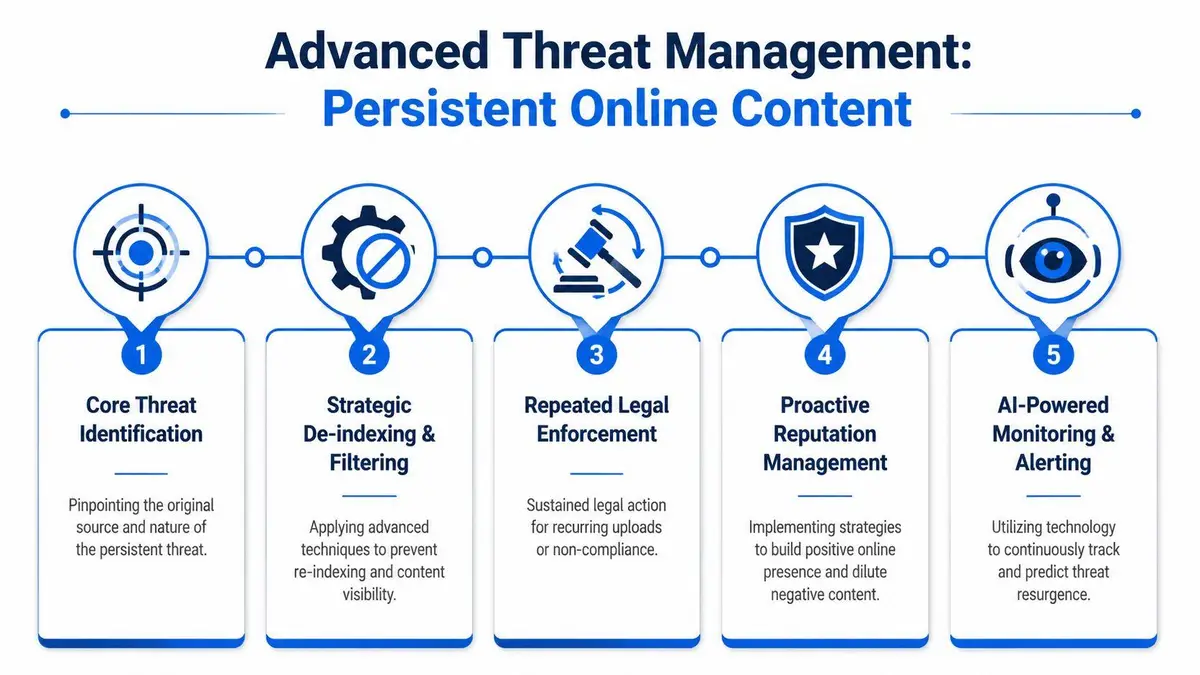
At this stage, stop asking whether you can “just remove it from Google.” The right question is whether your problem has become a campaign rather than a single item.
Why persistence changes the strategy
Google warns that robots.txt is not a permanent removal method, that all URL variations should be protected, and that a Removals tool request blocks URLs for only about six months, as discussed in Google’s video guidance on temporary and permanent URL removal. That warning matters most in persistent-threat cases because hostile actors exploit duplication. They change one parameter, repost one cached copy, or surface one forgotten variant, and the issue returns.
That is why complex matters require both cleanup and recurrence control.
A threshold test for escalation
You should consider specialist involvement when several of these conditions are present:
- The content keeps reappearing under new URLs, accounts, or domains
- The publisher is anonymous or offshore and ignores ordinary requests
- The subject matter affects safety, family privacy, or active transactions
- The attack spans search, web, and social channels simultaneously
- Your own time cost is now higher than the cost of coordinated intervention
One practical option in this category is ContentRemoval.com, which handles de-indexing and source-removal workflows as part of broader online content removal matters. The value in using any specialist firm isn’t magic. It’s process discipline, evidence handling, and continuity across repeated takedown cycles.
Suppression is not a consolation prize
Executives often resist suppression because it feels less decisive than deletion. That’s a mistake. If a hostile page can’t be removed promptly, reducing its visibility through stronger positive assets, controlled profiles, verified media, and updated corporate content is a rational defensive move. It protects counterparties who search your name tomorrow, not just lawyers who may obtain relief later.
The public doesn’t read the internet comprehensively. It reads what search surfaces first.
That makes search positioning part of risk management. In prolonged disputes, you need both offensive and defensive measures running at once.
Deciding When to Engage a Removal Specialist
You can handle some matters internally. If the page is on your own site, the issue is straightforward, and the content falls within a clear platform or Google policy path, a disciplined in-house team can often manage the first steps.
The threshold changes when the facts become messy. If the publisher is hostile, the legal basis is contested, the material has spread across multiple domains, or anonymity makes ordinary communication ineffective, you’re no longer dealing with a technical task. You’re dealing with an adversarial process.
A business test, not an emotional one
Use three questions.
First, what is the cost of staying visible while you experiment? For an executive, investor, or family office principal, a public result can distort diligence, negotiation advantage, and personal safety. Second, how many separate channels now require action? Search, source website, host, platform, and legal correspondence each add complexity. Third, who is best positioned to maintain pressure discreetly and consistently? Internal teams often lose momentum because this work competes with actual business operations.
If the answer to those questions points toward delay, fragmentation, or reputational downside, professional intervention is usually the rational choice. The advantage isn’t just speed. It’s coherence. The matter gets managed as a controlled operation rather than a series of improvised reactions.
If you’re dealing with a high-stakes search result, a leak, a false allegation, or a persistent online attack, ContentRemoval.com can assess the facts confidentially and map the correct path, whether that means de-indexing, source removal, publisher negotiation, or legal escalation.
Frequently asked questions
What is the difference between delisting and removing content from Google?
Delisting removes the URL from Google’s search results, while removal takes the page itself off the web. Google’s process only hides the result and requires specific URLs, so unless the site owner deletes the page, it stays live and can resurface through duplicate URLs or recrawls.
How long does a Google Removals tool request last?
For a site you control, Google says the block takes effect within about a day but lasts only about 6 months. To make it permanent, remove the page, password-protect it or add a noindex tag so Google has a lasting reason not to index it.
Should I use DMCA or defamation to get a page delisted?
Choose by the facts. A DMCA notice applies when the page republishes your copyrighted photo, video or text, and it typically goes to the host or platform. Defamation applies to a false statement of fact and needs a stronger record and jurisdictional review, so it is often the slower route.