
Deleting an online presence is a staged operation. It begins with an audit of every profile, forum post, data broker listing, public record and archived page tied to your name, sorted by risk. Removable liabilities are taken down through terms of service, DMCA and privacy law requests. Content that cannot be removed is suppressed in search, then everything is monitored.
Key facts
- Deactivation hides a profile but keeps the data; deletion is permanent after a 14 to 30 day grace period.
- Removal requests work best when they cite the exact terms of service clause the content violates.
- DMCA notices go to the hosting provider, while GDPR and CCPA grant a right to erasure against data brokers.
- Simple removals may resolve in 24 to 72 hours; news de-indexing or litigation can take weeks or longer.
Where ContentRemoval.com comes in. ContentRemoval.com carries out this kind of staged takedown for executives and public figures who want their name to return only what they choose, handling the audit, the source removals, the search engine requests and the monitoring afterward. The individual, their chief of staff or their agency usually makes contact after finding something they did not expect. A free, confidential 15-minute Exposure Scan maps what is removable, and the report is yours to keep. Get a Free, Confidential Exposure Scan or read how our content removal work is done.
Erasing your digital presence is not a matter of clicking a single “delete” button. It is a strategic demolition. The process commences with a forensic-level audit to map your exposure, which then informs a targeted campaign of deletion, de-indexing, and suppression. This is a methodical operation demanding both technical proficiency and legal precision to secure lasting results.
Your Digital Presence Audit: A Forensic Approach
Before any removal action can be taken, you must first establish a complete intelligence picture of what exists online. This is not a cursory Google search of your name. For a high-profile individual, this requires a deep, investigative audit to map every instance where your name, likeness, or data appears. You must construct a comprehensive dossier on your own digital self.
The objective is to catalog every digital asset: active social media profiles, dormant accounts untouched for a decade, obscure forum comments, and every professional biography ever created. The audit must extend beyond the obvious platforms. Your information often resides in unmonitored corners of the internet, exposed without your knowledge or consent.
Uncovering Hidden Liabilities
A proper audit systematically investigates third-party data broker sites, entities that profit from buying and selling your personal information, and scours public records databases for legal and financial histories. It also requires a review of archived web pages through services like the Wayback Machine, which can preserve unflattering or outdated information long after the original source is modified or removed.
This is where the true liabilities, missed by any surface-level search, are found. An offhand comment on a niche political forum from a decade ago can be weaponized in a professional context today. An old, forgotten profile on a defunct social network may still contain personal details that are a goldmine for an individual planning a social engineering or phishing attack.
A comprehensive audit necessitates treating your digital identity as a counter-intelligence target. Every data point is a potential vulnerability until it is identified, cataloged, and its risk level assessed. This is the only method to get ahead of the problem, rather than merely reacting to it.
Categorizing Your Digital Assets
With a full inventory compiled, the next phase is risk triage. You must classify every finding to distinguish benign data from high-risk liabilities that threaten your career or safety.
A direct method for prioritization is as follows:
- High-Risk Assets: These represent immediate threats to your reputation, security, or professional standing. Examples include defamatory articles, leaked personal data, negative news coverage, mugshots, or content revealing sensitive business intelligence. These are the top priority and require immediate action.
- Moderate-Risk Assets: This category encompasses dormant accounts, outdated professional bios, or public posts containing personal opinions that no longer align with your current professional identity. While not an active crisis, they represent a latent risk that could be exploited.
- Low-Risk Assets: This includes benign, positive, or neutral content that either supports your professional image (such as a well-maintained LinkedIn profile) or carries no reputational weight. These assets may be left in place or simply secured.
During the audit, it is also prudent to identify technical red flags that could damage your reputation or communications. An often-overlooked but crucial step is to check if your domain is blacklisted, which can severely impact email deliverability and online perception.
Categorizing your digital assets in this manner creates a clear, actionable roadmap for the removal process. A thorough audit transforms the vague anxiety of what might be “out there” into a concrete operational plan. To understand what this first stage entails in practice, our guide on a professional <https://www.contentremoval.com/digital-footprint-cleanup> provides a more detailed breakdown. This foundational work is non-negotiable for taking control of your digital narrative.
Choosing Between Strategic Deletion and Suppression
Once your online footprint is mapped and cataloged, the critical decision is how to act. The common impulse is a scorched-earth campaign to delete everything. This is almost always a strategic error.
A more effective approach is surgical. You must distinguish between genuine liabilities and assets that serve your interests. Not every mention of your name is detrimental. A positive article highlighting a career achievement or a well-curated LinkedIn profile are valuable reputational assets. The objective is not complete erasure; it is narrative control. A defamatory blog post requires removal, but a favorable interview should be preserved. Executing this distinction correctly is the cornerstone of a successful campaign.
This decision tree helps visualize the process of auditing your presence and triaging the uncovered risks.
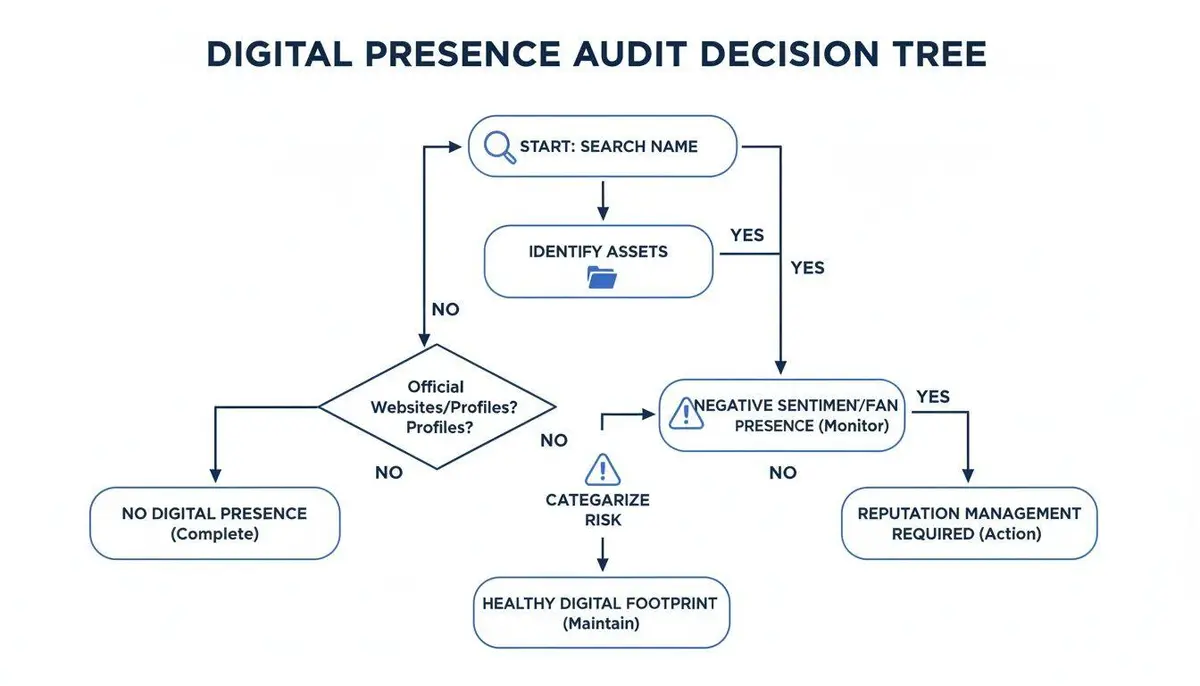
This roadmap, moving from discovery to risk assessment, enables an informed choice between deletion, deactivation, or suppression for each piece of content.
Deletion vs. Deactivation: A Critical Distinction
When addressing social media and other online accounts, platforms typically offer two choices: “deactivate” and “delete.” The terms seem similar, but their operational difference is significant, and choosing incorrectly can undermine your entire effort.
- Deactivation is temporary. It places an account in a state of hibernation. The profile, photos, and posts become invisible to the public, but the underlying data remains on the platform’s servers. This is suitable for a short-term break but is not a permanent solution for mitigating risk. The account can be resurrected instantly by anyone with the login credentials.
- Deletion is permanent. This is the point of no return. By deleting an account, you are formally requesting the platform to permanently erase your data. Most services provide a grace period, typically 14-30 days, during which the action can be reversed. After this window closes, the data is irretrievable. For old, forgotten, or high-risk accounts, deletion is the only secure option.
Choosing deactivation when deletion is required is like locking a door but leaving the key in the knob. It provides a false sense of security while leaving your data vulnerable to future breaches or a moment of weakness leading to reactivation.
The Power of Strategic Suppression
What is the solution for content that cannot be removed? This is a common challenge, particularly with major news articles, government records, or content hosted in jurisdictions that do not cooperate with takedown requests. Attempting to force removal in such cases is often futile.
This is where strategic suppression is deployed. Instead of removing the negative content, you bury it. The objective is to push it so far down in Google’s search results that it becomes effectively invisible. Given that over 75% of users never venture past the first page of search results, content on page three or beyond is rendered inert.
Effective suppression requires creating and promoting a wave of positive, high-authority content that outranks the negative material for your name. This proactive strategy involves several integrated tactics:
- Publishing on high-authority sites: Securing articles or mentions on respected industry publications and news outlets.
- Optimizing existing assets: Enhancing the SEO of your LinkedIn profile, corporate biography, and other positive pages under your control.
- Developing owned properties: Creating new personal websites or blogs over which you have total control.
This approach floods search results with a narrative you dictate, displacing the negative content. It demands time and a sophisticated understanding of search engine algorithms, but it is an exceptionally effective strategy. For a deeper analysis of this tactic, our guide on how to suppress negative search results for executives provides a detailed breakdown.
To clarify these key concepts, the following table breaks down the core differences between deletion, deactivation, and suppression, helping you decide which strategy is appropriate for different situations.
Deletion vs Deactivation vs Suppression Framework
| Strategy | Primary Goal | Permanence | Best Used For |
|---|---|---|---|
| Deletion | Permanent removal of data | Irreversible (after grace period) | High-risk, old, or unwanted accounts; content you control. |
| Deactivation | Temporary hiding of a profile | Reversible at any time | Taking a short break from a platform; pausing a profile. |
| Suppression | Pushing content down in search results | Ongoing effort; content remains live | Unremovable negative content like news articles or public records. |
Ultimately, cleaning up your online presence requires a blended approach. It combines aggressive deletion for removable liabilities with intelligent suppression for what you cannot remove. This integrated strategy is what restores control over your digital reputation.
4. Going on the Offensive: Legal and Technical Takedowns

The reconnaissance is complete. You have your target list and a clear plan of action. It is time to go on the offensive. This phase transitions from analysis to action, employing the appropriate channels to secure the permanent removal of unwanted data. This is not a matter of hopeful emails; it is about building a formal, documented case that a platform or publisher cannot legally or practically ignore.
The most direct route is always to first contact the site owner or administrator. The method of contact, however, determines its efficacy.
How to Craft a Removal Request That Gets Results
An emotional, rambling email will be dismissed. To be taken seriously, your request must be professional, direct, and framed as a formal notice, not a plea.
The platform’s own Terms of Service (TOS) is your primary weapon. Nearly every legitimate website has policies against harassment, copyright infringement, impersonation, or doxxing. Your task is to identify the specific rule the content violates and cite it directly.
For example, abandon language like, “This post is upsetting and I want it gone.” Instead, adopt a formal tone:
“I am formally requesting the immediate removal of the content located at [Insert Exact URL]. This content constitutes a direct violation of your Terms of Service, specifically Section 7.b, which prohibits targeted harassment.”
The dynamic has now shifted. It is no longer a personal complaint; it is a notification of their non-compliance with their own policies. This creates a clear paper trail and a legal obligation for them to respond. This approach is highly effective with established forums, blogs, and social media platforms that have a reputation to protect.
However, many site owners, particularly on less reputable parts of the web, will be unresponsive. When they ignore your initial request, it is time to escalate.
Bringing Out the Big Guns: Using Legal Tools to Force Removal
When a webmaster is uncooperative, legal instruments provide the necessary leverage to compel action. These are not empty threats; they are formal demands carrying legal weight that can create significant liability for a non-compliant host or publisher.
Here are the three most powerful instruments in your arsenal:
- The DMCA Takedown Notice: The Digital Millennium Copyright Act is the standard for addressing stolen intellectual property. If an entity has used your original photographs, articles, videos, or company logos without authorization, a DMCA notice is highly effective. It is not sent to the website owner but directly to their hosting provider. The host is legally obligated to remove the infringing content expeditiously or risk being held liable themselves.
- Privacy Laws (GDPR & CCPA): If a website is processing your personal data without a legitimate basis, laws such as Europe’s General Data Protection Regulation (GDPR) and the California Consumer Privacy Act (CCPA) are powerful tools. They grant individuals the “Right to Erasure” (or “Right to be Forgotten”). This is a critical lever for dealing with data brokers and other entities that process personal information without explicit consent.
- Defamation and Libel Claims: When content is not merely unwanted but actively false and damaging to your reputation, legal counsel is required. A sharply worded cease and desist letter from an attorney is the initial step. It identifies the defamatory content and demands its removal under threat of a lawsuit, putting the publisher on formal notice of impending litigation.
A well-crafted legal takedown notice is not a request. It is an order. It puts the hosting provider on the clock, informing them that they are currently hosting illegal content. The legal risk immediately shifts from you to them.
The sheer volume of exposed data is staggering. Projections for 2025 suggest over 80,000 data breaches could expose 3.5 billion personal records, making proactive removal more critical than ever. Professional takedown services rely on these legal tools to get content removed and de-indexed, often in as little as 24-48 hours. The financial penalties for non-compliance are severe; since GDPR was introduced, regulators have issued over €2.7 billion in fines, forcing companies to take deletion requests seriously. You can find more data on the scale of the problem by reviewing current digital footprint statistics and their implications.
What to Do When the Host Is Uncooperative
The most significant challenge is dealing with anonymous publishers or web hosts in foreign jurisdictions with lax enforcement. These entities can, and often do, ignore DMCA notices and legal threats without consequence.
In these situations, the strategy must shift. If you cannot destroy the content at the source, you must make it invisible.
This means filing a legal removal request directly with search engines like Google and Bing. By providing evidence of copyright infringement, a court order for defamation, or a severe privacy violation, you can have the URL de-indexed from their search results. The content may technically persist on a rogue server, but for all practical purposes, it is gone. No one will find it. This is often the most realistic and effective solution when other avenues are exhausted.
Building Your Digital Fortress for Long-Term Defense

Securing the removal of unwanted content is a victory, but it is only the first half of the engagement. The reality is that online information often attempts to resurface. The strategy must transition from offense to a robust, persistent defense.
The objective now is to construct a digital fortress around your name, one strong enough to repel new threats automatically. This is not a one-time cleanup; it is the implementation of a system for continuous vigilance against re-uploads, impersonation accounts, and new data leaks.
Set Up Professional-Grade Threat Monitoring
Standard Google Alerts are insufficient for this purpose. Professionals employ sophisticated, automated monitoring tools that operate 24/7, scanning everything from public websites to the dark web for specific keywords, including your name.
These systems function as a digital tripwire, calibrated to detect specific threats relevant to executives and their families:
- Impersonation Accounts: The moment a new social media profile or email address appears in your name, you receive an alert, enabling immediate shutdown before it can be used for fraudulent purposes or to spread disinformation.
- Leaked Credentials: Dark web monitoring specifically hunts for your email addresses and passwords in new data breach dumps. This provides a critical window to change compromised passwords before accounts are breached.
- Re-uploaded Content: These systems relentlessly detect any attempt to re-upload previously removed negative articles, images, or pirated content, allowing for swift re-engagement.
This is analogous to having a private intelligence analyst. It filters the noise of the internet to deliver only actionable threat intelligence, enabling an immediate and decisive response.
Harden Your Private Communications
A significant number of reputation-damaging leaks originate not from public hacks, but from compromised private communications: texts, emails, and direct messages. A truly secure perimeter requires locking down your communication channels.
Secure communication protocols are non-negotiable. An essential component of this is understanding end-to-end encryption. This security method ensures that only you and the intended recipient can read a message, locking out all third parties, including the service provider itself.
Establish a firm policy of using secure, encrypted messaging and email applications for all sensitive discussions. Standard SMS texts and most free email services lack this level of protection, leaving your conversations exposed.
Train Your Inner Circle on Digital Security
Your personal security is only as strong as its weakest link. Often, that link is a well-intentioned but digitally careless friend, family member, or colleague. Technology alone cannot prevent an accidental disclosure.
A crucial element of your long-term defense is educating your inner circle on basic digital hygiene. This is not about inducing paranoia; it is about establishing clear, simple protocols to prevent unintentional exposure.
Key training points include:
- No Public Tagging: Instruct family and friends to never tag you in photos or “check in” at locations on social media without your explicit permission. This prevents your location and private activities from being publicly broadcast.
- Secure Sharing Practices: Enforce strict rules regarding what can and cannot be discussed over unsecured channels. Sensitive financial or personal details must never be transmitted via standard email or social media DMs.
- Spotting Phishing Scams: Train them to recognize and report suspicious emails or messages designed to trick them into revealing passwords or personal information.
When your personal and professional circles become vigilant allies, you close a major vulnerability. This “human firewall,” in concert with technical monitoring, is the key to maintaining a clean and controlled online presence indefinitely.
When to Call in the Professionals for Content Removal
A DIY approach to managing your digital footprint has its limits. While deleting old social media accounts and tightening privacy settings are useful first steps, there is a clear line where self-help becomes ineffective and potentially counterproductive. Recognizing when to cease independent action and engage a specialist is a critical decision.
I have witnessed it repeatedly. An individual attempts to negotiate with an anonymous webmaster or navigate a complex legal request alone, with disastrous results. A poorly worded email can be perceived as desperate, encouraging a publisher to demand payment or intensify their attacks. One can also inadvertently confirm their identity or draw more attention to the very content they wish to remove, a classic manifestation of the Streisand Effect.
Red Flags: When DIY Becomes a High-Risk Gamble
Certain situations are unequivocal signals that you require professional intervention. If you encounter any of the following, proceeding alone is a high-stakes risk:
- Coordinated Attacks: You are facing not a single negative review, but a sudden deluge of negative articles, fake reviews, or hostile social media posts. This is a targeted campaign, not a random occurrence.
- Uncooperative Jurisdictions: The website hosting the damaging content is based in a country with weak privacy laws or a history of ignoring takedown requests.
- Persistent Harassment: The situation has escalated to ongoing doxxing, impersonation, or direct threats that pose a real-world safety risk to you or your family.
- High-Ranking Negative Content: A defamatory article has been published by a major news outlet, or an old legal matter is now the top search result for your name.
These scenarios demand more than a simple removal request. They require a sophisticated strategy involving legal pressure, technical maneuvering, and established relationships that only a dedicated content removal firm possesses.
The Professional Advantage: Speed and Certainty
Hiring a firm like ContentRemoval.com provides immediate access to a level of operational capability an individual cannot replicate. The engagement is not about sending emails; it is about deploying a system engineered for one purpose: removing content quickly, quietly, and permanently. The desire for this control is widespread. Recent research indicates that 6 in 10 Americans wish they could erase something about themselves from the internet, with 70% driven by privacy concerns. The full study is available at digital footprint anxieties and user behavior on allaboutcookies.org.
For executives, public figures, or anyone under significant pressure, a professional service delivers two outcomes a DIY effort cannot guarantee: speed and certainty.
A specialist firm operates on an entirely different timeline. While an individual might waste months sending futile emails, a professional team can launch a multi-front takedown operation within hours. They possess the proprietary tools and direct contacts within hosting companies, search engines, and global legal networks to execute swiftly.
This is the asset you are acquiring. Instead of attempting to navigate a complex and hostile system alone, you are deploying a team that already knows the playbook, the key players, and precisely where to apply pressure. Their methods for rapid de-indexing and source removal are far more advanced than Google’s public-facing tools. For those serious about reclaiming their online narrative, our guide on a professional digital footprint cleanup service for executives explains these advanced strategies in greater detail.
Ultimately, the decision rests on a cost-benefit analysis. When your reputation, career, or personal safety is at stake, the cost of inaction, or incorrect action, is far greater than the investment in a guaranteed solution. You secure confidentiality, expert strategy, and the resolution that comes from knowing the problem is being handled by specialists.
Answering Your Questions About Online Presence Removal
When executives and public figures contemplate scrubbing their online footprint, they invariably ask the same critical questions. Understanding what is operationally possible is the first step toward building a realistic and successful strategy.
Can I Really Wipe My Entire Online Presence Clean?
The concept of a complete digital erasure is largely a myth, but a state of near-total control is achievable. It is less about disappearing and more about curating your public narrative. While certain records, such as content on government websites or archived articles from major news organizations, are almost impossible to remove, the vast majority of a digital footprint is vulnerable.
This includes social media profiles, data broker entries, old forum posts, and other digital detritus. The objective for an executive is not to become a ghost, but to become the architect of their own story. By combining direct deletions, legal takedowns, and search engine suppression, a professional can neutralize over 95% of unwanted exposure.
The goal is not to vanish. It is to surgically remove liabilities while preserving, or enhancing, assets. The information people find about you must be an accurate, professional reflection of who you are today.
How Long Does This Process Actually Take?
A single timeline does not exist; it is contingent upon the nature of the content and the cooperativeness of the website owner.
- Quick Wins: Simple removals, such as old social media accounts or profiles on cooperative websites, can often be resolved within 24-72 hours.
- Complex Engagements: More difficult situations require more time. De-indexing a negative news article from Google or compelling a recalcitrant blogger to remove defamatory comments can take several weeks, or longer if litigation is necessary.
A reputable service will commence operations within 24-48 hours of engagement, providing a clear, confidential assessment and a realistic timeline for each targeted piece of content.
What Stops Deleted Content from Just Popping Back Up?
This is a critical concern. Content removal is one part of the solution; ensuring it stays removed is the other. Content has a tendency to reappear, especially if it originated from a data broker that re-scrapes its sources.
This is why deletion must be paired with proactive defense. Professional services employ continuous monitoring systems that constantly scan the web for any re-uploads of removed material. If a copy is detected, the takedown process is immediately re-initiated, typically before the content can gain any visibility.
More importantly, a thorough strategy targets the source database. By securing removal from a data broker’s master list and then monitoring for its return, the problem is addressed at its root, dramatically reducing the risk of automatic republication. This is how a removal is made permanent.
When facing a coordinated negative campaign, an uncooperative publisher, or a high-stakes threat to your reputation, a DIY approach often causes more harm than good. For an immediate, confidential review of your situation, the team at ContentRemoval.com has the expertise to deliver fast, decisive, and discreet results. You can learn more at ContentRemoval.com.
Frequently asked questions
Should I deactivate or delete old social media accounts?
Delete them. Deactivation only hides the profile while the data stays on the platform’s servers, and anyone with the login can revive it. Deletion sends a formal erasure request, and after the grace period of typically 14 to 30 days the data cannot be recovered.
What can I do about content that a website refuses to remove?
If the host or publisher ignores a terms of service request, escalate with a legal instrument: a DMCA notice to the hosting provider for copied material, a GDPR or CCPA erasure request for personal data, or a cease and desist for defamation. If the site sits in an uncooperative jurisdiction, file a legal removal request with Google and Bing to de-index the URL.
How do I stop deleted information from coming back online?
Pair removal with continuous monitoring for re-uploads, impersonation accounts and new breach data, and target the source database when a data broker is involved. Securing removal from the broker’s master list, then watching for its return, addresses the problem at its root.