
To prove slander you must show four elements: a false statement of fact rather than opinion, spoken to at least one third party, that was untrue, and that caused damage. Public figures and most executives must also prove actual malice, meaning the speaker knew it was false or acted with reckless disregard. Recorded video or audio is usually libel.
Key facts
- The actual malice standard comes from the 1964 case New York Times Co. v. Sullivan.
- Statutes of limitation are often one year, including California, New York, Texas and the United Kingdom, with Florida at two.
- Anonymous speakers can be unmasked through a John Doe lawsuit and a subpoena to the platform.
- Special damages are specific financial losses; general damages cover reputational harm and distress.
Where ContentRemoval.com comes in. ContentRemoval.com runs the takedown track alongside your defamation counsel: getting the podcast segment, clip or post removed at the source, de-indexed from Google and monitored for reuploads while the legal case proceeds, so the harm stops spreading during the months a lawsuit takes. Executives, creators and their attorneys usually make contact once the cease-and-desist has gone out. A free 15-minute Exposure Scan maps what is removable and the report is yours to keep. Get a Free, Confidential Exposure Scan or read how our defamation removal work is done.
When your reputation is attacked with spoken words, the damage can feel immediate and overwhelming. But moving from feeling wronged to proving slander in a legal context is a formidable challenge. Slander is, by its nature, fleeting, words spoken into the air. Unlike a written attack, there is often no instant paper trail, which puts the burden squarely on you to capture the evidence and build a case.
What It Truly Takes to Prove Slander
For an executive, creator, or public figure, a false spoken statement can spiral out of control in minutes, especially if it’s in a viral clip or a podcast. Your career and financial stability are on the line. A strong slander claim is not about hurt feelings; it’s about methodically proving four specific elements. If even one is missing, your case fails.
You must demonstrate that:
A defamatory statement was made. This is more than an insult. The statement must be a false assertion of fact that damages your reputation, exposing you to contempt, ridicule, or financial harm. “I think he’s a terrible leader” is an opinion. “He embezzled funds from his last company” is an assertion of fact.
It was “published” to a third party. In the context of slander, “published” simply means it was spoken to and heard by at least one other person. A private insult just between you and the speaker does not meet this threshold.
The statement was false. The truth is an absolute shield against any defamation claim. You must be able to present evidence that what was said is objectively untrue.
You suffered actual damages. You need to connect the slanderous statement to real-world harm. This could be special damages, such as a lost business deal or contract, or general damages, which cover reputational injury and emotional distress.
The Higher Hurdle for Public Figures
For a private citizen, proving slander might only require showing the speaker was negligent, that they were careless about checking their facts. For public figures, which includes most executives, influencers, and anyone with a significant public profile, the standard is far higher.
You must prove “actual malice.” This critical standard, established by the landmark 1964 case New York Times Co. v. Sullivan, means you must show the person either knew their statement was false when they said it or acted with a reckless disregard for the truth.
A slanderer acting with actual malice is not just mistaken; they are operating with a willful intent to harm or a profound indifference to the facts. Proving this state of mind is often the central challenge in high-profile cases.
Slander vs. Libel: Why the Distinction Matters
Historically, the line was simple: slander was spoken, and libel was written. But what about a defamatory YouTube video, a TikTok rant, or a podcast segment? The words are spoken, but they’re recorded and preserved, giving them the permanence of written text. This is where legal distinctions become critical.
The table below breaks down the core differences and how modern digital content is typically classified.
| Attribute | Slander (Spoken) | Libel (Written) | Modern Digital Context |
|---|---|---|---|
| Form | Spoken words, gestures. | Written, printed, or recorded text. | Video (YouTube, TikTok), podcasts, livestreams, voicemails. |
| Permanence | Transient, impermanent. | Fixed, permanent, or semi-permanent. | Often classified as libel because it is recorded and can be replayed, giving it a permanent form. |
| Burden of Proof | Often requires proof of special damages (specific financial loss). | Damages are often presumed, especially for serious accusations. | The classification (slander vs. libel) can impact the type of damages you need to prove. |
| Jurisdiction | Can vary; some states have specific statutes of limitation. | Generally consistent statutes of limitation. | Legal treatment varies by jurisdiction; a key strategic point for your legal counsel. |
Ultimately, how a court classifies a defamatory video or audio recording can significantly impact your legal strategy. It’s a critical nuance we explore further in our comprehensive guide to defamation.
Proving your case is a steep climb. A UNESCO World Trends Report found that approximately 80% of countries still criminalize defamation, showing how seriously false statements are viewed globally. Yet, in civil cases in jurisdictions like the US and UK, the burden of proof is high. The “actual malice” standard, for example, has been successfully proven in only about 15-20% of high-profile US cases since 2000. You can learn more about how different countries approach these issues and free expression on UNESCO’s website. This data underscores the necessity of a precise, evidence-based approach.
Building Your Evidence Dossier
When you are the target of slander, your initial reaction is likely outrage. A successful legal claim, however, is not built on emotion. It’s built on cold, hard proof. Your first move is not to react emotionally; it is to become a meticulous archivist, gathering every shred of evidence. This requires preserving proof in a manner that will stand up in court.
For an executive, creator, or public figure, the stakes are incredibly high. The primary challenge with slander is its ephemeral nature. Spoken words on platforms like Instagram Stories, Clubhouse, or a live stream can vanish in an instant. You must act with speed before the proof is gone forever.
Preserving Fleeting Spoken Words
The first, most critical task is to capture the slanderous statement itself. A standard screen recording is a start, but it often lacks the verifiable metadata that a legal team requires.
Your focus should be on authenticated capture. Use tools or professional services that can record the audio or video with indisputable timestamps. If the slander is in a podcast, capture the entire episode. For a livestream, you will want a recording of the whole broadcast, not just a snippet.
Once you have the recording, have it transcribed by a certified transcription service. This turns the spoken attack into a searchable, written document, which is essential for your lawyer’s analysis. If the slander occurred on a platform you own or manage, such as a company webinar, your IT team must preserve all server logs. These logs can prove exactly when and how the defamatory content was broadcast and accessed.
This chart breaks down the four core elements you must prove.
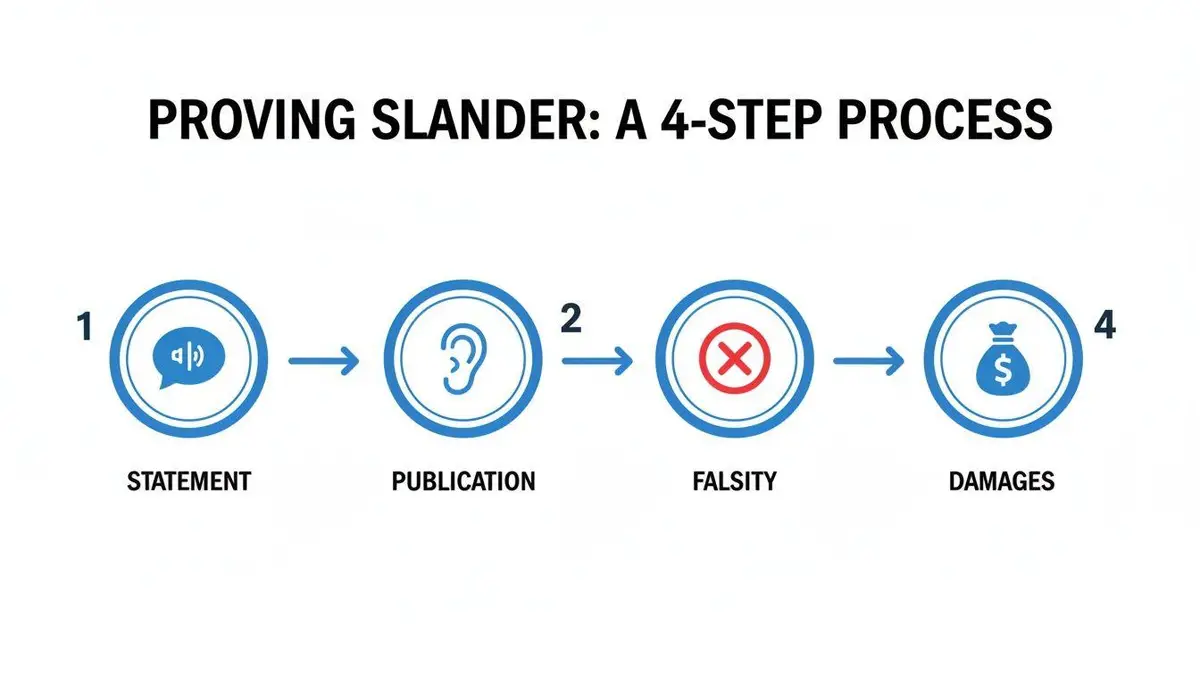
Your evidence must tell a complete story covering the statement, its publication, its falsity, and the damage it caused.
Documenting Publication and Identifying Attackers
Proving slander means showing the statement was “published,” which means at least one other person heard it. Witness testimony is key. You need to find individuals who heard the slander and are willing to provide a formal, sworn statement, an affidavit.
An affidavit from a credible witness is incredibly powerful. For instance, if a competitor made a false accusation about your business during a private conference call, a sworn statement from another person on that call can be the evidence that proves publication.
If the attacker is anonymous, a common problem on social media and online forums, unmasking these individuals is a vital part of building your case. This typically requires filing a “John Doe” lawsuit against an unknown defendant. This legal action allows your attorney to subpoena the platform, compelling it to release user data like an IP address, which can lead you directly to the person responsible. Continuous tracking through professional reputation monitoring is instrumental in these scenarios.
Capturing ephemeral content is a race against the clock. The second you learn about a slanderous audio clip or video, assume it could be deleted within hours. That first 24-hour window is your best, and sometimes only, chance to secure your primary evidence.
Building this dossier is a detailed process. Slander is an injury to your reputation, and like other personal injury claims, it demands a systematic approach to proving harm, a process similar to how one might document a personal injury case. Every piece you collect, from a timestamped recording to a witness affidavit, strengthens your claim and turns a fleeting verbal attack into a solid basis for legal action.
Quantifying the Damage: Putting a Price on Reputational Harm
A slanderous statement is not just an insult. It’s a direct assault on your personal and professional value. For a court to take action, you must prove you have suffered real, tangible harm. This means translating the damage to your reputation, career, or business into quantifiable terms.

Legally, this harm is categorized into special damages and general damages. Documenting both is essential for building a strong case.
Special Damages: Pinpointing Direct Financial Losses
Special damages are the most direct form of harm to prove because they represent specific, calculable financial losses that occurred as a direct result of the slander. This is not about guesswork; it is about drawing a straight line from the defamatory words to a financial loss.
For an executive or a company, this often manifests as clear, undeniable business setbacks. Consider these scenarios:
- Cancelled Contracts: A major client backs out of a signed deal immediately after false claims were made about you at an industry conference.
- Lost Business Opportunities: A promising partnership negotiation suddenly goes cold, and you possess emails or notes showing the other party’s withdrawal was linked to the defendant’s statements.
- Stock Value Decline: If you are a public company, you may see a measurable dip in your stock price immediately following a defamatory podcast interview about your leadership.
Proving special damages requires more than just pointing to the loss. You need to collect contracts, emails, financial statements, and witness testimony that ties the slander directly to the financial impact. A forensic accountant can build an expert analysis that proves causation beyond a reasonable doubt.
General Damages: Measuring Harm to Reputation and Well-Being
General damages are more difficult to quantify but are just as significant. This is the compensation for the harm done to your name, professional standing, and the emotional toll it takes: the anxiety, humiliation, and public ridicule. While you cannot get an invoice for a tarnished reputation, you can show its impact using data.
For a public figure or online creator, earning potential is tied directly to audience metrics. Your legal team can use this data to make a powerful case for significant general damages.
Proving general damages requires showing, not just telling. You must translate reputational harm into a language the court understands: data, trends, and expert analysis that reveal a clear pattern of negative impact.
Key metrics you need to document include:
- Drops in Social Media Engagement: Look for a sudden, sustained nosedive in likes, comments, shares, and follower growth immediately after the slanderous content appeared.
- Sponsorship or Brand Deal Losses: Keep a record of every brand that has paused, canceled, or refused to renew a partnership, especially if they cited the controversy.
- Negative Sentiment Analysis: Use professional monitoring tools to track the volume and tone of online conversations about you. This can prove a quantifiable shift from positive or neutral to overwhelmingly negative.
- Decline in Media Appearances: Note any drop-off in invitations for interviews, speaking engagements, or expert commentary roles that you would have previously secured.
The proliferation of social media defamation means that proving slander today often depends on platform data. Research suggests a high percentage of global users encounter abusive comments that can amplify false claims to millions overnight, making it harder to pinpoint specific damage. This new reality requires sophisticated monitoring to timestamp false statements and quantify their viral reach. You can learn more about these modern threats by reviewing the latest research on global media trends.
When you arm your legal counsel with this detailed evidence, combining direct financial losses with data-driven proof of reputational decay, you build a powerful, undeniable argument. You show that the defendant’s words were not just offensive; they were a direct and costly liability. That is how you win a slander case.
Navigating Jurisdiction and Statutes of Limitation
When someone slanders you, two critical and unforgiving clocks immediately start ticking. The first is the statute of limitations, the hard legal deadline for filing a lawsuit. The second is your window to choose the right court, or jurisdiction, to hear your case. A misstep on either can derail your efforts before they begin.
The Race Against a Punishingly Short Clock
Unlike many other civil claims, the statute of limitations for defamation is notoriously short. In many jurisdictions, you have just one year from the day the slanderous statement was made to file a lawsuit. Miss that deadline by even a day, and your right to sue is extinguished, regardless of the damage or the strength of your evidence.
This tight timeline is a significant risk for executives, creators, and public figures. The clock does not wait for you to assess the full damage; it starts the moment a defamatory podcast goes live or false words are spoken at an industry conference. You cannot afford to wait and see if the problem “blows over.”
I have seen countless strong cases evaporate because the victim hesitated. Waiting a few weeks to see how things shake out can be the costliest mistake you make. The statute of limitations is unforgiving.
Choosing the Right Battlefield: How Jurisdiction Works
The situation becomes more complicated when the person who slandered you is in another state or country. You cannot simply sue them in the court most convenient for you. The court must have authority over the person you are suing, a concept known as jurisdiction.
A court in your state gains jurisdiction over someone from another through what lawyers call “long-arm statutes.” These laws allow a court to reach across state lines if the defendant has sufficient “minimum contacts” with that state.
For a slander case, “minimum contacts” might include:
- The person aimed their false statements at an audience in your state.
- The reputational harm you suffered was centered in your state of residence or where you do business.
- They physically entered your state for an event where they made the slanderous comments.
If a competitor based in Texas gives a podcast interview, knowing it will be heard widely in California, and those comments damage the reputation of a California-based CEO, that CEO can likely sue the competitor in a California court. This can be a massive strategic advantage, as some states have laws, judges, or damage caps that are more favorable to victims of defamation.
Why Every Day Counts
Your choice of jurisdiction and the statute of limitations are directly linked. Since every state has its own deadline for defamation claims, a key part of the legal strategy is finding a court where you can not only win but where you still have time to file.
The table below shows how much these deadlines can vary, highlighting the urgency to act.
Statute of Limitation for Slander in Key Jurisdictions
These timelines are not flexible. They are rigid cutoffs that the courts strictly enforce.
| Jurisdiction | Typical Statute of Limitation for Slander |
|---|---|
| California | 1 Year |
| New York | 1 Year |
| Texas | 1 Year |
| Florida | 2 Years |
| United Kingdom | 1 Year |
Ultimately, knowing how to prove slander is useless if you run out of time to get your case before a judge. The moment you become aware of a defamatory attack, your first call should be to legal counsel. They can immediately map out these critical timelines and help you secure your right to fight back before the clock runs out.
Executing a Takedown and Mitigation Strategy
Once your evidence is organized and the legal timeline is clear, it is time to move from defense to offense. The objective is no longer just to prove slander. It is to actively stop the damage and begin restoring your name. For executives, creators, or anyone in the public eye, this demands a parallel strategy: one part legal pressure, one part aggressive content removal.

This is not about choosing between a lawsuit and a takedown. The fastest and most complete result is achieved by pursuing both simultaneously.
The Strategic Cease and Desist Letter
Your first major move is typically sending a well-armed Cease and Desist letter. Generic templates found online are useless. A proper letter, drafted by your legal counsel, is a powerful strategic tool. It formally notifies the slanderer that their actions have been documented and will have serious consequences.
A strong Cease and Desist letter accomplishes three things:
- It Lays Out the Case: It presents the specific defamatory statements you have proven false, making it clear you have the evidence.
- It Sets the Terms: The letter demands the immediate removal of the content and often requires a public retraction or apology.
- It Builds a Stronger Lawsuit: If the person ignores the letter and continues the attacks, it becomes crucial evidence. It helps prove “actual malice” by showing they were warned the information was false but proceeded anyway.
This letter is a final warning shot. It demonstrates you are serious and gives the other party a chance to back down and limit their legal exposure. Many will comply. A truly determined attacker, however, likely will not.
The Parallel Path of Rapid Content Removal
While the legal process is underway, you cannot let the slanderous content continue to spread online. For anyone whose reputation is their currency, waiting months or years for a court order is not a viable option. The damage will already be done.
This is where a specialized content removal strategy is essential. It is a separate, technical track that focuses on getting the defamatory material taken down at the source, fast.
A lawsuit is about getting compensated for past damages. A rapid takedown strategy is about stopping future harm before it happens. To truly protect yourself, you have to run both plays at once.
This process involves going directly after the platforms hosting the lies: Google, YouTube, social media sites, and gossip forums. A specialist firm does not just use the standard “report” button. It leverages established relationships and deep understanding of platform policies to get high-priority attention on the problem quickly.
A professional takedown strategy works alongside legal action in several ways. First, high-priority channels are used to appeal directly to platforms, building a concise case showing how the content is a clear violation of their terms of service, whether for harassment, defamation, or privacy violations.
At the same time, we work to get the harmful content de-indexed from Google search results. This is critical. Even if a slanderous post remains on an obscure website, making it invisible on Google renders it nonexistent for the vast majority of the public.
Finally, once content is removed, monitoring systems are put in place to watch for its reappearance. If it does, it can often be taken down again within hours.
This parallel approach gives you what a lawsuit cannot: immediate damage control. When handled by experts, defamatory content can often disappear in days, not years. This is especially important when dealing with targeted attacks like defamatory blog posts, a particular threat for executives. By combining legal force with technical skill, you seize control of the narrative and start the real work of repairing your reputation.
Common Questions About Proving Slander
Even with a clear plan, the reality of fighting slander can feel overwhelming. For executives, creators, and public figures under intense scrutiny, the uncertainties are often the most paralyzing. These are frequent questions from our clients, addressed here with direct answers.
What If the Slanderer Is Anonymous?
Anonymous online attacks are a classic tactic, designed to cause maximum damage with zero personal risk. However, anonymity is a hurdle, not a shield from accountability.
Unmasking an anonymous attacker is a methodical legal process. It begins when your attorney files a “John Doe” lawsuit against the unknown person. This action unlocks the next step: petitioning the court for a subpoena. That subpoena is then served to the platform where the slander occurred: a social media network, a review site, or a forum.
The platform is then legally compelled to provide identifying information tied to the account, most often an IP address. From there, the IP address can be traced back to the individual. Your anonymous attacker becomes a named defendant, legally responsible for the harm they caused. This process is a powerful way to turn the tables and prove that hiding behind a fake username does not grant immunity.
Is a Retraction Enough to Stop Legal Action?
It is a common tactic: the person who slandered you offers a retraction, hoping to make the problem disappear. While a retraction might be part of a final settlement, it is almost never sufficient on its own, and it does not undo the damage.
A false rumor about an executive’s ethics could kill a multi-million dollar deal long before a quiet retraction is posted. A viral lie can permanently tarnish a creator’s reputation with millions of followers, making a later correction feel like a whisper in a hurricane. The damage is already done.
A retraction is an admission of wrongdoing, not a get-out-of-jail-free card. It can help stop further damage, but it does not absolve them of liability for the wound already inflicted. Your legal claim remains very much alive.
In some jurisdictions, a retraction might only limit the type of damages you can claim, not your fundamental right to sue. Your legal team will help you weigh whether accepting a retraction, and under what specific terms, aligns with your goals of restoring your name and recovering your losses.
What Are the Real Costs of Pursuing a Slander Claim?
Pursuing a slander claim requires a serious investment. The costs can vary dramatically based on the complexity of the case, so a frank discussion about the budget with your legal and reputation advisors is imperative from the start.
Typical costs include:
- Attorney’s Fees: Most common are hourly rates or flat fees for specific stages of the process. Contingency fees are rare in defamation cases.
- Investigative Costs: This includes hiring digital forensic experts to preserve evidence, private investigators to locate anonymous defendants, and forensic accountants to calculate your financial losses.
- Court and Filing Fees: Every lawsuit has standard administrative fees for filing motions and other documents with the court.
- Expert Witness Fees: If your case proceeds to trial, you will need to pay for expert testimony from professionals who can authoritatively speak to the court about the reputational and financial harm you’ve suffered.
The cost is not just financial; it is an emotional and mental drain. For many of our clients, however, the cost of inaction is infinitely higher. Allowing a lie to fester can destroy a career, a brand, or an entire business. A strategic lawsuit is an investment in protecting your most valuable asset: your reputation.
When your reputation is on the line, you need a team that combines legal insight with rapid, decisive action. ContentRemoval.com specializes in protecting high-profile individuals by removing defamatory content at its source and providing the strategic support needed to navigate complex slander cases. If you are facing an attack, contact us for a confidential assessment.
Frequently asked questions
Is a defamatory YouTube video or podcast slander or libel?
Usually libel. Although the words are spoken, recorded content that can be replayed has the permanence of written text, and courts often classify it that way. The classification matters because libel damages are often presumed for serious accusations, while slander can require proof of specific financial loss.
How do I preserve evidence of something said about me on a livestream?
Capture it immediately with an authenticated recording that carries verifiable timestamps, record the whole broadcast rather than a snippet, and have it transcribed by a certified service. Identify witnesses who heard it and obtain sworn affidavits. Assume the content could be deleted within hours, so the first 24 hours matter most.
Does a retraction end a slander claim?
Rarely on its own. A retraction may be part of a settlement and can limit further harm, but it does not undo damage already done, such as a lost deal or sponsorship. In some jurisdictions it only limits the type of damages available rather than the right to sue, so weigh its terms with counsel.