
Getting a Glassdoor review removed depends on proving a Community Guidelines violation, not on showing the review is unfair. Glassdoor removes content for breaches such as private company information, defamation, abuse of its one review per year per company rule, or paid and coerced posting. Legal escalation, including a subpoena to identify an anonymous poster, is a separate second stage.
Key facts
- A review marked Removed on Glassdoor violated Community Guidelines and is no longer visible.
- Glassdoor removes reviews where it finds abuse of its one review, per year, per company worked at rule.
- Employer responses and removal requests are separate paths and should not be managed as one.
- Identifying an anonymous reviewer may require a subpoena or court order before pursuing removal.
Where ContentRemoval.com comes in. ContentRemoval.com handles Glassdoor reviews that name leadership, disclose internal matters or appear coordinated: auditing the post for identity and duplicate-posting breaches, packaging evidence without creating a fresh confidentiality problem, filing the single strongest guideline argument, and coordinating with employment or defamation counsel when moderation fails. General counsel, HR leadership or the founder usually makes contact. A free 15-minute Exposure Scan maps what is removable and the report is yours to keep. Get a Free, Confidential Exposure Scan or read how our review removal work is done.
A bad Glassdoor review rarely arrives at a convenient time. It shows up before a board meeting, during an executive hire, in the middle of fundraising, or just as a sensitive internal issue is settling down. The problem isn’t only the text itself. It’s the uncertainty. You don’t yet know whether you’re dealing with a disgruntled former employee, a fabricated post, a coordinated pressure tactic, or a review that will survive every internal challenge the platform offers.
That uncertainty is where most companies make their first mistake. They react emotionally, file a vague complaint, and hope Glassdoor sees the situation the way they do. It won’t. If you want a Glassdoor review removed, you need to treat the matter as a structured reputation-risk event. That means identifying the right track from the start: platform policy enforcement or legal escalation. Confusing those tracks wastes time and often hardens the problem.
The Moment a Malicious Review Appears
The typical sequence is predictable. A CEO gets forwarded a screenshot by HR. General counsel asks whether the statements are false. The talent team worries candidates have already seen it. Someone suggests “reporting it to Glassdoor,” as if the platform will make a common-sense judgment based on obvious unfairness.
That’s not how this works.
If the review is malicious, false, or strategically timed, you’re not dealing with a mere customer-service issue. You’re dealing with a reputational record on a high-visibility employment platform. It affects recruiting, executive credibility, internal morale, and sometimes litigation posture. When a review appears to target leadership personally or disclose internal matters, the issue moves out of routine employer branding and into risk management.
The first hours matter because your response posture gets set immediately. A disciplined team will preserve the evidence, restrict internal speculation, and assess whether the post fits a policy challenge or requires legal preparation. A sloppy team argues in Slack, contacts the wrong people, and creates discoverable commentary that later complicates the matter.
What executives usually get wrong
Most organizations focus on whether the review is “true.” That’s understandable, but it’s often the wrong first question. The immediate questions are narrower:
- Is there a clear policy breach that a moderator can verify from the post and supporting evidence?
- Is the reviewer likely authentic under Glassdoor’s rules for who may post and how often?
- Does the post create legal exposure because it alleges misconduct, names individuals, or includes confidential facts?
If you don’t already have a monitoring process for review platforms, fix that now. A discreet reputation monitoring system gives leadership warning before a harmful post begins shaping hiring conversations and executive perception.
A malicious review is rarely isolated. It often appears alongside broader employee-relations strain, exit disputes, or reputation attacks that need to be mapped, not merely answered.
The right mindset
You’re not trying to win an argument with an anonymous reviewer. You’re trying to remove harmful content if the rules allow it, preserve optionality if they don’t, and control the downstream effect either way. That requires precision, not indignation.
Understanding Glassdoor’s Grounds for Removal
The central fact is simple. Glassdoor’s removal policy is narrow. The company states that content is removed for strict policy violations, not just because a review is negative, and its help center says a review marked “Removed” violated Community Guidelines and is no longer visible on the platform, as stated in Glassdoor’s review removal guidance.
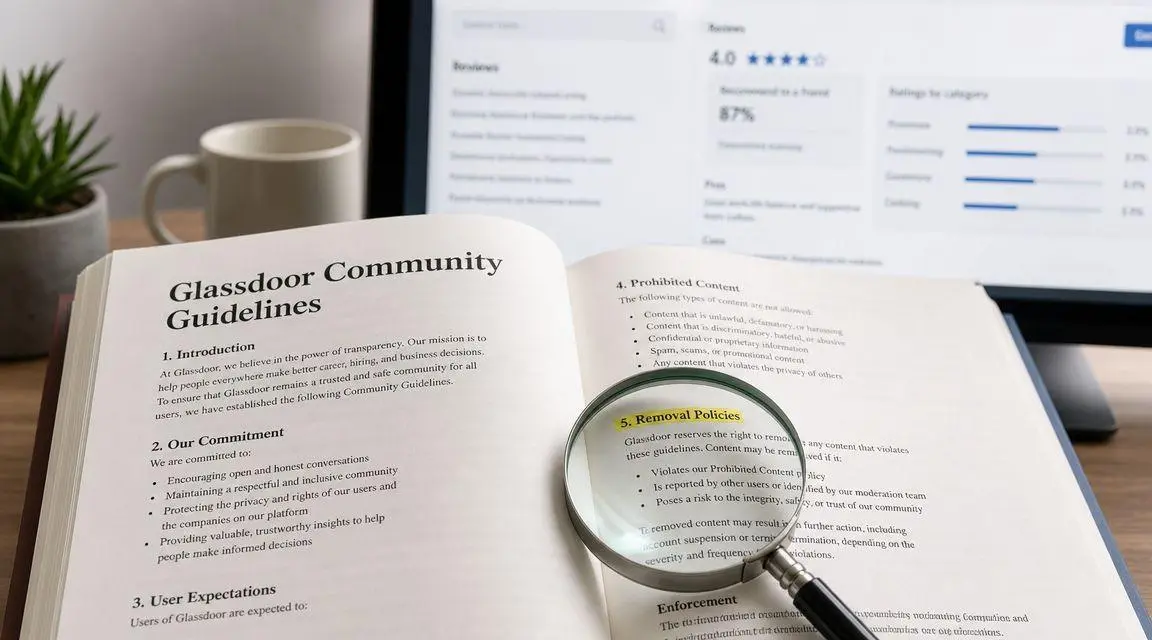
That single point eliminates most amateur takedown efforts. Executives often believe a false or unfair review should obviously come down. Glassdoor’s system doesn’t start from fairness. It starts from guideline compliance. If your complaint is “this is misleading and damaging,” but you can’t tie it to a concrete rule violation, you’re asking the platform to make a discretionary call it is not designed to make in your favor.
What Glassdoor is actually evaluating
A moderator isn’t deciding whether your company has been treated unfairly. A moderator is deciding whether the reported content violates a rule. That’s a different exercise.
The strongest grounds usually involve issues such as:
- False claims framed in a way that supports a rule-based challenge
- Defamation
- Private company information
- Other explicit Community Guidelines breaches
An employer response is a separate option from removal. That matters strategically. If moderation doesn’t result in deletion, Glassdoor notes that employers can still respond through an employer account. Response and removal are not the same path, and they shouldn’t be managed as if they were.
The misconception that causes most failures
The weakest removal request says, in effect, “This review is negative and inaccurate.” That language is too subjective. It tells the moderator how you feel, not what rule was broken.
Use a stricter frame instead:
| Wrong approach | Better approach |
|---|---|
| “This review is unfair.” | “This review discloses private company information prohibited by the platform’s guidelines.” |
| “This former employee is lying.” | “The post contains a specific false allegation that is defamatory and supported by attached contradictory records.” |
| “Please remove this negative review.” | “Please review this post for a documented guideline breach.” |
Practical rule: Don’t ask Glassdoor to referee sentiment. Ask it to enforce its own rules.
What this means for strategy
If the review is merely harsh, critical, or embarrassing, removal may not be available. That’s frustrating, but it’s better to know it immediately than to spend days escalating a nonstarter. The right test isn’t whether leadership dislikes the review. It’s whether the content can be mapped to a moderator-verifiable violation.
That distinction is where serious reputation teams separate themselves from internal comms staff improvising under pressure. A proper review analysis reads like a policy memo, not a rebuttal.
Executing a Policy Violation Takedown Request
A takedown request should be run like a controlled filing, not a complaint form. The goal is to make the moderator’s decision easy. Identify one primary violation, support it cleanly, and avoid burying the issue under emotional language.
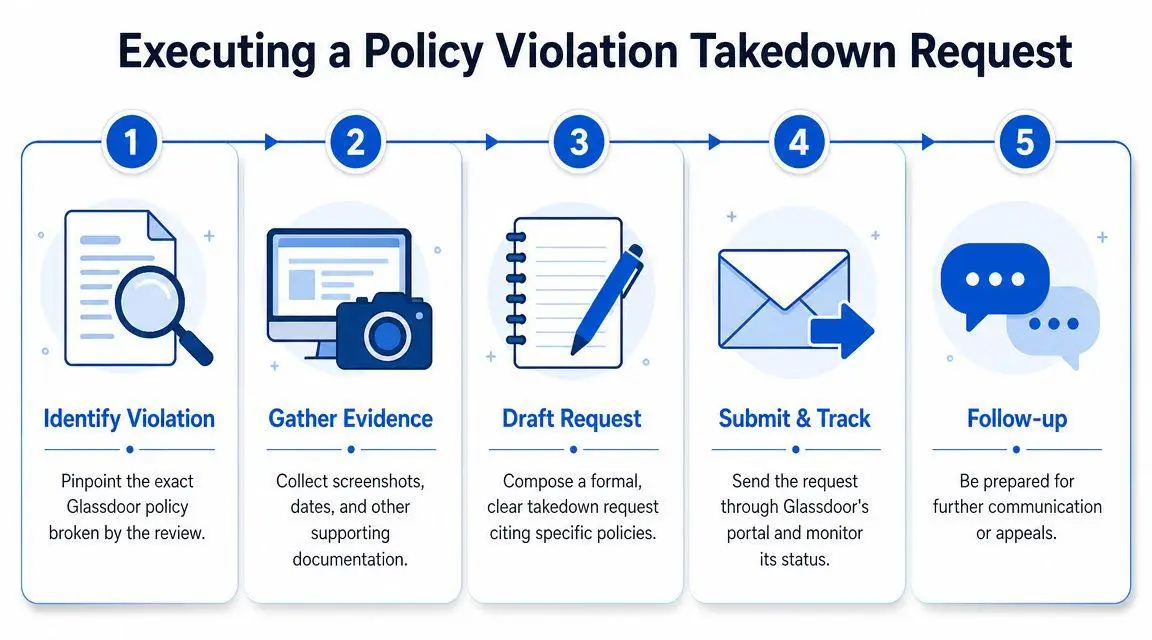
Glassdoor’s employer help center states that reviews are removed when the company finds evidence of abuse of its “one review, per year, per company worked at” rule, which makes a policy-violation audit the highest-yield route. In practice, teams should check for duplicate submissions, reviewer employment-history mismatch, and similar breaches before filing, as described in Glassdoor’s employer guidance on negative reviews.
Start with an audit, not a narrative
Before you submit anything, examine the review as if you were preparing a brief:
- Check identity plausibility
Does the claimed role, tenure, geography, or business unit match reality? If the reviewer describes a team that doesn’t exist or a location where you have no operations, that matters. - Check for rule abuse patterns
The duplicate-review issue is often overlooked. If the same person appears to be posting more than allowed under Glassdoor’s stated rule, that can be stronger than arguing over tone. - Check for content-specific violations
Look for confidential details, naming individuals improperly, or factual allegations that can be disproven without exposing additional sensitive material.
A well-run audit narrows the filing to a single strongest basis. That’s not cosmetic. Moderators work faster when you don’t make them sort through six weak arguments to find one valid one.
Here is a useful overview before submission:
How to draft the request
Most failed submissions are too long. The best ones are concise and documentary.
Use this structure:
- Identify the specific review by date, title, and any visible identifiers.
- State the rule violation plainly in the first sentence.
- Attach only supporting material relevant to that violation.
- Avoid motive arguments unless they directly support the rule breach.
- Do not threaten litigation inside a routine moderation request unless legal counsel has decided that escalation is already underway.
The moderator doesn’t need your outrage. The moderator needs a clean reason to act.
What to avoid
A poor filing usually contains one or more of the following errors:
- Stacked accusations that dilute the strongest point
- Internal commentary about employee loyalty or culture
- Unsupported claims that the reviewer was “obviously fake”
- Excessive rebuttal to every sentence in the review
A good request is clinical. If the objective is a Glassdoor review removed from public view, the filing should read as if you expect it to be screened by someone who knows nothing about your company and has no reason to favor you.
Gathering and Preserving Critical Evidence
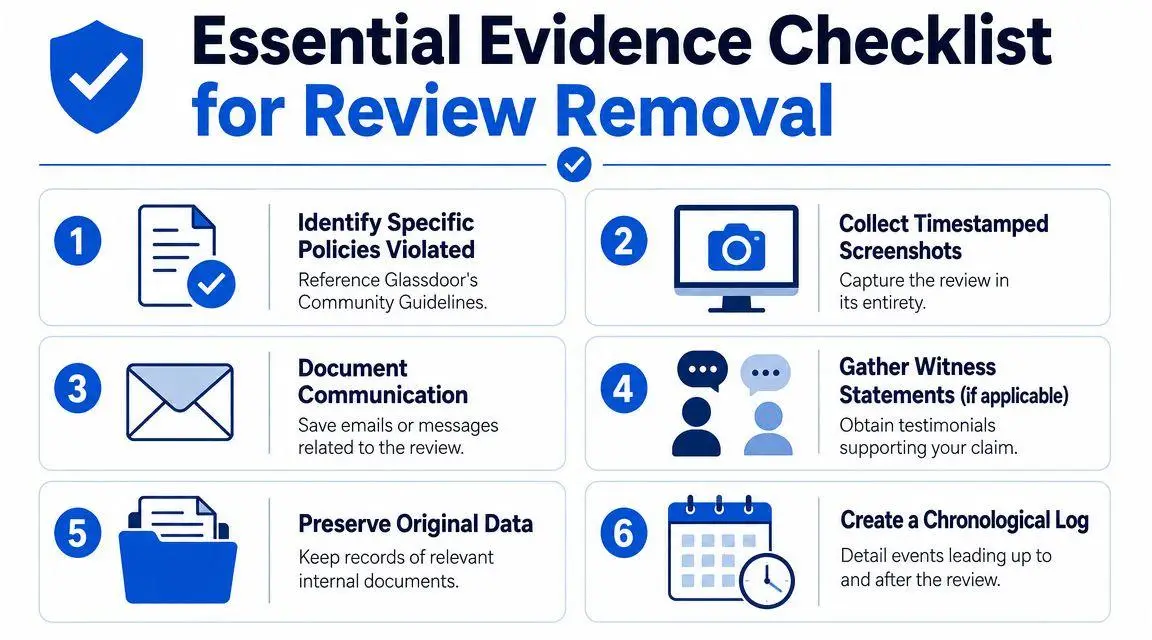
Once a harmful review appears, your evidence file should start immediately. If you don’t preserve the review as posted, you lose control of the factual record. That matters for moderation, counsel review, and any later dispute over what was published.
Glassdoor’s Community Guidelines indicate that the platform will remove reviews where there is evidence of paid or coerced posting, and its contribution rules allow certain user posts to be edited or deleted within 15 minutes of posting, or at any time if posted using a full name, according to Glassdoor’s Community Guidelines. Operationally, that means early evidence capture matters because the window for some user-side changes is short.
What belongs in the case file
Your internal file should be organized for two audiences: a moderator and, if necessary, outside counsel. That means every item should answer a specific question.
Include materials such as:
- Timestamped screenshots of the review in full, including visible date and surrounding page context
- A preservation log recording when the review was discovered and by whom
- Relevant internal records that disprove factual allegations without exposing unrelated confidential information
- Communications suggesting coercion or payment, if that issue exists
- Employment-history contradiction evidence where the claimed reviewer identity or tenure appears implausible
Don’t over-collect. A bloated file is almost as bad as a thin one. Evidence should be curated, labeled, and directly tied to the claimed violation.
How to prove without oversharing
Executives often create new problems. They try to disprove a review by disclosing internal personnel details, compensation information, or investigative records. That’s reckless. You can support a challenge without turning the moderation request into a secondary confidentiality breach.
Use a disciplined evidence standard:
| Evidence type | Why it helps | Common mistake |
|---|---|---|
| Screenshot archive | Preserves exact wording and context | Cropping out identifying details or dates |
| HR or operational record excerpt | Rebuts specific factual claims | Sharing more employee data than necessary |
| Chronology memo | Clarifies timing and sequence | Mixing facts with speculation |
| Communication archive | Supports coercion or coordination theory | Including irrelevant internal chatter |
Preserve first. Analyze second. Submit third.
The specific issue of manipulated reviews
If you suspect the review was paid for, coordinated, or coerced, document the basis carefully. Don’t make that allegation casually. It should rest on messages, payment solicitations, pressure campaigns, or matching conduct that points to organized misuse.
The same applies to authorship disputes. If the post appears impossible based on role, office, or period of employment, show the inconsistency directly. Don’t ask a moderator to infer it from your confidence.
A review challenge succeeds when the evidence file converts your position from opinion into a document-backed claim.
Legal Recourse and Advanced Escalation
When moderation fails, the question becomes whether the matter is merely unpleasant or legally actionable. Those are different categories. Not every hostile review justifies legal process. Some do.
Independent legal analysis notes that Glassdoor typically routes disputed content through moderator review, and when the reviewer’s identity matters, a party may need a subpoena or court order to identify the poster before pursuing removal or amendment. In serious matters, that creates a two-stage process: establish platform-policy grounds first, then move into legal process if internal remedies don’t resolve defamatory content, as discussed in Vorys’ analysis of false and defamatory Glassdoor reviews.
Platform action versus legal action
These routes should be compared soberly.
| Route | Best use case | Limitation |
|---|---|---|
| Platform moderation | Clear guideline breach that Glassdoor can evaluate internally | Won’t solve every false or malicious post |
| Legal escalation | Defamation, identity issues, or serious harm requiring formal process | Slower, costlier, and more demanding evidentially |
An appeal to a platform is still a platform process. A subpoena is not. Executives often blur these categories and lose momentum by assuming one naturally converts into the other. It doesn’t. Legal escalation requires counsel, a theory of the case, and a clear objective.
When legal escalation is justified
Legal process becomes more plausible when one or more of the following are present:
- A serious defamatory allegation that goes beyond opinion
- Anonymity that matters materially to the claim or defense
- Collateral damage involving investors, regulated relationships, key hires, or named executives
- Repeated failed moderation attempts despite a documented and supportable position
If you’re evaluating next steps, this deeper guide on how to remove defamatory content from the internet provides the broader framework executives need before involving counsel and formal process.
A failed moderation request doesn’t end the matter. It simply tells you the platform won’t resolve the dispute on the materials presented.
What legal counsel will need from you
Counsel can’t operate on indignation alone. They will ask for the preserved review, the factual rebuttal, the moderation history, the identity issue if relevant, and the business consequences. If anonymity is central, the procedural path may involve seeking information through court-backed tools rather than trying to pressure the platform informally.
That’s why the evidence discipline discussed earlier matters. A badly documented case makes legal escalation more expensive and less predictable.
Deciding When to Engage Professional Removal Services
At the C-suite level, the core question isn’t whether your team can click the report function. It’s whether your organization should be spending executive time on forensic review analysis, evidence packaging, moderation strategy, legal coordination, and follow-through. In low-stakes situations, internal handling may be fine. In sensitive ones, it’s usually a false economy.
The market around review removal is noisy for a reason. A 2024 industry article on whether Glassdoor removes negative company reviews argues that the platform’s business model raises questions about impartiality, while also discussing review manipulation concerns after layoffs. The same article notes that Glassdoor warns users not to trust paid services claiming they can guarantee removal. That warning is justified. Serious clients should be skeptical of anyone promising certainty where platform rules and legal thresholds plainly control the outcome.
When outside specialists become necessary
Professional intervention is warranted when the matter has one of three characteristics: complexity, sensitivity, or consequence.
Complexity means the review isn’t a simple false post. It may involve identity questions, duplicate-posting analysis, evidence of coordination, or legal overlap. Sensitivity means the target is a founder, public company executive, regulated professional, or family office principal. Consequence means the review affects hiring, transactions, litigation posture, or broader brand confidence.
In those cases, the right advisor doesn’t just file reports. The advisor decides which lane to use, what evidence to surface, what not to disclose, and when to stop treating the matter as moderation and start treating it as a formal dispute.
What to look for in a provider
If you engage outside help, use hard criteria.
- Policy fluency
They should understand the difference between a weak fairness complaint and a viable platform-violation argument. - Evidence discipline
They should know how to assemble a record that supports moderation without creating fresh exposure. - Legal coordination
They should work cleanly with employment counsel or defamation counsel when the case crosses into formal process. If your issue overlaps with a labor dispute or workplace claim, it may also help to find an employment lawyer in Mississippi or in the relevant jurisdiction to align the review strategy with the underlying employment facts. - Discretion
Executives don’t need a loud vendor. They need a team that can act discreetly and keep internal handling tight.
One option executives evaluate is professional content removal services for high-stakes cases, particularly when review issues sit alongside defamation, impersonation, or wider reputation attacks. The point isn’t outsourcing judgment. It’s preserving it.
The practical decision
If your team has already filed once and failed, don’t keep resubmitting variations of the same weak argument. If the post names leadership, alleges misconduct, or appears coordinated, don’t let middle management improvise the response, and if the review is one part of a wider reputational pattern, don’t isolate it from the larger problem.
A successful Glassdoor review removed outcome depends less on outrage than on route selection. The companies that handle this well understand that from the first day.
If a Glassdoor review is false, malicious, or strategically damaging, ContentRemoval.com can assess whether the right path is platform enforcement, legal escalation, or a coordinated reputational response. The first step is a confidential review of the post, the evidence available, and the business risk if it remains live.
Frequently asked questions
Will Glassdoor remove a negative review just because it is false?
No. Glassdoor’s moderators enforce Community Guidelines rather than judge fairness or accuracy. A complaint that says the review is negative and inaccurate is too subjective. The request has to map the content to a verifiable breach such as private company information, a defamatory factual allegation supported by contradictory records, or reviewer rule abuse.
How do I find out who wrote an anonymous Glassdoor review?
Glassdoor will not tell you. Where the poster’s identity matters materially to a defamation claim, counsel may need to seek a subpoena or court order, which is a formal legal process rather than a platform request. That is why cases typically run in two stages: platform-policy grounds first, then legal process if needed.
What evidence should I collect before reporting a Glassdoor review?
Timestamped full screenshots with visible date and page context, a preservation log noting who found it and when, internal records that rebut specific factual claims without exposing unrelated employee data, and any messages suggesting coercion, payment or duplicate posting. Curate the file to the single violation you are claiming rather than over-collecting.