
An employee reputation management service for executive-level risk does more than track sentiment. It identifies harmful content from hostile current or former staff, preserves evidence, removes what can be removed through platform policy or legal routes, de-indexes what lingers, and monitors for reuploads. It covers leaks, defamation framed as whistleblowing, doxxing, impersonation and coordinated review attacks.
Key facts
- Leaks, false accusations, doxxing, impersonation and review campaigns each need a different first move.
- The four pillars are proactive monitoring, rapid containment, content remediation and crisis recovery.
- US defamation law sets a high bar, while EU privacy rights offer more accessible removal routes.
- Specialists start meaningful action on leaks or doxxing within a 24 to 48 hour window.
Where ContentRemoval.com comes in. ContentRemoval.com is built for the hostile-insider scenario: leaked documents, fake executive accounts, doxxing pages and orchestrated review campaigns that HR and PR cannot take down. General counsel, a chief of staff or the company’s outside law firm usually makes contact once the material starts to spread. A free 15-minute Exposure Scan maps what is removable across search, social, forums and hosts, and the report is yours to keep. Get a Free, Confidential Exposure Scan or read how our reputation management work is done.
A former employee posts a cache of internal planning documents to an anonymous forum before your board meeting. By the time your general counsel sees it, screenshots are circulating on X, a fake account is messaging partners, and your comms team is drafting language for a problem that isn’t really a communications problem. It’s a containment problem.
That distinction matters. Most companies still treat employee reputation risk as an HR issue, or at most an employer brand issue. That works when the problem is criticism, morale, or a rough Glassdoor thread. It fails when the threat is malicious publication, impersonation, doxxing, or a leak designed to force a reaction.
An employee reputation management service worth retaining for executive-level risk has to do more than monitor sentiment and suggest response copy. It has to identify harmful content quickly, preserve evidence properly, remove what can be removed, suppress what can’t, and prevent re-upload cycles from becoming a standing vulnerability. If you are waiting for your HR team, outside PR agency, and platform reporting forms to align, you are already behind.
When Your Greatest Asset Becomes Your Greatest Threat
You hire talented people because they have access. They know where the sensitive material lives, which internal tensions are real, and which allegations would sound believable to outsiders. When one of those people turns hostile, they don’t need to guess where you are exposed. They already know.
The first hours usually unfold the same way. Leadership sees the visible symptom first: a thread, a post, a review, a document dump, a video clip stripped of context. Internal teams then split into familiar lanes. HR focuses on the employment relationship. Legal asks what can be proven. PR tries to control the message. Security looks at systems. No one owns the full digital perimeter, and no one moves fast enough across platforms, search engines, forum hosts, cached copies, and repost channels.
That delay is expensive. 69% of candidates reject a job offer from a company with a poor reputation, and a negative employer brand can cut engagement by 23% after a negative event. Those figures are usually discussed in recruiting contexts. In practice, they also signal something more serious. Public employee-originated attacks don’t stay in the hiring lane. They spill into investor confidence, customer diligence, executive credibility, and internal stability.
Harmful employee content is not feedback to be managed. It is exposure to be neutralized.
A standard employer branding program can respond to reviews and promote positive culture stories. It cannot reliably pull leaked files from search visibility, shut down impersonation accounts, or coordinate legally defensible takedown actions across multiple jurisdictions. That requires a different discipline.
An executive should treat this category of risk the way they treat a cyber incident. Not every hostile employee post is a crisis. Some are lawful criticism and should remain untouched. But once the conduct crosses into defamation, disclosure of protected material, targeted harassment, impersonation, or publication of private personal data, the problem is no longer reputational in the soft sense. It is operational, legal, and personal.
Defining the Scope of Employee-Sourced Digital Threats
Most executives underestimate the range of what a hostile current or former employee can do online because they frame the issue too narrowly. They think “negative review.” What they face is, in fact, broader and more dangerous.

Leaks, dumps, and strategic disclosures
The most obvious category is unauthorized publication of internal material. That can include strategy decks, customer lists, pricing logic, product roadmaps, internal emails, board papers, or compliance documents. The public often treats leaked material as automatically credible because it appears documentary, even when it is incomplete or misleading.
The damage isn’t limited to embarrassment. A leak can trigger client concern, strengthen a regulator’s interest, weaken a negotiation, or expose a security gap by showing how your organization handles sensitive information.
Defamation dressed as whistleblowing
Some employee-originated attacks are crafted to look protected when they are false factual assertions. The distinction is critical. A former employee can accuse a company or executive of criminal conduct, harassment, fraud, or discrimination in language designed to spread quickly and intimidate a response.
That content is often published in places chosen for friction, not legitimacy: anonymous forums, burner social accounts, review sites, and fringe blogs that scrape and republish one another. If you respond carelessly, you amplify it. If you ignore it, it hardens into the searchable record.
Doxxing and executive targeting
The issue turns personal. Hostile actors sometimes publish executives’ home addresses, family details, private numbers, travel patterns, or children’s information. The motive may be revenge, coercion, or ideological pressure. The risk is obvious. Once personal data enters the open web, it spreads across aggregator sites, discussion boards, and cached search results.
Practical rule: The moment personal identifying information appears alongside hostility or accusation, treat it as a safety issue first and a reputation issue second.
Impersonation and false authority
A rogue ex-employee can create a convincing fake profile in the name of a founder, HR leader, or business unit head. That profile may contact employees, vendors, or partners, spread false statements, solicit confidential data, or interfere with live transactions. This is not rare in high-conflict exits because impersonation gives the attacker reach and plausibility.
Coordinated review and narrative attacks
Review platforms still matter, but not for the simplistic reason most agencies claim. The issue isn’t that a few bad reviews hurt morale. It’s that coordinated false submissions can build a public narrative of instability, abuse, or misconduct that appears independently verified because it shows up in multiple places at once.
A useful way to classify these threats is by operational impact:
| Threat type | Primary risk | Why standard HR response fails |
|---|---|---|
| Leaked internal documents | Commercial and legal exposure | HR can’t remove distributed copies |
| False accusations | Executive and brand credibility damage | Internal investigation doesn’t stop online spread |
| Doxxing | Personal safety and privacy liability | PR has no removal authority |
| Impersonation accounts | Fraud, confusion, partner distrust | Employment remedies are too slow |
| Coordinated review attacks | Recruitment and diligence damage | Platform-by-platform replies don’t contain replication |
A serious employee reputation management service begins with this broader map. If you misclassify the threat, you choose the wrong remedy.
The Four Pillars of Employee Reputation Defense
The right operating model has four parts. If one is missing, the system breaks. Monitoring without removal just tells you you’re under attack. Removal without evidence preservation weakens your legal position. Suppression without monitoring leaves you blind to reuploads. Crisis response without a standing framework creates delay.
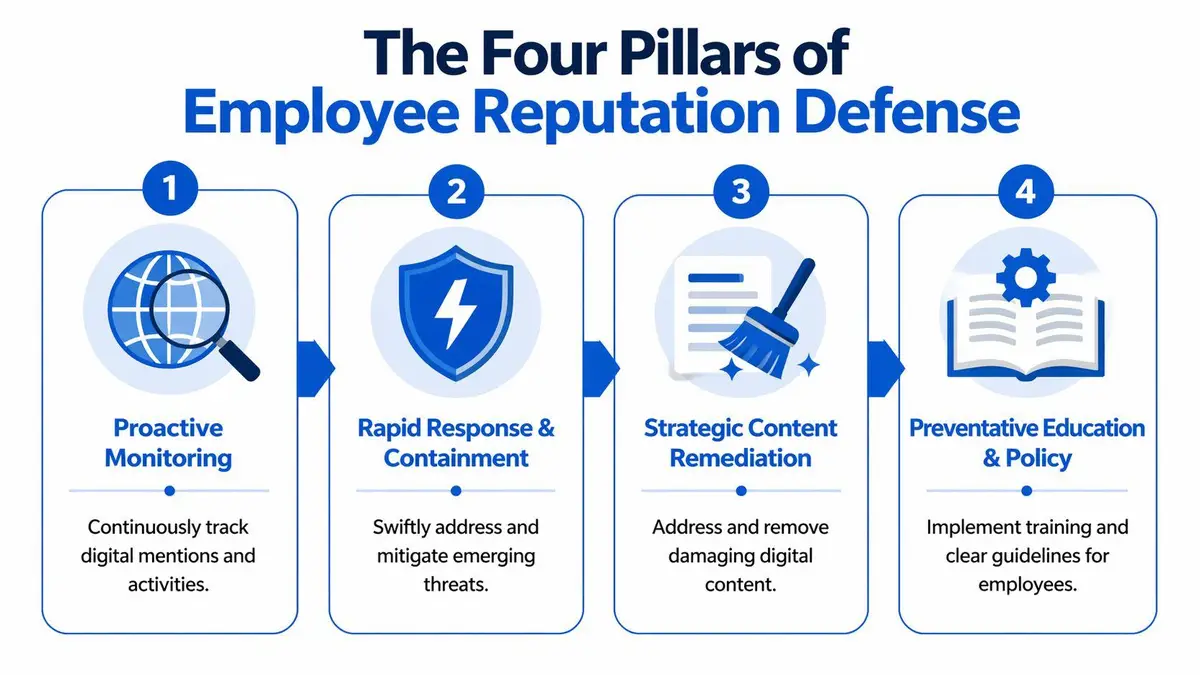
Pillar one. Proactive monitoring
If you’re learning about a hostile post from a colleague’s forwarded screenshot, your monitoring is inadequate. Effective defense starts with continuous observation across search, social, review platforms, forums, paste sites, and relevant dark web surfaces. The point is not merely to collect mentions. The point is to identify escalation patterns before they become public fact.
Tools in this layer often include platforms like ReviewTrackers, Leapsome, Semrush, and Hootsuite, but software alone isn’t enough. Someone has to distinguish lawful criticism from removable abuse, and rumor from provable publication. That requires analysts who understand both platform mechanics and evidentiary standards.
There is one hard technical advantage worth using. Natural language processing can classify employee feedback sentiment with 85-95% accuracy, and proactive intervention has been associated with a 40% reduction in the amplification of negative reviews and a 15-25 point boost in internal sentiment scores. In practice, that means a specialist can spot risk clusters early instead of waiting for a crisis memo.
For organizations that need continuous visibility, a dedicated reputation monitoring program for executive and brand risk is more useful than periodic review audits. The issue isn’t volume. It’s timing.
Pillar two. Rapid response and containment
The second pillar is triage. Not every item should be challenged the same way, and speed matters. A leaked confidential memo, a fake CEO account, and a defamatory post on a review platform each require a different initial move.
The first action is usually preservation. Capture the content, metadata where available, URLs, account identifiers, and visible dissemination paths. Then classify by removability:
- Platform-policy violations: Impersonation, doxxing, harassment, and some forms of manipulated or unauthorized content can often be challenged under platform rules.
- Legal claims: Defamation, copyright misuse, confidentiality breaches, and privacy violations may support host demands, legal notices, or search de-indexing requests.
- Security issues: Fake executive accounts or leaked credentials need immediate coordination with IT and security to stop secondary compromise.
A calm response is not the same as a slow response. In this category, slowness is often the mistake that creates the larger crisis.
Containment also means deciding what not to say publicly. Executives often worsen the problem by issuing broad denials before a factual and legal assessment is complete. Precision beats speed in public statements. Speed beats delay in backend action.
A practical overview helps:
| Scenario | First containment move | Secondary move |
|---|---|---|
| Fake executive account | Report for impersonation and preserve evidence | Notify affected partners privately |
| Leaked internal files | Secure source systems and capture spread points | Pursue host removal and search de-indexing |
| Doxxing post | Document and report under safety/privacy rules | Escalate to counsel and protective services if needed |
| False review campaign | Map account patterns and content overlap | Build platform or host challenge package |
A good response team works these tracks in parallel. Most internal teams don’t.
Before going deeper, it helps to see the framework visually and then in application.
Pillar three. Strategic content remediation
Removal is the center of gravity. It includes several distinct tactics, and they should be chosen based on the content type, host behavior, and legal context.
Some cases call for source removal, meaning the content is taken down at the website, platform, or account level. Others require search de-indexing, where the page remains live in some form but is removed from search visibility for meaningful audiences. In still other cases, the better route is a combined strategy: remove what is removable, de-index what lingers, and suppress residual search prominence with accurate counter-content only where that can be done without drawing further attention.
Mediocre agencies often fail. They treat every problem like a review-management project. High-stakes employee harm demands a more surgical approach. A leaked file needs a different remedy from a false accusation, and a doxxing page needs a different remedy from an anonymous repost on a foreign-hosted site.
Pillar four. Crisis response and recovery
Crisis response begins when the attack threatens enterprise continuity, key relationships, or executive safety. At that point, the service has to function like a command structure, not a marketing function.
A disciplined protocol usually includes these moves in close sequence:
- Assess exposure: Identify what is live, what is cached, and where replication has begun.
- Lock evidence: Preserve records for legal use and future host escalation.
- Prioritize removal targets: Start with the highest-harm nodes, not the loudest ones.
- Coordinate internal actors: Legal, security, investor relations, and leadership need one fact pattern.
- Monitor reappearance: Watch for reposts, mirrors, and new account creation.
Recovery is not a press release. Recovery means reducing visibility, stopping spread, protecting the executive, and narrowing the searchable residue that remains after the incident.
Navigating Global Legal and Privacy Complexities
The legal problem is not just whether content is harmful. The legal problem is where the content sits, who published it, what rights are implicated, and which remedy is available. The same post can be difficult to challenge in one jurisdiction and far easier in another.

The jurisdiction problem
The central mistake companies make is assuming a single legal theory will travel across borders. It won’t. The legal route for removing employee-generated harmful content has to be tailored to the jurisdiction, with the United States applying a high bar for defamation under First Amendment principles and the European Union offering more accessible right-to-be-forgotten mechanisms in appropriate cases.
That difference changes strategy. In the U.S., a blunt defamation threat can fail quickly if the publication is framed as opinion or public concern. In parts of Europe, privacy and data rights may provide stronger influence when personal data, outdated accusations, or disproportionate search exposure are involved.
The legal analysis usually turns on several questions:
- Is the statement opinion or fact? False factual assertions are treated differently from rhetoric or criticism.
- Does the content reveal protected personal data? Doxxing and privacy invasion can support a stronger challenge than mere insult.
- Was confidential material disclosed? Employment agreements, NDAs, and trade secret obligations may matter, but only if handled correctly.
- Is search visibility the main harm? In some cases, de-indexing is the practical remedy even if source removal is difficult.
Evidence can help you, or sink you
A company that rushes into surveillance, covert account access, or overbroad collection can create new liability while trying to solve the old problem. Evidence gathering has to be lawful, targeted, and documented. If your internal team cuts corners, opposing counsel will use that against you.
That is why executives should insist on a structured legal-tech process rather than improvised screenshots and threatening emails. A useful starting point is a strategic guide to online content removal laws for executives, because the remedy often depends as much on procedure as on merit.
The strongest takedown position is usually the one built quietly, with preserved evidence, a clean legal theory, and no unnecessary public confrontation.
Platform enforcement is not a legal afterthought
Platforms do not need a court judgment for every removal. Many harmful employee-generated posts can be challenged through terms of service, impersonation rules, privacy policies, and non-consensual publication standards. But the submission has to fit the platform’s categories and evidence thresholds.
Here is the practical divide:
| Route | Best used for | Common failure |
|---|---|---|
| Platform policy enforcement | Impersonation, doxxing, harassment, policy violations | Filing vague complaints without evidence packaging |
| Search de-indexing | Outdated, privacy-invasive, or disproportionate visibility | Treating de-indexing as source removal |
| Legal notice or demand | Defamation, confidentiality breach, unauthorized publication | Using the wrong jurisdictional theory |
| Court action | Severe, repeated, or noncompliant cases | Starting litigation before lower-friction remedies are tried |
Executives do not need to become experts in all of this. They do need to recognize that employee-sourced digital threats sit at the intersection of speech law, privacy law, platform governance, and crisis management. That is not a lane for generic agency work.
Quantifying the ROI of Proactive Reputation Defense
If you treat this service as a discretionary PR expense, you will underinvest until after the damage is public. The better frame is enterprise value protection.
The easiest line item to understand is hiring cost. Companies with poor corporate reputations pay at least 10% more per hire. That is a direct tax on reputational weakness. It is not theoretical, and it compounds when harmful employee-originated content sits in search results during active recruiting or executive transitions.
Where the return actually shows up
The financial return from a serious employee reputation management service usually appears in avoided loss, not in a glossy dashboard. You won’t always measure it as a single isolated number. You will see it in preserved negotiations, fewer escalations, faster stabilization, and reduced drag on recruitment and retention.
The practical sources of ROI include:
- Lower talent friction: You spend less fighting your own search results in recruiting conversations.
- Reduced legal sprawl: Early removal and containment can stop a narrow dispute from turning into broad litigation.
- Protected counterparties: Clients, lenders, and partners encounter less visible instability during diligence.
- Executive continuity: Leaders spend less time reacting to manufactured crises and more time running the business.
Why prevention beats cleanup
Boards often ask whether they should wait until there is a real incident. That is the wrong question. Once confidential material, false allegations, or personal data have spread, your options narrow. Hosts become less responsive after replication. Search residue becomes harder to clean. Internal disagreement about facts grows.
The cheapest intervention is almost always the one that happens before a hostile post becomes the first thing a stakeholder finds.
A proactive program doesn’t guarantee silence. It provides an advantage. It gives you earlier detection, better evidence, cleaner removal routes, and a narrower blast radius when something does break loose. For a C-suite team, that is not cosmetic. It is defensive infrastructure.
Anonymized Case Studies in Digital Intervention
The value of a specialist becomes obvious when the threat is concrete. The following examples are anonymized and illustrative of common intervention patterns. They are not performance claims, and they are not offered as universal outcomes. They show how the work unfolds.
The sabotaged product launch
A senior engineer left a growth-stage company after a dispute over equity. Days before a product announcement, excerpts from internal roadmap documents appeared on a forum frequented by competitors and industry gossip accounts. The internal reaction was predictable. Legal wanted to know the source. Comms wanted a holding statement. Leadership wanted the material gone.
The correct order was different. First, preserve the postings and identify every visible repost location. Second, separate confidential material from commentary around it. Third, challenge the publication routes most likely to feed search indexing and secondary sharing.
The useful move was not public denial. The useful move was coordinated backend action: host demands tied to unauthorized publication, search-focused remediation, and active monitoring for mirrors. The company avoided turning the leak into a public argument, and the launch proceeded without the leaked materials becoming the dominant search narrative.
The executive impersonation
A former commercial employee created a highly convincing fake profile of a senior executive on a major social platform. The account contacted vendors and external advisers with requests framed as urgent and confidential. At first glance, it looked like a fraud problem. It was also a reputation problem, because each message implied instability inside the company.
The intervention had two tracks. One was platform enforcement based on impersonation and deception. The other was relationship containment: discreetly notifying affected counterparties without broadly signaling panic. The company also had to clean up residual references after screenshots began circulating in private channels.
The key lesson was simple. Impersonation attacks cannot be solved with a press office. They require proof packaging, fast escalation, and tight message discipline.
The coordinated defamation campaign
A terminated manager launched what looked like spontaneous criticism across review sites, discussion threads, and social accounts. In reality, the language patterns, timing, and account behavior suggested orchestration. The content accused leadership of unlawful conduct in terms designed to provoke fear among candidates and current staff.
This was the type of case where emotional response would have been disastrous. The right move was to map the network, isolate repeated factual allegations, distinguish protected opinion from challengeable falsehoods, and build a platform and host case around policy and verifiable inaccuracy.
Not every ugly statement is removable. The job is to isolate the statements that cross the line and attack them with precision.
The campaign lost force once the most damaging nodes were challenged properly and the company stopped feeding the attacker with reactive statements. What remained was manageable because it was no longer the primary version of events a searcher would encounter.
These cases all point to the same truth. The problem is rarely just “bad employee sentiment.” The primary issue is hostile publication. That is why a genuine employee reputation management service must be built around intervention, not optics.
Selecting a Specialist for High-Stakes Reputation Defense
If you are vetting providers under pressure, ignore polished sales language and ask harder questions. Many firms can monitor mentions and draft responses. Very few can handle leaks, defamation, impersonation, and privacy exposure with the discipline those matters require.
The first criterion is integrated legal capability. Not litigation theater. Real understanding of platform enforcement, de-indexing routes, privacy claims, confidentiality breaches, and cross-border constraints. A provider that cannot explain why a piece of content should come down, under which theory, and in which jurisdiction will default to cosmetic suppression.
What to demand in the first conversation
Ask the provider how they would handle three distinct scenarios: a leaked internal document, a fake executive account, and a doxxing post. If the answers sound interchangeable, move on.
Then check for these essentials:
- Confidential operating model: They should be comfortable working under strict NDA conditions and limited internal distribution.
- Evidence discipline: They should preserve and package material properly before beginning takedown action.
- Cross-platform competence: They should be able to act across search, social, forum, host, and review environments.
- Reupload awareness: They should have a plan for recurrence, not just first-instance removal.
A serious executive team should also review a provider’s methodology for evaluating content removal engagements. A practical benchmark is this guide to evaluating professional content removal services for executives.
Speed is not a luxury
One fact separates high-stakes specialists from standard ORM vendors. The decisive differentiator is the ability to remove harmful content like leaks or doxxing rapidly and discreetly, often within a 24-48 hour action window. That doesn’t mean every matter is resolved in that timeframe. It means meaningful action starts there, because waiting invites replication.
Use this simple comparison when evaluating firms:
| Provider trait | Generic ORM agency | High-stakes specialist |
|---|---|---|
| Primary focus | Reviews and brand messaging | Removal, containment, legal-tech execution |
| Response model | Campaign-based | Incident-based and ongoing |
| Legal fluency | Limited | Central to strategy |
| Confidentiality posture | Standard agency workflow | Executive-grade discretion |
| Success definition | Improved sentiment | Reduced visibility and neutralized threat |
The right provider won’t promise miracles. They will give you a clear theory of action, realistic pathways, and strict handling protocols. That is what you need when the content is harmful and the clock is already running.
Conclusion Securing Your Digital Perimeter
When employee-generated content becomes malicious, passive reputation management stops being useful. You do not fix leaks, doxxing, impersonation, or defamatory campaigns with better employer branding language. You fix them with early detection, precise legal and platform action, disciplined suppression where necessary, and sustained monitoring against recurrence.
For executives, founders, and family offices, retaining a specialist is not an admission of crisis. It is what mature risk management looks like when the threat comes from someone who already knows where the vulnerabilities are.
If you need discreet help containing leaked material, removing defamatory employee-generated content, shutting down impersonation, or protecting executive privacy, ContentRemoval.com provides confidential assessments and a clear action plan built for high-stakes digital threats.
Frequently asked questions
What can a former employee legally post about a company online?
Lawful criticism and opinion should generally be left alone. The line is crossed at false factual assertions, disclosure of confidential material, targeted harassment, impersonation or publication of private personal data. Separating protected opinion from challengeable falsehoods is the first step before any removal action.
How do you get a fake executive profile taken down?
Report it under the platform’s impersonation and deception rules with a packaged evidence file: URLs, screenshots, account identifiers and proof of the real identity. At the same time, discreetly notify the partners and vendors the account has contacted, and coordinate with IT in case leaked credentials are involved.
Is de-indexing the same as removing leaked content?
No. Source removal takes the content down at the host or platform. De-indexing removes the page from search visibility while it may remain live. Serious cases often combine both, then add monitoring for mirrors and new accounts.