
An employee data breach response runs three workstreams at once: protect the affected people by locking exposed credentials and pausing payroll changes, preserve evidence with full-page screenshots and logs, and meet notification deadlines. Under GDPR and UK ICO rules, regulators must be told without undue delay, within 72 hours where feasible. Removal from search and leak sites runs alongside.
Key facts
- Verizon’s 2025 DBIR found human involvement in 60% of breaches, so insiders and vendors matter as much as hackers.
- GDPR Article 33 and the UK ICO require regulator notice without undue delay, within 72 hours where feasible.
- Google and Bing personal-information removals reduce discoverability but do not delete the source page.
- Dark-web listings usually cannot be deleted; the goal is reduced distribution, repost tracking and identity protection.
Where ContentRemoval.com comes in. ContentRemoval.com handles the exposure side of an employee data breach: source takedowns from leak and paste sites, search de-indexing of pages showing identifiers and addresses, and open-web and dark-web monitoring for reuploads. Contact usually comes from general counsel, the CISO or an HR leader once staff records surface online. A free 15-minute Exposure Scan maps what is removable and the report is yours to keep. Get a Free, Confidential Exposure Scan or read how our personal data removal work is done.
You’ve just received a call from an HR platform. A file containing employee names, government identifiers, compensation details, or dependent information may have surfaced online. An employee may already have found the material through a search engine, a leak forum, or a dark-web channel. The immediate risk isn’t limited to the original exposure. It includes payroll fraud, identity theft, targeted social engineering, regulatory scrutiny, employee distrust, and a public record that can outlast the incident itself.
Treat an employee data breach as both a privacy emergency and a reputation emergency. The responsible executive response protects affected people, preserves evidence, meets disclosure obligations, and removes exposed material wherever lawful action can limit its reach. Network security is only one part of that work. Insider activity, vendor failures, and ordinary process mistakes deserve the same urgency.
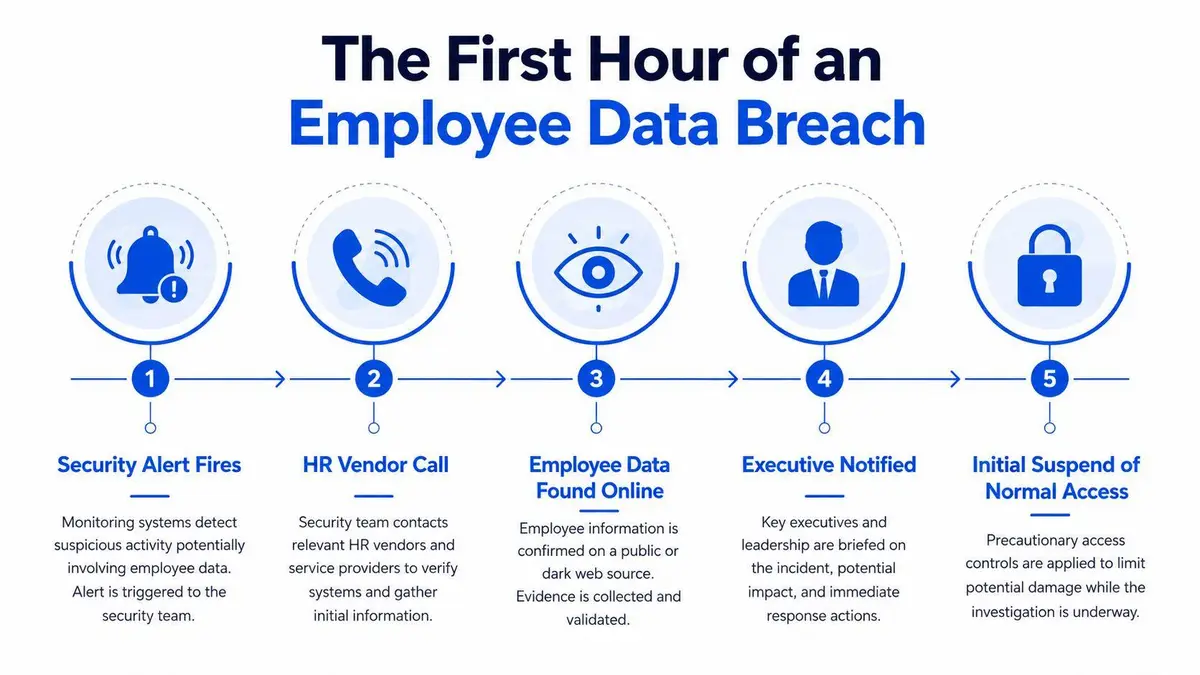
The First Hour of an Employee Data Breach
The first hour begins when a security alert fires, an HR vendor calls, or an employee sends a screenshot of their own information posted online. Don’t wait for perfect certainty before taking protective action. Record the exact time the organization became aware of the suspected exposure, then appoint one incident lead who can coordinate legal, security, HR, communications, and vendor contacts.
Run three workstreams at the same time.
Protect people first. Identify the affected employees and the types of information involved. Lock or suspend exposed credentials, pause unusual payroll or benefits changes, and review active sessions connected to compromised accounts. If an employee’s bank details or identity documents appear in the material, give HR a controlled process for urgent questions rather than allowing anxious staff to route requests through ordinary channels.
Preserve evidence second. Capture screenshots showing the full page, timestamp, URL, account name, and surrounding context. Preserve relevant email messages, vendor notices, endpoint data, access logs, and cloud audit trails. Use a clean device for investigation and limit the number of people who handle the material. Don’t delete the source file or ask a vendor to “clean up” before forensic counsel has established what must be retained.
Stabilize leadership without creating confusion
The CEO needs a concise briefing, not an unverified theory. State what was found, who may be affected, which systems or vendors are involved, what actions are already underway, and when the next update will arrive. Bring external privacy counsel into the response early so investigative decisions, notice analysis, and communications can be handled within an appropriate legal structure.
Practical rule: Keep staff communication minimal but prompt. Tell potentially affected employees that the organization is investigating, identify the approved contact channel, and warn them not to act on suspicious payroll, benefits, or account-change requests.
Don’t circulate a broad internal message that identifies a suspected insider or describes unverified allegations. That can tip off a participant, contaminate evidence, and create avoidable employment and privacy complications. The first hour determines whether the later response looks controlled and defensible, or improvised and damaging.
Where Employee Data Actually Leaks
The outside-hacker narrative is too narrow. Verizon’s 2025 Data Breach Investigations Report analyzed 22,052 security incidents and 12,195 confirmed breaches across 139 countries, finding human involvement in 60% of breaches (Verizon’s 2025 DBIR). That finding should change how executives allocate attention. A perimeter may be well defended while an employee exports a file, a vendor exposes a benefits database, or a recruiter publishes a document to the wrong audience.
Insider misuse has two distinct forms. A malicious employee may copy HR, payroll, or customer records before leaving. A negligent employee may email a spreadsheet to the wrong recipient, approve an unsafe access request, or save sensitive records in a broadly shared workspace. Those events often leave evidence in identity, endpoint, email, and cloud logs, not in the alerts executives usually associate with an external intrusion.
Third-party systems create another concentration point. Payroll providers, benefits administrators, recruitment platforms, background-check services, and HR software may hold extensive employee and dependent information. HackerOne’s disclosed benefits-administration incident exposed Social Security numbers, dates of birth, contact details, and dependent information for 287 employees (the ITRC H1 2025 analysis). The employee experiences the harm even when the employer didn’t operate the affected platform.
Compare the pattern before choosing the remedy
| Leak Pattern | Typical Records Exposed | Detection Difficulty |
|---|---|---|
| Insider misuse | HR files, payroll exports, performance records, customer-linked data | High when activity resembles normal authorized access |
| Third-party HR failure | Identity data, benefits records, dependents, tax and payroll information | High unless vendor logs and notifications are integrated |
| Process failure | Spreadsheets, shared folders, ATS pages, lost-device contents | Variable, often discovered by an employee or outside party |
| External compromise | Credentials, databases, backups, or files reached through compromised access | Dependent on endpoint, identity, and network monitoring |
The operational response must therefore cover more than hacking. Map who can access employee data, where vendors store it, how exports work, and which public-facing pages or repositories can reveal it. For executives and family offices, dark-web monitoring for employee and executive exposure should sit beside access governance and vendor review, not outside the security program.
Containment and Investigation Playbook
Once the exposure is confirmed, the incident lead needs a sequence that prevents well-intended actions from destroying evidence. Start with the blast radius. Identify every system, vendor, integration, administrator, and employee connected to the affected dataset. Freeze those sources in place. Don’t delete files, terminate accounts, or overwrite logs just because they appear suspicious.
Contain identities and access paths
Revoke active sessions for exposed accounts and force password resets where credentials may have been accessed. Rotate API keys, SSO tokens, and integration secrets connected to the affected systems. Disable service accounts touched during the suspected window, but preserve their configuration and activity records before making changes.
Separate containment from eradication. The immediate objective is to stop additional access while investigators determine how the exposure happened. If the suspected cause is an employee action, don’t confront that person before counsel and forensics agree on a preservation and interview plan. Premature questioning can prompt deletion, coordination, or a misleading change in behavior.
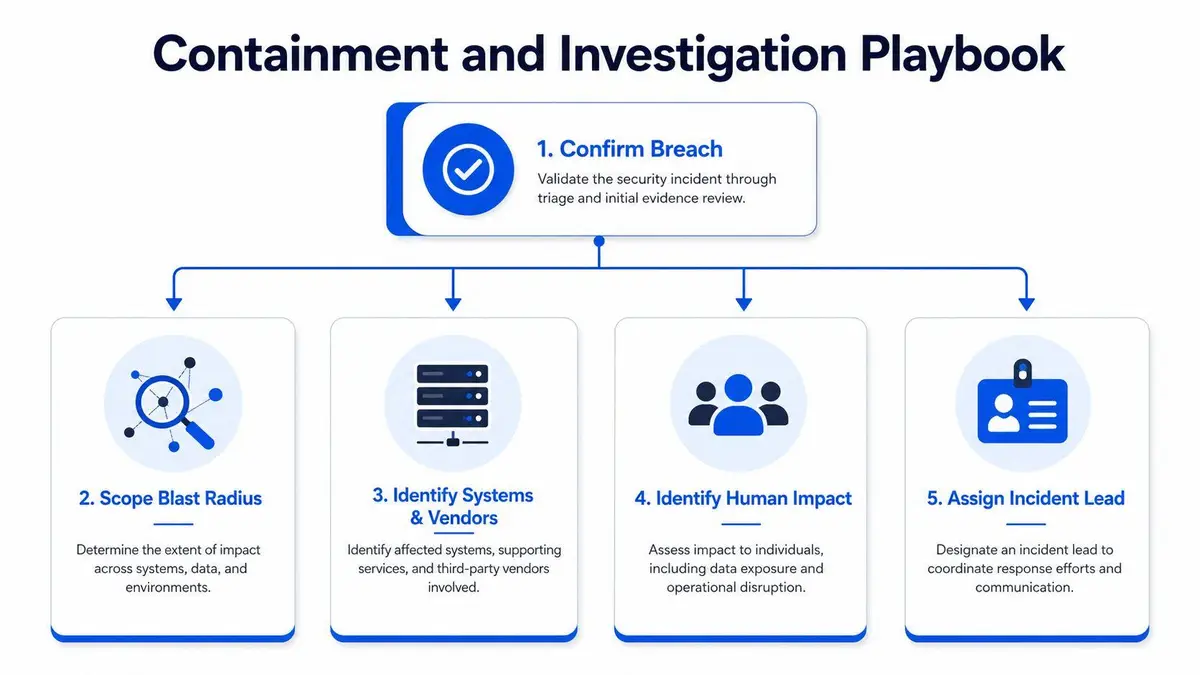
Preserve forensic images of relevant endpoints and export logs with timestamps, integrity checks, and a documented chain of custody. Collect identity-provider records, file-access events, email headers, cloud audit trails, vendor communications, and screenshots of public or dark-web postings. Assign one evidence owner. A fragmented evidence trail makes notification analysis and later litigation harder.
Classify the information before drafting notices
The exposed material may include national identification numbers, compensation, medical details, dependents, performance information, bank data, or credentials. Classification drives the risk assessment, employee support, regulator analysis, and content of any notice. Don’t describe the incident as “employee information” when the affected people need to know whether their tax records, health information, or family data was involved.
Decide early whether the response requires external privacy counsel, a breach coach, forensic investigators, a vendor-management lead, and a specialist who can address open-web and dark-web exposure. Watch for a common failure: treating every employee event as a confirmed malicious act. A compromised credential can look like insider misuse, while a careless process can resemble unauthorized access. The investigation must distinguish the identity used from the person responsible.
Use the following video as a concise visual reference for the response sequence, then adapt the process to the relevant jurisdiction and data categories.
Legal Notification and Disclosure Obligations
The regulatory clock is the hardest deadline in the room. Under GDPR Article 33, a controller must notify the competent supervisory authority without undue delay and, where feasible, no later than 72 hours after becoming aware of a personal data breach (GDPR Article 33). Start the clock at awareness, not at the point when the investigation has reached a comfortable conclusion. Record who learned what, when they learned it, and how that timestamp was established.
The UK ICO applies the same core timing rule for a notifiable personal data breach. The organization should report without undue delay and, where feasible, within 72 hours of becoming aware, explaining any delay (UK ICO breach guidance). Prepare the categories of data, the likely consequences, the affected workforce, and the organization’s contact point while investigators continue refining scope.
Employees may require direct notice as well. Where a breach is likely to create a high risk to employees’ rights and freedoms, the organization must inform affected individuals without undue delay. The notice should explain what happened, the likely consequences, and the protective measures being taken (employee breach notification guidance).
Use a jurisdiction matrix, not a single global script
| Jurisdiction | Regulator | Deadline | Employee Notice Required? |
|---|---|---|---|
| European Union under GDPR | Competent supervisory authority | Without undue delay and, where feasible, within 72 hours | Required when the breach is likely to create a high risk |
| United Kingdom | Information Commissioner’s Office | Without undue delay and, where feasible, within 72 hours | Required where the risk threshold is met |
| United States | State regulator or other authority, depending on jurisdiction | Varies by applicable state law | Depends on the state and the data involved |
A vendor doesn’t take the legal problem away. If a payroll or benefits processor caused the incident, require immediate written facts, preserve the contract and processor notices, and establish who will notify employees and regulators. Legal counsel should also assess contractual duties, employment implications, sector rules, and potential claims. Don’t promise a clean outcome before the facts support one, and don’t delay a legally required notice because the public-relations language isn’t perfect.
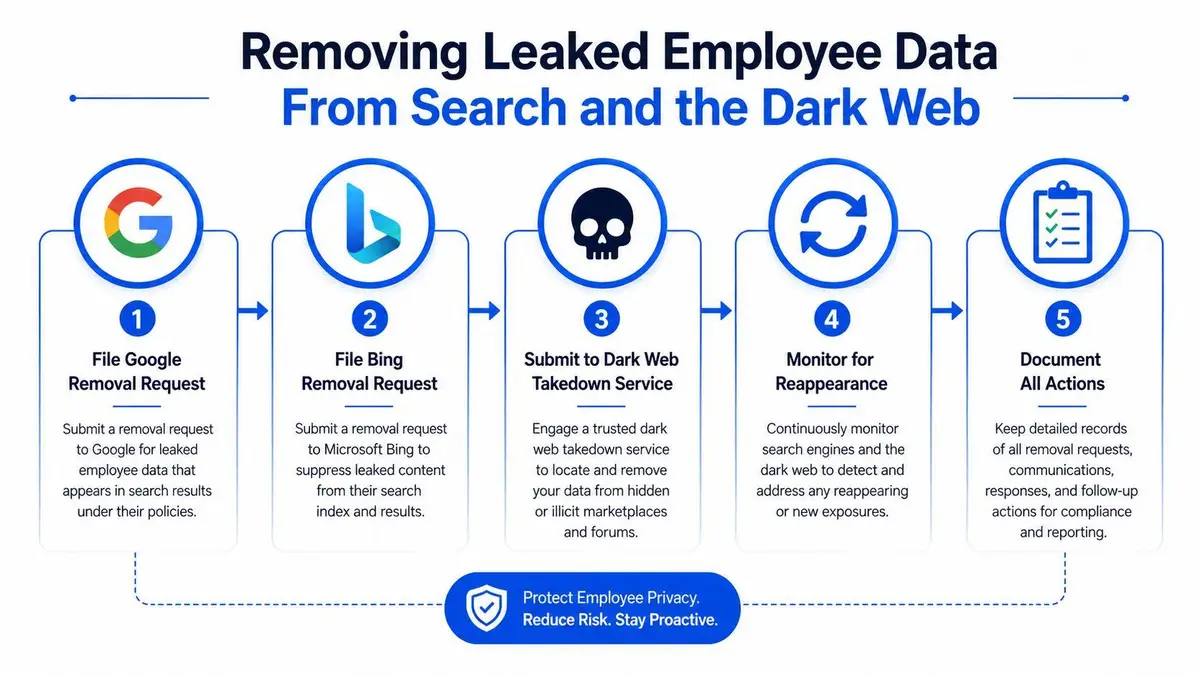
Removing Leaked Employee Data From Search and the Dark Web
Removal is a separate workstream from investigation. Preserve the evidence first, then pursue suppression and source removal in parallel. Begin with the pages that search engines can index, especially those exposing home addresses, government identifiers, bank information, signatures, or direct contact details.
Submit removal requests to Google and Bing under their personal-information policies. A successful delisting reduces discoverability, but it doesn’t delete the source. That distinction matters. Employees may still face direct exposure if the original page remains live, and a copied file can reappear under a different URL.
Work from the source outward
Identify the host through WHOIS information, registrar records, abuse addresses, and the site’s legal contact details. Submit a precise complaint with the affected employee’s information, the exact URLs, screenshots, and the legal basis for removal. Use a DMCA process only where the facts support copyright ownership. For privacy or unlawful-disclosure concerns, use the provider’s abuse process and escalate through counsel when the operator ignores a valid request.
Paste sites and mirrors require separate tracking. Search for the original text, distinctive file names, employee email aliases, and cryptographic hashes. Record every URL, timestamp, screenshot, account name, and response. Don’t repeatedly download sensitive files or forward them through ordinary email. Limit handling and store evidence securely.
Set realistic dark-web expectations
Tor-market listings usually can’t be deleted through a normal customer-support request. The practical objective is to reduce distribution, identify reposts, support law-enforcement engagement, and protect the affected identities. Dark-web monitoring partners and cryptocurrency tracing firms can help connect listings, payment activity, and re-upload patterns, while counsel coordinates preservation and escalation.
Use this strategic guide to removing personal information from Google after a data breach as a reference for the search-engine portion of the process. Then assign an owner to continuous monitoring across keywords, hashes, employee email aliases, breach feeds, paste sites, and leak channels. A takedown without monitoring is temporary containment, not resolution.
Communicating With Staff and Protecting Reputation
A senior executive at a regulated firm discovers that an HR file has appeared on an activist leak site. The file contains sensitive employee information, but the investigation hasn’t established whether the source was a vendor, a compromised account, or an internal export. The executive has three choices: remain silent, deny the exposure, or acknowledge the incident while the facts are being verified.
Silence leaves employees to discover the risk through social media or search results. Denial creates a credibility problem if the material is authentic. Controlled acknowledgment gives the organization room to investigate without pretending that uncertainty means nothing happened.
Sequence the audiences carefully
Affected employees should receive private outreach first. A personal call, signed letter, or secure individual message should explain what information may be involved, what the company has done, what employees should watch for, and how to reach a dedicated response team. A generic blast email is a poor choice when the disclosure involves high-risk personal information.
Leadership needs a structured brief covering known scope, unknowns, legal exposure, operational actions, and approved language. Keep the briefing factual. Don’t allow executives to speculate about an insider, blame a vendor before confirmation, or describe the incident as contained when copies may already be circulating.
Public messaging should wait for factual and legal review, but the company shouldn’t disappear during a material incident. A short acknowledgment can state that the organization is investigating a report involving employee information, has activated its response process, and will communicate directly with affected individuals as facts are confirmed.
Reputation counsel: Employees judge the response through visible action. A careful notice paired with account protection, practical support, and a real contact channel is stronger than a defensive statement designed only to reduce headlines.
The same principle applies to executives whose records appear in the leak. Coordinate personal privacy protection with corporate communications so the company doesn’t unintentionally amplify the material. A reputation-management response after a data breach should address search visibility, source publication, employee trust, media questions, and any ongoing re-uploads as one reputation problem.
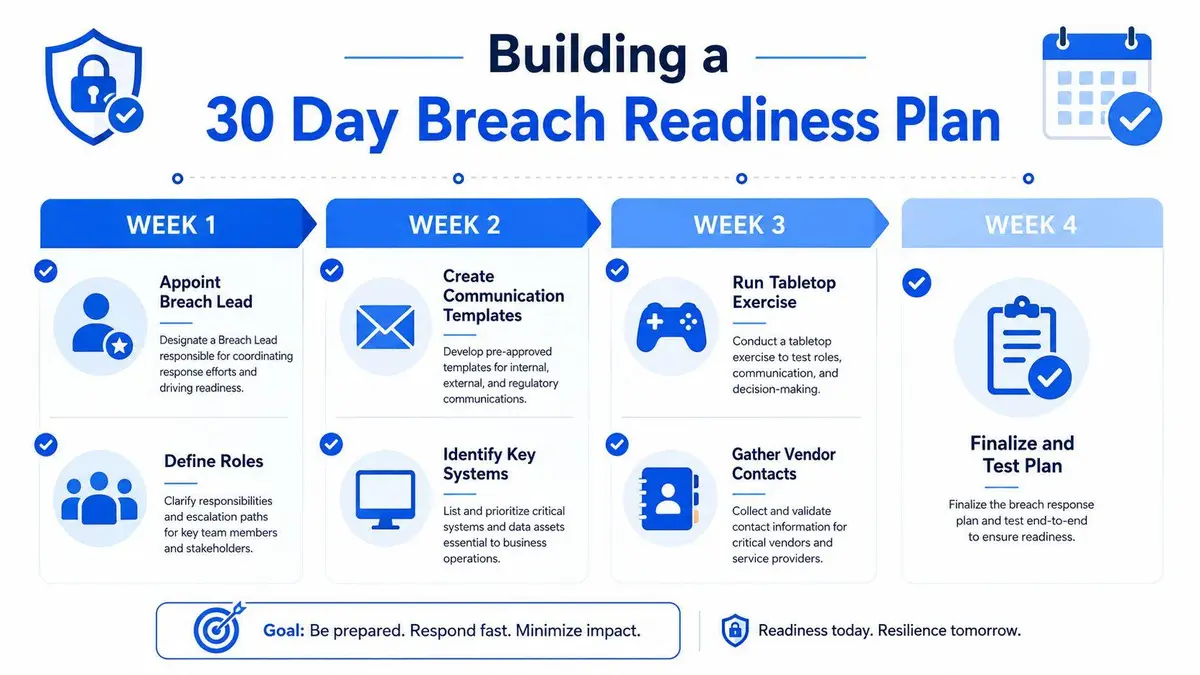
Building a 30 Day Breach Readiness Plan
A company doesn’t need a large security department to create a credible employee-data response. It needs ownership, a current data map, defined escalation rules, and rehearsed decisions. Build the plan over four weeks, with each week producing an artifact that leadership can inspect.
Week one creates accountability
Appoint a breach response owner with authority to convene HR, IT, privacy counsel, communications, payroll, and vendor management. Map where employee information resides across HR systems, payroll, benefits, recruitment, file shares, SaaS platforms, and archived records. For every operating jurisdiction, document the regulator, awareness trigger, notice threshold, and approval path.
Week two closes basic control gaps
Enforce SSO and MFA across staff systems, especially administrative and remote access. Review third-party HR contracts, breach-notification clauses, audit rights, data-retention terms, and escalation contacts. Restrict export permissions on employee databases and review privileged access against actual job responsibilities.
Week three builds visibility
Deploy open-web and dark-web monitoring for staff PII, executive names, business domains, credential dumps, paste sites, and leak channels. Define who reviews alerts, who validates a match, who preserves evidence, and who files removal requests. Rehearse Google, Bing, host, registrar, and platform takedown workflows before an employee discovers their own information online.
Week four tests the plan under pressure
Run a live tabletop exercise involving a leaked employee record. Give leaders incomplete facts, a vendor call, an employee complaint, and a regulator question. Test whether the team can identify the awareness timestamp, revoke access, preserve evidence, classify the data, draft employee notices, and maintain one approved public message.
Escalate to specialist support when employee government identifiers, medical or benefits data, executive records, active credential exposure, suspected insider activity, regulator inquiries, or public leak-site publication is involved. Those conditions require coordinated privacy, forensic, removal, and reputation decisions. ContentRemoval.com offers confidential assessment, open-web and dark-web monitoring, source takedown coordination, and search-result suppression for exposed personal information, with a response designed around the affected employees and the company’s public position.
If staff records have surfaced online, contact ContentRemoval.com for a confidential assessment of the exposed material, search visibility, source publication, and re-upload risk. Visit ContentRemoval.com to obtain a focused action plan for protecting affected employees and containing the company’s reputation exposure.
Frequently asked questions
How quickly do we have to report an employee data breach?
Under GDPR Article 33 and UK ICO guidance, a notifiable breach must be reported to the regulator without undue delay and, where feasible, within 72 hours of becoming aware. The clock starts at awareness, not when the investigation feels complete. US requirements vary by state and by the data involved.
Can leaked employee data be removed from Google?
Google and Bing accept removal requests under their personal-information policies for pages exposing identifiers, bank details, addresses or signatures. A successful delisting reduces discoverability but leaves the source live, so host abuse complaints and monitoring for mirrors and paste-site copies should run at the same time.
Should we confront an employee suspected of leaking data?
Not before counsel and forensics agree on a preservation and interview plan. Premature questioning can prompt deletion, coordination or a change in behavior. A compromised credential can look like insider misuse, so the investigation must separate the identity used from the person responsible.