
Electronic harassment lawyers handle coordinated online abuse by first classifying it as cyberstalking, online defamation, doxxing or nonconsensual image abuse, because each claim needs different proof and a different forum. The work starts with evidence preservation, then theory selection, identification of anonymous actors, a targeted demand, and escalation to protective orders, civil litigation or criminal referral.
Key facts
- Congress amended the federal stalking statute in 2013 to cover electronic and computer communications.
- Counsel preserves message timestamps, platform metadata, IP or device artifacts and communication frequency to prove a pattern.
- Federal cyberstalking can carry up to five years in prison and a 250,000 dollar fine.
- A court order rarely removes copies, reposts, mirrors or search results by itself.
Where ContentRemoval.com comes in. ContentRemoval.com runs the removal track while your lawyer runs the legal one: takedowns, search de-indexing, platform escalation and monitoring for reuploads, coordinated so neither side weakens the other. Clients, their chief of staff or their counsel usually contact us once the attack spreads across several platforms. A free 15-minute Exposure Scan maps what can be taken down, and the report is yours to keep. Get a Free, Confidential Exposure Scan or read how our content removal work is done.
Your phone lights up before breakfast. A fake account has tagged your spouse. A Reddit thread repeats a lie about your business. Someone has posted old photos with your home address. By mid-morning, your assistant has flagged hostile messages on LinkedIn, Instagram, and email. The instinct is to swat at each post one by one. That’s the wrong move.
When digital harassment turns coordinated, you need a controlled response that treats the problem as both a legal matter and an operational risk event. That means preserving evidence before it disappears, choosing the right legal pathway early, and handling removal in parallel so the material doesn’t keep circulating while lawyers argue about jurisdiction.
Responding to a Coordinated Digital Attack
The first hours are disorienting because the attack rarely arrives in one clean form. It comes as impersonation, direct messages, false allegations, reposted screenshots, threat-adjacent language, and sometimes contact with colleagues or family members. Clients often tell me the same thing: the volume is less frightening than the sense that the attacker is everywhere at once.
That feeling is real, and it follows a pattern professionals recognize. Pew Research Center reported that 41% of U.S. adults had experienced at least one of six forms of online harassment, and 25% had faced more severe forms such as physical threats, stalking, sexual harassment, or sustained harassment, up from 15% in 2014. This is not fringe behavior. It is common enough that serious counsel and digital-risk teams already know how to structure a response.

What control looks like
You don’t regain control by arguing online. You regain control by imposing order on the facts.
- Stabilize communications: Move internal discussion off public channels. Use one decision-maker and one evidence repository.
- Stop improvising: Don’t ask staff to message platforms casually, and don’t let family members engage the attacker.
- Preserve first, remove second: A deleted post you failed to capture may have been your strongest exhibit.
Practical rule: Treat every message, post, profile, and screenshot as potential evidence before you treat it as content to be removed.
The right mindset
You are not trying to “win the internet.” You are strengthening your position. Electronic harassment lawyers are most effective when they inherit a clean chronology, intact records, and a client who understands that the objective is resolution, not emotional satisfaction.
That shift matters. Once the matter is framed properly, the next questions become manageable: Is this cyberstalking, defamation, doxxing, nonconsensual image abuse, or a mix? Which forum gives you the fastest relief? What can be removed immediately without compromising a stronger legal action later?
Understanding the Legal Framework for Electronic Harassment
“Electronic harassment” isn’t a neat legal category. It’s a practical label people use when they know something serious is happening online but don’t yet know which claim or remedy fits. That distinction matters because the law doesn’t reward broad descriptions. It rewards precise classification.
A turning point came in 2013, when Congress amended the federal stalking statute to cover stalking through electronic or computer communications. SafeHome’s summary of cyberstalking law and prevalence notes that cyberstalking now affects as many as 7.5 million people annually. That’s why competent counsel starts by identifying the legal lane, not by sending generic threat letters.
The main categories counsel will test
Cyberstalking usually centers on repeated electronic conduct directed at a person. The legal fight often turns on pattern, intent, and the impact on the target.
Online defamation is different. The core issue is whether someone published a false statement presented as fact that damaged reputation. If your matter includes false allegations against your integrity or conduct, read this analysis of online defamation of character lawsuits with executive risk in mind.
Doxxing and publication of private facts involve exposing personal information, location details, family data, or sensitive material to invite harassment or pressure. The remedy may be part privacy claim, part platform enforcement, part protective order strategy.
Nonconsensual image abuse requires its own treatment. The legal options and removal pathways are often more urgent than in conventional reputation disputes because the material can replicate quickly across sites and search results.
Why classification comes before action
A lawyer who treats all online abuse as the same problem will waste time. Different fact patterns require different proofs, filing choices, and timelines.
| Conduct | Primary question | Likely strategic objective |
|---|---|---|
| Repeated direct messages and contact | Can you prove a pattern of conduct? | Protection, restraint, escalation to law enforcement |
| False public accusations | Can you prove falsity and publication? | Removal, retraction, damages, injunction |
| Posting personal identifiers | Does the disclosure create safety or coercion risk? | Fast takedown, platform action, privacy protection |
| Intimate or compromising images | Is distribution unauthorized and harmful? | Immediate removal, evidence preservation, injunction |
The phrase people search is “electronic harassment lawyers.” The real task is narrower. Identify the claim, choose the forum, then build pressure from a position of legal accuracy.
The Decisive Moment to Engage Counsel
Often, individuals wait too long. They assume they should hire a lawyer when the harassment becomes intolerable. That’s too subjective. The correct moment is when the problem demands a legal choice you can’t make safely on your own.
A recurring failure in this field is confusion about pathways. This discussion of cyberstalking and online harassment under Illinois law captures the issue well: people searching for electronic harassment lawyers are often really trying to determine whether the facts call for criminal harassment, a civil protection order, cyberstalking remedies, or a response to nonconsensual image abuse. If you choose the wrong path early, you can lose speed, advantage, and evidence.
Four moments when delay becomes expensive
First, engage counsel when the conduct becomes persistent across channels. One ugly post can be handled tactically. A repeated pattern across text, email, social media, anonymous accounts, and third-party contact requires legal framing.
Second, call counsel when the attacker is anonymous but traceable. That’s where subpoena strategy, platform preservation requests, and procedural discipline matter. Amateur sleuthing usually contaminates the process.
Third, act when the material threatens commercial or family harm. If a false accusation is reaching clients, investors, school communities, household staff, or relatives, you’re no longer managing annoyance. You’re managing risk exposure.
Fourth, move immediately when the conduct includes threats, tracking behavior, or compelled attention. At that point, the question isn’t whether the behavior is offensive. It’s whether the record can support protection and enforcement.
What counsel should decide quickly
A strong lawyer earns their fee by making early choices cleanly:
- Whether to go civil first: Useful when you need injunctions, account unmasking, or a record focused on reputational damage.
- Whether to involve law enforcement now: Necessary when safety, stalking, extortion, or escalating threats are present.
- Whether to lead with a protection order: Often the fastest route when the objective is distance and enforceable boundaries.
- Whether to run removal efforts in parallel: Essential when the client can’t afford ongoing public exposure while the legal process unfolds.
If you’re still asking whether the conduct is “bad enough,” you’re asking the wrong question. Ask which remedy creates control fastest without weakening the rest of the case.
How Electronic Harassment Lawyers Build and Execute a Case
Good electronic harassment lawyers don’t start with outrage. They start with architecture. The case has to show who did what, when they did it, how often they did it, where they did it, and why the pattern matters legally. Without that structure, even ugly facts can look scattered.
The technical backbone matters because many cyberstalking and harassment claims depend on showing a pattern of conduct. This overview of cyberstalking evidence issues notes that attorneys typically preserve message timestamps, platform metadata, IP or device artifacts, and communication frequency to test that element.
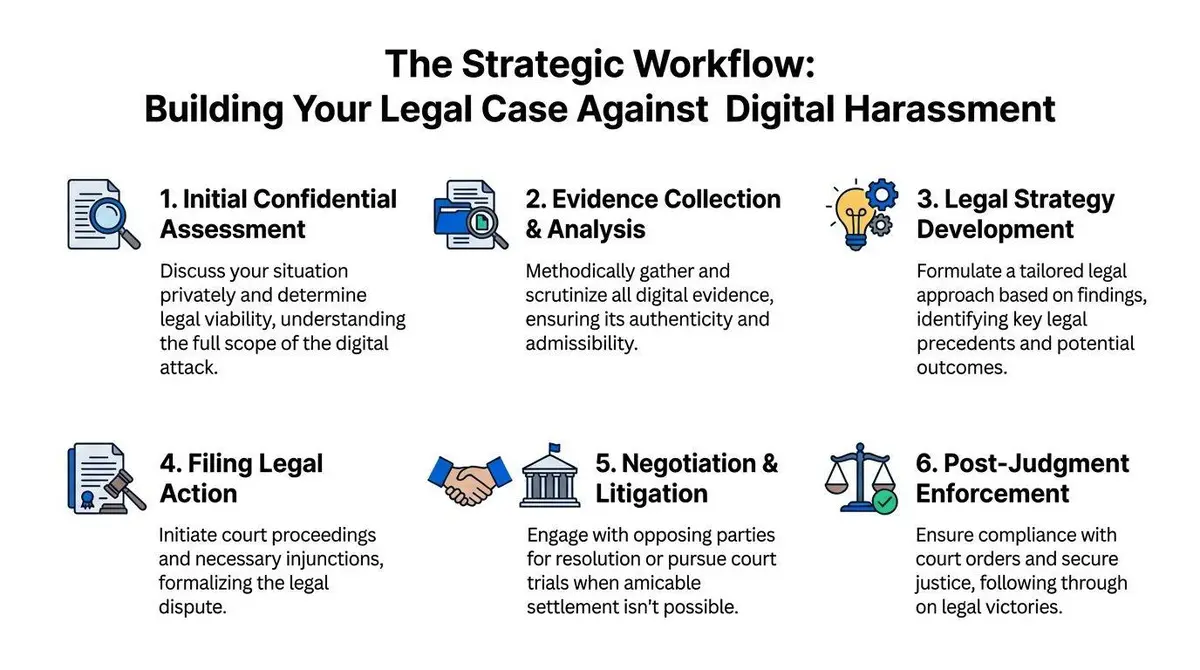
The workflow that actually works
- Confidential intake and scoping
Counsel first defines the universe of the attack. Which platforms, what dates, what identities, what third parties, what prior relationship, what commercial or personal fallout. - Evidence normalization
Screenshots alone aren’t enough. Lawyers and technical teams sort source files, URLs, account handles, post times, message exports, and any preserved headers into a format that can survive scrutiny. - Theory selection
One fact pattern can support several options, but not all options are wise. Sometimes the right move is a narrow protection-order application. Sometimes it’s a civil complaint built for subpoenas. Sometimes criminal referral should come first. - Identification of unknown actors
If the harasser is hiding behind burner accounts, counsel may pursue platform records or service-provider information through formal process. This has to be sequenced carefully. - Pressure phase
A precisely drafted cease-and-desist letter can be useful, but only if it’s sent for a reason. Sloppy demand letters often alert the attacker without locking down evidence or securing cooperation. - Escalation and enforcement
If the abuse continues, counsel moves to injunctions, protective orders, civil litigation, or coordination with prosecutors, depending on the facts.
What clients often misunderstand
They think they’re hiring a litigator. In reality, they’re hiring a strategist who knows when not to litigate yet.
A rushed filing with weak exhibits can be worse than waiting a week to assemble the record properly. By contrast, a disciplined file can support several forms of advantage at once: pressure on the attacker, a stronger platform complaint, a tighter application for court relief, and cleaner instructions for technical removal teams.
Strong cases are rarely loud at the beginning. They are organized.
Actionable Steps for Preserving Digital Evidence
Before you call anyone, secure the record. Evidence in online harassment matters is fragile. Posts get edited, accounts disappear, stories expire, and message threads become impossible to authenticate once someone starts deleting and reposting.
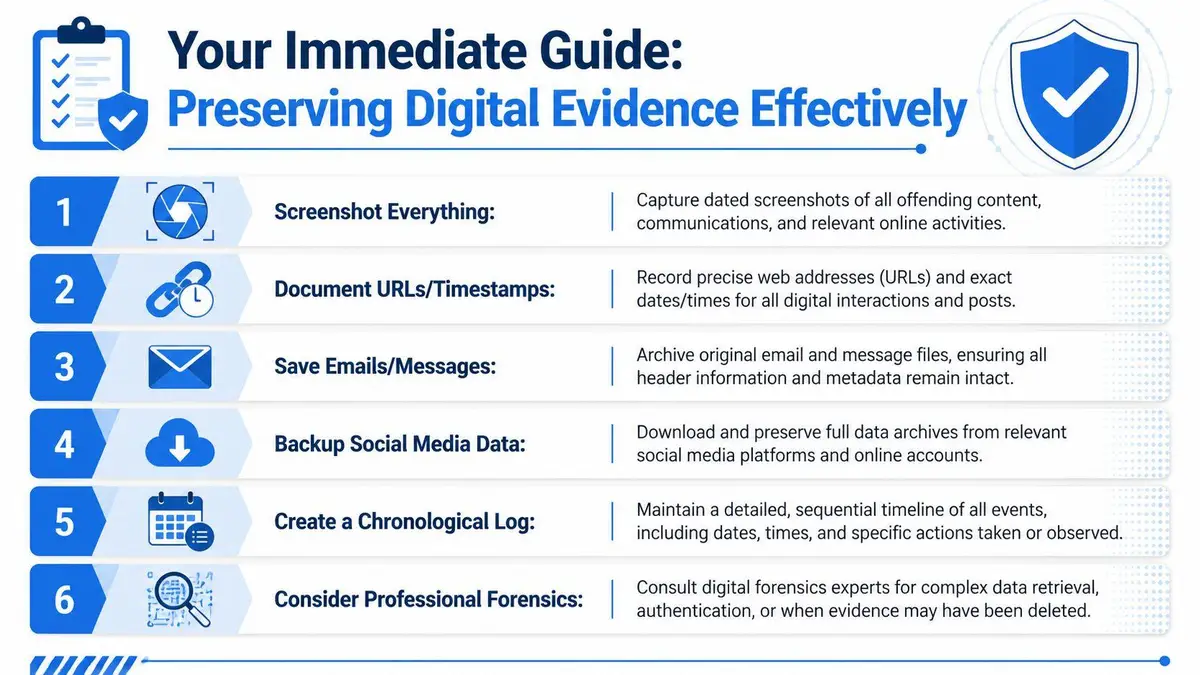
What to capture now
Start with the original material, not your reaction to it.
- Full-screen screenshots: Capture the entire display, including date, time, username, handle, and surrounding context. Cropped images create arguments you don’t need.
- Direct URLs: Save the exact page address for each post, profile, image, or comment thread.
- Native exports: Download emails, message threads, and platform data in their original format when the platform allows it.
- Chronology: Build a simple timeline with date, time, platform, account name, and what happened.
- Collateral impact: Preserve messages from clients, colleagues, schools, or family members if they show propagation or consequences.
If doxxing is part of the attack, this strategic response checklist for being doxxed is worth reviewing alongside your legal prep.
What not to do
Do not bait the harasser into “saying more.” Don’t edit screenshots. Don’t ask a staff member to log into unknown accounts. Don’t post public warnings that advertise your next move, and don’t delete material from your own inbox just because it’s upsetting.
Use a simple preservation discipline:
| Item | Do this | Avoid this |
|---|---|---|
| Social posts | Capture full page and URL | Cropping to only the offensive sentence |
| Emails | Save original message files | Forwarding only the body text |
| Texts and chats | Export thread where possible | Taking isolated screenshots with no context |
| Timeline | Record events as they occur | Reconstructing from memory later |
A short video can help if you need a quick practical refresher before handing the matter to counsel.
When to bring in forensics
Most matters don’t need a forensic team on day one. Some do. Bring in specialist support when accounts have been compromised, when material appears manipulated, when deleted data may matter, or when you expect a fight over authenticity.
The goal isn’t to become your own investigator. It’s to hand your lawyer a clean, defensible package that lowers cost and improves speed.
Integrating Legal Action with Digital Reputation Management
A court order can establish that content is unlawful. It usually does not remove every copy from search results, reposts, mirror sites, social platforms, and scrape networks. That gap is where many legal strategies fail in practice.
Legal action and digital remediation should run together, not in sequence. The lawyer creates legal authority, pressure, and procedural options. A content-removal team handles takedowns, de-indexing requests, platform escalation, monitoring, and reappearance management. If you separate those functions, harmful material often stays visible far longer than necessary.
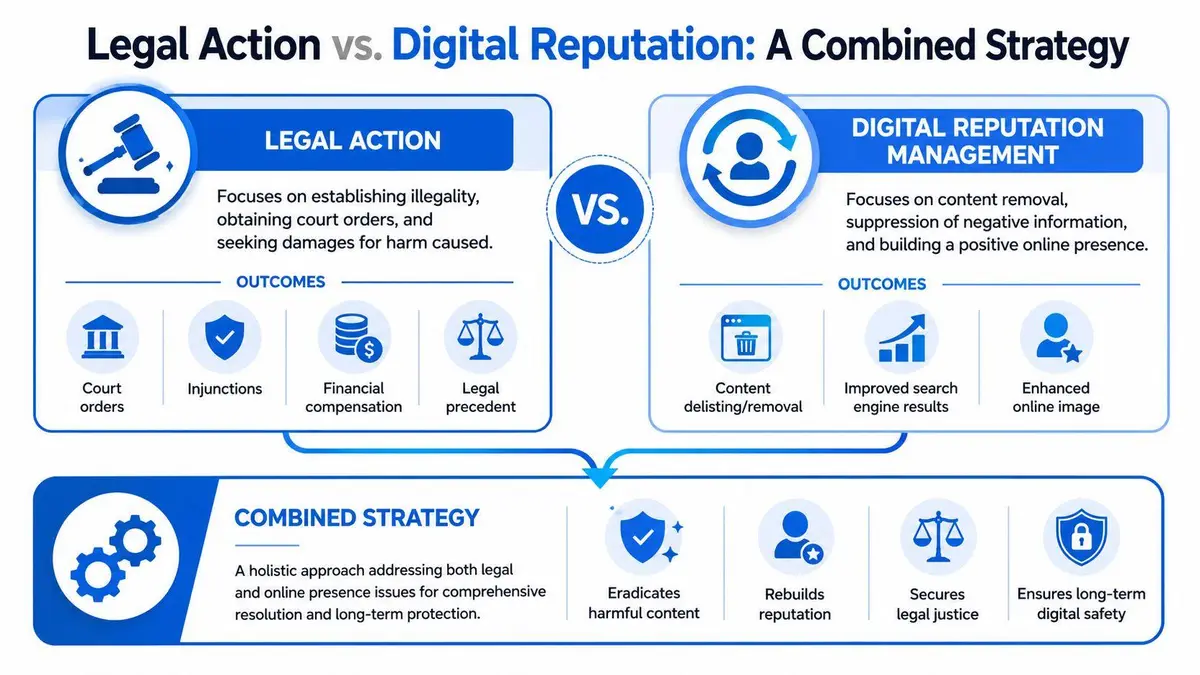
Why the dual track is stronger
The legal side answers questions like these: Can we compel disclosure? Can we restrain contact? Can we seek damages? Can we formalize notice? Can we preserve claims if the attacker migrates to a new account?
The reputation side addresses a different set: Where is the content indexed? Which hosts will act on policy grounds? Which copies can be suppressed while the legal file develops? Which keywords and profiles need monitoring?
One option in that second category is ContentRemoval.com’s guide to managing online reputation during a lawsuit, which reflects the practical reality executives face when public exposure continues during active legal proceedings.
A better operating model
Legal relief without removal leaves residue. Removal without legal framing leaves the attacker room to return.
The combined approach usually looks like this in practice:
- Counsel handles the rights: notices, filings, preservation demands, subpoenas, injunction strategy.
- Technical remediation handles visibility: source removal requests, search de-indexing pathways, platform escalation, ongoing monitoring.
- The client keeps one command structure: one timeline, one evidence set, one set of approved facts, one escalation policy.
That’s the model discerning clients use because it solves both parts of the problem. It addresses the conduct and the visibility of the conduct.
Vetting Counsel and Understanding Costs and Outcomes
Don’t hire the nearest litigation generalist. Hire someone who understands anonymous defendants, cross-platform evidence, emergency relief, and the practical limits of suing platforms directly. Electronic harassment lawyers should be able to discuss civil procedure and digital evidence with equal fluency.
Ask direct questions. Have you handled matters involving anonymous accounts? How do you preserve platform evidence? When do you seek subpoenas? When do you advise police involvement? How do you coordinate with a removal or reputation team? If the lawyer can’t answer cleanly, keep looking.
What outcomes are realistic
Some matters end quickly because a well-aimed notice, platform escalation, or protection-order filing changes the economics for the attacker. Others require a longer campaign, especially where false allegations, impersonation, or repeated reposting are involved.
Possible outcomes include:
- Informal resolution: cessation, deletion, retraction, negotiated undertakings
- Protective relief: restraining orders, no-contact terms, account-related conditions
- Civil resolution: settlement, injunction, damages, disclosure of identity
- Criminal exposure for the perpetrator: in serious cases, prosecutors may become involved
The stakes can be severe. This summary of federal cyberstalking penalties notes that the offense can carry up to five years in prison and a $250,000 fine, with a life sentence possible if the victim dies. You don’t need to threaten those penalties in every case. But you do need counsel who understands when the facts justify serious escalation.
On costs
Fees depend on what you need done, not on the label attached to the matter. A targeted cease-and-desist plus evidence review is a different engagement from emergency injunction work, subpoena practice, and parallel reputation remediation. Ask for a phased budget. Ask what assumptions drive the estimate. Ask what would trigger a move from negotiation to litigation.
That’s how an astute client behaves. Calmly, precisely, and with a clear understanding that speed, discretion, and sequencing matter more than theatrics.
If you’re facing a coordinated digital harassment problem and need the removal side handled with discretion, ContentRemoval.com can assess the exposure, identify what can be taken down or de-indexed, and coordinate with your legal team on a controlled response plan.
Frequently asked questions
When should I hire a lawyer for online harassment?
Engage counsel when the conduct persists across channels, when the attacker is anonymous but traceable, when false material reaches clients or family, or when threats and tracking behavior appear. The question is not whether it feels bad enough but which remedy creates control fastest without weakening the rest of the case.
What evidence do I need to preserve for an online harassment case?
Capture full-screen screenshots showing date, time and username, save direct URLs, download native exports of emails and message threads, and keep a running timeline. Preserve collateral messages from clients or family that show spread. Do not crop images, bait the harasser or delete upsetting material from your own inbox.
Can a lawyer get harassing content removed from the internet?
A lawyer can create legal authority through notices, subpoenas and injunctions, but a court order does not remove every copy from search, reposts and mirror sites. Removal, de-indexing and monitoring should run in parallel with the legal work so material does not keep circulating during the proceedings.