
Can a subreddit be taken down for harassment? Yes, Reddit bans communities for harassment, and it has done so at scale, repeatedly, for a decade. But if you’re asking the question because a subreddit is currently making your life miserable, the useful answer is more layered: subreddit bans happen under specific sitewide rules, through a specific enforcement hierarchy, at a threshold that is realistically high for any single victim to reach, and on a timeline you cannot control. Building your entire strategy around getting the community banned is usually a mistake, not because it’s impossible, but because it’s slow and uncertain, while faster remedies against the individual threads harming you sit unused.
We handle Reddit matters constantly, and the pattern we see is consistent: people spend months petitioning for a subreddit ban that may never come, while the three threads that actually rank on a Google search of their name could have been addressed in weeks. The professional approach runs both tracks at once. Build the documented pattern that supports admin action against the community, and simultaneously attack the individual posts through moderators, sitewide reports, and search de-indexing.
This guide explains how Reddit’s enforcement actually works: the difference between moderators and admins (and why confusing them wastes your reports), what the sitewide harassment rules cover, what Reddit’s history of community bans tells us about realistic thresholds, and the parallel remedies that deliver relief while the slower institutional process plays out. We’re a content removal firm, not a law firm, nothing here is legal advice, and if you’re facing threats or stalking, involve law enforcement.
Moderators vs. admins: Reddit’s two-layer system
Almost every failed Reddit strategy we’ve audited begins with the same misunderstanding, so let’s fix it first.
Moderators are volunteers who run individual subreddits. They aren’t Reddit employees. They enforce their community’s own rules (which can be stricter than Reddit’s, and often are) and they can remove posts, lock threads, and ban users from that subreddit only. They cannot ban a subreddit (their own or anyone else’s), and they have no obligation to act on sitewide policy, though many do.
Admins are Reddit employees. They enforce the sitewide Content Policy across every community, and they are the only people who can quarantine or ban a subreddit, suspend accounts platform-wide, or act against a moderator team itself.
The reason this distinction is strategic and not trivia: the correct door depends on the problem. If a post breaks the subreddit’s own rules (many communities prohibit personal information, harassment, or “no doxxing” by local rule even while allowing harsh discussion) a polite, specific modmail report is the fastest removal path on Reddit, sometimes resolving in hours. If the community itself is the problem, the moderators welcome or participate in the targeting, then modmail is worse than useless (it tips them off), and everything should go through admin channels at reddit.com/report, and critically for the subreddit-ban question: only a documented pattern in front of admins moves a community toward quarantine or ban. A hundred complaints sent to the hostile subreddit’s own moderators build no record where it counts.
What Reddit’s sitewide rules actually prohibit
Reddit’s Content Policy is short, and three of its rules do nearly all the work in harassment cases.
Rule 1: harassment and bullying. Reddit prohibits harassment, defined around behavior that torments or abuses an individual or that would make a reasonable person conclude Reddit is unsafe for them, and it explicitly prohibits communities organized around this conduct, not just individual posts. Context matters in enforcement: a single insulting comment rarely qualifies; sustained targeting of a private individual, dedicated threads tracking someone’s life, and follow-them-around abuse are what the rule was written for.
Rule 3, personal information. Posting someone’s personal information without consent, addresses, phone numbers, workplaces, non-public photos used to identify, is banned sitewide, and this is among Reddit’s most consistently enforced rules. Threads that dox get removed; accounts that dox get suspended; communities that tolerate doxxing accumulate exactly the record that supports community-level action. If a subreddit targeting you includes personal information, Rule 3 reports are usually your highest-percentage filings.
Brigading and interference. Reddit prohibits communities from directing harassment at people or other communities: organized downvoting, coordinated comment raids, “go get them” link posts. Brigading matters for the subreddit-ban question specifically because it converts individual misconduct into community-level misconduct: when a subreddit’s threads function as coordination points for off-subreddit or off-platform targeting, the community itself is violating policy, which is precisely what admins weigh in quarantine and ban decisions. If you’re experiencing brigading, document the coordination (the thread that pointed the mob at you, timestamped next to the wave that followed) because that causal chain is the evidence that matters.
When a subreddit gets taken down for harassment: lessons from banned communities
Reddit’s enforcement history is public and instructive, and you don’t need to speculate to learn from it. In 2015, Reddit adopted its first real harassment policy and banned a set of communities dedicated to harassing specific groups of people, the platform’s explicit reasoning was that the bans targeted behavior (coordinated harassment) rather than ideas. Communities have since been banned in recurring waves, including a large policy overhaul in 2020 in which Reddit banned roughly two thousand subreddits in a single sweep under a rewritten Rule 1. Reddit also developed the intermediate tool of quarantine (a community cut off from search, recommendations, and ad revenue, hidden behind an interstitial warning) which has repeatedly served as the probation stage before high-profile bans, including cases where sustained rule violations inside a quarantined community led to eventual removal.
Distilled into practical thresholds, the pattern across a decade of these actions looks like this:
- Communities get banned when violation is the community’s function, not an incident within it. A subreddit dedicated to targeting a person or group sits in the historically banned category. A general community where some threads target you almost never gets banned; its threads get removed.
- Moderator posture is close to dispositive. Admins consistently act against communities whose mod teams encourage, participate in, or refuse to police violations, and consistently spare communities whose mods demonstrably clean up. This is why your evidence file should document what moderators did (approved the doxxing thread, participated in it, ignored reports) not just what users posted.
- Repetition and recidivism drive escalation. Bans typically follow a documented arc: violations, warnings or quarantine, continued violations. One bad week rarely bans a community; a record does. Relatedly, Reddit bans recreated communities under its ban-evasion rules much faster than originals, a successor subreddit that resurrects a banned community can be reported as ban evasion and often dies quickly.
- Scale and visibility accelerate everything. Large-scale campaigns, press attention, and harm spilling off-platform have historically preceded major enforcement actions. This is uncomfortable but honest: a small subreddit quietly tormenting one private person can persist below the enforcement radar for a long time, which is exactly why the parallel remedies below matter so much.
What this means for your expectations: if the subreddit targeting you is dedicated to that targeting, a ban is a realistic medium-term outcome and your evidence-building directly serves it. If you’re being savaged inside a broader community, redirect your energy. The achievable wins are thread removals, user suspensions, moderator-level enforcement, and de-indexing, not a community ban.
The parallel track: neutralize the threads while the ban question grinds
Whatever happens to the subreddit, the harm reaching you flows through specific threads, especially the ones that rank in search for your name or business. Those threads can be attacked now.
Report precisely, thread by thread. File Rule 3 reports on every post containing personal information, Rule 1 reports on targeted-abuse threads with the pattern documented, and interference reports on coordination posts. Specific reports citing specific rules with specific links outperform narrative complaints many times over. Denied reports can be refiled with better documentation; Reddit’s front-line review is inconsistent, and persistence is rewarded often enough to be worth it.
Work cooperative moderators where they exist. In mixed communities, a factual modmail identifying rule-breaking threads gets faster results than any admin process. Keep it short, unemotional, and specific; volunteer mods respond to easy, well-founded requests and ignore rants.
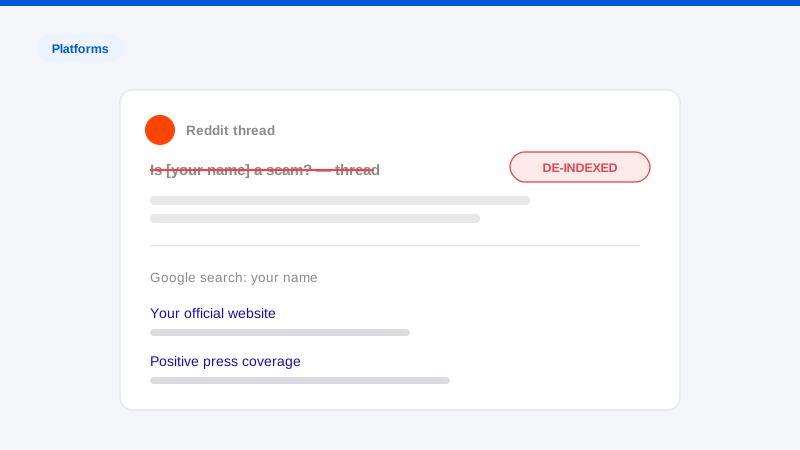
De-index what won’t come down. Reddit threads rank aggressively in Google, which is most of their real-world damage. Threads containing your personal information may qualify for removal from Google results under its personal-information policies regardless of whether Reddit acts, and quarantined communities drop out of search visibility entirely. De-indexing doesn’t delete the thread, but a thread nobody finds on page one has lost most of its power to harm a reputation. This thread-level combination, targeted reporting plus search removal, is the core of our Reddit removal practice, and it’s typically where clients see relief first.
Treat defamation and images as their own tracks. If threads assert provably false facts about you, that’s a defamation problem with its own remedies, including legal ones that don’t depend on Reddit’s discretion. If photos of you are being posted, image-based reports and image removal pathways apply, and if the Reddit activity is one front of a cross-platform campaign, it should be handled as coordinated cyber abuse, because platforms act faster on documented cross-platform campaigns than on siloed complaints.
A step-by-step campaign
- Build the evidence file before anything else. Every thread and comment: URL, screenshot, date, and the rule it violates. Capture moderator conduct specifically. Archive as you go, hostile communities scrub when they sense attention, and your documentation must survive their cleanup.
- Classify the community honestly. Dedicated attack subreddit, or general community with hostile threads? This single judgment sets the strategy: community-level admin campaign for the former, thread-level enforcement for the latter.
- File thread-level reports immediately. Rule 3 first (highest enforcement rate), Rule 1 with pattern evidence, interference/brigading with causal documentation. Log every report and outcome, the record of Reddit’s responses becomes part of your escalation file.
- Engage moderators only if they’re plausibly neutral. Short, specific, factual modmail. If mods are hostile or participating, skip this step entirely and document their conduct instead.
- Escalate the community pattern to admins. For dedicated-targeting communities, submit the assembled record (community purpose, moderator conduct, violation history, prior report outcomes) through Reddit’s report channels. Update it as new violations accrue; the arc of continued violation after enforcement contact is what historically precedes quarantines and bans.
- Run search de-indexing in parallel from week one. Identify which threads rank for your name, and file eligible ones with Google under its personal-information and other removal policies. Do not wait on Reddit for this; it’s independent.
- Monitor for ban evasion and resurgence. If enforcement lands (thread removals, quarantine, or a ban) watch for successor communities and recreated threads, and report them under ban-evasion rules, which move much faster than first-instance enforcement. Ongoing protection plans exist for exactly this maintenance phase.
Frequently asked questions
How many reports does it take to get a subreddit taken down for harassment?
Report count is the wrong variable. A subreddit isn’t banned at some threshold of complaints, and mass-reporting campaigns don’t force outcomes (coordinated false reporting violates Reddit’s rules itself). What moves admin decisions is the quality of the documented pattern: a community whose purpose is targeting, moderators who enable it, violations continuing after enforcement contact. One meticulous submission with fifty documented violations outweighs five hundred angry one-line reports. Build the record; don’t chase the count.
What’s the difference between a quarantine and a ban, and which should I expect?
A quarantine hides the community behind a warning interstitial, removes it from search and recommendations, and cuts its growth. The community exists but stops reaching new audiences, which for reputation purposes is most of the victory. A ban removes it entirely. Historically, quarantine has often been the probation stage before a ban when violations continue. Realistically: dedicated harassment communities with documented records can reach either outcome; hostile threads inside broader communities will see neither, and thread-level enforcement is the right goal there.
The subreddit’s moderators are the ones harassing me. What then?
Skip the moderators entirely, modmail in that situation only alerts them to preserve less and target more. Everything goes to admins, and moderator participation becomes the centerpiece of your file rather than an obstacle: admin actions against communities have consistently turned on mod-team conduct, so a mod posting or approving targeting content is the strongest community-level evidence you can document. Meanwhile, run the search de-indexing track for the threads that rank, since local removal is off the table.
Can I sue a subreddit to get it taken down?
You can’t meaningfully sue “a subreddit,” and Section 230 generally shields Reddit itself from liability for users’ posts, a suit against the platform to force a ban is not a realistic path, and we’d be lying to say otherwise. What litigation can do: individual posters can be pursued for defamation or unlawful conduct (sometimes after unmasking through legal process), and court orders resulting from those actions are honored by Reddit and by search engines. That’s a real but expensive and slow track, appropriate for serious provable harms, talk to an attorney, and see our overview of legal content removal for how court-backed requests fit alongside platform-level work.
If a subreddit has turned its attention on you, the worst move is waiting to see if it burns out. Start with our free exposure scan. We’ll identify which threads are actually reaching search results, which rules they violate, and whether your situation supports community-level action or a faster thread-by-thread campaign, with an honest assessment either way.