
Domain WHOIS privacy replaces the registrant’s name, address, phone and email in the public WHOIS database with a proxy’s details, preventing the registration from becoming a targeting dossier for phishing, doxxing and domain hijacking. Privacy services mask data, proxy services register the domain in another entity’s name, and GDPR redaction is a partial baseline. An LLC or trust adds separation.
Key facts
- ICANN requires accurate contact details on every registration, which is why unprotected records are public by default.
- An Interisle study found 58.2 percent of domain records used proxy protection by January 2026, up from 29.2 percent.
- Privacy shields yield to valid subpoenas, court orders, UDRP trademark disputes and abuse investigations.
- Some ccTLDs such as .us and .ca prohibit WHOIS privacy, and transfers between registrars can expose data temporarily.
Where ContentRemoval.com comes in. A private WHOIS record closes one door. Executives and family offices are usually still exposed through data broker listings, archived registrations scraped before privacy was enabled, leaked credentials and old coverage that links a name to a project. ContentRemoval.com addresses that wider footprint through personal data removal, de-indexing and dark web monitoring. Principals, chiefs of staff and IT leads usually make contact. A free 15-minute Exposure Scan maps what is removable, and the report is yours to keep. Get a Free, Confidential Exposure Scan or read how our personal data removal work is done.
Registering a domain name establishes a digital asset. Without proper safeguards, this action also places your personal information into a public database, exposing you to significant risk. Domain WHOIS privacy is the service that shields your identity, replacing your name, address, and email with a proxy’s details. For high-profile individuals and organizations, this is not an optional feature; it is a mandatory security protocol.
Why Your Domain Name Is a Public Vulnerability
The acquisition of a domain for a new business venture, personal brand, or private family use triggers an immediate and serious side effect. By default, your contact information (name, address, phone number, and email) is published in a global database called WHOIS.
This is not a system flaw but a foundational design principle. The Internet Corporation for Assigned Names and Numbers (ICANN) mandates that every domain registration includes accurate contact details. The result is a public directory accessible to anyone with an internet connection.
For the average user, this may lead to an increase in spam. For executives, public figures, and high-net-worth individuals, it transforms a digital asset into a personal liability, representing a direct and ongoing threat.
An unprotected WHOIS record is a ready-made targeting dossier. A hostile actor requires no sophisticated data breach to acquire it; a web browser and 30 seconds suffice. This public data is the entry point for myriad attacks.
This exposure is an open invitation to those who weaponize information. You can learn how to find who owns a domain name using these exact public lookups to understand the ease of access.
How Public WHOIS Data Is Weaponized
The information within a public WHOIS record is more than mere contact data. In the wrong hands, it becomes a set of keys capable of inflicting devastating reputational and financial harm. Threat actors use these details to construct highly specific and convincing attacks.
These are not random, automated campaigns but surgical strikes leveraging your personal information to establish an illusion of legitimacy. The consequences are severe:
- Targeted Phishing: When an attacker possesses your name, company, and email, they can craft incredibly believable fraudulent emails. They might impersonate a vendor, a colleague, or a financial institution, referencing details that appear correct because they were sourced from public records.
- Doxxing and Harassment: For any public-facing individual, the exposure of a home address or personal phone number serves as a gateway to intimidation, real-world harassment, and physical threats against you and your family.
- Corporate Espionage: Competitors can monitor your domain registrations to anticipate strategic moves. A domain registered for a confidential project becomes a public announcement of your organization’s next initiative.
- Identity Theft and Domain Hijacking: Armed with your personal details, an attacker can more easily impersonate you. They can contact your domain registrar and attempt to seize control of your most valuable digital assets.
The critical reality for anyone with a public profile is that domain WHOIS privacy is a fundamental security measure, not a convenience. It is a non-negotiable component of modern executive protection and a crucial step toward regaining control over your personal and professional life. For those requiring a more comprehensive solution, learning how to remove personal data from the internet is the next logical action.
How Domain WHOIS Privacy Protects Your Real-World Identity
When you register a new domain, your personal information is not filed away; it is published in a public directory. Domain WHOIS privacy is the administrative shield that prevents this by substituting your real name, address, email, and phone number with generic contact details from your registrar or a third-party service. It is your first and most fundamental defense against the exposure of your private data.
The mechanism is analogous to a registered agent for a corporation. A company utilizes a registered agent to handle official correspondence without publishing the owner’s home address on public documents. Similarly, domain privacy creates a necessary buffer between your personal identity and individuals probing your online footprint.
Not all privacy services are equivalent. They operate via several distinct methods, and understanding the differences is critical to selecting the appropriate level of protection. Each offers a unique degree of anonymity and legal insulation.
Privacy, Proxy, and Redaction: A Critical Distinction
These terms are often used interchangeably, yet they represent disparate legal and practical arrangements. Misunderstanding them can lead to a false sense of security, exposing you to the very risks you sought to mitigate. A clear understanding is non-negotiable for any high-profile person or brand.
The three primary methods of information protection are:
- Privacy Service: The most common option, wherein your registrar masks your information in the public WHOIS database and substitutes its own generic details. You remain the legal owner of the domain, and the service forwards important communications to your actual email address discreetly.
- Proxy Service: This offers a much stronger legal separation. A separate company registers the domain in its own name, becoming the legal registrant. You are granted full control and “beneficial ownership” through a private legal agreement, creating a more substantial barrier between you and the domain.
- Redaction: This is not a purchased service but a compliance measure undertaken by registrars, largely due to regulations like Europe’s GDPR. They automatically hide or “redact” personal data for registrants in specific regions. While a useful baseline, it is not a complete solution and often leaves business contact information visible.
For those who require a more immediate and all-encompassing solution to online exposure, our firm’s online privacy service extends far beyond what basic domain registration can offer.
The Market Shift Toward Anonymity
The demand for these services has surged, reflecting a growing recognition of the threats posed by public data. This is no longer a niche feature but a standard security measure for sophisticated individuals and businesses.
The data confirms this trend. A comprehensive January 2026 study from Interisle revealed that 58.2% of domain records were obscured by proxy-protection services, a significant increase from 29.2% in November 2020. The shift is even more pronounced for generic top-level domains (gTLDs), where visible registrant data plummeted from 75.7% in early 2018 to just 10.8% by early 2026. The full Interisle report on domain name data availability provides deeper analysis.
The choice between privacy, proxy, and redaction is strategic. It depends on your threat model, the value of your digital assets, and your legal jurisdiction. A basic privacy service may suffice for a personal blog, but a high-value corporate domain or personal brand almost always demands a proxy or a more sophisticated legal structure.
WHOIS privacy is not about evading legal obligations. It is about reclaiming a necessary boundary in an environment where personal data is perpetually at risk. By understanding your options and choosing the correct level of protection, you can transform a public vulnerability into a private, controlled asset.
Navigating the Legal Maze of Data Privacy Regulations
Digital privacy is not a static checkbox; it exists within a complex and evolving web of international law. For any public figure, understanding this legal landscape is as critical as implementing technical security measures. The rules governing domain data are in constant flux, creating both new avenues for protection and new compliance obligations.
The most significant disruption originated with the European Union’s General Data Protection Regulation (GDPR). Before its implementation, the WHOIS system functioned as an open directory for the internet. GDPR redefined personal details in a WHOIS record as protected information, compelling registrars to hide names and contact details for EU citizens by default.
This legal shift necessitated a technological upgrade. The legacy WHOIS protocol, a simple text-based system, was not designed for granular data management. To address this, the industry has migrated to the Registration Data Access Protocol (RDAP), a modern, more secure system that grants registrars precise control over data access.
The GDPR Effect and the Rise of RDAP
GDPR was a watershed moment for domain whois privacy, shifting the default for millions of domain owners from total transparency to mandatory privacy. However, relying solely on this baseline GDPR redaction creates a false sense of security. The protection is inconsistent and often does not apply if the domain is registered to a business or by an individual outside the EU.
RDAP provides a technical solution to this legal puzzle. Whereas the old WHOIS system returned the same block of public text to all queries, RDAP can provide tiered access, displaying different levels of information to different parties.
For instance, law enforcement or intellectual property attorneys can be granted access to the underlying data through a standardized and auditable process. This establishes a system of checks and balances that the former free-for-all could never offer, balancing public privacy with legitimate oversight.
While your personal data is far more protected from casual lookups, a formal process remains for it to be accessed when legally required. The entire system is professionalized, transforming chaos into a controlled and accountable process.
The NIS2 Directive and New Compliance Hurdles
Just as the industry adapted to GDPR, another European regulation is poised to introduce new complexities. The EU’s NIS2 Directive is rolling out strict identity verification rules that run counter to the principle of anonymous domain ownership, a key privacy tactic.
This table contrasts how GDPR and NIS2 approach WHOIS data, highlighting the evolving requirements for domain owners and registrars.
Key Regulations Impacting WHOIS Data
| Regulation Feature | GDPR (General Data Protection Regulation) | NIS2 Directive |
|---|---|---|
| Primary Goal | Protect the personal data of individuals. | Enhance cybersecurity across critical sectors. |
| Impact on WHOIS | Mandated redaction of personal data for EU citizens, prioritizing privacy. | Mandates accurate and verified registrant data, prioritizing security and accountability. |
| Verification | No explicit, rapid verification requirement for all registrants. | Requires registrars to verify registrant identity and contact data promptly. |
| Anonymity | Enabled greater privacy and “accidental anonymity” through default redaction. | Makes true anonymity nearly impossible for domains used by entities in key sectors. |
While GDPR focused on restricting data access, NIS2 emphasizes ensuring the individual behind the domain is real and reachable. This is a direct response to the rise in cyber threats that exploit anonymous registrations.
NIS2 compels registrars to verify a domain registrant’s identity and publish accurate data if that registrant is a legal entity. The regulation aims to bolster cybersecurity, particularly as domain-based attacks grow more prevalent. In 2026 alone, 75% of businesses faced domain-based phishing attacks, with phishing volumes escalating by 160% year-over-year, as detailed in this global domain name market report. The effect is clear: while identifiable gTLD registrant data stood at 75.7% before GDPR in 2018, it is projected to climb back from its low of 10.8% in 2026 as these new rules take effect.
The decision tree below helps visualize which identity protection strategy is most appropriate based on your objectives.
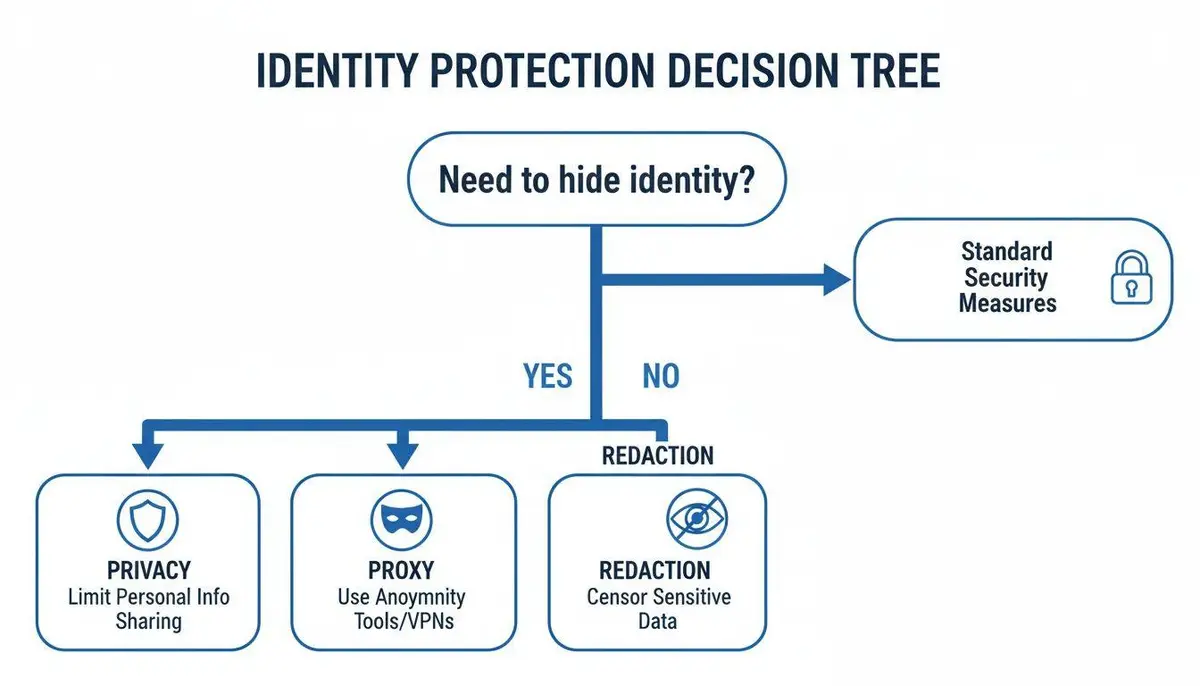
Your choice between basic redaction, a privacy service, or a proxy service depends on your threat model and the need to create legal distance. With regulations like NIS2 making true anonymity increasingly untenable, the future of domain privacy lies less in simple technical cloaking and more in sophisticated legal and administrative structuring.
When Your Privacy Shield Can Be Pierced
It is a dangerous misconception to view WHOIS privacy as an unbreakable digital fortress. While it will stop casual snoops, data scrapers, and low-level threats, it is critical to understand that certain parties possess a key.
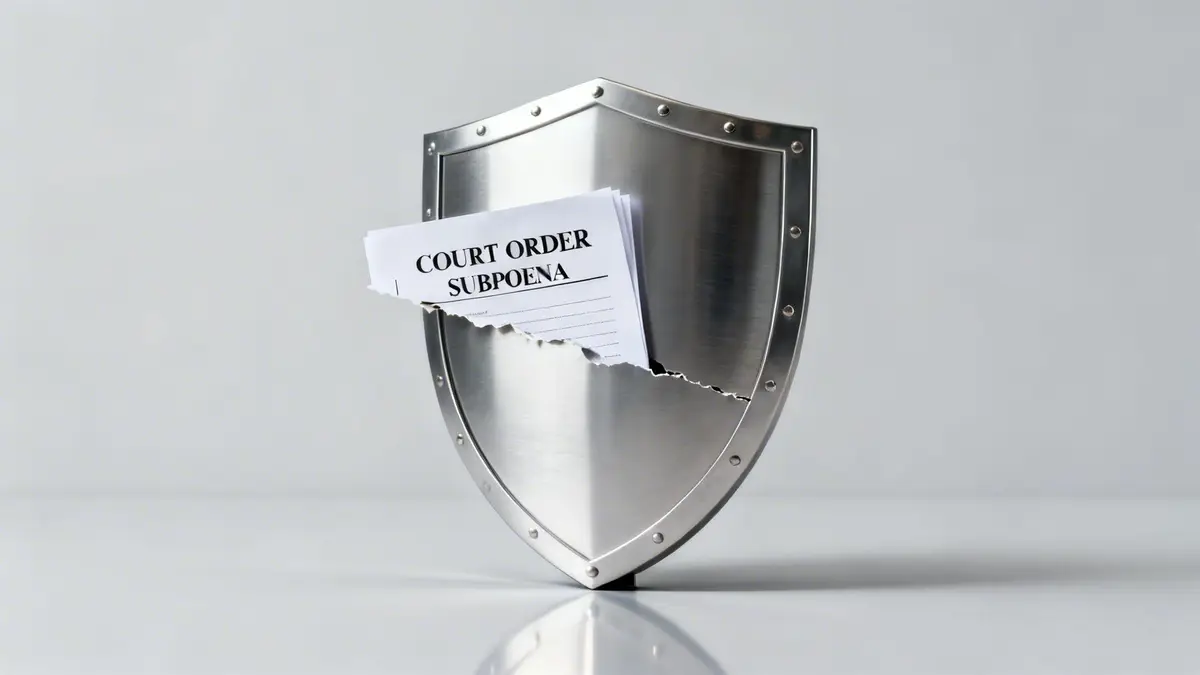
Your privacy service is an administrative layer, not an impenetrable legal barrier. The terms of service are explicit: the provider is legally obligated to comply with valid legal orders. They cannot and will not obstruct the law on your behalf.
Legal and Dispute-Based Exceptions
The most common triggers for bypassing the privacy shield are rooted in legal disputes. These are not loopholes but established rules designed to prevent malicious actors from hiding behind anonymous domains. Your registrar must follow these rules, set by ICANN and local laws.
Your identity will be revealed under the following circumstances:
- Law Enforcement Subpoenas and Court Orders: If a court or law enforcement agency issues a valid legal order, your registrar or privacy provider must surrender your real contact information. This is non-negotiable.
- UDRP Actions: The Uniform Domain-Name Dispute-Resolution Policy (UDRP) is the standard process for trademark holders combating cybersquatting. If a company files a UDRP complaint against a domain you registered, your identity will be revealed to the arbitration panel as part of the proceedings.
- Allegations of Abuse: Your domain cannot be used for illegal activities. If it is flagged for serious abuse (such as phishing, malware distribution, or spam operations) the registrar is obligated to investigate. They will often lift the privacy protection to contact you, the legal owner, and hold you accountable.
This framework balances everyday privacy with necessary paths for legitimate legal and intellectual property challenges.
Operational and Provider-Level Risks
Legal orders are not the only threat. Using a privacy service means entrusting a third party with your identity. This introduces operational risk, as your anonymity is only as strong as your provider.
A privacy service ceasing operations, or being acquired by a company with weaker privacy policies, could cause the protection you rely on to vanish. An unreliable provider represents a single point of failure. If they are hacked, the private data of all their clients could be exposed simultaneously, a catastrophic event for anyone requiring discretion.
The critical takeaway is that your domain’s security does not end with enabling a privacy feature. It is an ongoing assessment of legal realities and provider vulnerabilities. True protection requires a strategy that anticipates these potential points of failure.
Finally, even a simple domain transfer can create exposure. Moving a domain between registrars almost always requires temporarily disabling domain whois privacy. This unlocks the domain and ensures authorization codes are sent to your real email address. During that transfer window, your personal information is once again public. An attacker actively monitoring your domain can easily capture your data in that short period. High-stakes transfers must be planned with precision to minimize this window of exposure.
Advanced Strategies for High-Stakes Domain Registration
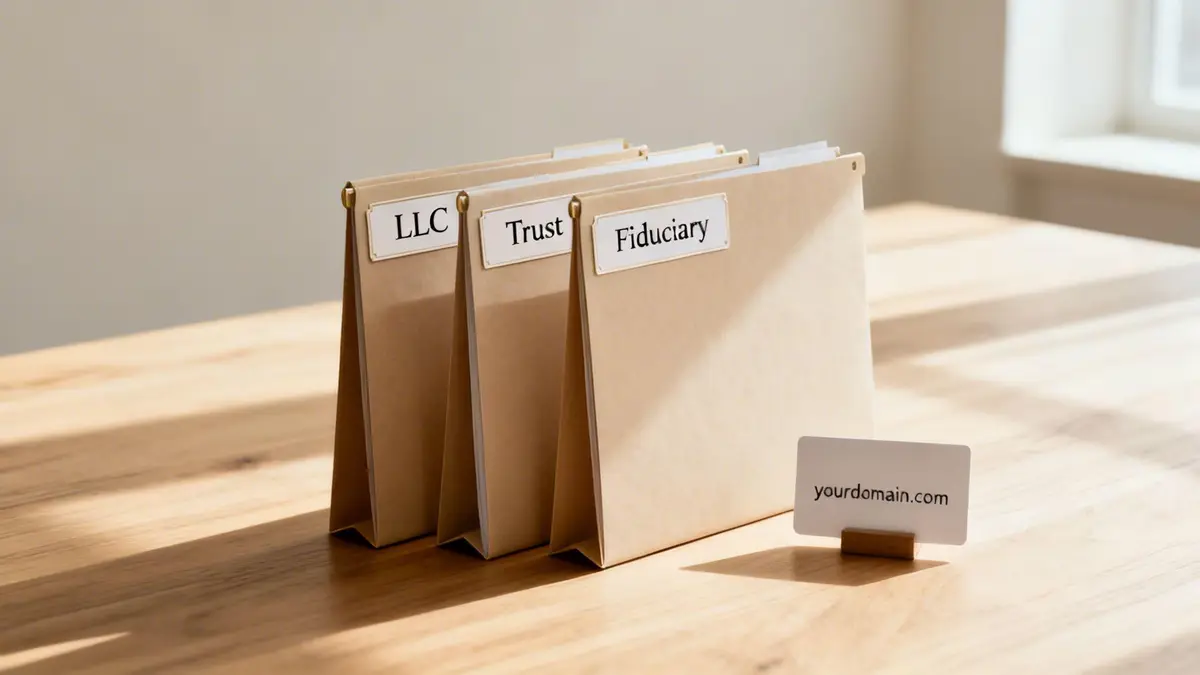
For high-profile individuals, brands, and their family offices, standard WHOIS privacy is merely a baseline. When stakes are high, a different approach is required. True digital asset protection involves moving beyond a simple add-on service and integrating domain names into a proper legal framework.
The objective is not just to hide your name, but to create structural, legal separation between your personal identity and your digital footprint. Instead of registering a domain in your own name and cloaking it with a privacy service, you register it from inception under a discrete legal entity. This constructs a genuine barrier, not just a curtain, making it exceedingly difficult to trace a domain back to you, even if a privacy shield is legally challenged.
Using Legal Entities for Domain Ownership
The most robust strategy is to use a legal structure, such as a Limited Liability Company (LLC) or a trust, as the official domain owner. This is an application of smart corporate and personal planning. An LLC can be established specifically to hold digital assets, complete with its own address and contact details entirely separate from your personal life or primary business.
When a domain is registered to an LLC, the public WHOIS record lists the company, not you. This confers several powerful advantages:
- Legal Insulation: It separates the domain from your personal estate. Any liability arising from the website is tied to the company, not your personal assets.
- Anonymity by Design: The privacy is structural, not a service that can be disabled or bypassed with a subpoena aimed at your registrar.
- Succession Planning: Transferring ownership is cleaner. Management can be handled through the entity’s operating agreement or trust documents, simplifying estate planning.
Registering a domain to a well-structured LLC or trust is the difference between adding a new lock to your front door and building the house with no doors facing the street. One is a reactive fix; the other is a foundational security choice.
This requires careful execution. The legal entity must be established correctly, with a registered agent and a physical address that cannot be traced back to you. At this level of operation, a thorough evaluation of registrars is critical; this Domain Registrar Comparison provides a starting point for assessing privacy features and administrative controls.
The Role of Trustee and Fiduciary Services
For individuals or family offices managing a large portfolio of domains, direct management can become a significant operational and security burden. In these instances, engaging a specialized trustee or fiduciary service is a logical step. These professionals act as managers for your digital assets, analogous to a trustee for a financial trust.
A fiduciary service can legally own and administer your entire domain portfolio on your behalf, offering the highest level of confidentiality and operational security. They handle all registrations, renewals, and compliance, all while being contractually bound to act in your best interest. It is the ultimate hands-off, high-security approach to domain management.
The need for domain whois privacy has become acute. What was once a niche option is now standard practice, with proxy services shielding over half of all registered domains. As of January 2026, 58.2% of domain records were using proxy protection, a massive jump from just 29.2% in 2020. This trend is a direct response to rising identity theft fears and rampant phishing, which hit 75% of businesses in 2026. For executives, this makes paid protection non-negotiable, especially as AI-powered phishing domains surged by 160% in the same year.
Advanced domain strategy is not about checking a “privacy” box. It is about weaving your digital assets into a sophisticated legal and administrative structure that supports your broader objectives for asset protection, reputation management, and personal security.
Building a Comprehensive Reputation Defense System
Securing your domain with domain whois privacy is a necessary action, but viewing it as a complete solution is a critical error. It can induce a false sense of security, as a blocked WHOIS record is a minor obstacle for a determined adversary.
Your real-world identity can be linked to a website through dozens of other vectors. Analytics scripts, website metadata, and even the unique combination of plugins used can create a digital “fingerprint.” An individual could easily cross-reference clues from your social media profiles and connect the dots back to you, completely bypassing your private domain registration.
Beyond the Domain: A Holistic View
Even with perfect domain privacy, your information is still exposed elsewhere. A data breach from a service you used years ago could leak an old email or password that connects directly to your current activities. This is precisely why a professional, multi-layered defense is indispensable.
A private WHOIS record is like locking the front door of your house. A real reputation defense system secures the entire property: inspecting the windows, the back gate, and the garage for any sign of vulnerability.
This is where our work truly begins. Isolated privacy tactics are insufficient. You require a complete strategy where discrete services actively collaborate to protect you.
- Proactive Content Removal: We do not wait for false or damaging information to proliferate. Our team actively hunts down defamatory, private, or inaccurate content and secures its removal at the source.
- Search Engine De-indexing: Removing content is only the first step. We work to ensure it is also erased from search engine results, effectively making it disappear from public view.
- Dark Web Monitoring: Your personal information often appears for sale on the dark web long before it is used against you. We monitor these hidden marketplaces to provide an early warning if your data has been compromised.
These services combine to form a robust shield around your entire online presence. By layering these solutions on top of basic domain security, you shift from a reactive posture to one of proactive control over your own narrative.
For a more detailed analysis, our guide on protecting your online identity provides a strategic framework for executives. The next logical step is a consultation to construct a defense tailored to your specific threat profile.
Common Questions About Domain Privacy
When securing your online reputation, you require clear and precise answers. Here are the most common questions our clients ask about domain WHOIS privacy and its role in a comprehensive security strategy.
Can I Add WHOIS Privacy to a Domain I Already Own?
Yes. If your personal information is currently exposed on an existing domain, you can and should enable domain whois privacy immediately.
This is typically a simple function within your domain registrar’s control panel. The change is nearly instantaneous, swapping your public details for the privacy provider’s information. However, your data was public before you made the change. Malicious actors are known to scrape and archive WHOIS records, so enabling privacy will not erase data that has already been captured. It will only prevent future lookups from revealing your details.
Does Using WHOIS Privacy Mean I No Longer Legally Own My Domain?
No. A standard privacy service simply acts as a shield for the public WHOIS database. You remain the legal registrant and retain complete ownership and control over your domain.
The only exception is a true proxy service, where another company legally holds the domain in its name on your behalf. Even in that scenario, a private contract establishes you as the “beneficial owner,” ensuring you retain ultimate authority.
A common concern is that using privacy services appears suspicious. In fact, the opposite is now true. With over 58% of domains using privacy, a publicly exposed record can signal a lack of security awareness, making you a more attractive target.
Will It Harm My Website’s SEO?
No. Search engines like Google do not use WHOIS data as a ranking factor. Enabling or disabling domain whois privacy has zero direct impact on your website’s search engine optimization or visibility. Its purpose is purely administrative and security-related, not marketing.
Are There Any Domains That Prohibit It?
Yes, and this is a critical point of due diligence. Some country-code top-level domains (ccTLDs) have registry rules that forbid the use of WHOIS privacy. For example, extensions such as .us (United States) and .ca (Canada) often mandate that registrant information be public. This is a crucial detail to consider when selecting a domain for a project that requires discretion.
Your digital footprint extends far beyond a single domain registration. While WHOIS privacy is a vital first step, it cannot protect you from data breaches, defamatory content, or sophisticated online threats. ContentRemoval.com provides a comprehensive defense system to secure your entire online presence.
Begin your confidential assessment with our experts today.
Frequently asked questions
What is the difference between WHOIS privacy and a proxy service?
A privacy service keeps you as the legal registrant but substitutes the registrar’s generic details in the public record and forwards important messages. A proxy service registers the domain in a separate company’s name, with you holding beneficial ownership under a private agreement, which creates a stronger legal separation. Redaction is a compliance measure registrars apply automatically under laws like GDPR.
Can my identity still be revealed if I have WHOIS privacy?
Yes. Providers must comply with valid law enforcement subpoenas and court orders, your identity is disclosed to the panel in UDRP trademark disputes, and registrars lift protection to investigate abuse allegations such as phishing or malware. Provider failures, acquisitions and the unlock window during a registrar transfer also create exposure.
Should I register my domain under an LLC or trust for privacy?
For high-stakes assets the article recommends it. Registering to a properly formed LLC or trust with its own registered agent and address means the public record lists the entity, not you, and the separation is structural rather than a service that can be disabled or pierced by a request to your registrar. It also simplifies liability separation and succession.