
The DMCA takedown process lets a copyright owner force removal of infringing content by sending a notice with five required elements under 17 U.S.C. Section 512(c)(3)(A) to the host, platform or search engine. It works only for copied protected expression, not defamation or impersonation, and a removal can be reversed if the uploader files a valid counter-notice.
Key facts
- Notices need a signature, identification of the work, exact location of the copy, contact details and good-faith and perjury statements.
- A cited Georgetown review found over 60 percent of DMCA misuse cases involved non-copyright complaints that platforms reject.
- After a valid counter-notice the provider waits 10 to 14 business days, then restores content unless a lawsuit is filed.
- Hosts, social platforms and search engines each need separate submissions through their own intake channels.
Where ContentRemoval.com comes in. When stolen material sits on several platforms, is amplified in search and mixed with reputational abuse, one notice will not resolve it. ContentRemoval.com manages the copyright track alongside the other removal paths, drafting precise notices, submitting to the right hosts and search engines, tracking each URL and preparing for counter-notices before the first filing goes out. Creators, executives and their counsel usually make contact. A free 15-minute Exposure Scan maps what is removable, and the report is yours to keep. Get a Free, Confidential Exposure Scan or read how our content removal work is done.
You found your content on a site you don’t control. Maybe it’s a leaked investor deck, a pirated training course, copied product photography, or a full repost of your writing under someone else’s name. The first instinct is speed. The better instinct is precision.
The DMCA takedown process gives copyright owners a fast legal mechanism to force removal of infringing content online. But it only works when you use it for the right problem, send it to the right party, and draft it with enough accuracy that the platform can act without hesitation. High-value clients get into trouble when they treat the DMCA like a generic online cleanup tool. It isn’t one.
If the stakes involve brand damage, leaked assets, impersonation, false accusations, or search visibility, the primary task is triage. You need to identify whether you’re dealing with copyright infringement, a reputational attack, or a mixed threat that requires parallel action. The law draws those lines sharply. Platforms do too.
Your First Move When Content Is Stolen
The right first move is not firing off an angry email to a webmaster. It’s building a record.
Start with evidence you can preserve today and defend later. Capture the exact page where the material appears. Save screenshots that show the copied content and the page address. Record when you found it. Preserve your original work in a form that shows ownership and authorship. If an employee or contractor created it, confirm you do hold the rights before you send anything under your name.
Stabilize the situation before you act
When clients are under pressure, they usually want one thing: immediate removal. That’s reasonable. But rushed notices fail for simple reasons. They identify the wrong content, target the wrong legal issue, or go to the wrong recipient.
A proper DMCA notice is a legal assertion, not customer service correspondence. It tells a service provider that specific material infringes your copyright and that you’re making that claim in good faith under penalty of perjury. That standard matters. If your facts are sloppy, your advantage is lost.
Practical rule: Treat every DMCA submission as if the other side will challenge it and the platform’s legal team will scrutinize it.
The law is useful because platforms depend on safe harbor protections and respond to valid notices. But the law is narrow. It addresses unauthorized copying of protected expression. It doesn’t solve every online harm that looks unfair, exploitative, or malicious.
Think in terms of strategy, not outrage
There are usually three questions that determine whether your takedown effort works.
- Is this copyright infringement? If the answer is unclear, stop and assess before filing.
- Can you identify the exact location of the infringing material? General complaints get ignored.
- Are you prepared for a counter-notice? Initial removal may be temporary.
If you’re dealing with copied articles, stolen images, reposted videos, course piracy, or unauthorized publication of proprietary creative assets, the DMCA is often the right starting point. If that’s your issue, a focused copyright infringement removal strategy is usually more effective than ad hoc complaints spread across multiple platforms.
The point is simple. Move fast, but only after you’ve defined the legal target with precision.
When to Use DMCA and When Not To
The most common mistake in the DMCA takedown process is using it for problems it cannot fix. That mistake wastes time and signals inexperience to the platform reviewing your complaint.
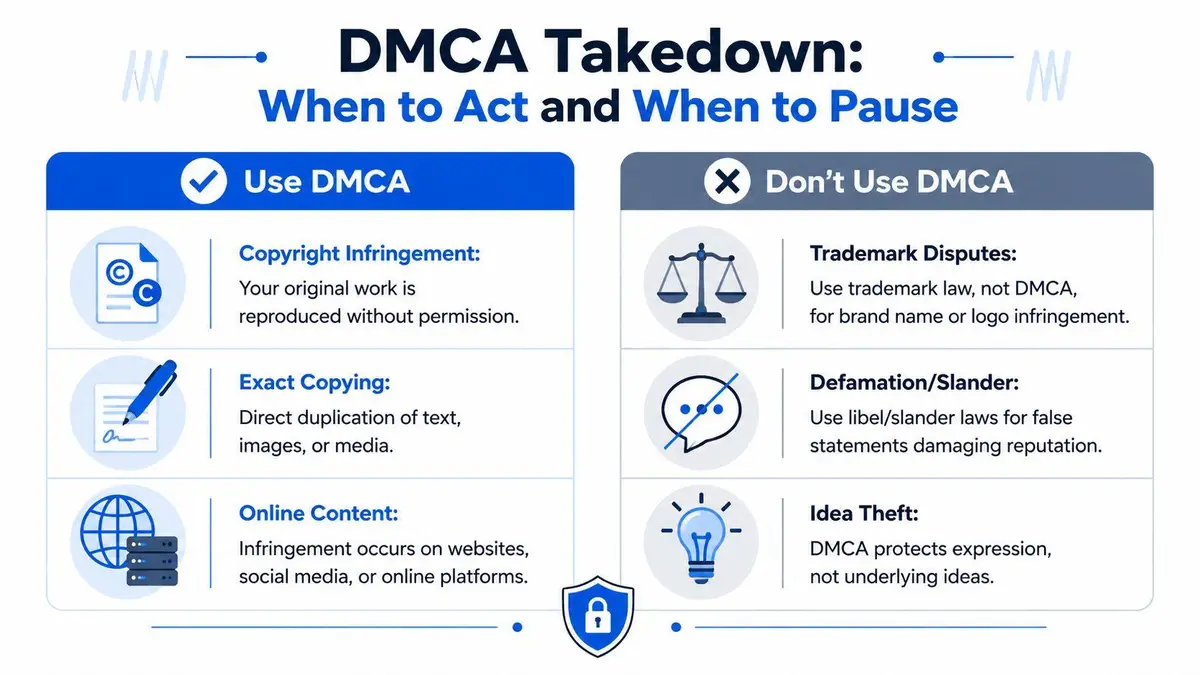
A DMCA notice is for copyright infringement. That means someone reproduced, distributed, displayed, or reposted your original protected work without authorization. Think copied blog posts, stolen product photos, republished videos, duplicated training materials, or reposted artwork.
It is not for defamation. It is not for impersonation by itself. It is not for fake reviews. It is not for trademark disputes. It is not for someone “stealing your idea” if they did not copy your specific expression of that idea.
The hard boundary most people miss
This isn’t a technical distinction. It decides whether the platform acts at all.
A 2025 Georgetown Law review found over 60% of DMCA misuse cases involve non-copyright complaints like defamation or impersonation, which platforms routinely reject. The same review highlights the core legal problem: 17 U.S.C. § 512 only covers copyright infringement (Georgetown Law review on DMCA misuse).
If someone creates a fake profile using your name and biography, the DMCA may help only if they also copied your protected photos, videos, or written content. If the harm is the false identity itself, you need an impersonation or platform policy strategy, not a copyright notice. If a review is false and damaging, that is a defamation or false-content issue, not a DMCA issue.
A quick decision framework
Use this table before you draft anything:
| Situation | DMCA fit | Better path |
|---|---|---|
| Someone reposted your article word-for-word | Strong | DMCA notice |
| A site copied your product photography | Strong | DMCA notice |
| A user uploaded your video without permission | Strong | DMCA notice |
| A fake account is pretending to be you | Weak unless copyrighted assets were copied | Impersonation report, legal escalation |
| A competitor published false statements | No | Defamation strategy |
| Someone used your brand name in a confusing way | No | Trademark enforcement |
| A business copied your concept but not your actual content | No | Contract, trade secret, or unfair competition analysis |
Filing a DMCA notice against the wrong category of harm doesn’t just fail. It delays the remedy you should have pursued first.
What qualifies as copyright evidence
Before you proceed, ask whether you can point to three things with confidence:
- Your original work: the photo, article, video, design, code, or other expression you own.
- The copied version: the exact online location where it appears without permission.
- A substantial match: not just a similar theme or concept, but copied expression.
For executives and public figures, a split strategy is often necessary. The online harm may involve copied assets and reputational abuse at the same time. In that case, use the DMCA where it fits and a separate removal pathway where it doesn’t.
That discipline is what keeps the takedown process efficient.
Crafting a Takedown Notice That Cannot Be Ignored
Most failed notices don’t fail because the copyright claim is weak. They fail because the notice is defective.
A legally effective DMCA notice requires five specific elements under 17 U.S.C. § 512(c)(3)(A), and notices missing even a single element, such as a URL or valid signature, are rejected in over 85% of cases according to the analysis cited by Clark Hill (Clark Hill on DMCA notice requirements).
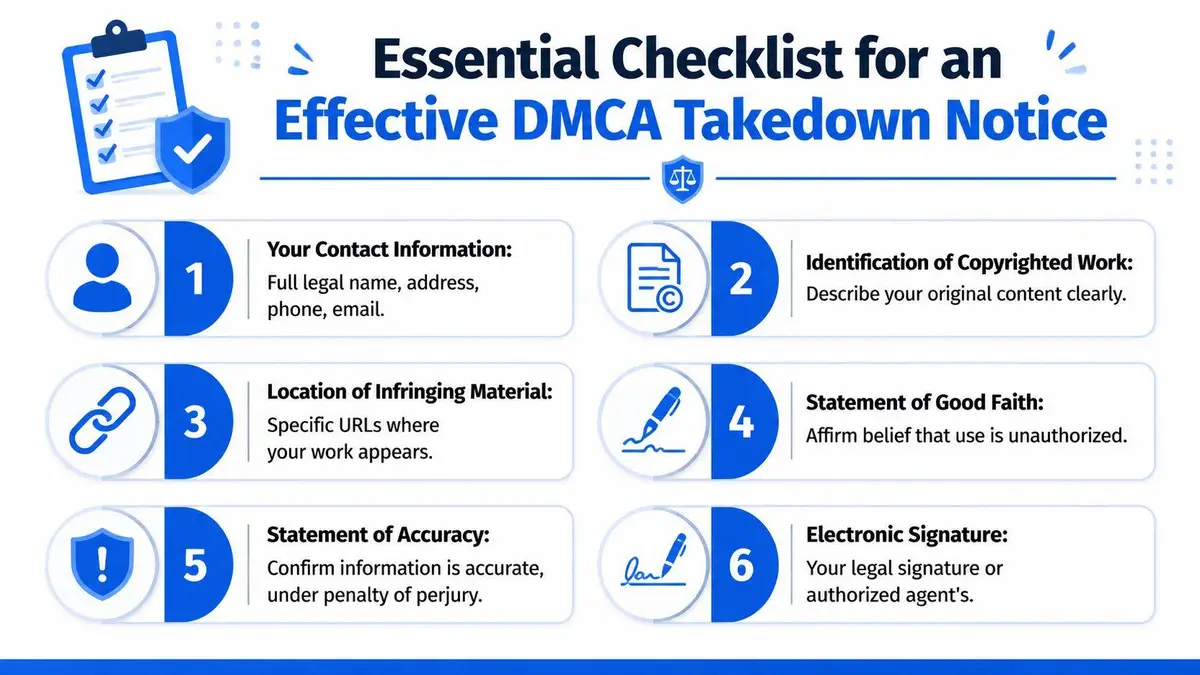
The practical lesson is blunt. If your notice lacks a required element, many platforms will reject it before anyone meaningfully reviews the claim.
The five elements that matter
Here is the working structure your notice needs.
- Signature
You need a physical or electronic signature from the copyright owner or an authorized agent. This tells the platform a real person with authority is making the legal assertion. - Identification of the copyrighted work
Describe the original work with enough specificity that the reviewer knows what you own. Vague phrases like “my content” are useless. - Identification and location of the infringing material
Give the exact URL or precise platform location of the copied material. If you want action, make the reviewer’s job easy. - Contact information
Include name, address, phone number, and email for the complaining party. - Good faith and perjury statements
State that you have a good faith belief the use is unauthorized, and that the information is accurate under penalty of perjury.
Why each part exists
A good notice doesn’t merely satisfy a checklist. It removes ambiguity.
If your work identification is weak, the platform can’t tell what was copied. If your URL is wrong, the platform can’t locate the material. If your authority is unclear, the provider may refuse to act. If your statements are missing, the notice lacks the statutory assurances the provider needs to rely on.
That’s why effective takedown practice is less about volume and more about drafting discipline.
A notice should read like a clean legal instruction set. No theatrics. No threats. No sprawling narrative.
Sample language you can adapt carefully
You don’t need ornamental legal prose. You need accuracy. A concise framework looks like this:
- Copyrighted work identification: “The copyrighted work at issue is the original article titled [title], first published by [owner] at [original location], or otherwise owned by [owner].”
- Infringing material identification: “The infringing material appears at the following URL(s): [exact URL].”
- Good faith statement: “I have a good faith belief that the use of the copyrighted material described above is not authorized by the copyright owner, its agent, or the law.”
- Accuracy and perjury statement: “I swear, under penalty of perjury, that the information in this notice is accurate and that I am the copyright owner or am authorized to act on behalf of the owner.”
- Signature: “/s/ [Full Legal Name]”
Don’t copy that blindly. Adapt it to the facts, and make sure each factual statement is true.
What strong notices do differently
Weak notices complain. Strong notices identify.
Use this short checklist before sending:
- Name the work precisely: title, format, author, and original publication location if available.
- List exact URLs: not a homepage, category page, or vague platform reference.
- State authority clearly: owner or authorized agent.
- Keep the claim narrow: target the copied material you can prove.
- Review every field twice: especially links, names, and contact details.
If you’re managing a portfolio of infringements across multiple sites, consistency matters. The same naming convention, evidence standard, and documentation format across notices reduces errors and makes follow-up far easier.
Submitting Your Notice to Platforms and Search Engines
A perfect notice sent to the wrong place is functionally worthless.
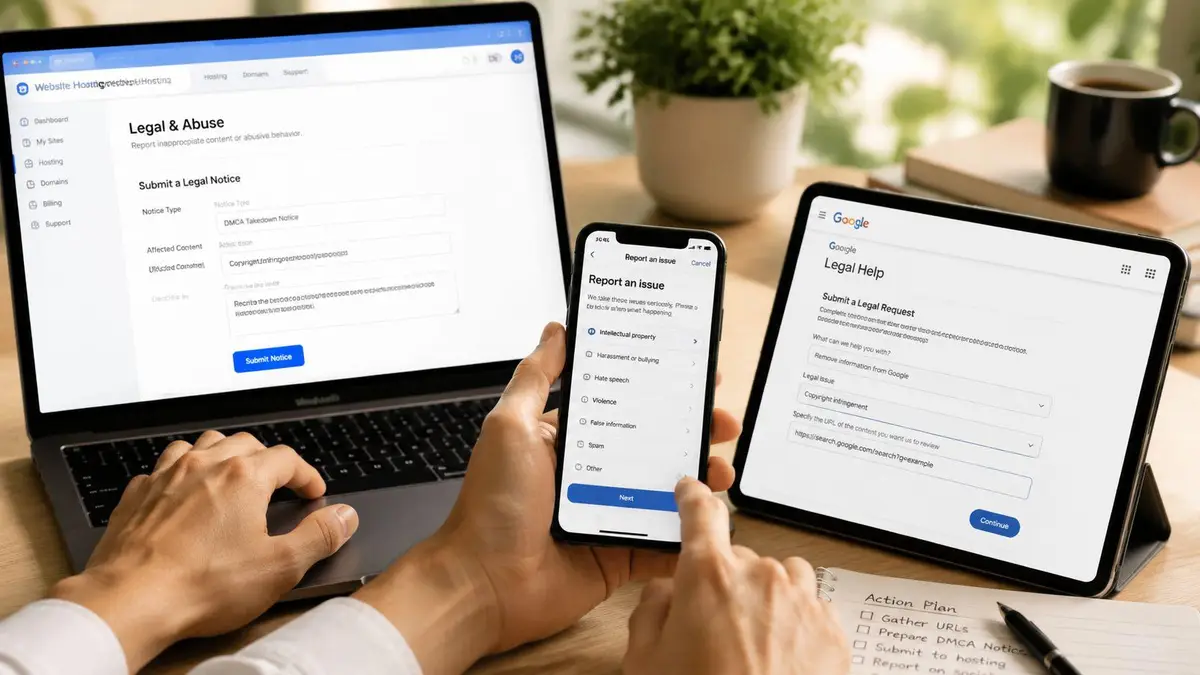
The submission path changes depending on what you’re trying to remove. A web host, a social platform, and a search engine play different roles. The host can often remove the source content. A search engine may only remove the result that leads users there. If you confuse those functions, you’ll think you acted when you only addressed half the problem.
Three common submission scenarios
Suppose a copied article appears on an independent website. Your first target is usually the site operator or hosting provider. You identify the service provider’s legal or DMCA intake channel and submit the notice there. If search results are amplifying the copied page, you may also submit a separate search removal request.
Now change the facts. The copied material is on a major social platform. In that setting, you usually work through the platform’s dedicated copyright reporting form, not a generic support inbox. Large platforms route these complaints through structured workflows, and freeform emails often disappear into the wrong queue.
The third scenario is search visibility. If the infringing page remains live while you pursue host removal, search de-indexing can still cut off discovery. If Google is surfacing the copied material prominently, use a proper Google legal request process rather than assuming source removal and search removal are the same task.
Errors that kill a submission
An empirical Stanford study found that at least 1.3% of all DMCA takedown requests contain substantive errors, including inactive URIs that make them impossible for a provider to process (Stanford study on DMCA notice errors). That sounds modest until you remember how many notices are filed and how often a single bad URL stalls the whole matter.
Common operational mistakes include:
- Broken links: the URL no longer resolves, was copied incorrectly, or points to a login-protected location the reviewer can’t access.
- Wrong target: you sent the complaint to a registrar, search engine, or general support channel when the host or platform copyright team was the proper recipient.
- Grouped claims with poor labeling: multiple infringements crammed together without clear mapping to the original works.
How to keep execution tight
Use a simple submission log. Track where you sent the notice, when you sent it, what URLs were included, and any case number or acknowledgment you received. This becomes essential if you need to escalate, prove notice, or coordinate source removal with de-indexing.
For more complex matters, some teams use outside enforcement support instead of handling every filing internally. One option is ContentRemoval.com, which manages copyright removal workflows as part of broader online content enforcement. That’s useful when the matter spans multiple platforms and search results at once.
The tactical point is straightforward. Draft once with precision. Submit separately where needed. Track every step.
Navigating the Counter-Notice and the 14-Day Window
The first takedown is not the final result. It is often the opening move.
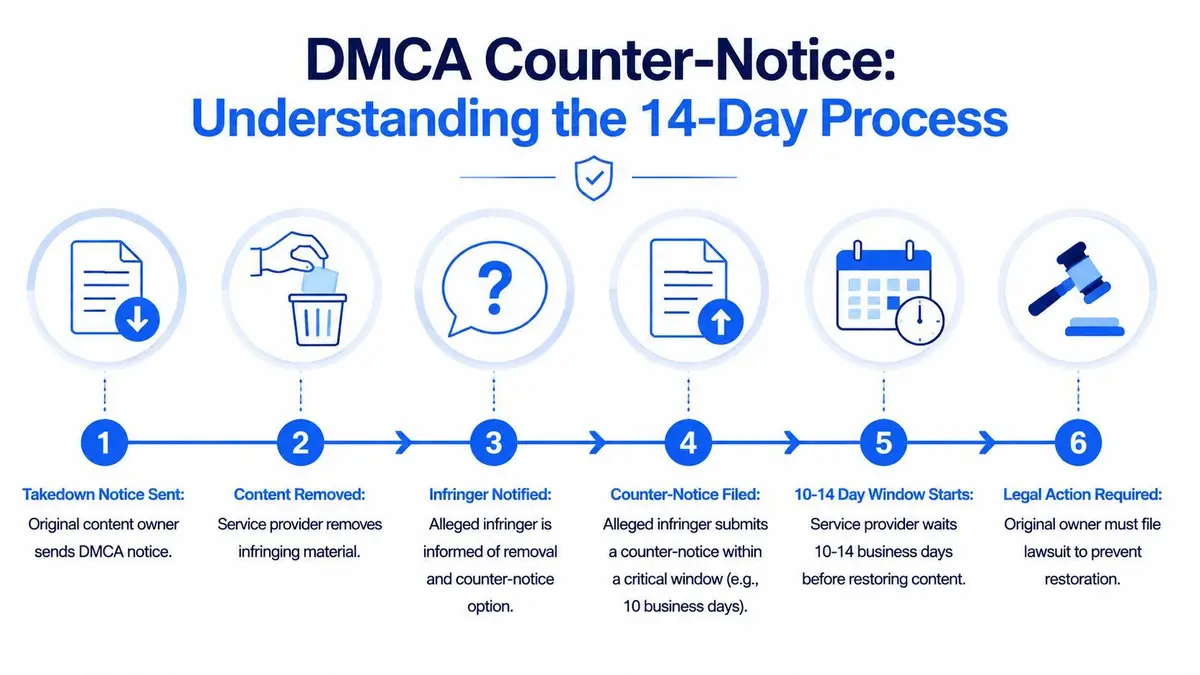
When the alleged infringer files a valid counter-notice, the legal posture changes immediately. The provider is no longer processing your complaint. It is following a statutory sequence that can end with the content being restored unless you escalate to court.
What a valid counter-notice does
The waiting period is not optional. After a counter-notice, the provider must wait 10 to 14 business days before restoring the content, and if the copyright owner does not file a lawsuit and notify the provider within that window, the provider is legally obligated to restore the material (Copyright Alliance explanation of the counter-notice window).
That means a takedown can reverse quickly if you treat the initial removal as a permanent win.
A valid counter-notice also has its own formal requirements. It must include a statement under penalty of perjury that the material was removed by mistake or misidentification, and the sender must consent to the relevant court jurisdiction. Without that consent, the counter-notice is invalid and the content should remain disabled (counter-notice requirements explained by NCRC).
Here is the process in plain view:
What you decide during the window
At this stage, clients need legal judgment, not generic internet advice.
You have two real options. File a lawsuit and notify the provider, or let the content come back. The right answer depends on the strength of your ownership record, the clarity of infringement, the business value of the content, and the broader reputational impact of litigation.
| Question | If answer is strong | If answer is weak |
|---|---|---|
| Can you prove ownership cleanly? | Litigation is more realistic | Reassess before escalating |
| Is the copying obvious and substantial? | Push harder | Counter-notice may expose weaknesses |
| Is the content commercially or reputationally significant? | Court action may be justified | Restoration may be tolerated while other remedies proceed |
| Will litigation create unwanted attention? | Balance carefully | Consider quieter parallel strategies |
Don’t wait until day ten to decide whether you’re willing to sue. By then, you’ve already lost time you needed.
The strategic trap for executives and public figures
Counter-notices are especially dangerous in mixed-harm situations. If the material includes copied assets and defamatory framing, the DMCA may remove it temporarily, but the reputational attack may continue through text, commentary, reposts, or mirror pages even if the copied asset is addressed.
That is why the post-counter-notice analysis often expands beyond copyright. If the remaining issue is reputational, false, or impersonation-based, you may need a separate internet defamation attorney consultation for executives rather than relying on copyright law to do work it was never designed to do.
How to respond without losing leverage
When a counter-notice arrives, verify four things immediately:
- Identity and authority: who submitted it and whether it appears procedurally valid.
- Jurisdiction consent: if absent, the counter-notice may be defective.
- Your proof file: ownership records, original files, publication history, agreements, and infringement evidence.
- Litigation readiness: whether you can file in time if you choose to proceed.
The key anxiety clients feel here is justified. The platform’s timeline is short, the legal threshold is real, and hesitation usually benefits the other side. If the asset matters, prepare for this stage before the first notice goes out.
Beyond the Takedown Prevention Monitoring and Strategic Recourse
Reactive takedowns are necessary. They are not a complete protection strategy.
If you manage valuable digital assets, your real objective is not sending better complaints forever. It is reducing the frequency, spread, and business impact of infringement before each incident turns into a chase across platforms, search engines, and mirror sites.
Build a system, not a habit of reacting
Start with ownership hygiene. Keep source files organized. Preserve creation records. Make sure employee and contractor agreements assign rights where they should. Add visible copyright notices where appropriate. Use watermarking or embedded metadata when the asset type justifies it.
Then monitor aggressively. Reverse image search, platform reporting tools, search alerts, and routine sweeps all matter. For organizations also thinking seriously about managing cyber threats for businesses, the overlap is obvious. Leaks, scraping, account compromise, and content abuse often sit inside the same broader risk environment.
Use the right remedy stack
Not every problem should start and end with the DMCA.
- Copyright theft: use the DMCA quickly and precisely.
- Defamation or false allegations: use a reputational and legal review track.
- Impersonation or fake profiles: use identity-based reporting and escalation.
- Search amplification: pair source removal with search de-indexing where justified.
The strategic approach is layered. You identify the harm, match the legal tool to the harm, and coordinate timing so one track doesn’t undermine another.
The clients who get durable results don’t just remove content. They monitor for reposts, close procedural gaps, and prepare for the next attempt before it appears.
There’s also a risk side to careless filing. False or misapplied notices can create exposure under § 512(f). That’s another reason serious matters should be handled with legal discipline, especially when the target is represented, the content may trigger defenses, or the business consequences of a mistake are high.
The DMCA takedown process is powerful when used correctly. It is ineffective when used emotionally, broadly, or outside its legal boundaries. High-stakes online protection requires a narrower hand and a wider strategy.
If you need a confidential assessment of stolen content, piracy, impersonation, defamation, or search-based exposure, ContentRemoval.com can help you evaluate the correct removal path and act quickly with a clear enforcement plan.
Frequently asked questions
Can I use a DMCA takedown for a fake profile or false review?
Only if the fake profile or review also copies your protected photos, videos or written content. The DMCA covers copyright infringement alone. Impersonation needs a platform identity report or legal escalation, false statements need a defamation strategy and brand misuse needs trademark enforcement. Filing under the wrong category delays the remedy you should have pursued.
Who do I send a DMCA notice to?
It depends on what you are removing. For a copied article on an independent site, target the operator or hosting provider’s DMCA intake. For content on a major social platform, use its dedicated copyright reporting form. If search results are amplifying a live page, submit a separate legal request to the search engine, since source removal and de-indexing are different tasks.
What happens after a DMCA counter-notice is filed?
The provider waits 10 to 14 business days and then must restore the content unless you file a lawsuit and notify them within that window. Check the counter-notice for a perjury statement and consent to court jurisdiction, since without both it is invalid. Decide early whether you are willing to litigate rather than waiting until the last day.