
A DMCA takedown notice template must contain the elements set out in 17 U.S.C. Section 512(c)(3): identification of the copyrighted work, the exact URL of the infringing material, your contact information, a good-faith belief statement, an accuracy statement under penalty of perjury and a signature. The article provides an email version and a formal letter version. Narrow and precise wins.
Key facts
- Send the notice to the platform’s designated DMCA agent or its legal request portal, not just the site operator.
- Pair each infringing URL with the specific original work; a domain root or category page is too vague.
- Average processing is cited at around 10 business days, with some platforms acting in 24 to 48 hours.
- A DMCA notice is the wrong tool for impersonation, doxxing, privacy or defamation problems.
Where ContentRemoval.com comes in. A template covers the isolated case with clear ownership. When copied board materials or leaked documents are ranking for an executive’s name and mirrors have appeared, the first filing has to be scoped correctly or it hands the other side an argument. ContentRemoval.com assesses whether copyright is the right instrument, prepares the notice and evidence file, and coordinates removal, de-indexing and monitoring. A free 15-minute Exposure Scan maps what is removable, and the report is yours to keep. Get a Free, Confidential Exposure Scan or read how our content removal work is done.
You found your work copied, republished, embedded, or reposted. It may be a leaked PDF, a stolen photograph, a copied article, a pirated video, or a page that exists for no reason other than to rank against your name. Your first instinct is usually the same as everyone else’s. Search for a free dmca takedown notice template, fill in the blanks, hit send, and hope the platform takes it down.
Sometimes that works. In lower-stakes matters, a simple notice can be enough.
In high-stakes reputation cases, that instinct can backfire. A DMCA notice is not a complaint form. It is a legal assertion sent into a system built for volume, reviewed by platform teams that reject unclear submissions quickly, and backed by statements made in good faith and under penalty of perjury. If you overclaim, send it to the wrong recipient, fail to identify the infringing location precisely, or use an aggressive but legally sloppy template, you can lose time, lose advantage, and in some cases create liability for yourself.
A useful dmca takedown notice template isn’t the one that sounds forceful. It’s the one that survives scrutiny and gets acted on.
The Anatomy of a Legally Effective DMCA Notice
The modern dmca takedown notice template exists because the Digital Millennium Copyright Act became law in 1998, and the notice-and-takedown framework is codified in 17 U.S.C. § 512(c)(3). Georgetown University Library’s summary of the statute explains that an effective notice must be sent in writing to the provider’s designated agent and include specific required elements, including identification of the copyrighted work, identification of the infringing material, contact information, a good-faith statement, an accuracy statement under penalty of perjury, and a physical or electronic signature, as outlined in Georgetown’s DMCA takedown guide.
What each required element actually does
A template fails when the sender treats these elements like admin fields instead of legal components.
Identification of the copyrighted work tells the recipient what rights you claim. If you’re protecting a single image, that is straightforward. If you’re dealing with a portfolio, article series, or a library of videos, the description has to be specific enough to establish ownership without creating confusion about the scope of the claim.
Identification of the infringing material is where many notices collapse. “My content appears on your site” is useless to a platform team. A takedown reviewer needs the exact location to evaluate and process the request. In practice, that usually means a precise URL and enough context to match the copied material to your original work.
Contact information is not clerical fluff. It allows the platform to authenticate the request, ask follow-up questions, and route any counter-notice properly.
The statements that create legal weight
The two most consequential lines in any dmca takedown notice template are the good-faith belief statement and the accuracy statement under penalty of perjury.
Those clauses are what separate a legal notice from an angry email. They tell the service provider that you are making a real copyright claim, not objecting to criticism, exposure, or unwanted attention.
Practical rule: If you can’t sign the notice comfortably because the ownership facts are uncertain, the notice isn’t ready.
The signature matters for the same reason. Georgetown notes that the signature can be physical or electronic, but it has to be there because the notice must be attributable to a real claimant.
For a more detailed filing walkthrough, see this guide on how to write and file a DMCA takedown notice. Use any template only after you understand why each line exists.
Ready-to-Use DMCA Takedown Notice Templates
A free dmca takedown notice template should do two things well. It should satisfy the statute, and it should be easy for a platform reviewer to process without guessing what you mean. Most public templates fail because they either sound too informal or try to sound like litigation before the recipient has even confirmed the facts.
Template for email submission
Use this version when the platform or host accepts notices by webform or email and speed matters.
Subject: DMCA Takedown Notice for Copyright Infringement
To the Designated DMCA Agent,
I am the owner of, or authorized to act on behalf of the owner of, the copyrighted work identified below.
Copyrighted work:
[Describe the original work with enough detail to identify it clearly.]Infringing material:
The material appearing at the following URL(s) infringes the copyrighted work identified above:
[Insert exact URL or URLs.]My contact information:
Name: [Full legal name]
Address: [Mailing address]
Telephone: [Phone number]
Email: [Email address]I have a good-faith belief that the use of the copyrighted material described above is not authorized by the copyright owner, its agent, or the law.
I declare, under penalty of perjury, that the information in this notice is accurate and that I am the copyright owner or am authorized to act on behalf of the copyright owner.
Signature: [Type full legal name as electronic signature]
Date: [Insert date]
This format works because it is short, readable, and easy to route internally. It avoids long factual narratives that slow down review. It also keeps the legal statements intact.
Template for formal letter
Use this version when the matter is sensitive, the copied content is tied to reputation harm, or you want a more controlled record.
| Section | Suggested language | Why it matters |
|---|---|---|
| Opening authority | “I write on behalf of the copyright owner regarding unauthorized use of copyrighted material.” | Establishes who is making the claim and in what capacity |
| Work identification | “The copyrighted work at issue is [description].” | Defines the protected material with precision |
| Infringing location | “The infringing material appears at [exact URL(s)].” | Gives the reviewer a workable target |
| Good-faith statement | Use the statutory language directly | Signals compliance rather than improvisation |
| Perjury statement | Use the statutory language directly | Gives the notice legal force |
| Signature block | Include full name, title if applicable, and electronic or physical signature | Makes the notice attributable and complete |
Here is the full letter format:
[Date]
Via [Email / Webform / Designated Agent Address]
Re: DMCA Takedown Notice
To the Designated Agent:
I represent the owner of the copyrighted work described below and submit this notice pursuant to the Digital Millennium Copyright Act.
The copyrighted work is: [clear description of original work].
The infringing material is located at the following URL(s): [exact URL(s)].
My contact information is as follows:
[Full name]
[Mailing address]
[Telephone number]
[Email address]I have a good-faith belief that the disputed use is not authorized by the copyright owner, its agent, or the law.
I declare, under penalty of perjury, that the information contained in this notice is accurate and that I am the copyright owner or am authorized to act on behalf of the owner.
[Physical or electronic signature]
[Name]
[Title, if applicable]
What free templates usually miss
The text is only the starting point. What matters just as much is what you attach and how narrowly you define the claim.
- Use exact URLs: A homepage, search result, or domain root usually isn’t enough.
- Match each URL to a work: If multiple works are involved, organize them so the reviewer can follow the claim.
- Strip out emotion: Accusations, threats, and outrage don’t help the reviewer remove content faster.
- Check authorization first: A former licensee, distributor, employee, or agency may complicate ownership and permission questions.
The strongest notice usually reads colder than the client expects. That is a feature, not a flaw.
Executing the Takedown The Submission Workflow
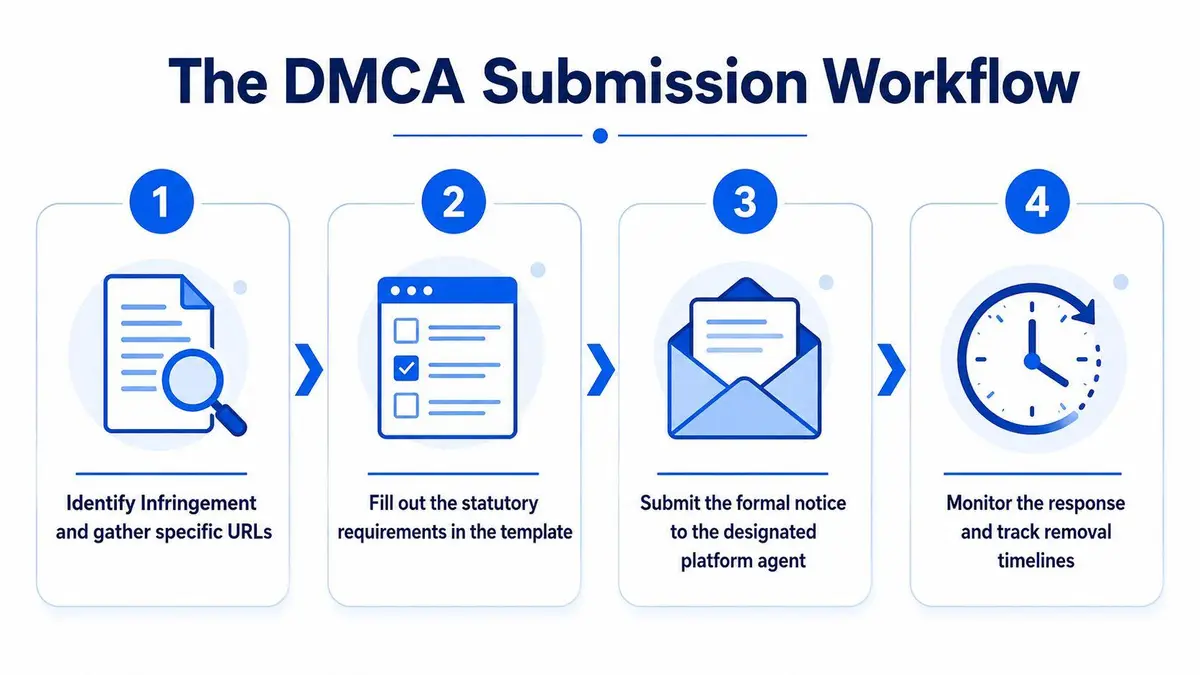
Most failed takedowns don’t fail because the sender lacked a template. They fail because the sender submitted a decent notice into the wrong channel, with poor evidence, in a format that doesn’t fit how platforms process requests.
The scale matters. Google reportedly received just over 75 million DMCA-related takedown requests in March 2016 alone, and industry-wide rights holders send notices for more than 78 million infringing files annually, according to DMCA statistics and trends compiled by DMCA Authority. The same source notes average processing around 10 business days, with some services advertising 24 to 48 hour turnaround and rejection or delay rates reaching 8.4% in one cited dataset. A high-volume system rewards precision. It does not reward persuasion.
Find the actual decision-maker
The first question is not “What do I want removed?” It is “Who has control over removal?”
Sometimes that is the platform itself. Sometimes it is the web host. Sometimes the visible website operator is irrelevant because the host or service provider controls the infrastructure and receives the notice through a designated agent. If a platform publishes a legal request portal, use it. If it identifies a designated DMCA agent, send the notice there.
A WHOIS lookup can still help map the domain and service relationships, but don’t mistake domain data for the final submission target. The right recipient is the entity with a defined takedown intake and authority to disable access.
For Google-specific search removals, this process is different from sending a website owner a demand. The submission path matters, and this walkthrough on how to submit a Google legal request explains that distinction.
Build the evidence file before you send
A strong submission package usually includes:
- Screenshots tied to timestamps: Capture the infringing page as it appeared when you found it.
- Original-source proof: Keep the original publication link, file metadata, publication record, or internal ownership record ready.
- URL map: If multiple pages are involved, prepare a clean list that pairs each infringing URL with the corresponding original work.
- Submission log: Record where you sent the notice, when you sent it, and what attachments or screenshots were included.
Format for machine and human review
Many legal request systems are reviewed in a semi-structured way. That means your notice should be easy for software to parse and easy for a person to verify.
Don’t bury URLs in paragraphs. Don’t paste ten different issues into one rambling message. Don’t use an attachment as a substitute for the required notice text unless the platform explicitly permits that method.
Operational insight: The faster a reviewer can identify the work, the infringement location, and the statutory statements, the lower the chance your notice gets kicked back for clarification.
If you need broader help coordinating source removal, search de-indexing, and monitoring, one available option is ContentRemoval.com, which handles copyright-based removals as part of wider online content enforcement workflows.
Managing Timelines and Platform Responses
A high-stakes client usually asks the same question within minutes of filing: when will this come down? The honest answer is that a DMCA notice starts a process, not a countdown clock. Platforms apply different review rules, different staffing models, and different risk tolerances. A free template does not change that.
In practice, the first platform response tells you more than the passage of time does. A same-day acknowledgment can still end in rejection. A slower review can still produce removal if the notice is clean, specific, and easy to verify. The operational mistake is treating silence as a legal answer or treating every delay as platform bad faith.
What the first response usually means
A takedown request usually falls into one of four tracks.
| Platform response | What it usually means | Your next move |
|---|---|---|
| Removal or disablement | The notice was accepted as actionable | Archive proof of removal and monitor for reuploads |
| Request for more information | The reviewer could not verify a material point | Answer the question directly and submit only the missing item |
| Rejection | The notice failed on legal sufficiency, formatting, or target selection | Review the defect before sending anything new |
| Counter-notice risk | The target may dispute ownership, authorization, or fair use | Preserve the file and reassess the broader legal strategy |
A clarification request often signals that the platform is willing to act if you close a narrow gap. That gap may be ownership, URL precision, or proof that the complained-of material matches the protected work. In reputation matters, that distinction matters. An overbroad follow-up can create a fresh problem by making the sender look careless, aggressive, or unfamiliar with the actual claim.
What timeline management actually looks like
A practical internal benchmark is to review the matter again within about 72 hours if there is no clear response. That is a case-management standard, not a legal deadline the platform owes you. Some providers disable access quickly when the infringement is obvious and the notice fits their intake rules. Others queue requests, ask for supplemental proof, or route edge cases to legal review.
The real work during that window is disciplined tracking. Record the submission time, any ticket number, the exact URLs reported, the response received, and the deadline for the next follow-up. If the matter later turns into a counter-notice dispute, repeat infringement issue, or broader enforcement campaign, that record will matter more than anyone’s memory.
This overview gives a practical visual of what happens after filing:
Follow-up without weakening your position
Follow-up should be controlled and sparse.
- Use the platform’s reference number every time: Fragmented email chains slow review and create avoidable confusion.
- Answer only the issue raised: If the platform asks for a source URL or ownership confirmation, provide that. Do not expand into defamation claims, business harm, or a narrative about the opposing party.
- Keep a litigation-grade record: Save confirmations, portal screenshots, emails, and the removed content as it appeared before takedown.
- Watch for migration: Content that disappears from one URL often reappears on mirrors, alternate accounts, or file-sharing pages.
I often tell clients the same thing here. Repeated same-day follow-ups rarely speed removal, and they sometimes make a reviewer less willing to trust the file. A measured response, sent with the missing proof and no extra noise, usually gets better results.
Critical Pitfalls and Legal Caveats to Avoid
A client calls after a copied document goes live on a hostile blog, starts ranking for the executive’s name, and triggers investor questions within hours. In that moment, a free dmca takedown notice template looks convenient. It can also make the situation worse if it overstates ownership, targets the wrong material, or turns a reputation problem into a false copyright claim.
The mistakes that quietly wreck notices
Templates fail when they are treated as paperwork instead of legal instruments. A platform reviewer is looking for a valid statutory notice tied to identifiable copyrighted material. Opposing counsel, if the matter escalates, is looking for overreach, factual sloppiness, and any statement that can be framed as a bad-faith misrepresentation.
The recurring problems are predictable:
- Ownership is assumed, not confirmed: A company may own the brand and still lack rights in a freelancer’s image, a licensed chart, or a draft created before assignment paperwork was signed.
- The claim is broader than the rights: Demanding removal of an entire article because it includes one protected image is often harder to defend than targeting the specific infringing asset.
- Copyright is used to solve the wrong problem: If the complaint is about reputational damage, impersonation, privacy invasion, or false statements, a DMCA notice may fail outright and complicate the stronger claim.
- The notice is written for effect instead of compliance: Platform teams respond to precise URLs, ownership facts, and required statutory statements. They do not need a grievance narrative.
I see this often in reputation matters involving former employees, competitors, anonymous operators, and mixed allegations. The legal issue is rarely as clean as the template assumes.
Overclaiming creates legal exposure
A DMCA notice carries legal weight because it includes statements made in good faith and under penalty of perjury. That matters.
If the facts are thin, the filing can do more than miss the takedown. It can invite a counter-notice, preserve a record of overstatement, and give the publisher an argument that the notice process was abused. In a high-stakes reputation case, that loss of credibility can affect every later step, including platform appeals, search deindexing requests, negotiated removal, and litigation posture.
The operational mistake is filing too early. Counsel should first confirm who owns the work, whether the allegedly copied material is protectable, whether the use is narrow enough to target precisely, and whether another removal path fits the facts better. Our strategic DMCA takedown process for high-risk content removal matters is built around that sequence because it reduces avoidable errors before the notice goes out.
Precision beats force
The stronger notice is usually the narrower one.
Identify the exact asset. Match it to the exact infringing URL. State only the rights you can prove cleanly. Keep copies of the original work, registration records if they exist, license and assignment documents, and screenshots showing how the material appeared at the time of infringement.
A rushed or inflated notice can fail for reasons that have nothing to do with the underlying harm. In reputation-driven cases, that is the risk free templates miss. The goal is not to send a form letter. The goal is to remove the content without creating a second problem in the process.
When to Escalate Beyond a DIY Takedown Notice
A client usually calls after the first notice fails. The copy is still live, mirrors have appeared, and the other side now knows exactly which asset matters most.
That is the point where a free dmca takedown notice template stops being a cost-saving tool and starts creating exposure. A template can work when the infringement is isolated, ownership is straightforward, and the platform has a clear intake process that functions. Once the facts get messy, the notice becomes a legal instrument that has to be scoped, timed, and supported correctly.
Escalation makes sense when the infringement spans multiple domains, the operator is anonymous, the host sits offshore, or the content mixes copyright issues with impersonation, privacy violations, extortion, or search suppression tactics. Those matters usually require more than one removal path. They also require message discipline, because every statement sent to a platform, host, registrar, or publisher can be reused against you later.
The legal risk is not abstract. A careless notice can trigger a counter-notice, preserve a record of overreach, and undermine later requests to platforms or search engines. In a high-stakes reputation matter, that credibility loss is expensive. It affects speed, negotiating position, and, in some cases, whether the next reviewer treats the file as serious or abusive.
Escalate early when the material has real business value.
That includes board materials, internal reports, unreleased media, executive photographs, paid research, customer lists, or any asset tied to a financing event, litigation, or public controversy. In those cases, a failed first pass often gives the publisher time to duplicate files, change hosts, and widen distribution before a stronger response is in place.
The practical question is not whether you can send a notice yourself. It is whether you can afford to get the first move wrong. A narrower, supported, strategically timed filing usually performs better than a fast template submission, especially where the other side is motivated, experienced, or trying to provoke a procedural mistake.
If the matter has reached that stage, use a process built for multi-path enforcement rather than another generic form. Our guide to strategic DMCA takedowns for high-risk content removal matters outlines how to assess escalation before a weak notice makes the situation harder to contain.
Frequently Asked Questions on DMCA Notices
Can one notice cover multiple works
Sometimes, yes. A single notice can work when the works are related and the infringing locations are identified clearly enough for the recipient to act. The practical test is whether the reviewer can understand exactly what belongs to you and exactly where the copied material appears. If a combined notice becomes confusing, separate notices usually perform better.
How specific do URLs need to be
As specific as the platform needs to locate the material without guesswork. A domain name alone is often too vague. A category page may also be too broad. The safer approach is to identify the exact page, post, file location, or asset URL where the allegedly infringing material appears.
What if the content is harmful but not clearly infringing
Then copyright may not be the right removal path. A DMCA notice is not a universal content-removal tool. If the issue is impersonation, misuse of identity, doxxing, leaked private information, harassment, or defamatory framing built around original text written by the publisher, a different legal or platform policy route may be stronger.
What if the platform ignores the notice
That usually means one of three things. The notice didn’t reach the right recipient, the submission lacked a required element or usable evidence, or the platform doesn’t see sufficient grounds to act on what was sent. Before resubmitting, diagnose the failure. Repeating the same defective notice usually wastes time.
Should you mention reputational damage in the notice
Only if it directly helps explain the infringement context and does not distract from the copyright claim. Most of the time, the notice should stay narrow. The reviewer’s job is to assess copyright compliance, not to adjudicate the broader harm the publication is causing you.
When copied or leaked content threatens your reputation, speed alone isn’t enough. ContentRemoval.com helps clients assess whether a DMCA notice is the right instrument, prepare defensible submissions, and coordinate broader removal strategy when the problem extends beyond copyright.