

A digital footprint audit for executives is a structured review of everything findable about a person, their entities and their close associates, followed by triage and a remediation plan. It answers four questions: what exists, who sees it, how harmful it is, and whether to remove, de-index, suppress, monitor or leave alone. Scope it the way a hostile party would.
Key facts
- Scope covers aliases, prior companies, subsidiaries, family office entities, board members and name variants.
- Advanced search operators find most indexed data, but a sizeable share sits on brokers, forums and non-indexed sites.
- Triage scores each finding on severity, visibility and likely intent, then ranks by business consequence.
- Four remedies exist: source removal, search de-indexing, suppression and strategic non-response.
Where ContentRemoval.com comes in. ContentRemoval.com runs digital footprint audits for executives and enterprises as the front end of remediation: a defensible inventory of exposure across search, brokers, archives and hidden sources, a ranked risk register, and a written action matrix covering removal, de-indexing and monitoring. General counsel, chiefs of staff and security leads usually commission the work. A free 15-minute Exposure Scan maps what is removable, and the report is yours to keep. Get a Free, Confidential Exposure Scan or read how our content removal work is done.
A journalist calls your office at 7:10 a.m. with a screenshot and a deadline. An investor has already circulated an old filing under a defunct company name. Someone has matched your home address to a family member’s social profile and posted both in a forum you have never visited. At that point, the issue is not visibility. It is exposure.
A proper digital footprint audit is part of strategic risk management. It identifies what is publicly accessible, what is commercially available, what has been copied or indexed by third parties, and what can be weaponized in a dispute, investigation, transaction, or media cycle. For enterprise leaders, that means looking beyond the executive’s name to aliases, subsidiaries, prior ventures, family office entities, close associates, and the digital traces that connect them.
The threat is usually broader than clients expect. Your risk does not sit on your company website or LinkedIn profile alone. It sits in old PDFs, litigation databases, review platforms, data broker records, cached pages, breach references, archived social accounts, code repositories, and obscure forums that surface at the worst possible moment.
An audit gives you control.
You learn what exists, who can find it, how credible it appears, how quickly it can spread, and which problems justify removal, suppression, correction, or formal legal action. That is the difference between managing risk in advance and defending your judgment under pressure after someone else defines the story for you.
Beyond the Search Bar An Introduction
At 7:10 a.m., your general counsel forwards a screenshot. An old allegation, a stale directory listing, or a copied document has resurfaced just as a financing round, board review, or regulatory inquiry begins. In that moment, a quick name search is useless. You need a defensible picture of exposure and a plan to contain it.
A professional digital footprint audit belongs in the risk function, not the personal privacy checklist. It applies the discipline of legal review to public and semi-public information. You identify the records, pages, profiles, databases, and cached materials that can affect negotiations, trigger scrutiny, support impersonation, or expose private facts. For executives, founders, and families with real visibility, that work sits alongside legal, cyber, and communications planning because the threat rarely stays in one lane.
What a real audit is actually for
The purpose is control.
A proper audit tells you what can be found, who is likely to find it, how credible it appears, and which issues justify action. The target is not vanity. The target is reducing legal exposure, reputational harm, transaction friction, and personal security risk.
As noted earlier, the volume and persistence of online data push your exposure far beyond assets you own or manage directly. Search engines, data brokers, archives, aggregators, court databases, forums, and mirror sites keep records alive long after the original source is forgotten. That is why a serious audit starts with an adversarial question.
Practical rule: If a hostile journalist, activist short seller, extortionist, opposing party, or fixated individual can find it, your team should have identified it first.
That standard changes the assignment. The question is no longer whether your profile looks polished. The question is what can be used against you, your company, or your family, and what lawful options exist to remove it, de-index it, correct it, suppress it, or prepare for it.
Why standard privacy advice falls short
Generic privacy advice is built for consumers. It focuses on account settings, old posts, password hygiene, and browser habits. Useful, but incomplete.
It does not tell a board chair whether an outdated enforcement matter still ranks for a legacy company name. It does not identify cached copies of sensitive PDFs, scraped executive biographies, false profiles, doxxing threads, or copied contact records circulating across broker networks. It does not distinguish between embarrassing material and material that creates litigation risk, settlement pressure, or a duty to act.
High-value clients need a stricter method. You need a documented record of exposure, a way to rank risk, and a remediation plan grounded in law, platform policy, search behavior, and the practical limits of takedowns.
The standard I recommend
An audit should answer four questions with precision:
| Question | What you need to know |
|---|---|
| What exists | Names, aliases, domains, profiles, documents, listings, leaks, mentions |
| Who sees it | Public searchers, customers, investors, counterparties, threat actors |
| How harmful it is | Legal exposure, reputational damage, impersonation risk, privacy loss |
| What to do next | Remove, de-index, suppress, monitor, or leave alone |
If your current process cannot answer those four questions, you do not have a working audit. You have unmanaged risk disguised as familiarity.
Defining the Audit Perimeter and Scope
The first mistake clients make is searching only their own name. That misses the ecosystem around them.
A useful digital footprint audit starts by defining the perimeter. In legal terms, this is your scope of discovery. If you define it poorly, you waste time on trivia and miss the item that matters.
Start with the subjects that create risk
For an enterprise client, the subject list usually includes more than the CEO. It should cover the parent company, subsidiaries, legacy entities, trademarks, product names, board members, senior executives, founders, family office principals, and any spokesperson whose name carries commercial weight.
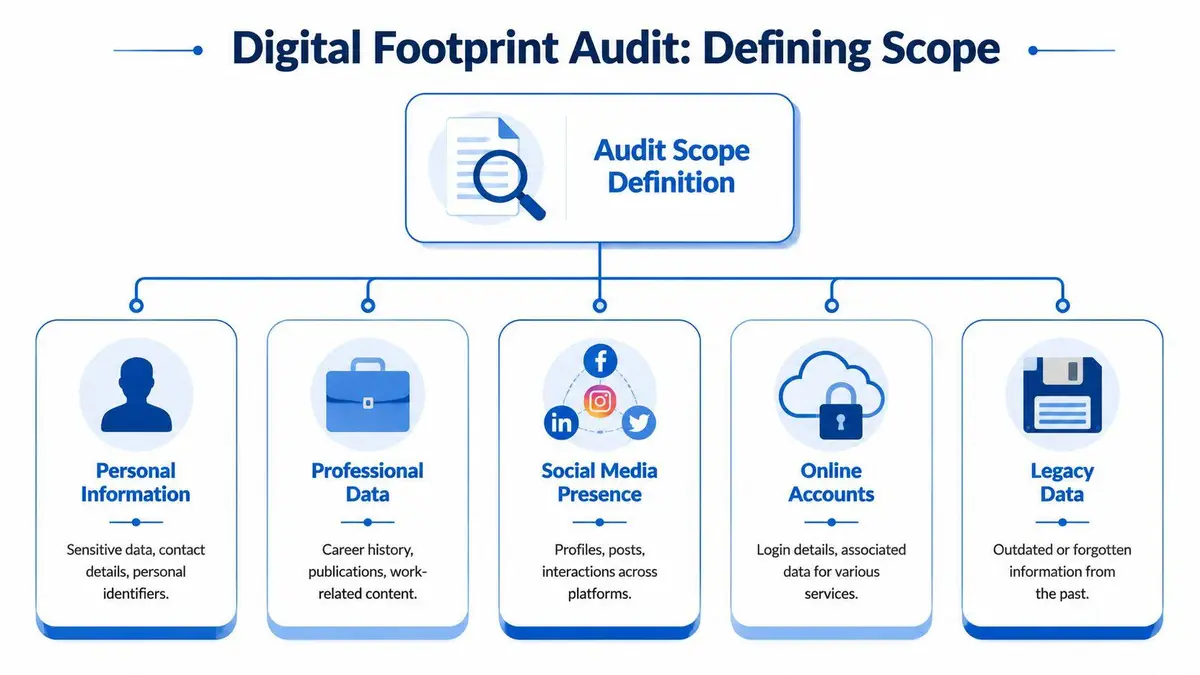
That list also needs variants. Include maiden names, shortened names, former company names, common misspellings, and names that appear in old press releases or public records. If your target is a founder who sold one company and now leads another, both histories belong in scope.
The reason is simple. Online reputation doesn’t form from a complete biography. It forms from fragments that rank well and are easy to misread.
According to Bright Future Branding’s discussion of digital footprint audits, 70% to 74% of employers review a candidate’s online presence, and decision-makers rarely look beyond the first two pages of search results. For executives, that same compressed attention applies to investors, boards, journalists, and counterparties. Your “first impression zone” needs to be mapped before a crisis forces the issue.
Define scope by risk scenario, not curiosity
A disciplined scope is tied to the event you’re protecting against. That’s where many internal teams fail. They collect data without deciding what would hurt.
Use scenarios such as these:
- Transaction diligence: Old lawsuits, sanction references, executive controversies, leaked documents, negative review clusters tied to a product name.
- Leadership transition: Prior statements, politically exposed associations, old aliases, dormant social accounts, stale biographies with inconsistent facts.
- Media scrutiny: Family links, property records, archived comments, photos, niche forum posts, criticism hosted on low-authority sites that could suddenly amplify.
- Security threat: Credential exposure, data broker listings, legacy resumes, personal phone numbers, location clues, exposed files in cloud sharing services.
A footprint audit should be scoped the way a hostile party would scope an investigation. Anything less is administrative busywork.
Build the audit map before you search
I advise clients to produce a scope sheet with three columns: subject, identifier, and risk context. Keep it simple, but complete.
- Subject layer includes the person, entity, or asset.
- Identifier layer includes names, usernames, emails, old domains, trademarks, and recurring phrases.
- Risk context states why that item matters. M&A. Media. Family privacy. Litigation. Brand abuse.
That pre-work prevents a common failure. Teams jump into search and collect hundreds of irrelevant references while missing the one old PDF, pseudonymous profile, or review page that drives exposure.
A digital footprint audit begins with judgment. Search comes second.
Advanced Discovery and Data Enumeration Techniques
Once scope is set, discovery becomes an intelligence exercise. Casual searching won’t do it. You need layered enumeration across indexed and non-indexed sources, with clean evidence logging from the first query.
Surface web discovery
The first pass still matters. It just needs to be done properly. Search across multiple engines, not just Google, and use advanced operators to force precision. Queries such as "Full Name" intext, "Full Name" filetype:pdf, and site:platform.com "Full Name" often reveal documents, profile pages, and references that ordinary searches bury.
That matters because My Digital Footprint’s audit guidance states that 70% to 80% of data is typically found through Google, Bing, and Yahoo using advanced operators, while 20% to 40% of sensitive records sit on non-indexed sites, data aggregators, and niche forums. If your team stops after a branded Google search, you’re leaving material behind.
Use a disciplined capture method. Every hit should be logged with the query used, URL, date, visible title, screenshot, and a short note on why it matters. That record becomes essential later if you need to prove publication, support a takedown, or show a platform that a page contains personal data.
Platform and broker enumeration
A large share of reputational damage doesn’t begin on mainstream news sites. It begins in semi-structured environments that people overlook. Review platforms, people-search sites, old job boards, local business directories, cached investor decks, and community forums often rank better than they deserve.
Data broker exposure deserves its own track because it creates both privacy and security risk. If you need a practical primer on how those ecosystems work, this strategic guide to executive privacy and data brokers is worth reading before you start remediation.
Search each relevant platform directly. Don’t rely only on engine indexing. Internal site search, public profile URLs, and archived user pages often expose more than search snippets show.
Deep web and dark web review
In this context, standard guides become unserious. Executives don’t just need a reputation scan. They need exposure mapping across leak repositories, breach references, underground chatter, and repositories that never rank in ordinary search.
That doesn’t mean every mention is catastrophic. It means you need to know whether credentials, personal identifiers, or internal references are circulating outside public view. For a public figure, a dark-web finding may affect extortion risk. For a company leader, it may affect account security and impersonation exposure.
Search visibility and threat visibility aren’t the same thing. A page can be invisible to Google and still be highly actionable.
Discovery standards that separate professionals from amateurs
The search itself is only half the job. The other half is repeatability.
Use this working standard:
- Preserve evidence early: Save screenshots, cached copies where lawful, and timestamped notes before pages change or disappear.
- Record the exact query: If you can’t reproduce the finding, you can’t defend the conclusion.
- Tag by source type: Search result, broker listing, social profile, review page, leaked file, archive, forum, or public record.
- Note ownership and jurisdiction: A U.S. blog, an EU-hosted forum, and a platform-based profile each require different tactics later.
A digital footprint audit becomes valuable when it produces a defensible inventory, not a pile of bookmarks.
Risk Triage and Priority Scoring
Discovery produces volume. Triage creates strategy.
Most raw findings don’t deserve the same attention. An unflattering article may be visible but lawful. A forgotten account may be obscure but dangerous. The job is to rank exposure by business impact, not by emotion.
Use a matrix, not a gut feeling
I use a simple model built on three questions: how severe is the item, how visible is it, and what is the likely intent behind it?
Severity asks whether the item creates legal risk, privacy harm, security exposure, or decision-making friction. Visibility asks whether it ranks prominently, appears in branded search, or sits in a place your actual stakeholders search. Intent asks whether the item is malicious, mistaken, outdated, or inconvenient.
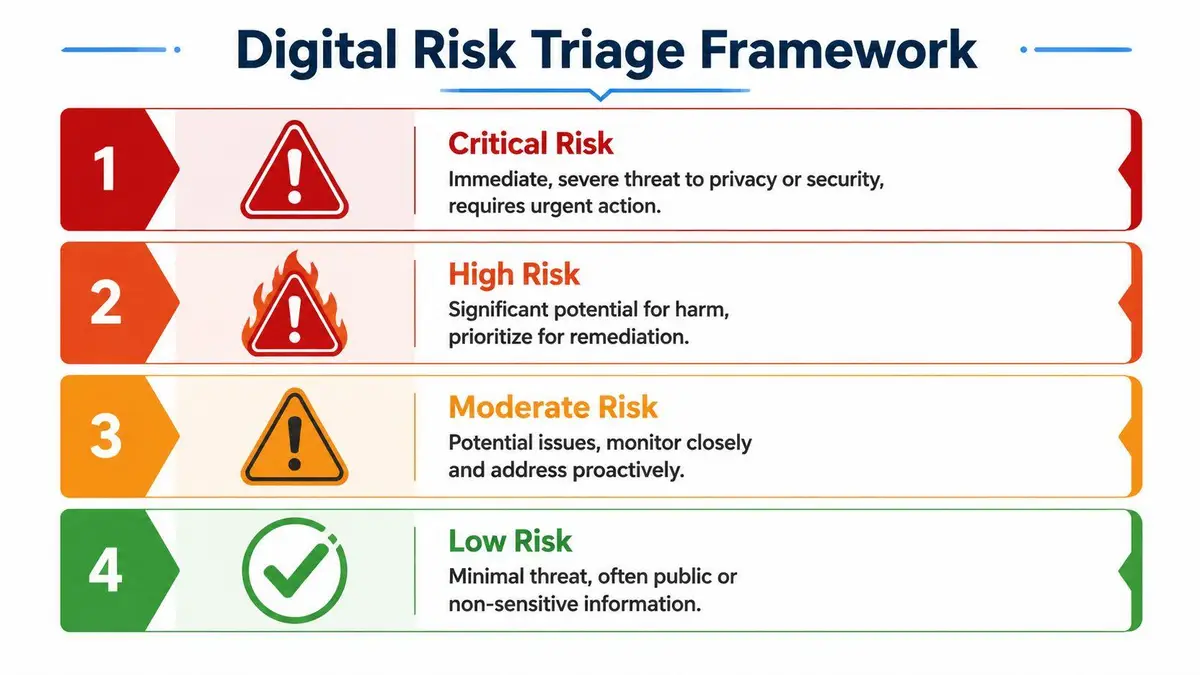
That framework stops clients from wasting money on material that feels offensive but has little practical effect, while forcing attention onto the quiet items that carry real danger.
The items people underestimate
Legacy exposure is one of the most persistent problems. Reputation X’s digital footprint analysis reports that 60% to 70% of individuals have legacy or inactive accounts, and those forgotten assets contribute disproportionately to reputational harm through data exposure.
That fits what we see in practice. Old forum handles, expired microsites, past campaign pages, resume uploads, and abandoned profiles often contain phone numbers, personal emails, biographies, or comments that no longer reflect current reality. They look stale, but stale content can still rank, be scraped, or be used to authenticate impersonation attempts.
A working triage model
Use four categories. Keep the definitions strict.
| Risk level | Typical example | Action bias |
|---|---|---|
| Critical | Leaked personal data, impersonation, exposed credentials, unlawful intimate content, clear defamation with visibility | Immediate removal and containment |
| High | Prominent false review clusters, damaging archived documents, high-ranking accusation pages, exposed family data | Fast legal and technical review |
| Moderate | Inaccurate biographies, old press items, low-authority criticism, stale profiles | Correct, suppress, or monitor |
| Low | Benign mentions, public speaking listings, routine corporate references | Document and revisit |
Example-based judgment matters
Consider two findings.
An inactive account on an old forum may have almost no present visibility. But if it exposes a personal email, a reused username, or personal details tied to account recovery patterns, its severity is higher than it first appears.
A negative blog post with weak authority may upset the client more. But if it ranks poorly, cites opinion rather than false fact, and draws no meaningful audience, it may be better handled through monitoring or suppression rather than an expensive takedown fight.
Don’t ask which item is most offensive. Ask which item creates the most leverage against you.
Priority should follow consequence
Good triage leads to a sequence, not just a score. Usually that sequence is:
- Contain items that expose security or private data
- Remove material with a strong legal or policy basis
- Address high-visibility reputation threats that affect decision-makers
- Clean up residue that could become tomorrow’s problem
That sequence keeps a digital footprint audit grounded in executive reality. Your time is limited. Your legal budget should be directed at the findings that change outcomes.
Strategic Remediation and Removal Pathways
Once you know what exists and what matters, the next question is blunt. What can be done?
The answer depends on the content, the publisher, the platform, the jurisdiction, and the remedy available. Anyone who tells you every problem can be “removed from the internet” is selling fiction.

Match the remedy to the problem
There are several distinct pathways, and they should never be confused.
Source removal is the cleanest result. If content violates platform terms, contains exposed personal information, infringes copyright, impersonates a person, or is otherwise unlawful, removal at the original publication point is usually the objective.
Search de-indexing is different. The content may remain online, but major search engines stop showing it for relevant name-based queries. That can be useful when source removal is unavailable or delayed.
Suppression is different again. You don’t claim the content is unlawful. You reduce its prominence by strengthening neutral or positive assets that deserve to outrank it. This is often the right answer for lawful but harmful opinion content.
Then there’s strategic response. Sometimes the correct move is a factual rebuttal, private outreach, or no visible response at all. Not every attack should be amplified by confrontation.
Why generic guides mislead executives
Most public guidance collapses all of this into “contact the site owner.” That’s amateur hour. High-value matters are rarely that simple.
Research discussing organizational exposure and audit gaps notes that most online guides fail to address the legal and jurisdictional complexity of content removal for high-profile clients, especially the choice between legal takedown routes under regimes such as GDPR or CCPA and suppression strategies where lawful publication remains online. That gap is exactly where many executive matters stall.
A false review on a U.S.-hosted site, an outdated people-search listing, a defamatory post on an anonymous forum, and a personal-data exposure indexed in Europe each require a different playbook.
The practical toolset
A serious remediation program usually draws from a mix of legal, technical, and reputational methods:
- Policy-based takedowns: Best for impersonation, privacy violations, account abuse, and platform-rule breaches.
- Legal notices: Used where defamation, copyright infringement, confidentiality breaches, or unlawful disclosure creates a formal basis for action.
- Broker opt-outs and privacy removals: Useful for reducing mass exposure across people-search ecosystems. For a general overview of one such broker-removal service, see SponsorRadar’s Incogni page.
- Search-focused action plans: Appropriate where indexing, snippets, cached references, or autocomplete effects create the main harm.
- Suppression campaigns: Suitable where removal is weak but visibility reduction is realistic.
For clients evaluating coordinated removal strategies, this framework for removing personal information from the internet is a useful reference point because it separates source deletion, search handling, and ongoing monitoring rather than pretending they’re the same task.
A provider such as ContentRemoval.com may be appropriate when the matter requires coordinated takedowns, de-indexing, and monitoring across platforms and jurisdictions, particularly where discretion and evidence handling matter.
Here’s a concise explainer on why remedy selection matters:
What clients should demand from a remediation plan
Insist on a written action matrix. Each item should state the content type, legal basis if any, target platform or publisher, proposed remedy, fallback option, and review date.
If your advisor can’t tell you why a piece should be removed, de-indexed, suppressed, or watched, they aren’t advising. They’re improvising.
Establishing Continuous Monitoring and Prevention
A digital footprint audit is a snapshot. Risk management is a system.
If you clean up a few visible results and stop there, exposure returns. New broker listings appear. Old data gets republished. A review resurfaces. A cached copy survives. A fresh mention lands on page one because nobody was watching.
Monitoring is the actual control
The sensible posture is continuous detection with periodic reassessment. That means tracking key names, entities, brands, and known problem terms so new exposure is caught before it matures into a reputational event.
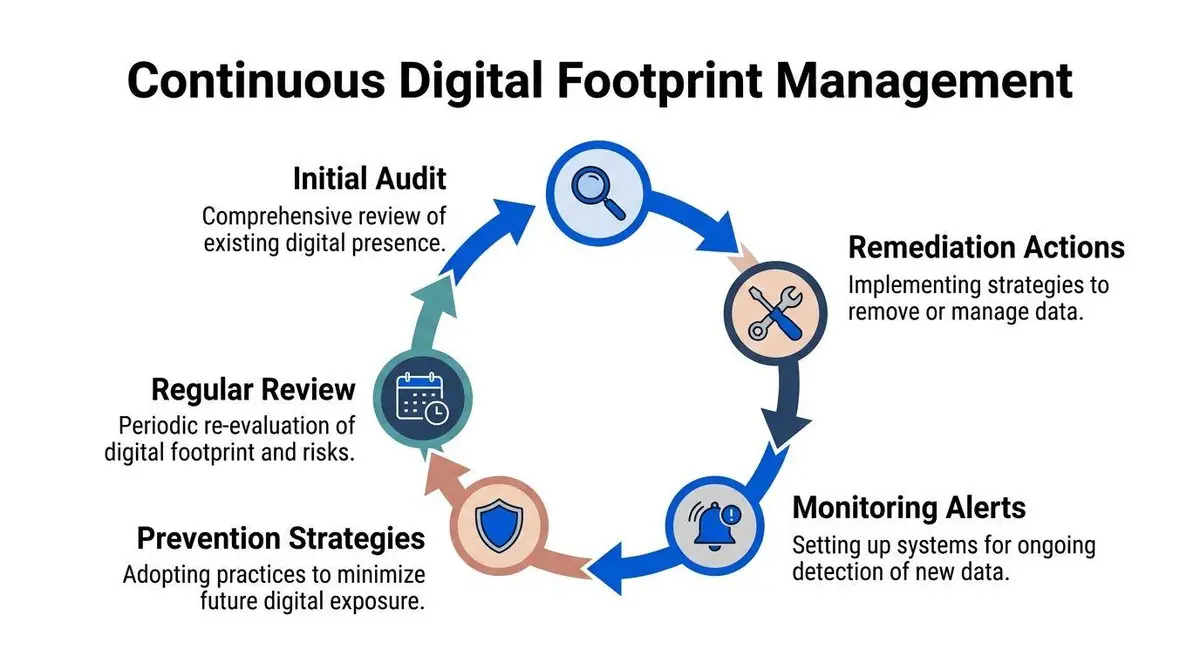
For executives, I prefer a monitoring structure that includes direct name alerts, executive-family watch terms where appropriate, brand-plus-allegation combinations, and routine re-checks of previously remediated URLs. If a problematic page was removed once, assume someone may repost it.
This isn’t paranoia. It’s governance.
Prevention belongs inside policy
Monitoring only works if your organization changes behavior after the first audit. Prevention needs to be operational.
Use a short control set:
- Executive publishing controls: Review what biographies, contact data, and family references appear on corporate sites, event pages, and press materials.
- Account lifecycle management: Close unused accounts, retire legacy pages, and remove stale cloud-shared files.
- Offboarding discipline: Former staff pages, legacy credentials, and old profile access should be shut down cleanly.
- Social and media protocols: Senior personnel need guidance on posts, tags, photos, and public responses during sensitive periods.
The cheapest removal is the page that never gets published with unnecessary detail.
Re-audit on a fixed cadence
A one-time search won’t keep you safe. Re-audits should be scheduled around real business triggers: financing, acquisitions, IPO preparation, executive appointments, disputes, and major media cycles.
Between those milestones, continuous online monitoring closes the gap. If you’re comparing options for that function, professional online monitoring for peace of mind outlines what a structured service should watch for.
What changes when monitoring is done properly
The benefit isn’t cosmetic. It’s speed.
When teams monitor well, they spot impersonation before it spreads, challenge harmful indexing before it hardens, and fix policy or publishing failures before they become search-result liabilities. They also create a record of diligence, which matters if you later need to justify legal action, regulatory disclosures, or internal security decisions.
That’s the mature view of a digital footprint audit. It isn’t a cleanup project. It’s a standing executive protection function.
Implementing Your Digital Audit Protocol
The process is straightforward, even if the execution isn’t. Define the perimeter carefully. Enumerate broadly. Triage by consequence. Match the remedy to the legal and practical facts. Then monitor continuously.
That sequence turns scattered online exposure into a manageable risk register. It also prevents the two most common failures I see: overreacting to low-value content and ignoring the quiet data points that create real advantage against an executive or company.
What to do next
If you’re under immediate pressure, don’t start by sending panicked emails to publishers or arguing in public. Preserve evidence. Identify the ownership of the content. Confirm whether the problem is source-level, search-level, broker-level, or platform-level. Then choose the remedy that fits.
If you’re not yet in crisis, that’s better. Use the window you have. Build the audit before the board meeting, financing round, litigation threat, or press inquiry arrives.
A workable protocol usually fits on a single process map. Scope. Search. Log. Score. Act. Monitor. That’s the discipline. The sophistication lies in judgment, not complexity.
Use a checklist, not memory
Senior people get into trouble when they rely on instinct for repeatable tasks. A digital footprint audit should be documented with a checklist and process map so your legal, communications, security, and executive office teams are aligned.
Include the subjects searched, identifiers used, repositories checked, evidence standards, triage criteria, remediation routes, and monitoring triggers. If a new issue appears, your team should know exactly where it belongs and who owns the next move.
The internet doesn’t forget. Well-run clients don’t rely on forgetfulness.
If you need a confidential, structured review of executive or enterprise exposure, ContentRemoval.com handles digital footprint audits, removal planning, de-indexing strategy, and ongoing monitoring for high-stakes matters. Start with a private assessment, organize the risk clearly, and move on facts rather than guesswork.
Frequently asked questions
What should an executive digital footprint audit include?
A defined perimeter of subjects and identifiers including aliases and legacy entities, layered discovery across search engines, platforms, data brokers, archives and leak repositories, a logged evidence file with queries and screenshots, a triage matrix ranking findings by severity, visibility and intent, and a remediation plan that matches each item to a remedy.
How often should an executive audit their online footprint?
The article recommends re-audits around real business triggers such as financing, acquisitions, IPO preparation, executive appointments, disputes and major media cycles, with continuous monitoring between those milestones. Previously remediated URLs should be re-checked because removed content is often reposted.
Which online exposures do executives most often underestimate?
Legacy and inactive accounts, old forum handles, expired microsites, uploaded resumes and abandoned profiles. They look stale but often expose personal emails, phone numbers and details that support impersonation or account recovery attacks. A low-visibility item can carry more risk than an offensive but poorly ranked blog post.