
To delete a Glassdoor review you have two real options: prove it violates Glassdoor’s Community Guidelines, such as naming a non-executive employee, disclosing confidential company information or making threats, or pursue a defamation claim against the anonymous poster through a John Doe lawsuit to obtain a court order. Glassdoor itself cannot be sued because of Section 230.
Key facts
- Glassdoor allows naming C-suite and public-facing leaders but not other employees, a clear removal ground.
- Flagged reviews with clear violations are typically handled in roughly 5 to 15 business days.
- Defamation litigation to unmask a poster and secure a court order runs about 6 to 18 months.
- Closing your Employer Center account does not remove existing reviews.
Where ContentRemoval.com comes in. Glassdoor moderators enforce policy, not fairness, and the wording of the report decides the outcome. ContentRemoval.com prepares review removal cases the way moderators need to see them, isolates the actionable statements from protected opinion, and coordinates legal escalation where a review crosses into defamation. HR leads, general counsel and executives themselves usually make contact. A free 15-minute Exposure Scan maps what is removable, and the report is yours to keep. Get a Free, Confidential Exposure Scan or read how our review removal work is done.
A single false or defamatory Glassdoor review is not a nuisance; it is a direct threat capable of derailing recruiting efforts and damaging an executive’s credibility. Removing a review is not a matter of a simple request. To delete a Glassdoor review, you have two primary options: prove it violates Glassdoor’s own terms of service or pursue legal action to obtain a court order. Success hinges on a precise, evidence-first strategy.

The Executive’s Dilemma with Damaging Glassdoor Reviews
When a negative review appears on a company’s Glassdoor profile, it constitutes a public attack on both corporate and personal reputations. For an executive, one anonymous, malicious post can erode investor confidence, complicate the recruitment of top-tier talent, and sow internal discord. The fundamental problem is not merely what the review states, but its public, persistent, and highly visible nature.
This guide dispenses with generic advice. We understand you are under pressure and require clear, actionable steps, not platitudes about “engaging with feedback.” Your objective is the removal of damaging and often false content. We will delineate the exact paths to achieve this.
Understanding the Stakes
The fallout from a defamatory review extends far beyond brand perception. A staggering 83% of job seekers scrutinize company reviews before deciding to apply. A review alleging a toxic work environment, unethical behavior, or leadership misconduct can instantly deter premier candidates. This creates significant operational drag, elevating recruitment costs and extending hiring timelines.
The damage does not stop at human resources. Competitors, journalists, and potential partners monitor these platforms. A defamatory post can become fodder for negative press or be leveraged in business negotiations.
The central challenge is that platforms like Glassdoor are shielded by Section 230 of the Communications Decency Act. This legal safe harbor means they are not liable for user-generated content, providing minimal incentive to remove posts unless they clearly violate platform policies.
Three Pathways to Resolution
Your approach must be tailored to the specifics of the review. There are three primary routes for handling a damaging post.
Platform Policy Enforcement is the most direct method. It requires identifying a clear violation of Glassdoor’s Community Guidelines and submitting a detailed, well-argued report. This is not an emotional appeal but a forensic analysis of the review against the platform’s rules.
Legal Recourse becomes necessary if a review contains demonstrably false statements of fact that cause tangible harm (defamation). This path often begins with a “John Doe” lawsuit to unmask the anonymous poster, with the ultimate goal of securing a court order compelling Glassdoor to remove the content.
Strategic Reputation Mitigation is the required response when a review is merely negative, violating no policy and not rising to the level of defamation. In these cases, the focus shifts to damage control. This involves issuing a strategic public response and launching a proactive campaign to generate authentic positive reviews that suppress the negative one.
To determine the most appropriate path, consider the following overview of options, their typical use cases, and realistic outcomes.
Glassdoor Review Removal Pathways At a Glance
| Method | Applicable Scenario | Typical Timeframe | Likelihood of Success |
|---|---|---|---|
| Flagging & Reporting | The review clearly violates Glassdoor’s terms of service (e.g., hate speech, threats, reveals private info). | 5-15 business days | Low to Moderate |
| Legal Action (Defamation) | The review contains verifiably false statements of fact that have caused measurable harm to reputation. | 6-18 months | Moderate to High (with strong evidence) |
| Response & Suppression | The review is subjective opinion or criticism that doesn’t violate rules or meet the legal bar for defamation. | Immediate (response) to Ongoing (suppression) | N/A (focus is on mitigation, not removal) |
Each of these pathways demands a tactical and unemotional approach. A careful initial assessment of the review’s content is the critical first step in determining which course of action will be most effective.
When confronting a negative Glassdoor review, the instinct to argue that it is unfair or false is a strategic error. To secure removal, you must cease thinking about fairness and adopt the mindset of a Glassdoor moderator.
Their function is not to adjudicate truth but to enforce their own rulebook, the Glassdoor Community Guidelines. Your objective is to identify a clear, undeniable rule violation and present it in a manner that requires no subjective judgment on their part. Make it a simple procedural checkmark for them.
A complaint that a review is “untrue” will be summarily rejected. You must construct a case based on black-and-white evidence drawn from their own policies.
Finding a Clear Policy Violation
Glassdoor operates under a dual mandate: protecting user anonymity while preventing platform abuse. The key is to identify where a review crosses that line. Most successful removal requests fall into a few specific categories of violation.
One of the most straightforward violations to prove is the disclosure of confidential company information. This refers not to office gossip, but to tangible, non-public data. A review mentioning snippets from a private email, details about a classified project like “Project Nightingale,” or specific internal financial figures not present in public reports provides a rock-solid case for removal.
Another common error by reviewers is the naming of employees who are not senior executives. Glassdoor’s policy is explicit: C-suite leaders or individuals in major public-facing roles may be named, but others may not. A review that complains about “John Smith in accounting” or “our team lead, Jane Doe” is in direct violation. This rule exists to prevent targeted internal harassment, and Glassdoor enforces it seriously.
Pro Tip: Your report to Glassdoor must be surgical. Reference the exact rule that was broken. The less you leave to interpretation, the higher the probability of success.
Here is the relevant section from the guidelines where these rules are articulated.
The guidelines explicitly state that reviews revealing confidential information or identifying most employees are subject to removal. This confirms that your focus must be on objective rule-breaking, not on disputing the reviewer’s opinion.
Building Your Removal Request
Once a violation is identified, the request must be framed correctly. It is insufficient to state, “They named an employee.” You must present the violation in a way that is impossible for a moderator to disregard.
Consider a real-world example. A review states: “The VP of Marketing is a complete tyrant and screamed at our team lead Sarah P. for missing a deadline.” This sentence contains two distinct elements, only one of which is actionable. “Complete tyrant” is a subjective opinion protected by Glassdoor. Do not address it. Naming “Sarah P.,” a team lead, is the violation. It is a clear breach of their privacy policy.
Your report should laser-focus on this actionable breach. State clearly that the review identifies a non-C-suite employee by name, which violates their Community Guidelines. By ignoring the subjective “tyrant” comment, you demonstrate to the moderator that you understand the rules and are not lodging a baseless complaint.
The “No-Brainer” Violations
While many rules allow for interpretation, some are so severe they almost guarantee removal. If a review contains credible threats of violence, hate speech attacking protected classes, or discloses private contact information like a phone number or home address, you must act immediately.
When a review contains this type of content, your report should be direct and urgent. You are not merely requesting removal; you are flagging a safety issue. Glassdoor is highly motivated to remove such content swiftly to protect its users and mitigate its own liability.
Recognizing when a negative review crosses into abuse is the first step. The next is framing your request to delete the Glassdoor review around that specific, undeniable violation.
Getting Hands-On: The Flagging and Reporting Process
You have identified a review that clearly violates a rule. The critical phase is the execution of the report. The composition of your report will determine its success. Your sole objective is to make it exceptionally easy for a human moderator at Glassdoor to see the violation and concur.
First, locate the “Flag” link at the bottom right of the review box. Clicking it opens a form where you select a reason and, most importantly, explain your rationale. This text box is where most removal requests succeed or fail.
How to Write a Report That Actually Works
This is where most companies err. They submit reports that are emotional, vague, or simply complain that a review is “unfair.” This is the fastest path to denial.
You must be surgical. Your report must be a concise, factual argument that points directly to the specific Community Guideline the review violates. It is not a complaint; it is an assistance to the moderator in enforcing their own rules. They are not arbiters of truth; they are enforcers of policy.
This chart illustrates the most effective paths for reporting a review, all predicated on identifying a violation that is not open to debate.
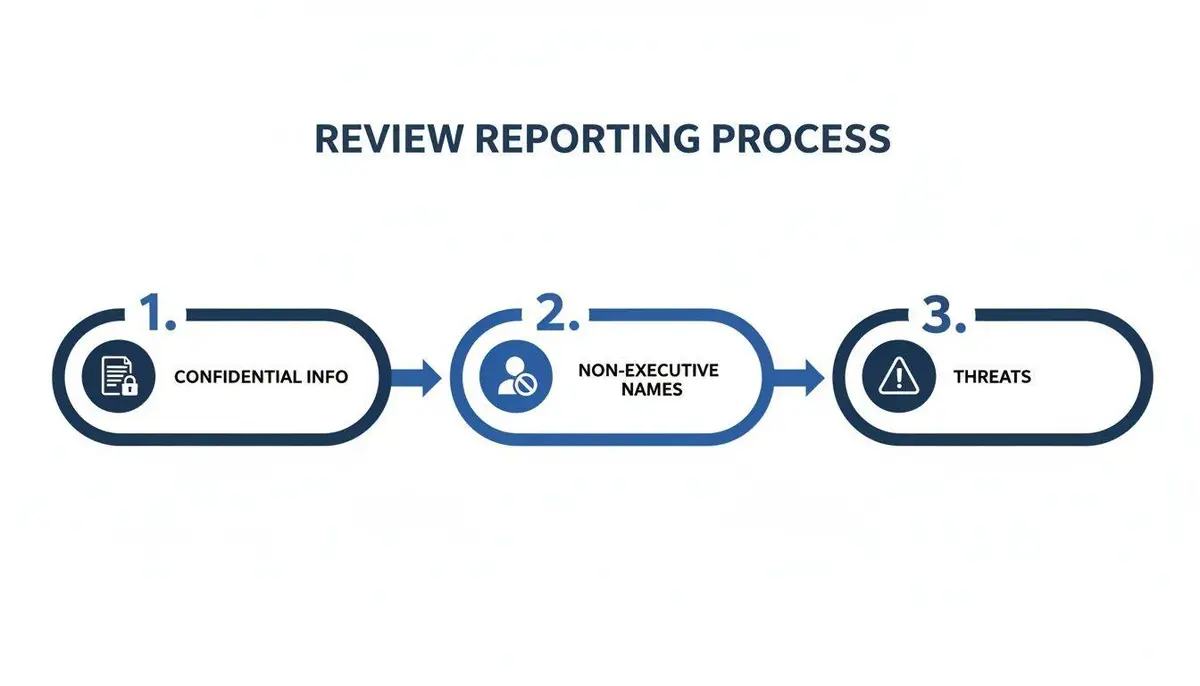
Your strongest position is to focus on black-and-white issues. Exposing trade secrets, naming non-managerial staff, or making direct threats are violations Glassdoor is highly incentivized to remove quickly. These clear-cut breaches provide the strongest possible case to delete a Glassdoor review.
Sample Messages That Get Results
Your report must be precise. The following are examples tailored for specific, common violations. Adapt them to the exact details of the review you are targeting.
When a non-executive employee is named:
This review violates Glassdoor’s Community Guidelines by identifying a non-C-suite employee by name. The person mentioned, [Employee’s Name], is a [Employee’s Title] and does not hold a public-facing leadership position. As per your policy against revealing the identities of non-senior leadership, we request this review’s removal to protect our employee’s privacy.
When confidential information is disclosed:
This review contains confidential company information, a direct violation of your Community Guidelines. The specific phrase “[Quote the exact text containing confidential info]” discloses internal financial figures that are not public knowledge. To prevent the dissemination of our proprietary data, we request that this review be removed.
When a review contains a false, defamatory statement:
This review makes a defamatory statement of fact that is demonstrably false. The claim that “[Quote the false statement, e.g., ‘the company is currently under federal investigation’]” is untrue and is causing our business material harm. While we respect that opinions are allowed, this specific claim is a false statement of fact and violates your content policies.
Note the tone: formal, direct, and devoid of emotion. You are not arguing; you are presenting evidence. This strategic thinking applies across other review platforms. Many core principles for how to get rid of negative Yelp reviews follow a similar logic of focusing on policy, not emotion.
What Happens After You Hit ‘Submit’
Once your report is submitted, the review enters Glassdoor’s moderation queue. Do not expect an immediate result; the process can take from a few days to several weeks. Do not flag the same review repeatedly, as this can lead to your reports being marked as spam, nullifying your efforts.
If your first request is denied, do not abandon the effort. It indicates your argument was not sufficiently compelling or did not align perfectly with a policy violation. You may need to identify a different angle or reframe your case. Patience and precision are your most powerful tools.
Legal Recourse for Defamatory or False Reviews
You have flagged a review, but Glassdoor refuses to remove it. This is not the end of the line. When a review transcends negative opinion and enters the realm of demonstrably false and damaging statements, you must shift your focus from Glassdoor’s support queue to the legal system. This is where real results can be achieved, but it demands a strategic, evidence-based approach.
You cannot sue Glassdoor to remove a review. Pursuant to Section 230 of the Communications Decency Act, online platforms are not legally responsible for third-party content. Any legal action targeting Glassdoor directly is a non-starter. Your actual target is the anonymous individual who authored the review.
The Foundation of a Defamation Claim
To compel the removal of a review through legal channels, you must prove it constitutes libel, written defamation. The evidentiary bar is high. You must build a case that solidly demonstrates four key elements: a false statement of fact (not opinion), publication to a third party (satisfied by the Glassdoor posting), negligence on the part of the author, and tangible damages to your reputation, career, or business.
The most critical hurdle is the distinction between fact and opinion. This is the fulcrum on which most defamation cases turn.
An opinion is subjective and cannot be proven true or false. A statement of fact is an assertion that can be objectively verified. Correctly classifying the content is an essential prerequisite to engaging legal counsel.
Fact vs. Opinion: Where the Fight is Won or Lost
Let’s dissect this with practical examples.
- Protected Opinion: “My manager was disorganized and a poor leader.” This is entirely subjective. “Disorganized” is a matter of perception. This is classic opinion and is protected speech.
- Actionable False Fact: “The CFO was fired for altering the company’s Q3 financial records to hide losses.” This is a specific, factual claim that can be proven true or false by examining employment and financial records. If the statement is false, it constitutes defamation.
Your first step is to dissect the review and isolate only the specific, provably false statements of fact. Vague insults and general complaints are not actionable in court. Focus exclusively on verifiable falsehoods. That is your only path forward.
Unmasking the Poster: The “John Doe” Lawsuit
Since the reviewer is anonymous, you cannot sue them without knowing their identity. This is the purpose of a “John Doe” lawsuit. You file a lawsuit against an unknown defendant, creating the legal grounds to petition the court for assistance in identification.
The process involves requesting a subpoena from a judge. If granted, the court order compels Glassdoor to release any identifying information it possesses, typically an IP address. With that IP address, you can then issue a second subpoena to the internet service provider, ordering them to reveal the account holder’s identity.
Once a name is obtained, the lawsuit is amended to name that person directly. This creates significant leverage. Most individuals, when confronted with a public and costly defamation lawsuit, will agree to a settlement that includes removing the review.
If they refuse and you proceed to trial and win, the judge can issue a court order demanding removal of the defamatory content. Presented with a valid court order, Glassdoor will comply. For executives facing these damaging, false attacks, the process is complex but effective. You can learn more about our approach to removing online defamation in our dedicated service overview. While the legal route requires resources, it is often the most definitive method to permanently delete a Glassdoor review built on falsehoods.
Strategic Response and Reputation Mitigation

You attempted to have the review removed, and Glassdoor declined. This is a common outcome and does not represent failure. When a review does not violate technical platform rules, your strategy must shift from removal to mitigation.
This is not capitulation; it is about seizing control of the narrative and neutralizing the damage. A single unremovable negative review requires a sophisticated, two-part approach: a carefully crafted public response and a proactive plan to suppress it with authentic, positive feedback.
A poorly executed public reply can backfire, a phenomenon known as the Streisand Effect, and amplify the negative attention. Your response demands precision and composure, designed to demonstrate attentiveness without engaging in a public dispute.
Principles of an Effective Employer Response
Crafting the ideal reply is an exercise in professional restraint. Your audience is not the reviewer, but every future candidate, partner, and client who will see the exchange. The response must be brief, professional, and devoid of emotion.
The objective is to show that leadership is engaged and takes feedback seriously, without necessarily validating the specific complaints.
If a review alleges a “toxic culture,” a defensive rebuttal will only suggest guilt. A superior approach is to affirm your company’s commitment to a healthy workplace.
Example Response Framework:
“We take all feedback from current and former team members seriously, as it helps us build a stronger, more supportive workplace. The experience described does not reflect the culture we are committed to fostering. We encourage the reviewer to connect with our HR department through our confidential channels to discuss this matter further.”
This response achieves three goals: it validates the act of giving feedback, gently counters the claim without initiating conflict, and moves the conversation offline. You appear engaged, not defensive.
Diluting Negative Content with Proactive Review Generation
Responding is merely the first step. The long-term solution is to dilute the negative review by surrounding it with a preponderance of positive, genuine ones. A single negative review is conspicuous. One negative review among twenty positive ones appears as an outlier.
This is not a call to post fraudulent reviews, which is unethical and will result in penalties from Glassdoor. It is about implementing a simple, non-intrusive system to encourage satisfied employees to share their authentic experiences. This is effective. Research indicates that 71% of Glassdoor users report an improved opinion of a company when they see an employer respond to reviews.
Protecting your brand’s image online also requires a broader perspective. This is where comprehensive Search Engine Reputation Management strategies become critical, allowing you to control the digital narrative across all platforms.
A successful internal campaign should not feel coercive. Effective methods include timing the request after a positive event, such as a project completion or promotion; using internal communications to casually reinforce the value of employee feedback; and integrating the request into the exit interview process for employees leaving on good terms.
Your goal is to generate a steady, organic stream of positive content that accurately reflects your company. This not only diminishes the visibility of the negative review but also builds a stronger, more authentic employer brand over time. While the impulse to delete a Glassdoor review is strong, a well-executed mitigation plan can be more powerful. This is a core component of our expert reputation management services.
Frequently Asked Questions About Glassdoor Review Removal
When a damaging Glassdoor review surfaces, a consistent set of high-stakes questions arises. Executives and legal teams require definitive answers. Here, we address the most common concerns.
Can I Sue Glassdoor to Remove a Review?
The answer is almost invariably no. Section 230 of the Communications Decency Act shields platforms like Glassdoor from liability for content posted by their users. Suing Glassdoor directly is a futile effort that will likely result in immediate dismissal. The viable legal strategy is a defamation lawsuit against the anonymous poster (a “John Doe” action). A victory in that case yields a court order that Glassdoor will honor, compelling removal.
How Long Does a Glassdoor Takedown Take?
The timeframe varies. A report of a clear and flagrant rule violation, such as hate speech or the disclosure of private financial data, may result in removal within 7 to 14 business days. For more nuanced cases, such as a defamation claim not yet supported by a court order, the process can extend to several weeks or longer. A denial of your first report is not necessarily final; a subsequent report with a stronger, clearer argument can succeed.
Should Our Company Publicly Respond to the Review?
A public response can be a strategic asset if executed correctly. A calm, professional, and non-defensive reply demonstrates to potential hires and partners that leadership is engaged and values feedback. It is an opportunity to project transparency.
The objective of a public response is not to win an argument in a public forum. Its sole purpose is to de-escalate, project professionalism, and reassure observers that mature leadership is in control.
Conversely, an emotional or argumentative response will backfire. It amplifies the negativity and suggests the criticism was accurate. If you cannot reply with absolute professional composure, it is better to say nothing.
Will Deleting Our Employer Profile Remove Past Reviews?
No. This is a common misconception. Deactivating an “Employer Center” account or canceling a paid subscription will not delete Glassdoor reviews already posted. Reviews are tied to the company profile, not an administrative account. All content, positive or negative, will remain. The only methods for removal are a successful flagging report or legal action resulting in a court order.
When your reputation is on the line, you require an expert response. The team at ContentRemoval.com specializes in the discreet removal of false and defamatory content from platforms like Glassdoor. We possess the strategic knowledge to navigate these systems and secure results for our clients. Start your confidential assessment and build an action plan by visiting ContentRemoval.com.