
To delete a post, first work out whether you control the account it lives on. If you do, preserve evidence, remove the visible post from the feed, then clear the underlying media and references. If you do not, deletion becomes a campaign built on platform policy, DMCA rights and legal escalation, followed by cleanup of copies and search results.
Key facts
- Delete the public-facing post first, then purge attached media, or the file can stay discoverable for up to 72 hours.
- Many professional forums require admin approval to delete a post once it has replies.
- Report the specific violation category, such as impersonation or privacy, since platforms enforce by category.
- DMCA notices often outperform general abuse reports because they rest on a statutory process.
Where ContentRemoval.com comes in. When the post is not yours, the author is hostile or copies keep resurfacing across forums, archives and search, ContentRemoval.com handles the whole chain as one process: evidence preservation, source removal through the strongest policy or legal basis, de-indexing and monitoring for reposts. Family offices, executives and their legal teams usually make contact. A free 15-minute Exposure Scan maps what is removable, and the report is yours to keep. Get a Free, Confidential Exposure Scan or read how our content removal work is done.
A post goes live, and within minutes the problem is obvious. It names your family office. It exposes private contact details. It republishes a video you thought you’d already removed. Or it captures a careless remark that now sits in front of clients, journalists, investors, or litigants.
At that point, speed matters, but so does sequence. Many users waste the first critical hours clicking around platforms, deleting the wrong asset, or filing the wrong report. That approach creates delay, preserves evidence badly, and often leaves the content visible in search, screenshots, or forum archives long after the user believes it is gone.
If you need to delete a post, treat it as a removal matter, not a housekeeping task. The primary question isn’t whether a delete button exists. The primary question is who controls the content, what rights can be enforced, and how fast you can force a durable outcome.
An Immediate Action Plan for Unwanted Content
The first move is diagnosis. There are only two meaningful categories. Either you control the account or system where the post lives, or you don’t.
If you control it, act directly and carefully. Don’t improvise. Preserve the post first with screenshots, URLs, timestamps, account identifiers, and any visible engagement. Then remove the public-facing post itself. If media files, attachments, or account-level archives are involved, handle those only after the visible post is gone. Executives often reverse that order and create a mess: the post survives, the asset breaks, and the evidence trail becomes harder to manage.
If you don’t control it, stop looking for a delete button that isn’t yours to press. Your influence is derived from policy, rights, and escalation. That means identifying whether the post falls into a platform-enforceable category such as harassment, privacy violations, impersonation, doxxing, copyright infringement, non-consensual imagery, or other terms-of-service abuse. It also means deciding quickly whether this is a routine moderation request or a legal removal issue.
The first hour
Three actions belong at the front of the process:
- Preserve evidence cleanly: Capture the full page, the account name, the timestamp, the URL, and any comments or reposts attached to it.
- Classify the content: Decide whether this is your own post, a third-party post, a website page, a forum thread, or an archived copy.
- Choose the channel: Direct deletion, admin request, platform report, DMCA notice, or legal counsel. Pick one primary route and one backup. Don’t file contradictory narratives across multiple systems.
Practical rule: If your first action makes the content harder to prove, you’ve made the wrong first action.
The strategic split
Most removal failures start with a false assumption: people treat every unwanted post as if it’s technically and legally the same. It isn’t.
A post you authored on LinkedIn is an account-management problem. A copied image on X is a rights-enforcement problem. A defamatory thread on Reddit is a moderation and legal problem. A statement published on a professional forum may be an administrative dependency problem, where your access rights are narrower than you assume. The right response follows the structure of control.
That distinction sounds simple. In practice, it’s the line between a clean removal and a public, prolonged dispute.
Direct Deletion Protocols on Key Platforms
When the post is yours, direct deletion is usually the fastest route. But direct deletion isn’t the same as complete removal. The visible post, attached media, platform cache, account archive, and search visibility don’t always disappear in one motion.
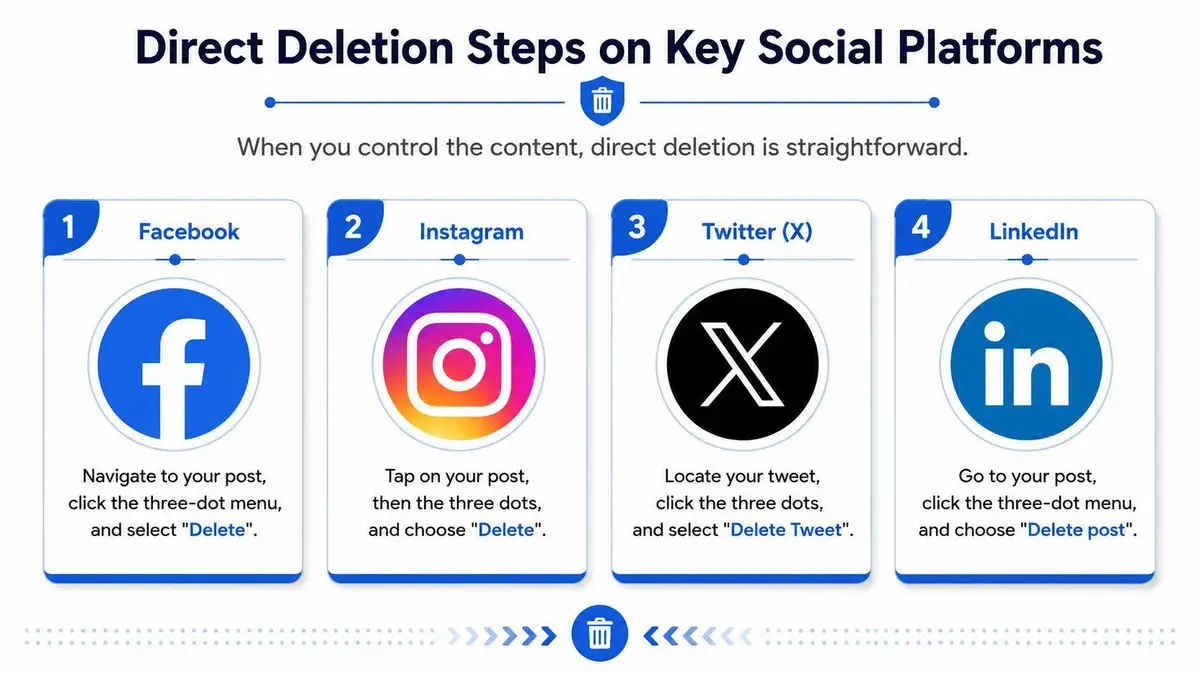
Facebook, Instagram, X, and LinkedIn
On Facebook, go to the post itself, open the three-dot menu, and delete the post from the feed. If the post contains uploaded media, remove the public post first. Only afterward should you review albums, media libraries, or business assets for the underlying file.
On Instagram, the same discipline applies. Open the post, tap the three dots, and delete the post from the profile grid or reel feed. If the content also exists in drafts, archived stories, or professional media libraries, clear those separately. Don’t assume deleting one surface removes every instance.
On X, delete the tweet from the post-level menu, then check quoted reposts, attached media history, and any embedded references you’ve made elsewhere. If the post concerns executive risk, review this strategic guide to remove a Twitter post for executives, which addresses the practical issues that come after the click itself.
On LinkedIn, delete the post from your activity feed or company page post stream. If you’re closing an account to limit exposure, remember that LinkedIn states in its privacy help documentation that user data is generally deleted within 30 days of account closure, subject to retention exceptions. That matters if the post is part of a wider account-shutdown strategy rather than an isolated deletion.
YouTube and Reddit
YouTube requires more care because users often confuse deleting a video with deleting every public trace of that video. If the issue is a standard uploaded video, remove it from the channel dashboard. Then review community posts, descriptions, playlists, and channel tabs that may still reference it. If a clip was reused in Shorts, embeds, or comments, those references can continue to surface even after the original upload is gone.
Reddit is different because deleting your own post doesn’t erase the conversation around it in the way most professionals expect. Remove the post from your profile or the subreddit thread if the interface allows it. Then check whether your username remains attached to comments, quoted fragments, or moderator notes. If the post concerns you but was written by someone else, don’t treat it like a self-service problem. Use the escalation route instead. For that scenario, this professional guide to remove a Reddit post about you is the more relevant playbook.
Delete the public-facing object first. Then clean up the assets underneath it.
The sequence most people get wrong
A persistent technical error appears when users delete the file and leave the post intact. According to a discussion of video deletion behavior in HubSpot’s social tools, users must first delete the post from the feed, then purge the media from their library. Skipping that order persisted in 40% of attempted content purges, leaving the media file orphaned but still discoverable via search indexes for up to 72 hours in that context, as described in the HubSpot community explanation of deleting video used in social posts.
That issue isn’t limited to one software environment. The broader lesson is technical: platforms often separate the visible post from the stored asset. Remove the wrong layer first, and you create a broken remnant instead of a clean disappearance.
Direct deletion checklist
| Platform type | First action | Second action | Common mistake |
|---|---|---|---|
| Social feed post | Delete the post from the feed | Remove attached media or references | Deleting media first |
| Video platform upload | Remove the public video | Check playlists, posts, descriptions | Ignoring secondary references |
| Professional network post | Delete from activity feed | Review account closure or profile remnants | Assuming account closure is instant |
| Forum post you authored | Delete if permissions allow | Check quoted replies and copies | Assuming thread context disappears |
The point is simple. If you’re trying to delete a post, don’t settle for visual disappearance on one screen. Confirm the post is gone from the feed, the asset is gone from storage, and the references are gone from the places that still keep it alive.
Removing Posts from Controlled Websites and Forums
Your own website gives you more authority, but not always more safety. A WordPress blog, a Squarespace site, a newsroom archive, and a company knowledge base all behave differently. If you publish through a content management system, the post may be live on the front end, stored in revisions, mirrored in category pages, and cached in search results even after you hit delete. If you want a practical primer on how these systems work at a structural level, learn CMS from DesignStack before you start stripping out content blindly.
Website posts you control
On a site you own, remove the post from the public site first. Then review the backend for drafts, revisions, media attachments, author archives, category archives, and internal search pages. If the post had a dedicated URL, decide whether that URL should return an intentional deleted state or redirect to a closely related page. That’s not just an editorial choice. It affects how long the old page remains visible in search and whether visitors land on a dead endpoint.
For company sites, involve whoever controls publishing rights before you act. General counsel, marketing, and IT often each have part of the picture. One person may delete the page while another leaves the downloadable file, the press release PDF, or the mirrored newsroom copy untouched. That’s how supposedly deleted statements keep resurfacing.
Forums and professional communities
Executives often misjudge their control. A profile login doesn’t always include deletion authority. On professional communities, user access is often subordinate to moderation policy, especially once replies exist.
According to an ArcGIS community discussion cited in the verified data, 29% of professional community platforms require admin approval or direct team contact for post deletion, particularly for posts that already have responses. The same source states that a 2025 industry survey found 54% of entrepreneurs falsely believe they can instantly remove harmful posts, only to be blocked by those policies. See the ArcGIS community discussion on whether questions can be deleted.
Your login is not the same thing as ownership. Many forums treat answered threads as part of the platform’s record, not your private property.
Administrative dependency changes the timeline
When a forum locks deletion behind moderators or staff, write the request like a legal-business communication, not a complaint. Identify the post precisely. State why it should be removed. Tie the request to privacy, risk, confidentiality, or policy. Ask for written confirmation and a timeline.
If the post is about you rather than by you, skip any assumption that voluntary cooperation will solve it quickly. A specialist process may be necessary, especially on Reddit-style communities and professional boards where community continuity gets priority over personal regret. That’s the point at which a focused removal strategy matters more than another support ticket.
Strategies When You Cannot Directly Delete the Post
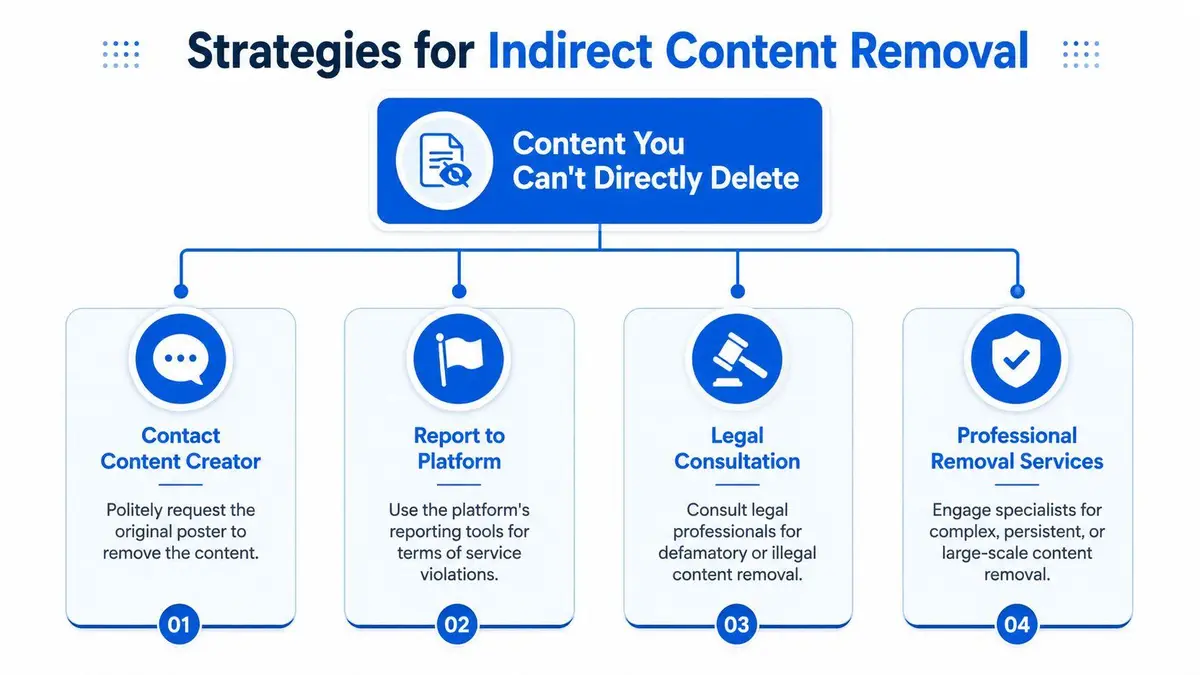
The phrase “delete a post” misleads people because it assumes authority they often don’t have. If someone else published it, if a forum has locked the thread, or if the content sits on a third-party site, deletion is no longer a button. It’s a campaign.
Start with leverage, not outrage
The wrong instinct is emotional confrontation. The right instinct is strategic assessment. Ask four questions.
- Who published it: The author, a moderator, a newsroom, an anonymous account, or an automated scraper.
- Where does it live: A mainstream platform, a forum, a private blog, a complaint site, or a mirror domain.
- What rule does it violate: Privacy, impersonation, copyright, harassment, doxxing, non-consensual imagery, or platform abuse.
- What outcome is realistic: Full removal, account suspension, de-indexing, edit-and-correct, or suppression while formal action proceeds.
That framework changes the objective from “I want this gone” to “Which party can be compelled to act first?”
The escalation ladder
Sometimes the publisher will remove the post voluntarily. Ask once, in writing, and keep the request concise. If they refuse, move on. Repeated pleading rarely helps and often gives the other side time to duplicate the content elsewhere.
Platform reporting comes next. Report the specific violation category that matches the content. Generic complaints fail because platforms enforce rules through categories, not through sympathy. If the issue is impersonation, file impersonation. If it’s private information, file privacy. If it’s copyrighted material, don’t bury that point inside a vague reputational complaint.
File the strongest accurate claim, not the broadest emotional one.
What “removal” often means in practice
A high-stakes matter may require different outcomes on different layers. The source post may stay up temporarily while a search engine de-indexes a copy. A platform may remove an image but leave the text. A forum may redact your name but preserve the thread. These are not ideal outcomes, but they can still reduce harm while you press for more.
Use this decision table as a practical model:
| Situation | Primary route | Secondary route |
|---|---|---|
| Copyrighted photo or video reposted by another user | Rights-based notice | Platform escalation |
| Post includes private personal details | Privacy or doxxing report | Counsel letter to publisher |
| Fake account posting as you | Impersonation report | Identity verification escalation |
| Defamatory allegations on a forum | Terms-of-service report | Lawyer-led demand or court action |
Persistence after deletion
Even when a post comes down, the matter may not be over. Community members quote content, screenshot it, and move it elsewhere. AI-driven scraping has made that worse by replicating public material quickly across forums, archives, and feed summaries. That’s why serious removal work doesn’t stop at the first takedown confirmation. It includes monitoring, follow-up notices, and secondary removals where copies appear.
This is also the point where many internal teams run out of capacity. Legal sees liability. Communications sees optics. IT sees platform mechanics. Nobody owns the whole problem. When that happens, assign one decision-maker and one escalation path. Fragmented responses are slower, noisier, and easier for harmful content to outlast.
Advanced Removal Pathways and Legal Instruments
The post is still live. The platform has ignored your report. Screenshots are spreading faster than the original. At that point, stop treating this as a customer-support issue and start using the right legal instrument for the specific violation.
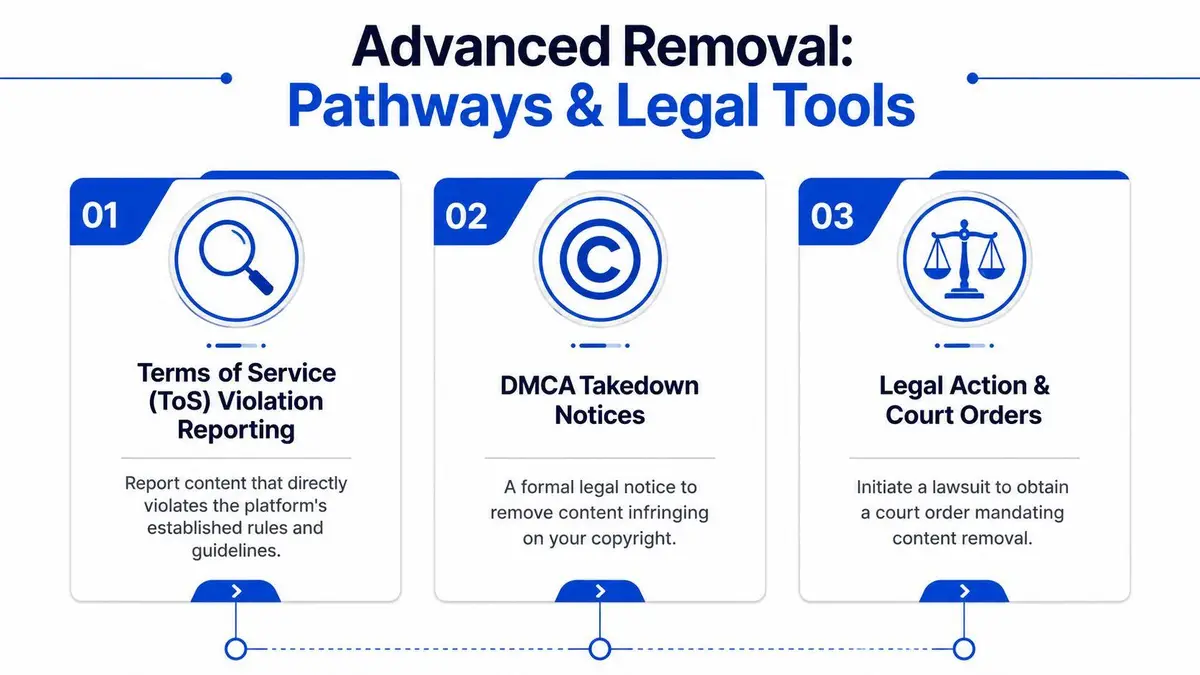
Indirect removal works only when the claim matches the mechanism. Your three serious options are terms-of-service enforcement, copyright takedown, and formal legal action. Before you use any of them, lock down evidence. Save the live URL, account name, publication date, visible comments, and any edits. If the author changes or deletes the post after notice, your record may become the only reliable proof.
Terms-of-service enforcement
Use platform rules when the platform has a clear policy basis to act. Harassment, impersonation, privacy violations, doxxing, and non-consensual imagery usually fit here. This route can be fast, but speed depends on how well you present the complaint.
Write for a rushed reviewer. Identify the exact post. Cite the policy category. Quote the offending language only if it helps the reviewer confirm the violation quickly. Keep the explanation tight and fact-based. Long emotional narratives weaken good reports because they bury the rule violation under background the reviewer does not need.
DMCA notices
For copyrighted material, a DMCA notice is often the strongest removal tool available. It works because copyright claims are tied to a statutory process, not just a platform’s internal discretion. If the post uses your photo, video, article, graphic, or other original work without permission, use that route first.
Draft it carefully. A weak notice causes delay, invites pushback, or gets rejected for technical defects. This strategic guide to filing a DMCA takedown notice is worth using as a checklist because precision decides whether the platform removes the content or sends you back to revise it.
KJK’s analysis of social media content removal and DMCA mechanics also makes the larger point clearly. Copyright complaints often outperform general abuse reports because they rely on a formal legal framework instead of broad moderation judgment.
Formal legal action and record-related issues
Some cases require counsel early. Defamation, impersonation tied to fraud, fabricated allegations, and posts that expose private information with real commercial or personal consequences often justify a lawyer-led demand or court application. Platform reports alone rarely resolve those matters cleanly, especially if the publisher is outside a major platform or is acting with obvious malice.
A legal demand should have a clear objective. Removal, correction, preservation of evidence, identification of the poster, or a court order are different remedies. Choose the one that reduces harm fastest.
Record-related content adds another layer. If a post repeats or amplifies old criminal-record information, source-level cleanup may matter as much as online takedowns. For readers dealing with that issue in Georgia, this resource on how to expunge records in North Georgia explains what can and cannot be addressed through the underlying record itself.
Archival copies and secondary takedowns
Serious removal work does not end with the original URL. Harmful content survives through archive sites, quoted reposts, scraper pages, forum mirrors, and search snippets. Treat the problem as a distribution chain, not a single post.
The process should follow three stages. Audit where the content appears. Take action against the source and the highest-visibility copies. Monitor for recurrence and issue follow-up requests where the material resurfaces. The Minc Law overview of internet content removal options reflects that same practical reality. Effective removal usually requires coordinated review, targeted action, and continued monitoring rather than a one-time complaint.
ContentRemoval.com is one option for matters that have already spread across multiple sites or keep reappearing after initial takedowns. Its role is straightforward. Source removal, de-indexing support, and ongoing monitoring are handled as one process instead of disconnected requests.
When to Engage Professional Removal Services
A post names your company, copies private material, and starts appearing in search results, reposts, and screenshots before your internal team finishes its first round of reporting. At that point, this is a risk-management problem, not an admin task.

Hire professional removal support when control is fragmented, the author is hostile, or the post triggers legal exposure. That includes defamation, impersonation, doxxing, leaked intimate content, trade secret disclosures, extortion, coordinated harassment, and repeated reposting after earlier takedowns. It also includes cases where the platform gives you no direct path because you are not the account owner, the site operator is anonymous, or the content sits across multiple domains.
Speed matters. So does sequence. A capable removal team does more than file complaints. It preserves evidence in a form lawyers and platforms can use, identifies the ultimate decision-maker behind the page or account, matches the facts to the strongest policy or legal basis for removal, and tracks copies after the original post comes down.
Do not assign this to a general marketing vendor. If you want a broad overview of what that function typically covers, this guide to digital marketing agency functions is useful. Marketing firms handle brand positioning, traffic, content, and campaigns. They do not usually handle platform enforcement, privacy claims, copyright notices, preservation protocols, or cross-border takedown strategy.
Bring in outside professionals early when delay raises the cost of cleanup. That is the rule for matters involving minors, false criminal accusations, nonconsensual imagery, investor-facing allegations, or attacks aimed at customers, employers, or family members.
If you need to delete a post and standard platform options have failed, start with a confidential assessment at ContentRemoval.com. The process should be disciplined: preserve proof, identify who controls the content, choose the strongest removal path, and keep going until secondary copies and resurfacing posts are addressed.
Frequently asked questions
How do I delete a post that someone else made about me?
You cannot press their delete button, so influence comes from policy, rights and escalation. Ask the publisher once in writing, then report the exact violation category to the platform, use a DMCA notice if your copyrighted photo or video was used, and bring in counsel for defamation, impersonation or doxxing. Preserve full-page evidence before any of that.
Why does a deleted post still show up in Google?
Platforms often separate the visible post from the stored asset, and search engines cache pages, so a deleted post can persist in snippets, archive copies, quoted reposts and screenshots. Confirm the post is gone from the feed, the media is gone from storage and references are gone from playlists, descriptions and comments, then address search and archive copies separately.
Can I delete a post on a forum after people have replied?
Often not on your own. The article notes that a sizeable share of professional community platforms require admin approval or direct team contact to delete answered threads, treating them as part of the platform’s record. Write the request like a business communication, name the post precisely, cite privacy or policy grounds and ask for written confirmation.