
Defamation per se is a false statement so inherently harmful that the law presumes reputational damage without proof of financial loss. The four categories are accusations of a serious crime, statements injuring someone in their profession, imputations of a loathsome disease, and allegations of serious sexual misconduct. For executives, the priority is removing the content before litigation can catch up.
Key facts
- Per se claims do not require proof of a specific lost contract or measurable financial loss.
- Public figures must still prove actual malice under New York Times Co. v. Sullivan, a high evidentiary bar.
- The UK’s serious harm threshold under the Defamation Act 2013 effectively dismantled per se there.
- Limitation periods can be as short as one year, and the article urges action within 24 to 48 hours.
Where ContentRemoval.com comes in. A per se accusation does its damage the moment it is indexed, long before any court weighs in. ContentRemoval.com focuses on that window: de-indexing the content from search, pursuing removal from the host and monitoring for reposts, all handled discreetly so the response does not amplify the lie. Executives, their general counsel and their communications advisers usually make contact. A free 15-minute Exposure Scan maps what is removable, and the report is yours to keep. Get a Free, Confidential Exposure Scan or read how our defamation removal work is done.
Some statements are so inherently harmful that the law presumes they have caused financial damage. This is defamation per se. For an executive, entrepreneur, or public figure, it is a critical threat. Unlike a standard defamatory remark requiring extrinsic context to prove its damaging nature, a per se statement is immediately and unequivocally destructive.
A Direct Assault on Your Career and Credibility

When an online attack rises to the level of defamation per se, it is more than an insult; it is a direct assault on your professional reputation and the equity of your personal brand. Most defamation claims, known as defamation per quod, require the plaintiff to prove specific, measurable financial losses. Defamation per se inverts this burden.
The law recognizes the statement as so toxic on its face that reputational harm is automatically assumed. This legal distinction makes such attacks exceptionally dangerous for individuals whose livelihood depends on their credibility. The accusation strikes directly at the foundation of trust you have built over a career.
While litigation remains a potential recourse, the immediate objective must be control of the narrative and swift damage mitigation. Waiting for a court to act is a failing strategy when your reputation is being dismantled in real-time.
The Immediate Threat to Executives
For a C-suite leader, a false allegation of professional misconduct can precipitate immediate and catastrophic fallout: investor panic, emergency board meetings, and the collapse of pending deals. These are precisely the scenarios that defamation per se addresses.
Accusations falling into this category typically involve:
- Commission of a serious crime.
- Statements injurious to one’s profession or business.
- Imputations of a “loathsome” disease.
- Allegations of serious sexual misconduct.
Consider a fabricated blog post accusing a CEO of embezzlement. The damage is done the moment that post is indexed by search engines. To the market, the board, and your stakeholders, the fine legal distinction between per se and per quod is irrelevant. The reputational crisis has already ignited.
The Shifting Legal Landscape
Relying on litigation is further complicated by evolving legal standards regarding presumed harm. The United Kingdom’s Defamation Act 2013, for example, introduced a “serious harm” threshold that effectively dismantled the traditional concept of defamation per se in that jurisdiction.
The consequence was a 53% drop in new defamation claims filed in the UK High Court between 2019 and 2020. As the full judicial statistics on this “libel thaw” demonstrate, legislative changes can fundamentally reshape strategic options.
Because the legal ground can shift, committing solely to litigation is a significant gamble. A rapid, proactive strategy focused on content removal is the only prudent first action. This approach directly addresses the public visibility of the attack, rather than awaiting a judicial process that may take years to conclude. The priority is protecting your life’s work.
The Four Categories of Per Se Statements Explained
False statements that are so fundamentally destructive that the law presumes reputational damage form the basis of defamation per se. The plaintiff is not required to prove a specific lost contract or a quantifiable dip in stock value; the accusation itself is considered so toxic that injury is a given.
For an executive or public figure, these accusations are the four-alarm fires of reputational attacks. Understanding the four primary categories is the first step in recognizing when a false statement has crossed the line from insult to an actionable crisis. While specific rules vary by jurisdiction, these classifications are the bedrock of U.S. defamation law.
Allegations of Criminal Conduct
This is the most straightforward category of defamation per se. The statement must falsely accuse the target of a serious crime involving “moral turpitude”, acts that reveal a corrupt or depraved character, such as theft, fraud, embezzlement, or assault. A false claim about a minor infraction does not qualify.
For a C-suite executive, a false online allegation of bribery or insider trading is a ticking time bomb. It can trigger regulatory investigations, unnerve investors, and force a board’s hand long before the truth is established. The accusation is the crisis.
Statements Implying Professional Incompetence
This category strikes at the heart of your career. It encompasses any false statement that directly attacks your ability to perform your professional duties, questions your integrity, or otherwise poisons your trade or business. These are not merely harsh opinions but specific, factual-sounding assertions that attack your core competence.
Examples include:
- A fabricated report that a chief financial officer is “cooking the books.”
- An anonymous post accusing a surgeon of operating while under the influence.
- A false claim that a financial advisor is secretly operating a Ponzi scheme.
Each assertion does more than sting; it suggests a fundamental unfitness for your profession, making it nearly impossible to continue operating without clearing your name.
This flowchart illustrates how to determine if a statement fits a per se category.
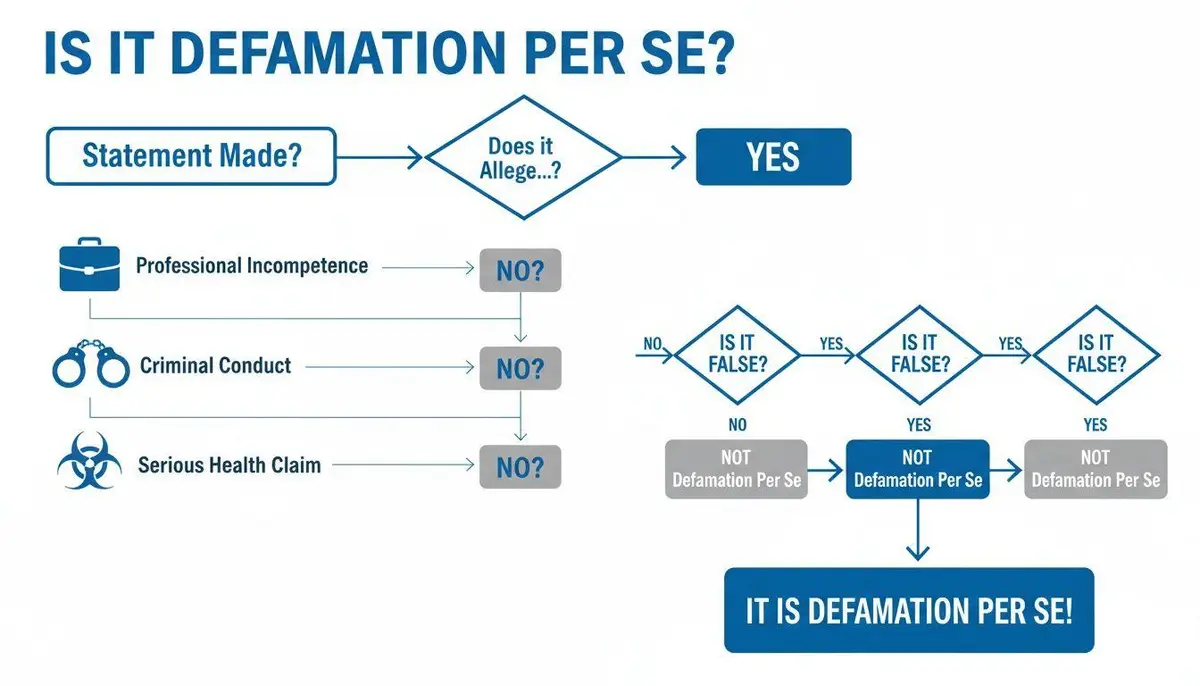
When a statement squarely targets professional conduct, criminal acts, or certain health issues, it often qualifies as defamation per se, allowing a legal case to proceed without the added burden of proving specific financial losses.
Claims of a “Loathsome Disease”
While its origins are archaic, historically targeting claims of leprosy or venereal diseases that would lead to social ostracization, this category persists. The modern interpretation focuses on being falsely accused of having a serious, contagious disease that carries significant social stigma. The core principle is that the lie itself would cause others to shun you, inflicting immediate and profound reputational harm.
Accusations of Sexual Misconduct
The fourth category involves false accusations of “unchastity” or serious sexual misconduct. This doctrine, originally created to protect women from reputation-destroying allegations, now generally applies to any individual falsely accused of significant sexual impropriety. A baseless accusation of sexual assault, harassment, or other predatory behavior is devastating. It is a career-ending event that can destroy personal and professional life instantly.
As seen in cases like Couteller v. Mamakos, where a building superintendent was falsely accused of sexual assault, such statements are considered defamatory per se because they charge a serious crime and injure the victim in their profession. The court recognized the accuser’s malice and affirmed a significant damages award, underscoring the gravity of these claims.
For any public-facing individual, these allegations are often weaponized to obliterate credibility. Once indexed by Google, such a lie becomes a permanent digital liability that can derail partnerships and erode public trust. While litigation is an option, the immediate goal must be to neutralize the online threat.
Per Se vs. Per Quod: A Critical Strategic Distinction
Defamation law draws a sharp distinction between two types of attacks. This is not a mere legal technicality; it is a fundamental difference that dictates the entire response strategy. Understanding the chasm between defamation per se and defamation per quod is the first step toward regaining control.
Defamation per se involves a statement so overtly toxic that damage is presumed. The classic examples are false accusations of a serious crime, professional incompetence, having a loathsome disease, or sexual misconduct. When a statement falls into a per se category, the court assumes reputational harm, granting the plaintiff a significant legal advantage by removing the burden of proving specific monetary loss.
Defamation per quod, by contrast, is more insidious. These statements appear harmless on their face and become defamatory only when extrinsic information is introduced. They are reputational landmines awaiting context to detonate.
The Hidden Danger of Defamation Per Quod
An anonymous blog post stating that a prominent CEO was seen at “123 Oak Avenue” last Tuesday night is, on its own, meaningless. But if public records show that 123 Oak Avenue was raided as part of a federal insider trading investigation, the statement suddenly implies a connection to a serious white-collar crime.
To win a defamation per quod case, the plaintiff must present this external context and prove special damages: a specific, measurable financial loss directly resulting from the statement. This is an incredibly difficult burden, making litigation long, expensive, and uncertain.
While a defamation per se claim is stronger in court, the attack itself is a five-alarm fire for your reputation. The damage occurs in real-time, long before a judge ever sees the case.
Defamation Per Se vs. Defamation Per Quod: A Strategic Comparison
For executives and public figures, this distinction dictates the urgency and focus of your response. The following table outlines the critical strategic differences, moving beyond legal theory to the practical realities of a reputation under siege.
| Attribute | Defamation Per Se | Defamation Per Quod |
|---|---|---|
| Nature of Harm | Obvious and apparent from the statement itself. | Hidden; requires extrinsic facts to become defamatory. |
| Burden of Proof | Harm is presumed; no need to prove specific financial loss. | Plaintiff must prove both extrinsic facts and special damages. |
| Strategic Urgency | Extremely high; the damage is immediate and public. | High, but the threat can be latent until context is known. |
| Primary Goal | Immediate content removal and reputational control. | Proving a complex case and recovering quantifiable losses. |
This is why the first move must be focused on content removal. While the legal system grinds forward, a false accusation cements itself at the top of search results, poisoning public opinion and destroying trust. The bleeding must be stopped at the source, not merely addressed by a legal remedy that may come too late.
Why the ‘Actual Malice’ Standard Favors the Attacker
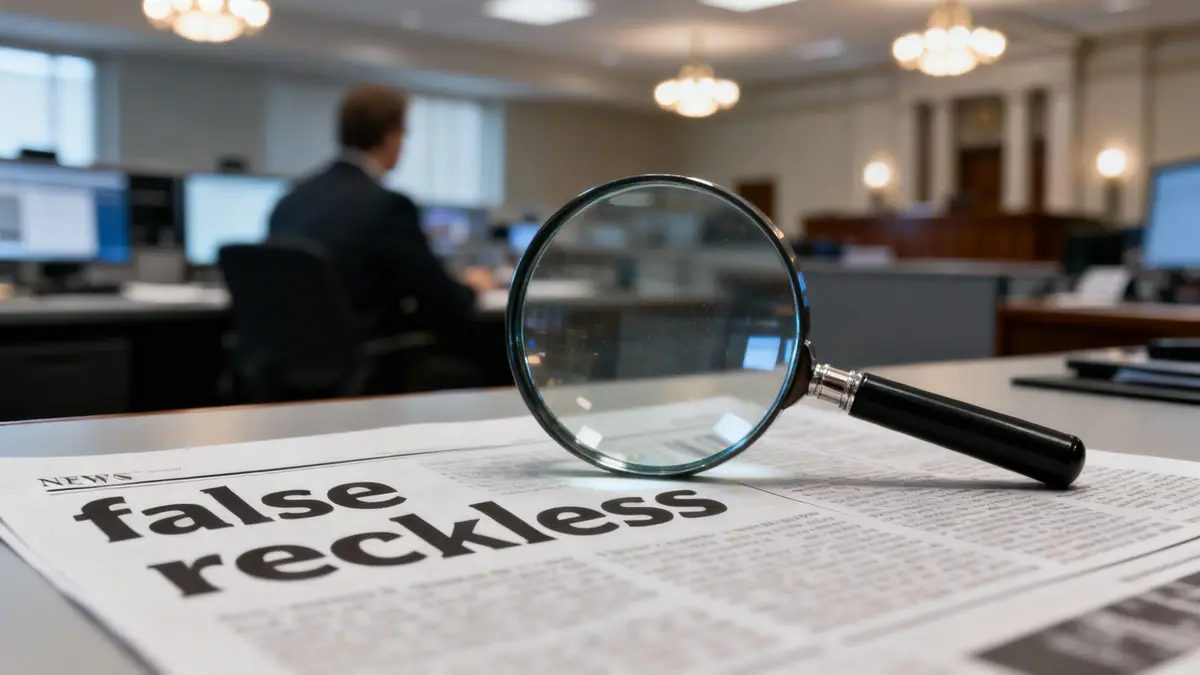
For a public figure, the single greatest obstacle in a defamation lawsuit is the ‘actual malice’ standard. This brutal legal requirement heavily favors the defendant, which is why litigation is often a poor first response to a reputational attack. It initiates an expensive, exhausting, and emotionally draining conflict that you are statistically likely to lose.
The ‘actual malice’ rule dictates that it is insufficient to prove a statement was false and damaging. A public figure plaintiff must go further and prove the publisher knew it was false or acted with reckless disregard for the truth. This is an exceptionally high bar.
This standard was established in the landmark 1964 U.S. Supreme Court case, New York Times Co. v. Sullivan, which fundamentally altered American defamation law. It forced public officials to prove that a defendant published a lie either knowingly or with a reckless indifference to the facts. An analysis of public figures in famous defamation cases illustrates how this decision tipped the scales.
Proving a State of Mind
The core challenge is proving the defendant’s state of mind. You must effectively climb inside the mind of the person or organization that published the falsehood and demonstrate malicious intent or profound carelessness. The case ceases to be about the damage done to your reputation and becomes entirely about their mental state at the moment of publication.
Obtaining such proof requires a massive and intrusive discovery process. Counsel will need to depose writers, editors, and sources. Months or years can be spent fighting for access to emails, text messages, and internal notes, a process that can easily cost hundreds of thousands, if not millions, in legal fees.
The legal discovery process itself can amplify the original defamatory statement, creating a larger crisis. Every court filing, deposition, and motion becomes public record, subject to media coverage that re-publishes the very lie you are trying to erase.
The Attacker’s Advantage in Discovery
During discovery, the defendant holds most of the cards. They can claim they believed their sources were reliable, argue they performed due diligence (however sloppy), or assert it was an honest mistake. Proving “reckless disregard” is not the same as proving unprofessionalism. You must show they entertained serious doubts about the story’s truthfulness and published it anyway.
This dynamic creates a high-risk, low-reward gamble:
- High Cost: Litigation is a financial black hole with no guaranteed outcome.
- Extended Timeline: A lawsuit can drag on for years, all while the damaging content remains online.
- Public Scrutiny: The lawsuit itself becomes a story, often amplifying the original falsehood.
- Low Probability of Success: The ‘actual malice’ standard is so difficult to meet that many legitimate defamation claims fail.
A public legal war over ‘actual malice’ is a slow, expensive, and uncertain journey that frequently inflicts more reputational harm than the initial attack. A superior strategy bypasses this legal quagmire altogether. By focusing on fast, discreet, and decisive content removal, you neutralize the threat before it becomes a public spectacle, protecting your name without the ordeal of a court battle.
Anticipating Common Defenses to Defamation Claims
To counter a defamation attack, you must anticipate your opponent’s legal strategy. Understanding the defenses they will almost certainly deploy is not a mere academic exercise. It is about knowing their playbook in advance. This foreknowledge allows you and your team to build a stronger case, anticipating their moves and preemptively countering them.
Most defamation defenses reduce to three arguments: truth, opinion, and privilege. While they appear straightforward, in the hands of a determined adversary, each has layers that can be exploited to prolong the process and exhaust you financially and emotionally.
The Absolute Defense of Truth
The most powerful defense to any defamation claim is that the statement was true. If the assertion is factually accurate, it does not legally constitute defamation, regardless of the damage to your reputation or the publisher’s motive. The defendant bears the burden of proving that the “sting” of the accusation, the part that inflicts the reputational damage, is substantially true. They cannot evade liability by proving a minor, irrelevant detail was correct while the core, reputation-shattering allegation was a fabrication.
The Gray Area of Opinion
A frequent tactic is for the attacker to claim their statement was merely an “opinion” and therefore protected speech. This is often a smokescreen for a factual assertion they cannot substantiate. The legal test is whether a reasonable person would interpret the statement as a claim of actual fact.
A comment like, “In my opinion, he’s a criminal,” is not automatically protected. If the statement implies the speaker possesses undisclosed, damning facts to support it (which are themselves false), it can cross the line into defamation.
Courts are trained to analyze the full context. Disguising specific, false accusations as a personal take is a common but often unsuccessful defense. This gray area is where many legal battles are fought.
The Shield of Privilege
Finally, an attacker might argue their statement was “privileged.” Privilege is a legal concept granting immunity in specific situations where open communication is deemed vital for the public good. It exists in two primary forms:
- Absolute Privilege: A complete shield against liability, even for statements made with malice. This is reserved for specific official proceedings, such as statements made by judges, lawyers, or witnesses in a courtroom.
- Qualified Privilege: A conditional immunity that applies to statements made in good faith on a matter of shared interest, such as an internal report of suspected misconduct. This shield is lost if the plaintiff can prove the defendant acted with actual malice: publishing out of spite or with a reckless disregard for the truth.
A thorough analysis of these potential defenses is a critical step in mapping the best path forward. This process often begins with securing the swift and quiet removal of the harmful content. For a more detailed analysis, our guide on online defamation of character lawsuits offers a strategic evaluation for executives.
Moving Beyond Litigation: Strategic Content Removal

Understanding the legal theory of defamation is one thing; for a high-net-worth individual or public figure under attack, it is cold comfort. The primary objective is not to win a court case years from now; it is to restore your reputation and neutralize the threat today. This requires a shift from legal analysis to decisive action, prioritizing strategic online intervention over protracted litigation.
When hit with a statement amounting to defamation per se, time is the enemy. Every hour that damaging content remains online, it spreads across the internet, cementing its position in search results. The traditional legal response, a lawsuit, is not engineered for the speed of a digital crisis.
For a high-profile executive, the goal is not merely to be proven right in a court of law. It is to make the reputational attack disappear, swiftly and discreetly, before it can inflict irreversible damage to your career, your company, and your personal life.
The Power of Immediate Intervention
A modern response to online defamation operates with speed and precision, bypassing the slow, uncertain grind of the courts. The objective is the surgical removal of the problem at its source, rendering the attack invisible to the public, partners, and key stakeholders. This approach relies on a number of confidential tactics working in concert.
This immediate action has clear advantages over litigation:
- Rapid De-Indexing: The first priority is to scrub the defamatory content from search engine results. When an attack no longer appears on Google, its primary distribution channel is severed and the damage is contained.
- Direct Source Takedowns: Concurrently, we work to remove the content from its original host website. This requires a combination of proprietary technical methods and targeted legal pressure on the host.
- Strategic Suppression: If outright removal is challenged, the strategy pivots to a sophisticated suppression campaign. By creating and promoting a wave of positive, authoritative content, we can push the negative material off the first page of search results, effectively burying it.
This process is about taking control of the digital narrative that defines your reputation. While a lawsuit focuses on proving past damages, strategic intervention is about preventing future harm before it can metastasize.
Avoiding the Streisand Effect
One of the greatest risks of a public legal battle is inadvertently triggering the Streisand Effect: the phenomenon where attempting to remove content only makes it more widespread. Filing a lawsuit creates a public record, attracting media attention and turning a manageable problem into a public spectacle. The original lie is then quoted in news articles and amplified across social media.
Our work is designed for complete discretion. By operating behind the scenes, we engage directly with search engines, hosting providers, and platform administrators to secure removal without initiating a public conflict. This protects your privacy and prevents the very fallout you are trying to escape. The courts are equipped to argue damages and precedent; they are not designed for rapid, discreet reputation repair.
We believe in eliminating the threat, not merely litigating it. This approach provides a clear, actionable solution to a severe reputational crisis, restoring control when it is needed most. Our guide to the essentials of removing online defamation provides a deeper dive into these advanced strategies.
Frequently Asked Questions About Defamation Per Se
When a false and damaging statement appears online, critical questions demand immediate answers. For executives and public figures, the stakes are too high for uncertainty. Here are the most common concerns we address for clients facing a potential case of defamation per se.
Can a Negative Online Review Be Defamation Per Se?
The answer depends on a critical distinction: is the review an opinion or a false statement of fact?
A review stating, “The CEO is arrogant and out of touch,” is almost certainly protected opinion. It is subjective. However, if the review claims, “The CEO embezzled funds to pay for his vacation,” it crosses a legal boundary. That is a specific, factual claim that, if false, constitutes a textbook example of defamation per se.
The moment a review shifts from subjective experience to making false factual accusations about professional integrity, criminal activity, or personal conduct, it becomes an actionable attack.
How Quickly Must I Act on a Defamatory Statement?
Immediately. Both a legal clock and a practical one are ticking.
Legally, every state has a statute of limitations for defamation, which can be as short as one year from the date of publication. Missing that deadline extinguishes your right to sue.
Strategically, the damage multiplies hourly. The longer defamatory content remains online, the more it is viewed, shared, and indexed by search engines, making it exponentially more difficult to remove. Taking decisive action within the first 24 to 48 hours is critical to containing the fallout before it becomes a permanent liability on your digital reputation.
Inaction allows the lie to harden into perceived truth. Assuming a reputational attack will simply blow over is the most significant mistake you can make.
Is It Possible to Remove Anonymously Posted Content?
Yes. Anonymity is a hurdle, not an insurmountable barrier.
While unmasking an anonymous attacker involves a complex “John Doe” lawsuit and subpoenas to web hosts or internet providers, it is a well-established legal process.
More importantly, identifying the poster is not always necessary to solve the problem. The faster route often involves focusing on the content itself. By leveraging a platform’s terms of service or working directly with hosting companies, we can often secure the takedown of the defamatory post or its de-indexing from search engines, neutralizing the threat far more quickly than litigation would allow. Understanding the legal criteria is the first step, and our guide on the topic offers a more detailed analysis for executives and founders analyzing their situation.
When your reputation is under fire, you require more than advice. You require a solution. ContentRemoval.com specializes in rapid, confidential strategies to remove damaging online content and restore your name. If you are facing a reputational threat, contact us for a confidential assessment. ContentRemoval.com