
Defamation of character in Florida requires proof that the defendant published a false statement about you to a third party and that the falsity caused reputational or financial injury. Private figures must show negligence, public figures actual malice. Claims must be filed within two years of first publication under Florida Statute 95.11(4)(g), so containment and evidence come first.
Key facts
- Florida’s two-year filing deadline runs from the initial post date, not from when you discovered it.
- The article puts traditional Florida defamation litigation at 6 to 18 months to resolve.
- Identification does not require your name if the audience knows who is meant.
- Truth, opinion, privilege and attacks on damages or causation are the defenses to expect first.
Where ContentRemoval.com comes in. Florida counsel can preserve the claim and pursue damages within the two-year window, but the false post keeps ranking and spreading in the meantime. ContentRemoval.com handles the visibility problem: source removal through platform and publisher channels, search de-indexing and monitoring for reposts, working alongside your attorney. Executives, physicians, founders and their general counsel usually make contact. A free 15-minute Exposure Scan maps what is removable, and the report is yours to keep. Get a Free, Confidential Exposure Scan or read how our defamation removal work is done.
A false post goes live before breakfast. By lunch, a client forwards it to your general counsel. By dinner, it’s in search results, group chats, screenshots, and competitor whispers. That’s how defamation of character florida problems usually arrive for executives and public figures. Not as a legal theory, but as an active threat with commercial consequences.
If you’re waiting for a courtroom to solve the first phase of the problem, you’re already behind. Florida law gives you a path to sue. It does not protect you from the speed of online distribution. The first job is containment. The second is evidence. Litigation comes after those two are under control.
The Critical Window for Action in Florida Defamation Cases
The first mistake high-value targets make is treating online defamation like a conventional lawsuit from the outset. That mindset is too slow. Florida law may give you a claim, but the internet gives the attacker a head start.
Existing Florida guidance tends to focus on the filing deadline. That matters, but it misses the tactical reality that the first 48 hours are often when search and social platforms give a false statement its widest exposure, while litigation is still nowhere near a remedy. Traditional legal action is reactive and often takes 6 to 18 months to resolve, according to Parrish Goodman’s discussion of Florida defamation timing and online harm.

What happens before your lawyer can file
A defamatory post doesn’t wait for pleadings. People screenshot it. Aggregators scrape it. Search engines index it. Other users paraphrase it, which creates fresh reputational problems even when the original post later disappears.
That timing gap is the core strategic issue. You may have a valid claim under Florida law and still lose the short-term reputation battle if you don’t move immediately on preservation and suppression.
Practical rule: Treat the first day as an evidence and containment operation, not a debate about whether you’re morally right.
The correct first posture is disciplined, not emotional. Don’t argue in comments. Don’t threaten a lawsuit in public. Don’t contact the poster before you’ve captured the evidence and identified where the content is spreading.
Your objective in the first phase
In the first phase, you’re trying to do three things at once:
- Freeze the record: preserve exactly what was published, where, and when.
- Limit further spread: pursue platform, host, search, and direct removal options where available.
- Prepare the legal file: build the factual record your attorney will need if the matter escalates.
If you need a tactical checklist for that immediate response, review this strategic guide for online defamation victims. It aligns with what serious counsel wants preserved before anyone starts making threats.
Understanding the Four Elements of a Defamation Claim
Florida defamation claims aren’t won because a statement was nasty. They’re won because the statement fits a legal structure. If one element is weak, the whole case becomes more expensive, slower, and easier to attack.
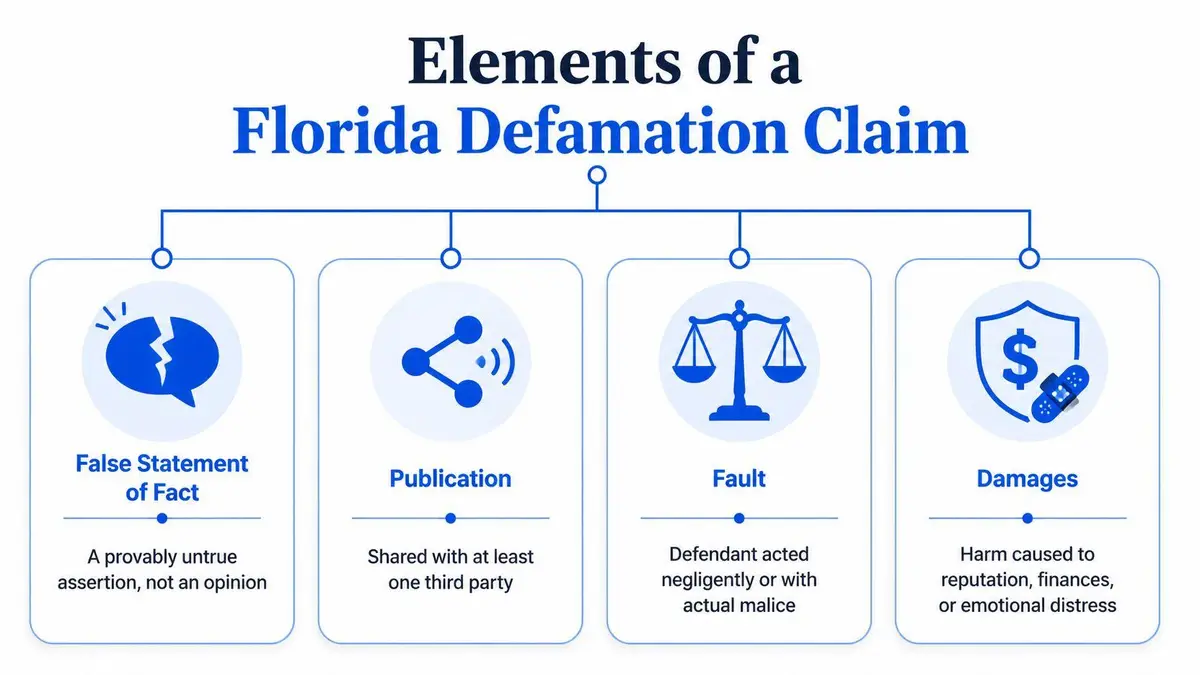
Under Florida law, a claim must show that the defendant published a false statement, the statement was about the plaintiff, it was communicated to at least one third party, and the falsity caused injury, such as reputational or financial harm. Early documentation of measurable harm is critical, as explained by Jimerson Birr’s overview of Florida defamation elements.
False statement and identification
A statement must be false, not merely insulting. “I think this CEO is arrogant” is generally not the same as “this CEO falsified investor numbers.” The first reads like opinion. The second reads like a factual assertion that can be proven true or false.
The statement must also be about you. That doesn’t always require naming you directly. If a post references “the managing partner of the Miami healthcare fund who lied to investors last quarter,” and your audience knows exactly who that means, identification may not be difficult to establish.
Publication and fault
Publication sounds technical, but it usually isn’t. If one other person saw or heard the statement, that element is usually in play. A LinkedIn post, review site comment, forwarded email, podcast segment, or private group message can all create publication issues.
The harder question is often fault. Florida distinguishes between private plaintiffs and public figures, which changes what you have to prove. That distinction can determine case value, settlement advantage, and whether the claim should be filed at all.
A concise explainer helps if you want a visual overview before talking strategy:
Damages decide whether the case has teeth
The final element is where clients often underprepare. You need to show harm. In practice, that means more than saying your reputation suffered. It means proving how the falsehood affected revenue, investor confidence, deal flow, patient relationships, speaking invitations, recruiting, or other identifiable interests.
Start documenting immediately:
- Commercial loss: cancelled meetings, paused transactions, lost accounts, or investor concerns tied to the publication.
- Reputational evidence: client emails, recruiter pullbacks, board inquiries, or screenshots showing public association of the allegation with your name.
- Digital context: URLs, timestamps, engagement indicators, and copies of related reposts or commentary.
A defamation file gets stronger when it moves from outrage to proof.
Public vs Private Figure The Critical Distinction
Most clients want to start with the statement itself. That’s understandable, but from a litigation standpoint the first serious question is often about you, not the attacker. Are you a private figure, a public figure, or something in between?
That classification matters because Florida applies different fault standards. A private figure generally needs to prove negligence. A public figure must prove actual malice. The problem for executives, founders, and online personalities is that modern visibility doesn’t fit neatly into old categories.
Why the label changes the whole case
A founder with frequent press coverage, a CEO active on LinkedIn, or a private equity executive who comments publicly on an industry controversy may be pushed toward limited-purpose public figure arguments. That doesn’t mean the defense will win that argument. It does mean you should expect it.
The ambiguity is real. As Chiappetta Trial Lawyers notes in discussing public versus private figure status in modern defamation disputes, Florida law clearly separates negligence from actual malice, but classification of digitally prominent people remains unsettled enough to become a threshold strategic fight.
| Factor | Private Figure | Public Figure |
|---|---|---|
| Fault standard | Negligence | Actual malice |
| Core strategic issue | Whether defendant failed to use reasonable care | Whether defendant knew the statement was false or acted with reckless disregard |
| Typical defense move | Argue no falsity or no damages | Argue plaintiff invited public scrutiny and can’t meet the higher fault burden |
| Plaintiff concern | Building proof of harm | Surviving the heavier evidentiary burden |
| Early case value | Often stronger if facts are clean | Often depends on internal communications, sourcing, and proof of state of mind |
Digital prominence creates gray zones
Courts didn’t build these categories with modern executives in mind. A person can be well known in a niche industry, highly visible online, and still not be a public figure for every topic. That’s why experienced counsel looks at the controversy itself. Did you voluntarily enter it? Were you already a public voice on the subject? Did the alleged defamation concern that same issue?
Those questions shape your advantage. If you’re likely a private figure, your claim may be far more practical than you think. If you’re likely a public figure, you need a more aggressive evidence strategy early because actual malice cases often rise or fall on proof that isn’t publicly visible.
Don’t assume you’re a public figure just because you’re successful or searchable online.
Navigating Common Defenses to a Defamation Claim
A credible plaintiff strategy starts with the defendant’s playbook. If you know the likely defenses before you send a demand or file suit, you’ll avoid weak claims and write stronger takedown requests.
Truth is the first line of defense
If the statement is substantially true, your outrage won’t rescue the claim. You need to separate damaging content from false content. Clever defendants know this, and they often blend true background facts with one false accusation to make the whole publication feel credible.
That means your response must be precise. Identify the exact sentence or implication that is false. If you attack everything, you look careless. If you isolate the false factual assertion, you look credible.
Opinion is the defense people misuse most
Online attackers love to hide behind “it’s just my opinion.” That phrase doesn’t automatically protect them. Courts usually care more about whether the statement reads as a factual assertion than whether the speaker labels it opinion.
These examples show the difference:
- Likely protected framing: “I wouldn’t trust this consultant. My experience was bad.”
- Higher-risk factual assertion: “This consultant forged documents and stole client funds.”
- Mixed statement requiring context: “In my opinion, this surgeon lies about credentials.”
The closer the language gets to provable fact, the stronger your position.
Privilege and procedural defenses
Some statements receive legal protection because of where or why they were made. Statements in judicial proceedings, certain reports, or internal communications can trigger privilege arguments. Those defenses don’t always end the case, but they can narrow it fast.
Other defenses are procedural. The defendant may attack identification, causation, or your proof of damages. They may also argue that your own public conduct opened the door to the criticism.
Your lawyer should test your case against the defense version before sending a single letter. If your claim survives that internal stress test, you’re in a stronger position to demand removal, correction, or compensation.
The Two-Year Clock and Your Legal Remedies
Florida gives you a hard deadline, not a flexible one. Under Florida Statute 95.11(4)(g), a defamation claim must be filed within two years from publication, and for online content the clock starts on the initial post date, as summarized in this discussion of Florida’s defamation statute of limitations.
That rule catches people off guard because digital content feels continuous. A post stays online, gets rediscovered, and keeps hurting you. But the filing analysis is tied to first publication, not your delayed discovery of the damage.
Why delay is expensive
Clients often spend months trying to manage the issue on their own, hoping the post will disappear or stop ranking. Sometimes it does. Sometimes it becomes the defining result tied to their name. If you let the legal deadline pass, your damages claim is gone.
That’s why legal evaluation should start early, even if your immediate goal is removal rather than suit. You need to preserve options while deciding whether litigation is worth the cost and exposure. This strategic evaluation of online defamation lawsuits for executives is useful if you’re weighing whether formal legal action helps or hurts your broader reputation position.
Match the remedy to the outcome you actually want
Clients usually want one of two things. They want the content down, or they want compensation for the harm. Those aren’t always achieved the same way.
A simple decision frame helps:
| Primary objective | Strategic implication |
|---|---|
| Remove or suppress the content | Push pre-litigation takedowns, preservation, negotiated removal, and platform or publisher pressure |
| Recover money damages | Build a litigation file with falsity, identification, fault, and documented harm |
| Deter future attacks | Consider cease and desist letters, formal demands, and a broader monitoring protocol |
| Restore search visibility | Pair legal strategy with search-focused reputation response |
The mistake is assuming a lawsuit automatically delivers fast removal. It usually doesn’t. Litigation can be necessary, but it rarely solves the first-phase visibility crisis on its own.
Your First Moves Preserving Evidence and Initiating Takedowns
When harmful content appears, your first response should be disciplined collection. A casual screenshot isn’t enough. If the matter becomes contested, missing context can cripple both your takedown request and your legal case.
Preserve the record like it will be challenged
Capture the full page, not just the offending sentence. Include the visible URL, account name, date, time, post thread, and surrounding comments where relevant. If the content appears in search results, preserve the search query and the result page. If it appears on a review platform, preserve the reviewer profile and any linked history.
Build a simple evidence folder with filenames that make sense. Keep the original files. Don’t edit the screenshots. Create a written log that records when you found the content, where you found it, and any immediate business impact you observed.
The best evidence file is boring, chronological, and complete.
Choose the right takedown path
Not every defamatory statement should get the same response. Some content is best handled through a platform complaint based on impersonation, harassment, manipulated media, doxxing, or terms-of-service violations. Other content calls for a direct legal notice to the poster, publisher, or host.
Use the response that fits the platform and the facts:
- Platform-first route: best when the content clearly violates site policies and you need quick intervention.
- Legal notice route: stronger when the statement is specific, false, commercially harmful, and the publisher is identifiable.
- Dual-track approach: often appropriate when you need speed and record-building at the same time.
For site-level attacks, complaint drafting matters. This guide to reporting a defamatory website and pursuing removal lays out the mechanics of that process in a way most general legal articles don’t.
Don’t contaminate your own case
Avoid public threats, emotional replies, or direct messages that invite the poster to delete key evidence before you preserve it. Don’t encourage friends or employees to pile on. Don’t post “receipts” without legal review if there’s any confidentiality risk.
If the matter involves a board dispute, former employee, competitor, ex-spouse, or anonymous account with insider details, assume the attacker may already be planning for litigation. Act accordingly.
Developing Your Reputation Defense Strategy
The right strategy in a defamation of character florida matter is rarely “file suit and wait.” That approach ignores how online harm spreads and how uneven the legal burdens can be, especially for visible executives and public figures.
Florida requires public figures to prove actual malice, a much steeper burden than the negligence standard applied to private individuals, as discussed in Blue Ocean Global Technology’s Florida defamation law guide. That alone is enough reason to build a response around speed, evidence quality, and non-litigious removal paths where possible.
Your defense plan should answer four questions fast. Is the statement false in a provable way? How are you likely to be classified? Where is the content spreading? What outcome matters most, removal, compensation, deterrence, or search repair?
For many matters, the right team is hybrid. You need defamation counsel to assess the claim and preserve a strong position in litigation. You may also need operational support to triage inbound reports, preserve intake consistency, and route evidence properly. Firms handling a high volume of sensitive complaints sometimes strengthen that front end with resources like a Hire legal intake specialist so urgent reputation matters don’t die in voicemail or email backlog.
When removal speed is the priority, specialized vendors can also play a defined role. ContentRemoval.com handles source removal, de-indexing, and platform takedown workflows across search engines, websites, and social platforms, which can complement legal counsel when the immediate problem is visibility rather than final judgment.
If your name, company, or family is under attack online, start with a confidential assessment from ContentRemoval.com. You’ll get a clear action plan focused on evidence preservation, takedown options, and the fastest path to regaining control.
Frequently asked questions
How long do you have to file a defamation lawsuit in Florida?
Two years from publication under Florida Statute 95.11(4)(g). For online content the clock starts on the initial post date, not when you found it or when it started ranking. Delayed discovery of the damage does not extend the deadline, so legal evaluation should begin early even if removal is the immediate goal.
Am I a public figure for a Florida defamation case if I am active on LinkedIn?
Not automatically. Florida separates negligence for private figures from actual malice for public figures, but classification of digitally prominent people is unsettled and often becomes a threshold fight. Courts look at whether you voluntarily entered the specific controversy and whether the statement concerned that same issue.
What should I do first if someone posts something false about me in Florida?
Treat the first day as an evidence and containment operation. Capture the full page with URL, account, date, thread and surrounding comments, preserve search results, and log the business impact. Do not reply publicly, threaten suit in comments or contact the poster before preserving proof. Then pursue platform, host or publisher removal while counsel prepares the legal file.