
Defamation law firms are specialist litigators who assess whether a false statement meets the legal test, quantify the damage, preserve digital evidence and pursue retractions, injunctions, damages or the unmasking of anonymous attackers. Litigation is slow and public, so the strongest reputation defense usually pairs a law firm with a discreet content removal service working in parallel.
Key facts
- A claim needs a false statement of fact, publication to a third party, fault and quantifiable harm.
- Public figures in the U.S. must prove actual malice, a substantially higher fault standard.
- The article puts litigation at 9 to 24 or more months versus 7 to 90 days for platform-based removal.
- Anonymous attackers are identified through John Doe lawsuits and subpoenas to platforms or hosts.
Where ContentRemoval.com comes in. ContentRemoval.com is the removal track that runs alongside your lawyers. While counsel builds the case for damages or an injunction, the firm works directly with platforms and search engines to get defamatory posts, reviews and articles removed or de-indexed, quietly and without a court record. Attorneys often bring us in for exactly this reason. A free 15-minute Exposure Scan maps what is removable, and the report is yours to keep. Get a Free, Confidential Exposure Scan or read how our defamation removal work is done.
When your reputation, the product of a lifetime of work, is subjected to a calculated online assault, regaining control is the only acceptable outcome. This is the domain of specialized defamation law firms. They are not generalists; they are legal strategists equipped to dismantle false attacks. Their function is to analyze the threat, quantify the damage, and execute a legal strategy that restores your command.

The Strategic Role of Defamation Law Firms
When your name, business, or character is being systematically attacked online, the pressure is immense. A single coordinated campaign of false reviews, a misleading article, or a viral post can inflict immediate and lasting harm on your financial standing, professional relationships, and personal life. This is the precise moment to engage a specialist defamation law firm.
These practitioners are not average litigators. They are strategists immersed in the unique challenges of reputation warfare. Their role extends beyond filing lawsuits; they function as a rapid-response team, designed to assess a threat, contain its spread, and neutralize it with legal precision.
Core Functions of a Defamation Specialist
A top-tier firm’s initial action is a fusion of crisis management and strategic legal review. They will meticulously analyze the attack to determine if a viable legal claim exists. This involves a clinical examination of the line between a hostile but protected opinion and a factually false, defamatory statement.
A defamation specialist’s primary responsibilities are centered on several key functions. They must first conduct a Case Viability Analysis, determining if the false statements meet the strict legal criteria for defamation. This requires proving the statement was false, published to a third party, made with a requisite level of fault, and caused demonstrable harm.
Next is Damage Quantification. This involves a forensic assessment of the financial and reputational injury, from lost revenue and career setbacks to the intangible but significant harm to your brand and personal standing. This analysis forms the basis for any damages claim.
Concurrently, they direct Evidence Preservation, securing the digital record (screenshots, website archives, and the technical data needed to trace anonymous attackers) using methods that satisfy evidentiary standards in court.
Finally, they execute Strategic Action Deployment. This may begin with a precisely worded cease-and-desist letter or a demand for retraction. If such measures are insufficient, they prepare for litigation.
Beyond the Courtroom
While litigation is a powerful tool, it is not always the optimal first step. The best defamation law firms understand that a public court battle can amplify the very falsehoods you seek to suppress. For this reason, they often deploy a multi-pronged strategy, exploring discreet solutions such as direct negotiation with the publisher or the platform hosting the content.
When a lawsuit is the necessary course, these firms manage every detail. When selecting counsel, confirm they possess access to essential resources, including specialized legal transcription services to create a verbatim record of depositions and court proceedings.
The objective is not merely to win a case; it is to restore your reputation. This requires a sophisticated strategy that balances aggressive legal action with careful reputational considerations, ensuring the remedy is not more damaging than the initial attack.
Engaging a defamation law firm is an offensive measure to reclaim your narrative. They provide the expertise, structure, and authority required to reverse the tide of a false attack, enabling you to return to leading your business and your life.
When a Reputation Attack Demands Legal Action
Not every hostile online comment constitutes defamation, and even when it does, litigation is not always the prudent response. For an executive or public figure facing an attack, the decision to engage a defamation law firm must be strategic, not emotional.
Litigation is a significant undertaking. The legal standard for defamation is high, and each element of the claim must be proven. A failure on any single point will likely result in a dismissal, costing significant resources and, paradoxically, amplifying the original attack.
The Four Elements of a Defamation Claim
A successful defamation claim must satisfy four distinct legal elements. An experienced attorney will immediately assess whether your situation meets all four criteria.
- A False Statement of Fact: This is the foundation of any claim. The statement must be presented as a fact and be demonstrably false. “The CEO is a poor leader” is an opinion. “The CEO embezzled $1 million” is a factual allegation that can be proven or disproven. Parody and satire are typically protected because they are not intended to be interpreted as literal truth.
- Publication to a Third Party: The false statement must have been communicated to at least one other person. A private email sent only to you does not qualify. However, the same statement posted on social media, published in an online article, or spoken to a colleague meets the publication requirement.
- Fault or Negligence: The publisher of the statement must be at fault. For private individuals, this often means proving negligence: that they failed to exercise reasonable care in verifying the information. For public figures, the standard is substantially higher. You must prove actual malice, demonstrating the publisher knew the statement was false or acted with reckless disregard for the truth.
- Quantifiable Harm: You must demonstrate that you have suffered real, measurable damages. This can be purely financial, such as a lost contract or a decline in company value. It can also be significant harm to your professional reputation that directly affects your career and earning capacity.
Calculating the Stakes of Litigation
The ability to sue does not automatically mean you should. While potential awards can be substantial, the $787 million settlement in the Dominion Voting Systems case against Fox News is a powerful example of how defamation law firms can achieve accountability, such outcomes are exceptional.
Lawsuits are public, protracted, and expensive. They also carry the risk of the Streisand effect, drawing far more attention to the very falsehoods you are trying to suppress. A rigorous strategic evaluation of the risks and benefits of litigation is the critical first step before filing any claim.
An experienced defamation lawyer’s most critical function is not merely to argue in court, but to act as a strategic advisor. They help you weigh the potential for a favorable verdict against the real-world costs and the risk of exacerbating the damage.
Ultimately, initiating legal action is a measure reserved for the most severe cases. It is a decision made only when the damage is catastrophic, the evidence is undeniable, and the strategic upside of litigation clearly outweighs the considerable risks.
Legal Takedowns Versus Digital Removal Strategies
When your reputation is under attack, selecting the correct tool is paramount. The appearance of defamatory online content demands immediate action, but there are two distinct playbooks: the traditional legal route through a defamation law firm and the agile, technology-driven approach of a digital removal service.
Viewing these as mutually exclusive options is a strategic error. They are not competing solutions; they are different tools designed for different outcomes.
The legal path is powerful but deliberate. It involves public court proceedings that are neither swift nor inexpensive. The process, from discovery and motions to hearings and potential appeals, can extend for months or years. All the while, the harmful content often remains online, accruing views and compounding the damage.
A defamation lawsuit is the heavy artillery in your arsenal. It is built to deliver a decisive legal blow, set precedent, and secure financial damages. It was never designed for speed or discretion.
The Objective of Legal Action
The primary objective of a defamation law firm is to secure a legal victory. This entails methodically proving the specific elements of defamation to a judge or jury. The desired outcome is a court order, a forced public retraction, or a monetary judgment for the harm suffered.
To prevail in court, your legal team must construct a case on several foundational pillars.
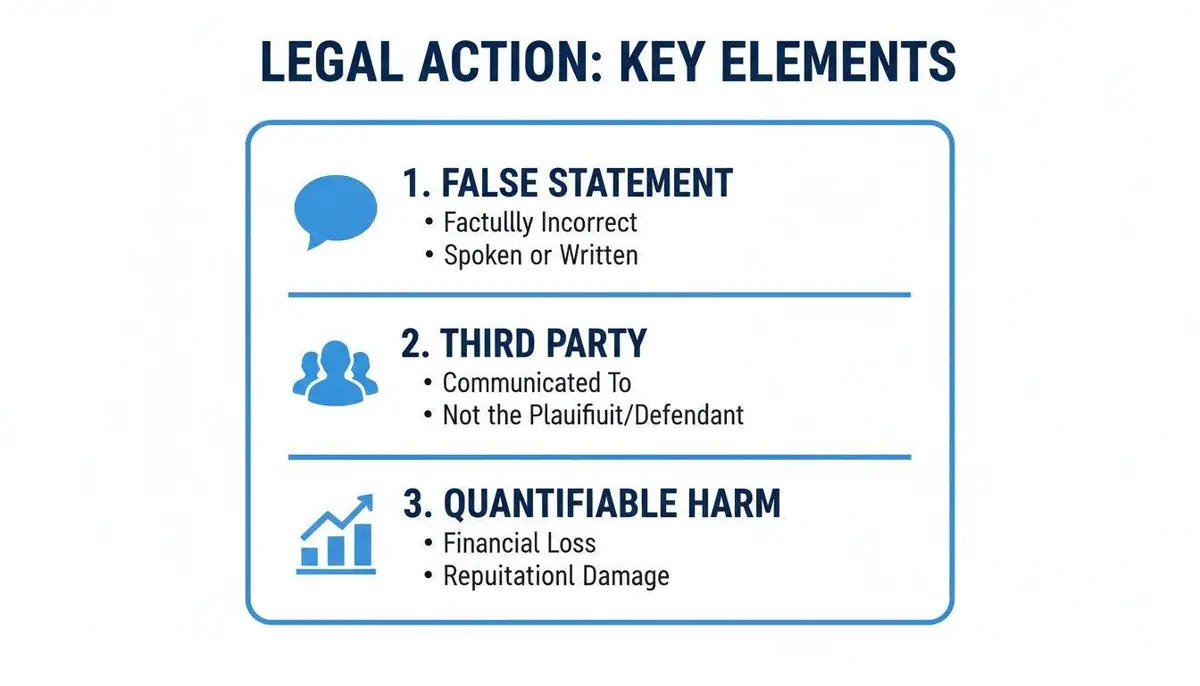
This illustrates the methodical nature of the legal process. Proving a false statement was published and caused measurable harm requires rigorous, evidence-based arguments, a non-negotiable process that explains the lengthy timeline of litigation.
The Role of Digital Removal Specialists
A specialized digital removal service operates with the precision of a special operations unit. Its mission is not to win a protracted court battle but to secure the removal of damaging content. Swiftly.
The focus is on immediate containment. They work to stop the reputational bleeding, prevent an attack from going viral, and quietly excise the problem from the internet.
This approach bypasses the court system entirely. Instead of legal briefs, it employs a different toolkit. This includes proprietary technology to monitor the spread of negative content, established relationships within online platforms to fast-track removal requests, and expert knowledge of Terms of Service (ToS). Specialists master the complex rules of each platform, identifying violations (such as harassment, privacy invasions, or impersonation) that a purely legal argument might overlook.
For example, a defamatory post may contain a false statement (the legal issue) but also violate a platform’s policy against personal attacks. A content removal expert identifies that policy violation and uses it to secure the post’s removal in days or weeks, not years. The process is confidential, avoiding the public spectacle of a lawsuit.
When facing an online attack, it is essential to compare your options to determine which strategy aligns with your immediate objectives. This table breaks down the core differences between the two primary approaches.
Table: Strategic Approaches to Content Removal
A comparison of the primary methods for removing defamatory online content, highlighting their distinct advantages, timelines, and ideal use cases for high-profile individuals.
| Attribute | Traditional Defamation Law Firm | Specialized Content Removal Service |
|---|---|---|
| Primary Goal | Win legal judgment, secure damages, unmask attacker | Fast, discreet, and permanent removal of content |
| Key Method | Formal legal proceedings (cease-and-desist, lawsuit) | Direct engagement with platforms using ToS violations |
| Typical Timeline | 9-24+ months | 7-90 days |
| Cost Structure | High (retainers, hourly billing, court fees) | Typically a flat, project-based fee |
| Discretion | Low (public court records) | High (confidential, non-public process) |
| Best For | Pursuing financial compensation and holding attackers accountable | Quickly stopping reputational damage and containing a crisis |
Ultimately, the correct path depends on your priorities. Each serves a vital but different purpose. Our guide on reporting defamatory websites explores these non-legal strategies for content removal in greater detail.
A Coordinated Strategy
The most effective reputation defense strategies often run these two approaches on parallel tracks. While a digital removal service works to scrub damaging material from the internet, a defamation law firm can simultaneously build a legal case to pursue damages and unmask anonymous attackers.
The decision hinges on your immediate priorities. If you are focused on stopping the bleeding and containing the crisis discreetly, a digital removal service is your frontline defense. If your primary goal is financial justice and holding the perpetrator accountable in court, you will need a defamation law firm to lead that charge. Understanding how each functions allows you to build a comprehensive strategy that protects your reputation both now and in the future.
How to Vet and Select a Defamation Law Firm

Choosing legal counsel is the single most critical decision in a defamation conflict. The right firm serves as your strategic command center. The wrong one can deplete your resources, escalate the crisis, and fail to achieve your objectives.
Your vetting process must be as rigorous as a high-stakes executive hire. Move beyond surface-level inquiries about “experience.” To identify the right fit, you must probe for specific skills and strategies that demonstrate a firm’s performance under pressure. The goal is to interview them with the authority of a seasoned general counsel, leaving no doubt about their capacity to protect your name.
Assessing a Firm’s Track Record and Technical Acumen
Disregard marketing materials. A firm’s past performance in cases analogous to yours is the only reliable predictor of future success. Direct, incisive questions will quickly distinguish true specialists from general litigators who dabble in defamation.
Questions that cut to the core of a firm’s competence include:
- Anonymous Defendants: “Describe your process for unmasking anonymous online actors across different jurisdictions. What specific legal and technical tools have you successfully used?” This tests their practical knowledge of “John Doe” litigation, subpoenaing tech platforms, and digital forensics.
- High-Profile Cases: “What is your protocol for managing media attention and ensuring client confidentiality when a case attracts public interest?” This reveals whether they have a media strategy or are improvising, which is critical to preventing the lawsuit from becoming a second PR crisis.
- Case Outcomes: “Provide examples of cases where you not only secured a financial award but also obtained a court order for content removal and an injunction against future attacks.” This shifts the focus from monetary awards to comprehensive reputational repair.
A top-tier defamation firm must articulate a clear, step-by-step strategy for identifying anonymous posters. If they cannot explain their process for using subpoenas and digital forensic analysis to trace IP addresses and user accounts, they lack the technical depth required for modern online cases.
Their technical acumen is non-negotiable. Inquire about their digital forensic partners and their procedures for collecting and preserving fragile digital evidence. A firm that outsources this thinking or lacks a coherent tech strategy is not equipped for the fight.
Evaluating Fee Structures and Strategic Alignment
You must understand how a firm is compensated. Its fee structure directly influences its incentives and case approach, making total clarity essential. The legal market for these services is robust, offering a variety of payment models.
Defamation and reputation management are growing sectors. Profits per lawyer at top firms have increased by 53.7% since 2019. This has driven investigative hourly rates into the $350 to $550 range, with rates for expert testimony exceeding $550 per hour for over 26% of specialists. This detailed legal market analysis provides deeper insight into these trends.
Common fee structures include:
- Hourly Billing: The traditional model where you pay for all time spent on your case. It is flexible but can become extremely expensive in a prolonged engagement.
- Flat Fee: Some firms quote a fixed price for a specific task, such as drafting a cease-and-desist letter or conducting an initial investigation.
- Contingency Fee: The firm takes a percentage of any monetary award. This is less common in defamation unless a substantial damages award is highly probable.
- Hybrid Model: A combination of a reduced hourly rate and a smaller contingency fee. This can align incentives, as the firm is motivated to work efficiently while also sharing in a successful outcome.
Insist on complete transparency regarding all potential costs, including fees for expert witnesses, court filings, and digital forensics. A reputable firm will provide a detailed budget and a clear engagement letter defining the scope of work and all associated costs. This financial due diligence ensures there are no surprises and that your defamation law firm is a true partner in resolving your crisis.
Navigating Global Defamation and Jurisdictional Issues
When personal brands and business interests are global, so are the reputational vulnerabilities. A false post from a blogger in London or a competitor in Sydney can inflict immediate and serious damage on a U.S.-based executive. The internet has erased borders, but defamation laws have not. This disparity creates a complex web of legal challenges demanding a sophisticated, cross-jurisdictional approach.
This is where forum shopping becomes a critical strategy, the careful selection of the most favorable jurisdiction in which to file a lawsuit. The differences between legal systems are not minor; they can determine the outcome of a case.
Contrasting Global Legal Standards
The United States, with its First Amendment, offers some of the world’s strongest free-speech protections. This places an extremely high burden of proof on the plaintiff. A public figure must prove “actual malice,” demonstrating that the publisher knew their statement was false or acted with reckless disregard for the truth. This makes winning a defamation case in the U.S. exceptionally difficult.
In contrast, other countries are far more plaintiff-friendly. This has led to “libel tourism,” where a lawsuit is filed in a jurisdiction known for favorable laws, regardless of where the defendant or the primary audience is located.
This legal patchwork means a defense strategy effective in one country may be useless in another. While truth is a powerful defense in the U.S., Germany permits the prosecution of damaging statements even if they are factually correct. The UK and Australia are so plaintiff-friendly that they are often the preferred jurisdictions for claimants. This complex global landscape of defamation law reveals the stark variations in legal standards.
Challenges in Enforcement and Defense
Securing a judgment is one challenge; enforcing it is another. A multi-million-dollar libel judgment won in a foreign court may be unenforceable in the U.S. if the case would have failed under America’s robust free-speech standards.
To counter libel tourism, the U.S. and other nations have enacted laws to protect their citizens from foreign defamation judgments that conflict with their own legal principles. These laws, combined with the rise of anti-SLAPP (Strategic Lawsuit Against Public Participation) statutes, are designed to shield critics from being silenced by lawsuits used as weapons.
For a high-profile individual with global operations, a single-jurisdiction strategy is often insufficient. An attack originating from a country with weak free-speech protections requires a different tactical response than a domestic one. A multi-pronged approach, potentially involving legal action in multiple countries, is often essential for comprehensive reputation defense.
This is precisely why one needs a defamation law firm with a genuine global network. A team with cross-jurisdictional experience can analyze the origin of the attack, the publisher’s location, and the audience’s geography to pinpoint the optimal legal battleground. This strategic decision is key to neutralizing international reputation threats and protecting your name worldwide.
What to Do Right Now
In a reputational attack, hesitation is the enemy. The longer false information remains online, the greater the damage. This is a clear, immediate action plan to regain control.
A three-step sequence has proven effective. It shifts your posture from being a target to taking command of the situation.
Step 1: Preserve Everything
Your first action: preserve everything. The instinct to delete the content is a mistake. Before the author can cover their tracks, you must capture a perfect record of every defamatory post, comment, and article.
This requires more than a quick phone screenshot. Be methodical.
- Create a dedicated, secure folder for each piece of content.
- Save the full, complete URL, not a shortened link.
- Take high-resolution, uncropped screenshots of the entire webpage, ensuring the date and time are visible if possible.
- Maintain a simple log of when and where you found each piece of evidence.
This evidence is the foundation of your case. Without a pristine record, your options for a quick takedown or future litigation are dramatically diminished.
Step 2: Assess the Damage
With the evidence secured, conduct a calm assessment of the threat. Not every negative comment warrants a full legal mobilization. Analyze the nature of the attack, the platform, and the real-world harm it is causing.
Is this a minor annoyance on a low-traffic forum, or is it a viral post on a major platform that is costing you business or threatening your career? This analysis is critical for matching your response to the severity of the problem and avoiding an overreaction that could escalate the situation.
The most critical decision in a crisis is not whether to act, but how to act. Speed and strategy are not mutually exclusive; they are intertwined. A swift, surgical strike to contain a viral threat can run in parallel with the methodical construction of a legal case for long-term justice.
Step 3: Engage the Right Help
Your assessment will dictate the appropriate course of action. This is the point at which you engage professionals.
For a rapidly spreading problem requiring immediate containment, a digital removal specialist is your first call. Their sole focus is on getting the content removed, often within days, working discreetly to neutralize the threat.
For situations demanding the unmasking of an anonymous attacker, financial compensation for damages, or a court order, you need one of the vetted defamation law firms discussed here. They possess the legal authority to compel platforms and internet service providers to reveal the identities of attackers and hold them accountable.
Often, the most robust strategy is a two-pronged attack: using a removal service for immediate damage control while simultaneously engaging a legal team to build a case for long-term justice. The situation is urgent. Your next move is to get a confidential assessment to build out your response.
Your Top Questions About Defamation Law, Answered
When your reputation is at stake, practical questions demand direct answers. These are the most common inquiries we receive from executives and high-net-worth individuals considering their legal options with a defamation law firm.
How Long Does a Defamation Lawsuit Typically Take?
A defamation lawsuit is a marathon. A relatively straightforward case will likely take 12-18 months to resolve. More complex litigation, especially involving anonymous defendants or international jurisdictions, can easily extend into a multi-year engagement.
Several factors contribute to this protracted timeline:
- Court Dockets: Overloaded court systems cause significant delays between hearings and trial dates.
- Delay Tactics: A determined opponent can intentionally slow the proceedings by contesting every request for evidence during discovery.
- The Appeals Process: A favorable verdict is not always the end. An appeal can add another one to two years to the process.
This reality is why a dual-track strategy is often most effective. While lawyers pursue long-term justice and financial damages, a specialized content removal service can work in parallel to remove damaging material from public view quickly.
What Are the Average Costs of Hiring a Defamation Law Firm?
Hiring a top-tier defamation law firm is a significant financial commitment. Senior partners at elite firms command hourly rates starting at $800 and rising well past $1,500. A full-scale lawsuit will almost certainly cost six figures, and high-stakes, contentious cases can run into the millions.
Expect a substantial initial retainer to begin an engagement. For a premier firm, this can range from $25,000 to over $100,000, depending on the anticipated intensity of the case.
While you may hear of contingency or “no-win, no-fee” arrangements, they are rare in high-stakes defamation work. The vast majority of these cases are billed on an hourly basis.
Can I Sue an Anonymous Person for Online Defamation?
Yes. Anonymity is not a shield for defamation. The legal instrument for this is a “John Doe” lawsuit.
The process involves filing a lawsuit against the unknown defendant. Your legal team then uses the power of the court to issue subpoenas to online platforms, web hosts, or internet service providers. These subpoenas legally compel them to disclose information that can identify the anonymous individual. While this adds steps, time, and cost, it is a standard and powerful method for holding attackers accountable.
When a reputation crisis demands a swift and decisive response, ContentRemoval.com offers a clear path forward. Our specialists use a combination of proprietary methods and deep platform knowledge to secure the fast, discreet removal of harmful content, often in a fraction of the time it takes to see results through the legal system. Start your confidential assessment today to build a tailored response plan.
Frequently asked questions
When should I hire a defamation lawyer instead of a removal service?
Engage a law firm when you need to unmask an anonymous attacker, recover financial damages or obtain a court order, and the evidence is strong enough to survive the high legal standard. Use a removal service when the priority is stopping the spread quickly and discreetly. The article recommends running both tracks together in serious cases.
How much does a defamation law firm cost?
According to the article, senior partners at elite firms bill from around 800 dollars an hour upward, initial retainers run from 25,000 to over 100,000 dollars, and a full lawsuit will almost certainly cost six figures. Contingency arrangements are rare in high-stakes defamation work, so most matters are billed hourly.
What questions should I ask before hiring a defamation law firm?
Ask how they unmask anonymous actors across jurisdictions, how they manage media attention and confidentiality in high-profile matters, and for examples where they secured content removal orders and injunctions rather than only money. Confirm their digital forensics partners and insist on a written budget covering experts, filings and forensics.