
Data privacy compliance for a large enterprise is a governance problem, not a policy drafting exercise. A defensible program starts with a named executive owner, a privacy steering committee and a live data inventory, then builds one master framework adapted locally, pushes controls into vendors and systems, trains staff by role, rehearses incidents and monitors continuously for drift.
Key facts
- By early 2025, 144 countries had privacy laws and 21 U.S. states had passed their own.
- GDPR fines can reach 4 percent of global revenue or 20 million euros, whichever is higher.
- A Record of Processing Activities should answer what, why, where, who, how long and current risk.
- DPIAs should gate launches involving sensitive data, automated decisions or unverifiable vendor and AI processing.
Where ContentRemoval.com comes in. Compliance controls limit what escapes, but when leaked files, doxxing pages or impersonation material reach search results, containment becomes a removal problem. ContentRemoval.com works with general counsel, privacy leads and communications teams to remove that content at source, de-index what lingers and monitor for reposts. A free 15-minute Exposure Scan maps what is removable, and the report is yours to keep. Get a Free, Confidential Exposure Scan or read how our personal data removal work is done.
You’re likely dealing with a familiar problem already. The business wants to launch products faster, centralize customer data, expand AI use, and streamline vendor onboarding. At the same time, regional counsel, security, procurement, marketing, and HR are all making privacy decisions from different playbooks.
That model fails.
For a Fortune 500 legal function, data privacy compliance is no longer a policy drafting exercise. It is an enterprise control problem with legal, operational, and reputational consequences. If your company treats privacy as a sequence of local checklists, you will miss the inherent risk. The fundamental risk is fragmentation. Different teams collect data for different purposes, vendors copy it into different systems, and nobody can answer the board’s basic questions with confidence: what data do we hold, why do we hold it, where does it move, who can access it, and what obligations attach to it in each market?
A defensible program starts when the General Counsel imposes structure. Not more memos. Structure.
Navigating the Global Privacy Minefield
The privacy domain has crossed a threshold. By the end of 2024, data protection laws covered 6.3 billion people, or 79% of the global population, and by the beginning of 2025 there were 144 countries with data and consumer privacy laws. In the United States, 21 states had passed data privacy laws as of early 2025, meaning 42% of states had enacted privacy legislation, according to Usercentrics’ privacy law statistics.
That changes the executive question. It’s no longer, “Do we need a privacy program?” You already do. The critical question is whether your company’s privacy program is coordinated enough to survive product growth, cross-border data use, regulator scrutiny, and a public incident.
Why the old approach breaks down
A jurisdiction-by-jurisdiction response sounds careful. In practice, it creates blind spots. Regional teams draft separate notices, procurement negotiates inconsistent vendor clauses, product teams invent their own consent logic, and security focuses on access controls without a clear record of lawful use.
The result is predictable:
- Legal fragmentation: One team optimizes for GDPR, another for state privacy rights, and neither owns the global operating model.
- Operational drift: Systems evolve faster than policies, so the written position and the actual processing environment diverge.
- Reputational exposure: When an incident hits, the company can’t explain its data practices clearly to regulators, customers, journalists, or the board.
Compliance stops being credible the moment your documents describe a privacy program your systems don’t actually follow.
This pressure isn’t limited to large consumer platforms. Even narrower use cases can trigger meaningful obligations when personal data, marketing workflows, payments, and international backers or customers intersect. If you want a compact illustration of how privacy obligations show up outside traditional enterprise settings, GDPR for crowdfunding creators is a useful reference point.
What executives should assume now
Treat privacy as a standing enterprise risk, not a legal specialty issue delegated downward.
A practical way to frame the current environment is to compare the old and new assumptions:
| Operating assumption | Reality now |
|---|---|
| One major law drives the program | Multiple national and state regimes apply at once |
| Privacy sits with legal and IT | Privacy requires legal, product, security, HR, procurement, and marketing alignment |
| Notices and consent mechanisms are the core task | Governance, data mapping, vendor controls, and audit evidence are the core task |
| Local remediation is enough | Global consistency with local adaptation is the only sustainable model |
If you’re a new General Counsel, this matters immediately. You inherit not one privacy program, but a patchwork of decisions embedded in contracts, applications, adtech tools, employee systems, and outsourced workflows. Your first job isn’t to rewrite everything. It’s to establish command over the sprawl.
Establishing Executive Governance and Global Strategy
Most privacy failures start as governance failures. Not technical failures. Not drafting failures. Governance failures. The organization never decided who owns the standard, who can approve exceptions, who maintains the inventory, and who reports unresolved risk to the board.
Research on fragmented global privacy regimes points to the operational challenge: businesses face overlapping obligations across GDPR, CCPA, and 160+ jurisdictions, and the core problem is governance. Organizations need a live, centralized inventory of what data they have, where it flows, and which legal basis applies in each market, as discussed in this analysis of global privacy operationalization.
Build a command structure first
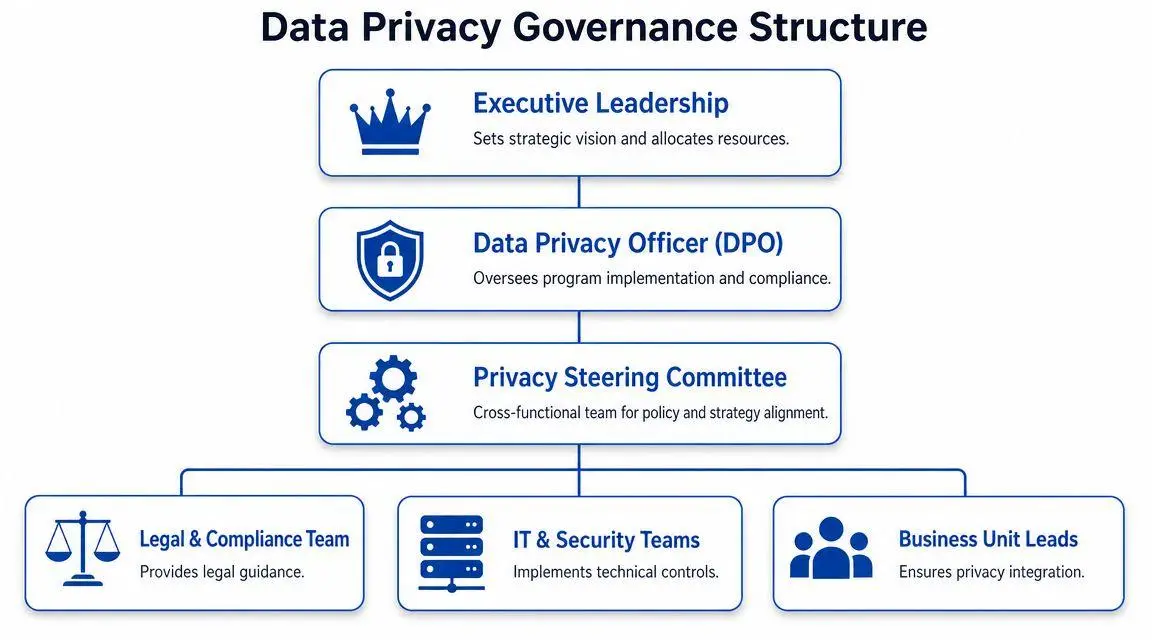
A serious privacy program needs a clear chain of accountability. I would structure it this way.
- Executive leadership owns risk appetite: The board or a designated board committee should receive regular privacy reporting. Management decides where the company accepts constrained risk, where it remediates, and where it exits a data practice entirely.
- The DPO or equivalent privacy lead runs the program: This person is not a symbolic appointment. They need authority, budget access, and direct escalation channels to legal leadership and senior management.
- A privacy steering committee makes cross-functional decisions: Legal, security, IT, HR, marketing, procurement, product, and data teams should all sit at the table. Privacy breaks when one of those groups operates outside the model.
- Business unit leaders remain accountable for execution: Central governance sets rules. Business units implement them in products, campaigns, employee processes, and vendor relationships.
What the General Counsel should insist on
Do not let privacy remain diffused across regional legal teams and system owners. Centralize the standard, then localize implementation where needed.
Your immediate governance actions should be concrete:
- Issue a formal privacy governance charter. Define decision rights, escalation paths, approval thresholds, and reporting cadence.
- Name one accountable executive owner. If nobody owns the program end to end, everybody will assume somebody else does.
- Create an enterprise privacy risk register. This must track known high-risk processing, pending remediations, vendor exposures, and open regulatory questions.
- Require board-level visibility. Privacy should appear in the same reporting ecosystem as cybersecurity, litigation, and enterprise risk.
Board rule: If privacy risk is material enough to create regulatory exposure, customer distrust, or executive embarrassment, it belongs in board reporting.
For executives who also manage personal exposure, family-office concerns, or public-facing reputation risk, the same governance logic applies outside the enterprise perimeter. The high-net-worth digital privacy framework is useful because it frames privacy as a coordinated control environment rather than a collection of isolated fixes.
What weak governance looks like
You can usually spot it in a week. The company has multiple privacy notices. Procurement uses inconsistent data processing clauses. Marketing tools are onboarded without privacy review. HR and security classify employee data differently. Product teams escalate questions only after launch pressure makes redesign expensive.
That isn’t a maturity problem. It’s a leadership problem.
Conducting a Foundational Risk and Data Inventory
You can’t govern data you haven’t identified. Most companies discover this too late, usually when they receive a regulator inquiry, a rights request, a breach report, or a board question they can’t answer cleanly.
The foundational exercise is not policy drafting. It’s building a live data inventory and a usable Record of Processing Activities. That inventory becomes the company’s source of truth for legal basis, processing purpose, retention logic, data-sharing pathways, and system ownership.
Start with a structured discovery process
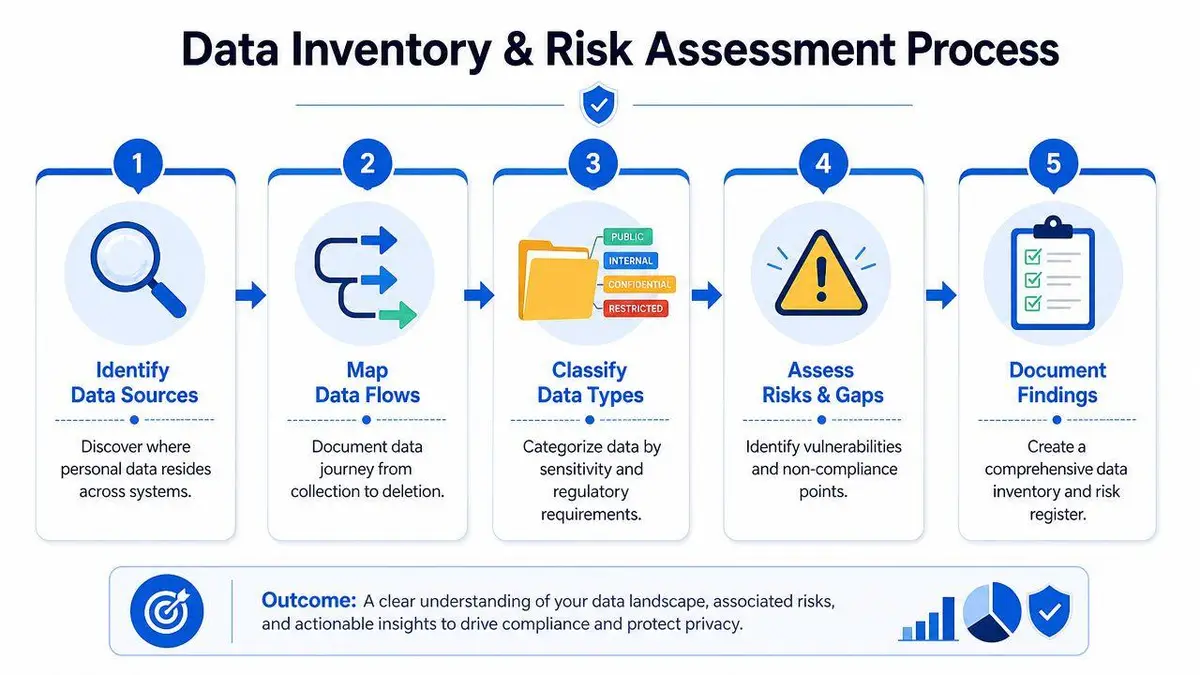
Run the inventory as a business process, not a survey. Questionnaires alone produce fiction. Teams answer aspirationally, omit shadow systems, and understate downstream sharing.
The discovery sequence should look like this:
- Identify systems and owners. Start with HR platforms, CRM, support tools, ERP systems, marketing automation, analytics tools, collaboration software, data warehouses, and vendor-managed environments.
- Trace data flows. Follow data from collection through storage, internal use, sharing, enrichment, retention, and deletion.
- Classify the data. Separate ordinary business contact data from employee records, customer communications, behavioral data, financial information, health-related fields, precise location data, and other higher-sensitivity categories where applicable.
- Map lawful use and purpose. For each processing activity, document why the company uses the data, who approved that use, and whether the use remains aligned with the original collection context.
- Record retention and access logic. If a team can’t explain who has access and when data is deleted, the process isn’t under control.
Where companies usually miss risk
The highest-value work often comes from uncovering what formal system diagrams ignore.
Common blind spots include:
- Shadow IT: Department-level tools purchased on expense cards or through decentralized procurement.
- Exports and duplicates: CSV downloads, local spreadsheets, ad hoc reporting extracts, and unmanaged backups.
- Vendor side processing: Data copied into support desks, implementation environments, analytics connectors, and subcontractor platforms.
- Legacy workflows: Historic campaigns, archived employee files, and retired applications still holding personal data.
A good inventory process should expose not just where data sits, but where it leaks operationally.
To sharpen that analysis, legal teams should understand how external actors may already aggregate and trade personal information outside the company’s direct environment. This guide to what data brokers are is helpful for framing that broader exposure.
Here’s a useful briefing to align internal stakeholders before the exercise gets buried in technical jargon:
Turn the inventory into a working control
Do not accept a static spreadsheet produced for audit season. That’s not a control. It’s a stale artifact.
Your RoPA or equivalent inventory should answer, at minimum, these questions:
| Control question | What the record should show |
|---|---|
| What data do we collect | Data category and system source |
| Why do we process it | Business purpose and legal basis |
| Where does it go | Internal recipients, vendors, transfers |
| Who can touch it | Access roles and responsible owner |
| How long do we keep it | Retention trigger and deletion rule |
| What is the current risk | Sensitivity, known gaps, mitigation status |
If your inventory cannot support rights responses, contract review, incident analysis, and board reporting, it isn’t detailed enough.
The General Counsel should treat this exercise as nondelegable oversight work. Legal doesn’t need to map every field personally, but legal must own the standard for what counts as complete, defensible, and usable.
Architecting a Unified Legal and Policy Framework
Once the inventory exists, policy architecture becomes practical. Before that, it’s guesswork.
A unified framework should be built from the strictest standards likely to matter across the enterprise, then adapted with local supplements where necessary. For most global companies, the operational baseline will look heavily influenced by GDPR-style requirements because they force discipline around lawful use, transparency, retention, access, and accountability.
According to Salesforce’s summary of data privacy compliance requirements, the control stack is built on seven core principles, and noncompliance can trigger fines up to 4% of annual global revenue or €20 million, whichever is higher. The same framework highlights operational requirements including breach notification within 72 hours and maintaining verifiable records such as DPIAs and RoPAs.
Build one master framework, not scattered documents
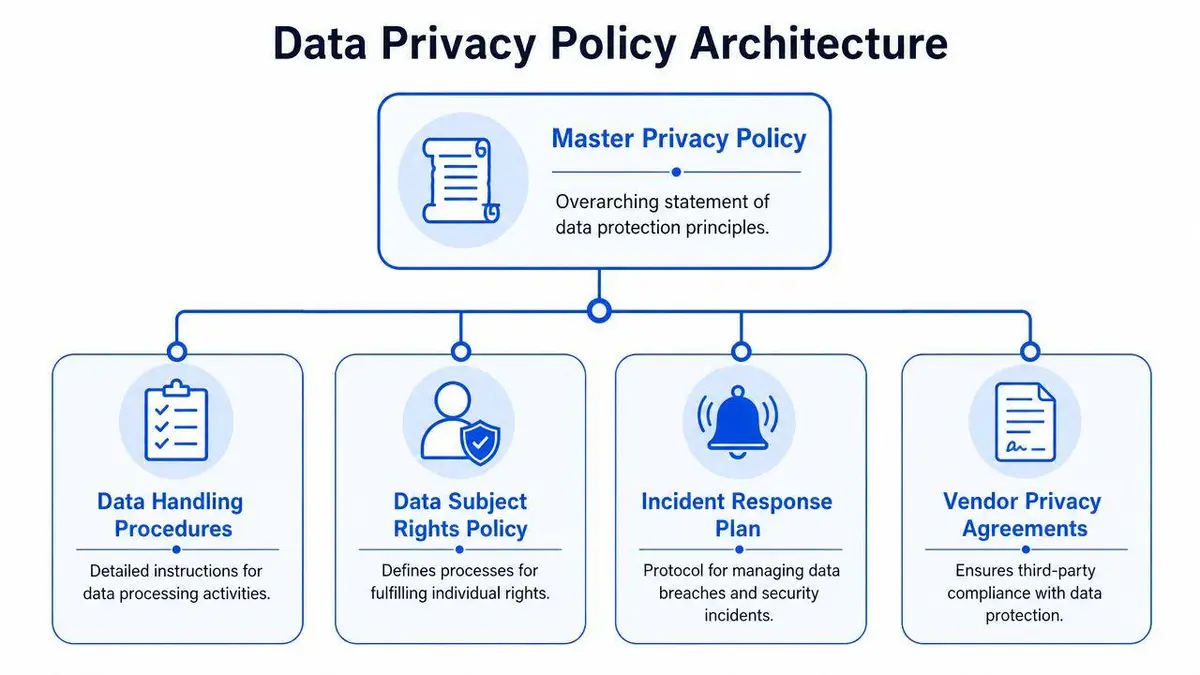
I advise clients to organize policy architecture in layers.
At the top sits a master privacy policy for internal governance. That document states the company’s processing rules, decision principles, role allocations, escalation standards, and documentation expectations. It is not a marketing notice. It is the operating constitution.
Beneath that, create subordinate instruments tied to real workflows:
- Data handling procedures for collection, use, sharing, retention, deletion, and access.
- Data subject rights procedures for intake, verification, review, fulfillment, and exception handling.
- Incident response rules aligned with legal, security, communications, and executive escalation.
- Vendor privacy terms that push requirements down the chain.
Translate principles into enforceable instructions
The seven core principles only matter if they become operating rules.
A workable conversion looks like this:
| Principle | Internal rule |
|---|---|
| Lawfulness, fairness, transparency | No processing activity launches without documented purpose, notice position, and approval path |
| Purpose limitation | Teams cannot reuse personal data for unrelated initiatives without legal review |
| Data minimization | Product and marketing teams must justify each data field collected |
| Accuracy | System owners need correction workflows and record maintenance rules |
| Storage limitation | Retention schedules must connect to deletion or defensible archival logic |
| Integrity and confidentiality | Access controls, encryption, and security controls must map to data sensitivity |
| Accountability | DPIAs, RoPAs, approvals, and exceptions must be documented and retrievable |
Write notices that match reality
Most privacy notices fail for a simple reason. They are drafted by lawyers using assumptions supplied by business teams that don’t reflect the systems.
Use the inventory first. Then draft customer, employee, applicant, and vendor-facing notices that mirror actual processing practices. If the company uses profiling, cross-system enrichment, behavioral targeting, or AI-supported decision workflows, the notice position must be consistent with what the systems do.
If you want a practical benchmark for how an external service publicly structures its disclosures, it can be useful to review data protection practices in live privacy policies, not to copy them, but to pressure-test clarity, scope, and operational alignment.
For organizations also dealing with search visibility, legacy indexed material, or erasure-related strategy, GDPR content removal guidance can help legal teams connect privacy rights analysis with reputational remediation.
A privacy notice is not a branding asset. It is an evidentiary document that will be compared against your systems, your contracts, and your incident record.
Operationalizing Controls Across Vendors and Systems
At this stage, most corporate privacy programs reveal whether they are real.
A peer-reviewed model that scored privacy policies found the mean score for SMEs was only 6.19 out of 100, and firms with policies still met an average of only 12.15 of 31 basic criteria. More than half collected personal data without any announced privacy policy, according to this peer-reviewed privacy policy assessment. The lesson isn’t that SMEs are careless. The lesson is that written commitments regularly outpace operational reality.
Large companies make the same mistake at a different scale. They publish polished privacy statements while vendors, analytics connectors, customer support tools, and archived repositories process data outside disciplined control.
Vendor management is a privacy function
Procurement often treats privacy review as a contract appendix. That’s insufficient. Every vendor that touches personal data extends your risk perimeter.
Your vendor process should separate three questions that companies too often blur together:
- Can the vendor secure the data?
- Can the vendor use the data only for permitted purposes?
- Can the company prove those limits in contract language, due diligence records, and ongoing oversight?
If you can’t answer yes to all three, the vendor is not ready.
The strongest approach is to tier vendors by data sensitivity and processing importance, then apply escalating controls. A low-risk software tool is not reviewed the same way as a customer support provider, marketing processor, identity platform, payroll partner, or AI-enabled analytics vendor.
DPIAs should block launches when needed
A Data Protection Impact Assessment is not paperwork to complete after a project is effectively approved. It is a gating mechanism. Use it when a project introduces heightened risk because of data sensitivity, automated decision-making, broad monitoring, novel data use, or material sharing with third parties.
A useful internal threshold test asks:
- Is the data set sensitive or difficult to remediate if mishandled?
- Is the proposed use materially different from the collection context?
- Will the system combine data sources in a way that changes the risk profile?
- Will a vendor or AI tool process the data in ways the company cannot independently verify?
If the answer to several of those questions is yes, pause and assess before deployment.
Technical controls need legal purpose behind them
Encryption, access control, pseudonymization, logging, and segregation matter. But legal teams often let technical controls stand in for privacy governance. That is a mistake. A well-encrypted misuse of personal data is still misuse.
The right operational model ties each system control to a business and legal rule. Role-based access should reflect need. Retention logic should reflect documented purpose. Logging should support incident reconstruction and rights handling. Vendor restrictions should mirror the uses the company has authorized.
This is also the section where one practical tool category matters for high-risk incidents involving personal data exposure in search or public platforms. Firms such as ContentRemoval.com handle content removal and monitoring workflows relevant when personal information, leaked files, impersonation material, or doxxing content escapes into public view. That doesn’t replace compliance controls. It supports incident containment when those controls fail.
Activating a Resilient Program Through Training and Response
A privacy program is tested by human behavior long before it is tested by a regulator.
The weak version of training is familiar. Employees click through an annual module, answer obvious questions, and forget it by the next week. Then a recruiter exports applicant files to a personal drive, a marketer syncs data to a new platform without approval, or a support team member discloses account information to the wrong person under deadline pressure.
That isn’t an edge case. It’s how privacy incidents start.
Train by role, not by slogan
Your workforce does not need generalized privacy inspiration. It needs role-specific judgment.
A useful training design looks more like scenario rehearsal than policy recital:
- Marketing teams should be trained on consent handling, data reuse limits, audience suppression, and tool onboarding discipline.
- HR teams should be trained on employee confidentiality, access restrictions, applicant data handling, and response escalation.
- Customer support teams should practice identity verification, account disclosure boundaries, and secure case handling.
- Product and engineering teams should understand privacy review triggers, data minimization choices, and release blocking rules.
Train employees on the decisions they actually make, not the policy language lawyers prefer.
Managers matter even more than front-line staff. Most privacy drift becomes normalized because managers prioritize speed, convenience, or quarterly targets over governance. If supervisors don’t model escalation discipline, no annual training module will fix it.
Rehearse the incident before it happens
The companies that respond well to privacy incidents rarely improvise well. They rehearse well.
Run tabletop exercises that involve legal, security, communications, HR, product, and executive leadership. Use realistic scenarios. A vendor breach exposing employee records. A public leak of executive travel or family data. Misconfigured analytics capturing sensitive fields. An AI workflow ingesting data beyond approved scope. A search result indexing internal material that should never have been public.
Each exercise should force decisions on four fronts:
| Incident question | Decision owner |
|---|---|
| What happened and what data is involved | Security and system owner |
| Does the event trigger legal obligations | Legal and privacy lead |
| Who needs to be notified internally and externally | Legal, communications, executive leadership |
| What immediate containment steps are authorized | Security, IT, business owner |
The point isn’t dramatic simulation. It’s decision speed and role clarity.
Build a culture that escalates early
The strongest signal of program health is whether employees escalate uncertain issues before harm occurs. You want staff to surface bad facts quickly, not sanitize them.
That requires a response culture with two traits. First, people must know where to report concerns. Second, they must believe escalation won’t be punished if they raise an issue in good faith.
If your program only hears about privacy problems after a complaint, breach, or public post, the culture is still defensive. That is not resilience. That is delay.
Sustaining Compliance Through Continuous Monitoring and Audits
Privacy programs decay unless someone measures them. New vendors are added. AI features are deployed. Data pipelines change. Old retention rules become ineffective. Regional requirements shift while business teams keep shipping.
That’s why mature data privacy compliance now depends on continuous monitoring rather than periodic document refreshes. Recent guidance emphasizes embedding consent into data streams and using automated monitoring, shifting the focus from static policies to continuous, machine-enforced controls for AI-driven use and real-time processing, as described in this discussion of privacy controls for modern data pipelines.
Build a feedback loop, not an audit ritual
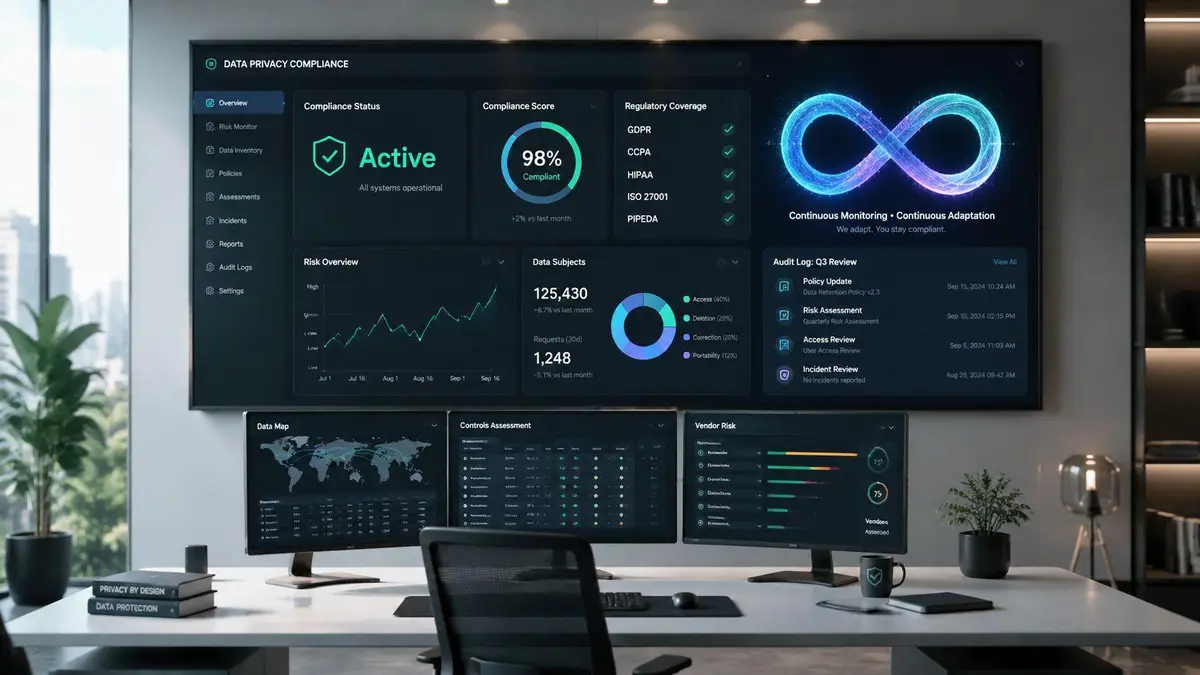
An audit should not be a ceremonial review of documents prepared for legal. It should test whether the operating model still matches reality.
I recommend a repeating cycle:
- Monitor: Track processing changes, vendor onboarding, consent enforcement, retention exceptions, and unresolved incident findings.
- Test: Sample high-risk workflows, access rights, deletion execution, rights request handling, and system-to-notice alignment.
- Report: Give the steering committee and board a plain-language view of open risk, remediation status, and control failures.
- Adapt: Update rules when products, laws, vendors, or AI use cases materially change the risk profile.
Pay special attention to AI and live data flows
AI complicates privacy because it shortens the gap between collection and downstream use. Data moves faster, transforms faster, and becomes harder to trace if governance is weak.
Your monitoring program should focus on practical questions. Are consent states flowing with the data? Are sensitive fields filtered before transmission? Are automated uses documented, reviewable, and limited to approved purposes? Does retention logic still work when data is copied into model development, analytics, or downstream service layers?
The old audit model asked whether a policy existed. The current model asks whether controls are being enforced continuously inside the data flow itself.
For a General Counsel, this is the final test of program credibility. You do not need perfect symmetry across every jurisdiction. You do need a program that detects drift, documents exceptions, and corrects failures before they become enforcement problems or public crises.
When a privacy failure becomes public, legal exposure quickly turns into reputational damage. ContentRemoval.com works with executives, brands, and legal teams on discreet content removal, personal data exposure response, and ongoing monitoring when leaked files, impersonation, search indexing, or doxxing incidents create immediate risk. If your privacy program now includes incident containment as well as compliance governance, that capability belongs in your response planning.
Frequently asked questions
Who should own data privacy compliance in a large company?
The article recommends one accountable executive owner supported by a DPO or privacy lead with real authority and budget, a cross-functional steering committee covering legal, security, IT, HR, marketing, procurement and product, and business unit leaders responsible for execution. Privacy risk should reach the board alongside cybersecurity and litigation.
What is a data inventory and why does it matter for privacy compliance?
It is a live record of every system holding personal data, the purpose and legal basis, where data flows, who can access it, retention rules and current risk. Built through structured discovery rather than questionnaires, it becomes the source of truth for rights requests, contract review, incident analysis and board reporting.
How do you keep a privacy program compliant over time?
Through a repeating cycle of monitoring processing changes and vendor onboarding, testing high-risk workflows and deletion execution, reporting open risk in plain language to the board, and adapting rules when products, laws or AI use change. Static annual document refreshes are not enough.