
A cyber background search is a layered review of a person’s digital history: identity and alias mapping, public records and aggregator data, professional history verification, social and forum activity, breach and credential exposure, then a human risk assessment. For executives, run it on yourself first, read it as an adversary would, and remove or contain what is exploitable.
Key facts
- Reviewers look for what is exploitable, not what is embarrassing: exposed contacts, reused credentials, impersonation vectors.
- Instant commercial reports aggregate stale records and identity collisions; treat them as an alert, not a verdict.
- Triage by source credibility, recency, severity over embarrassment, pattern over one-offs, and actionability.
- Escalation ladder: direct remediation, formal platform reporting, legal intervention, specialist investigation and removal.
Where ContentRemoval.com comes in. ContentRemoval.com runs the search on the client’s behalf before counsel or a counterparty does, then removes, de-indexes or contains what would need a live explanation in front of a board. General counsel preparing an appointment, a chief of staff or the executive’s family office usually makes the approach. A free 15-minute Exposure Scan maps what a motivated outsider can find and what is removable, and the report is yours to keep. Get a Free, Confidential Exposure Scan or read how our content removal work is done.
The email usually arrives at the worst moment. You’re preparing for a board interview, a financing event, a regulatory review, or a major acquisition, and counsel asks for a “routine” cyber background search. Routine for them. Potentially career-altering for you.
What they’re really asking is simpler and more dangerous. What appears when someone with money, influence, or suspicion starts pulling on your digital history? Not just your public profiles, but old forum activity, exposed credentials, aggregator records, litigation references, cached pages, and the kind of context-free fragments that look worse when compressed into a diligence memo.
If you’re the subject of that search, passivity is a mistake. Someone else will assemble your digital profile whether you participate or not. Your job is to know what they’ll find before they do, decide what matters, and remove or neutralize what shouldn’t be there.
Understanding Your Digital Liability
A chief executive nearing a public board appointment often assumes scrutiny will primarily focus on compensation, conflicts, and governance. Then a diligence team surfaces an old alias tied to a forum account, a breach listing connected to a personal email, and a people-search profile with current family address data. None of it proves misconduct. All of it raises questions.
That is how a cyber background search works in practice. It doesn’t need to reveal criminality to create damage. It only needs to introduce uncertainty.
When scrutiny starts moving faster than your response
Private equity firms, lenders, litigators, journalists, activist investors, and counterparties all look for different things, but the objective is the same. They want to know whether your digital footprint creates operational risk, reputational instability, or a point of vulnerability. A merger can trigger that review. So can a C-suite hire, a family office transaction, a speaking role, a donor controversy, or a dispute that turns public.
For executives, the worst part is usually the asymmetry. You don’t know what dataset they’re using, what timeline they’re working from, or which result they’ll treat as credible. They may be looking at records that are outdated, wrongly matched, or stripped of context. They may also be looking at information that’s accurate enough to become a serious problem.
A single bad result can have measurable commercial consequences. A single negative search result can lead to a 22% reduction in business opportunities for high-net-worth individuals, according to ContentRemoval.com’s pricing guide for 2026.
Practical rule: If a result would require a live explanation in front of a board, investor, or journalist, treat it as a liability now, not later.
What sophisticated reviewers are actually trying to find
They aren’t just checking whether you look polished on LinkedIn. They’re mapping where you’re vulnerable. That includes exposed contact data, signs of poor account hygiene, inflammatory posts, niche community participation, compromised credentials, negative media associations, and records that make impersonation or harassment easier.
Here’s the mistake many high-profile people make. They focus on what’s embarrassing. Reviewers focus on what’s exploitable.
A useful mental model comes from product security. Founders who aren’t very technical still benefit from understanding attack surfaces, because exposure usually starts where nobody bothered to inventory it. The same logic applies to reputation risk, and this security guide for non-technical founders is useful for that reason. It shows how small overlooked weaknesses become strategic problems once someone tests them.
You need your own version of due diligence
If your name carries commercial value, your digital past is part of the asset. It can also become part of the negotiation against you. That’s why waiting for an external party to define your risk profile is reckless.
Run the search on yourself first. Interpret it as an adversary would. Then decide what gets corrected, what gets removed, and what requires a prepared explanation. That is how you regain control.
The Anatomy of a Comprehensive Digital Vetting
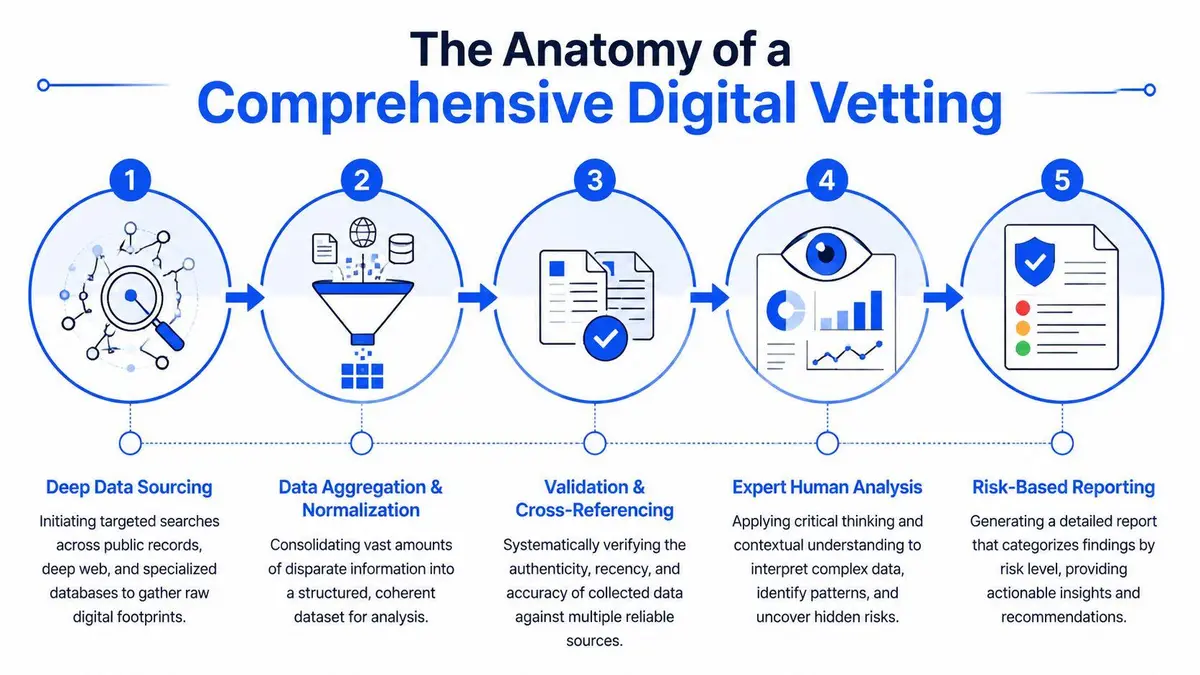
A real cyber background search isn’t a vanity search and it isn’t a one-page dashboard. It’s a layered inquiry that combines public data collection, identity validation, contextual review, and risk scoring. If the process is weak at the start, every conclusion after that is unreliable.
Start with identity, alias, and footprint mapping
Professionals begin by identifying all the ways you appear online. That means legal names, common misspellings, former names, usernames, email handles, profile images, employer references, domain registrations, and associated accounts. If that foundation is wrong, the search will contaminate itself with false matches.
This is why identity verification isn’t an administrative detail. It’s the control that separates your records from someone else’s debris. If you want a plain-language overview, this explanation of why identity verification is crucial is useful because it frames verification as a trust and fraud issue, not a paperwork exercise.
A systematic methodology then moves through a clear sequence. It begins with gathering digital footprints, including public social media profiles and forum posts, transitions to analyzing professional history, and concludes with a formal risk assessment where data is evaluated for red flags. That process matters because 92% of recruiters now use social media to screen candidates, as noted by CyberLynx.
Then move from raw data to verified data
Most raw findings are not yet facts. They’re leads. A specialist has to determine whether a forum comment belongs to you, whether a breach listing reflects current risk, whether a negative article is syndicated across dozens of low-quality sites, and whether an image has been reused under a false identity.
That requires cross-referencing across multiple classes of material:
- Public records and data aggregators reveal addresses, associates, business entities, and long-tail references that often survive long after they should’ve disappeared.
- Professional history checks compare stated roles and dates against public biographies, archived staff pages, conference listings, and social profiles.
- Social and community analysis reviews not just what you posted, but where you participated and what those associations imply.
- Breach and credential review checks whether your email addresses, usernames, or reused profile data appear in exposed datasets that raise security concerns.
- Narrative consolidation turns a pile of disconnected references into a report that someone in legal, investment, or media can act on.
A serious review also requires disciplined exclusion. If a result can’t be validated, it shouldn’t be accepted. Weak vetting creates fake liabilities as often as it finds real ones.
Good digital vetting doesn’t ask, “What can we find?” It asks, “What can we defend in front of decision-makers?”
Human judgment is where the risk assessment happens
Automated tools are decent at collection and terrible at meaning. They can find an old Reddit handle. They can’t tell whether it belongs to the same person, whether the activity is professionally relevant, or whether the apparent issue is stale, malicious, or trivial.
That last step matters most when the subject is an executive or public figure. A specialist needs to understand what a lender cares about, what a board cares about, what opposing counsel cares about, and what a journalist will pull into a headline. The same fact pattern can be negligible in one context and fatal in another.
If you’re preparing for a leadership transition or high-stakes appointment, this due diligence checklist for a new executive’s online reputation is a sensible companion because it helps translate search findings into operational preparation rather than panic.
Commercial Search Tools and Their Critical Limits
Most commercial cyber background search tools sell speed, certainty, and convenience. What they deliver is a mixed file of scraped public data, stale associations, and unsupported inferences. For a consumer, that’s sloppy. For an executive under scrutiny, it’s dangerous.

Why instant reports distort reality
These platforms often rely on aggregation. They ingest public records, social fragments, old addresses, and third-party datasets, then flatten them into a profile. That profile may look complete because it contains a lot of fields. Volume is not accuracy.
The core weaknesses are predictable:
| Problem | Why it matters |
|---|---|
| Outdated records | Old addresses, former associates, and stale employment data create false narratives |
| Identity collisions | Common names and reused usernames produce damaging mismatches |
| No context | A post, image, or account may be technically connected and still strategically irrelevant |
| Surface-level coverage | Public scraping misses less visible risk and often overstates visible noise |
Most clients who come to us after using a DIY report have the same complaint. The report gave them more anxiety, not more clarity. That’s because automation can collect accusations, but it can’t weigh them.
The dual-use problem nobody should ignore
There’s another issue, and it’s more serious. These tools aren’t used only by employers, compliance teams, or investigators. Publicly accessible search tools can also function as reconnaissance assets for bad actors.
If a tool can assemble your address history, relatives, emails, and profile fragments in minutes, it can help a recruiter screen you. It can also help someone impersonate, pressure, or target you.
Use them as an alert, not a verdict
Commercial tools are useful for one thing. They show what a motivated outsider can access quickly. That alone makes them worth checking. But treating their output as definitive is a strategic error.
The right response is to validate the report, remove what shouldn’t be public, and monitor what keeps resurfacing. If you need a framework for ongoing oversight rather than one-off panic searches, reputation monitoring is the discipline to understand. Monitoring tells you when the exposure changes, not just what was visible on one bad afternoon.
Interpreting Findings with a Risk-Based Approach
When reviewing a cyber background search, there’s a tendency to read it emotionally. Individuals fixate on the most embarrassing result, the most personal exposure, or the most unfair accusation. That’s understandable and often wrong. The proper question is narrower. Which findings can genuinely be used to your disadvantage?
Not every bad result is a serious result
A decade-old social post may be unpleasant and still immaterial. A fresh breach listing tied to an executive email is less dramatic and often more dangerous. So is a searchable people-profile exposing your current home address, relatives, and phone numbers. Relevance depends on role, visibility, and threat model.
That’s why a risk-based approach is the only adult way to review findings. For high-risk roles such as network administrators, screening must be more extensive, including criminal history, credit reviews, and qualification verification, while lower-risk roles warrant a narrower inquiry. According to Accurate, that tailoring helps minimize false positives while keeping focus on relevant threats.
Executives should use the same logic on themselves. The question isn’t whether something looks bad in isolation. The question is whether it creates business, security, legal, or coercion risk in your specific position.
A simple triage model that works
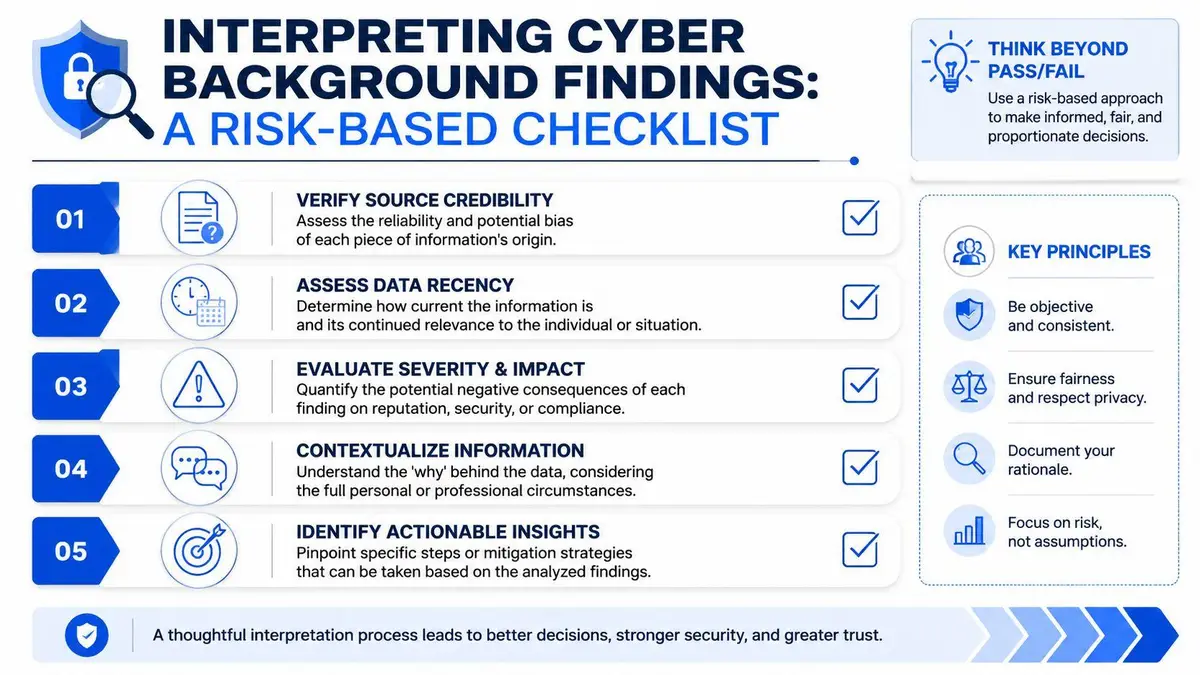
Use this framework when reading any cyber background search:
- Source credibility first. A court record, a verified publication, and a forum rumor don’t carry the same weight.
- Recency changes priority. Current exposure usually matters more than stale noise, unless old material is newly resurfacing.
- Severity beats embarrassment. Exposed credentials, address data, impersonation risk, or extortion material deserve attention before awkward commentary.
- Pattern matters more than one-offs. A single impulsive post is different from repeated conduct that signals judgment problems.
- Actionability decides sequence. Tackle what can be corrected, removed, or contained fastest.
Context decides whether a finding survives scrutiny
One of the most common review errors is treating all associations as equal. A fleeting mention in a controversial thread is different from sustained participation. An old article naming you in a dispute may matter less than a current search result that wrongly implies you were accused personally. A breach record tied to a dormant personal account may be manageable. The same issue tied to an executive identity used for banking, travel, or investor communication is not.
Decision test: If a hostile journalist, investor, regulator, or litigant used this result against you tomorrow, how hard would it be to explain in one paragraph with supporting evidence?
If the answer is “very hard,” you have a priority item. If the answer is “easy once context is supplied,” you may have a communications problem rather than a removal problem.
Executing Remediation and Escalation Strategies
Finding the exposure is the easy part. Removing it, suppressing it, or containing it is where most self-directed efforts fail. Executives often assume a few takedown emails and privacy setting changes will solve the issue. They won’t.
Start with controlled immediate action
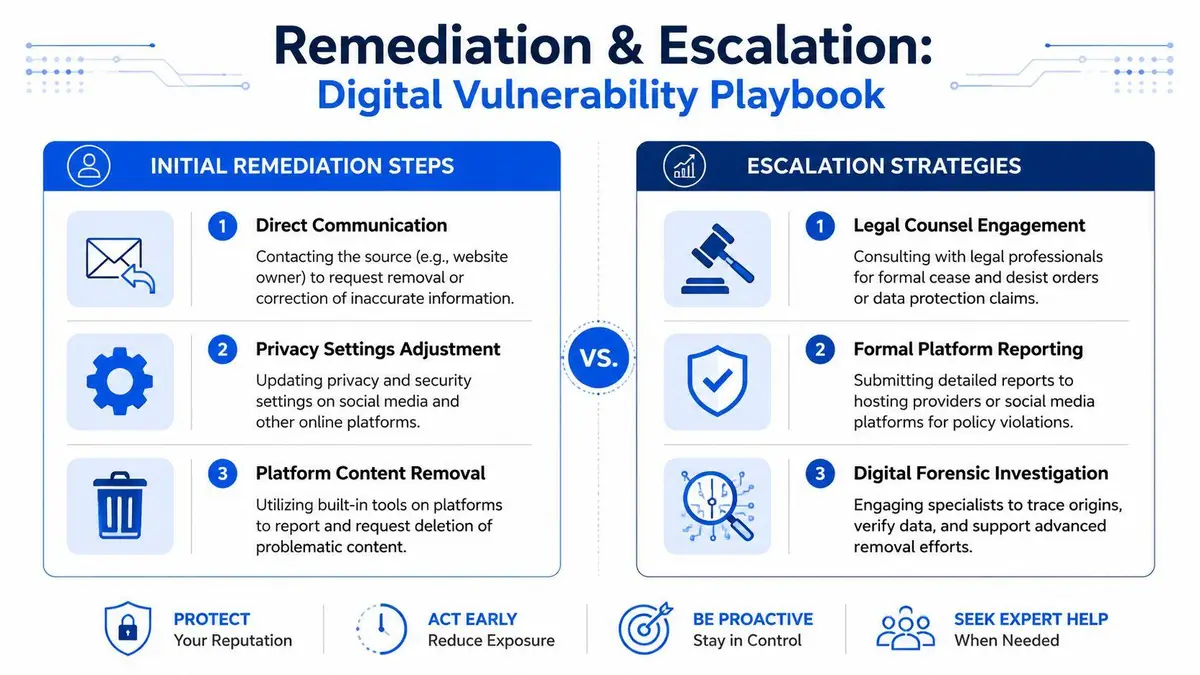
You should act quickly on issues that are straightforward and reversible. Correct platform privacy settings. Remove unnecessary personal details from bios and old profiles. Report impersonation. Request correction of obvious inaccuracies. If a data broker or aggregator offers an opt-out path, use it.
For some platforms, privacy law can help. Certain services permit removal requests that require identity verification and direct submission. That’s useful, but it’s only the start. Removal from one source does not guarantee de-indexing in search engines, and it does nothing to stop mirrors, syndication, reposting, or fresh aggregation.
A disciplined first pass usually includes:
- Account hygiene work that closes obvious exposure, including profile cleanup and old account review.
- Platform-specific takedowns for impersonation, copied media, and policy-violating material.
- Broker opt-outs and correction demands where the issue is personal data availability rather than defamatory content.
- Evidence preservation before any request is sent, especially if legal escalation may follow.
Why ad hoc requests break down
The central problem is fragmentation. Harmful material rarely exists in one place. It appears in search results, archives, copycat posts, thumbnails, aggregators, and scraped indexes. You remove one instance and discover six derivatives.
That is why effective removal of personal information from the internet requires a deliberate, systematic process rather than sporadic takedown requests, because piecemeal efforts fail to stop reuploads or achieve complete de-indexing, as explained by ContentRemoval.com’s analysis of internet information removal.
A scattered response also creates evidentiary and strategic problems. If you contact the wrong publisher too early, you may alert them, harden their position, or trigger wider distribution. If you pursue legal threats where platform policy enforcement would’ve worked faster, you waste time. If you rely on platform reporting when the issue is defamation, NCII, extortion, or a coordinated attack, you may lose critical days.
The objective isn’t to send more requests. It’s to run a coordinated campaign that removes the source, limits indexing, and prevents recurrence.
Know when to escalate
Some issues justify immediate escalation. Leaked intimate material, fabricated allegations, doxxing, breach-driven exposure, blackmail threats, and hostile publications with no practical correction path shouldn’t be handled casually. They require legal assessment, forensic review, or specialist removal work, often at the same time.
A useful escalation ladder looks like this:
- Direct remediation for simple inaccuracies, opt-outs, and profile cleanup.
- Formal platform and host reporting when policy violations are clear and documented.
- Legal intervention when the content is defamatory, invasive, coercive, or jurisdictionally sensitive.
- Specialist digital investigation and removal when the content spreads across multiple domains, search engines, and repost channels.
That sequence keeps costs and friction under control. It also prevents the common executive error of treating every problem as a public relations issue when removal is the actual solution.
When to Engage Professional Reputation Counsel
There’s a point where DIY stops being prudent and starts being negligent. If the issue affects a transaction, appointment, family security, active litigation, or sustained media scrutiny, you’re already there.
The option of professional removal and remediation is often still underestimated. As of 2026, only 6% of U.S. adults have used data removal services, with fewer than half aware such services exist, according to ContentRemoval.com’s reporting on data removal adoption. That gap doesn’t mean the risk is minor. It means many people don’t know what competent intervention looks like until they need it urgently.
The threshold is lower than most executives think
You should engage specialist counsel when any of the following is true:
- The content is spreading across platforms or search results, not sitting on a single page.
- The publisher is uncooperative or anonymous, making direct resolution unrealistic.
- The issue crosses jurisdictions, which changes both legal remedies and response speed.
- The material acts as a tool for influence, including extortion, harassment, stalking, or pressure during a commercial event.
- You need discretion, because amateur outreach can make a private problem more visible.
Professional reputation counsel doesn’t replace your lawyers or your communications team. It fills the operational gap between them. Lawyers protect rights. Communications advisers shape narrative. Specialists remove, suppress, trace, and contain.
For high-stakes matters, that combination is the difference between hoping the issue settles down and controlling it. If you’re facing persistent harmful content, review the options for removing online content before the next diligence request lands in someone else’s inbox.
If a cyber background search could affect your role, transaction, or personal safety, treat it like a live risk issue, not a branding exercise. ContentRemoval.com works confidentially with executives, public figures, family offices, and legal teams to identify damaging online exposure, remove harmful content, and build a clear remediation plan before scrutiny turns into loss.
Frequently asked questions
What shows up in a cyber background search on an executive?
Old forum aliases, exposed credentials tied to personal email, people-search profiles with current addresses and relatives, litigation references, cached pages, archived bios and social activity. None of it needs to prove misconduct to create damage; it only needs to introduce uncertainty.
Are online background check tools accurate?
They are fast, not accurate. They flatten scraped public records, stale addresses and third-party datasets into a profile that looks complete because it has many fields. Identity collisions and missing context are common, and the same tools serve as reconnaissance for bad actors.
When should I get professional help with a background search result?
When the content is spreading across platforms or search, the publisher is uncooperative or anonymous, the issue crosses jurisdictions, the material is being used for pressure or extortion, or discretion matters because amateur outreach would make a private problem visible.