
Crisis management best practices for digital incidents run three tracks at once: containment of the source through takedowns and de-indexing, disciplined communications with a holding position and regular updates, and evidence-based legal escalation. The first hour is triage by a small authorized cell that freezes outbound messaging, preserves evidence and classifies the incident, followed by monitoring for re-emergence.
Key facts
- One incident often holds several threats: impersonation, unauthorized disclosure, narrative attack and operational spillover, each with different routes.
- First-hour assessment asks only what exists, where it is hosted, what is false or stolen, and who has seen it.
- Refresh public status updates every 4 to 6 hours during fast-moving events when information is limited.
- Re-emergence changes format: a fake account becomes a fan account, a leaked file becomes cropped images.
Where ContentRemoval.com comes in. When the crisis lives online, ContentRemoval.com takes the containment track: platform impersonation reports, privacy complaints, host escalation and de-indexing, with monitoring for the second wave that follows the first takedown. The chief of staff, general counsel or the family office usually makes contact while the incident is still live. A free 15-minute Exposure Scan maps what exists and what can be removed now, and the report is yours to keep. Get a Free, Confidential Exposure Scan or read how our content removal work is done.
You wake up to a message from your chief of staff before sunrise. A fake screenshot is circulating. A burner account is tagging journalists. An internal document, real or altered, has appeared on a forum that feeds social platforms by mid-morning. Staff are texting one another, outside counsel wants facts, and someone on your team has already drafted a statement that says more than you can prove.
That’s a modern reputational crisis. It doesn’t arrive as a neat press issue. It arrives as a mixed attack surface: search results, social posts, cloned accounts, leaked files, manipulated media, and a widening gap between what happened and what the internet now believes happened.
Most organizations still respond as if the job is media management. It isn’t. Crisis management best practices for high-stakes digital incidents require three tracks running at once: containment of the source, disciplined communications, and evidence-based escalation through legal and technical channels. If you miss any one of those tracks, the crisis continues to mutate while your team debates language.
The good news is that this is manageable. Even ugly situations become controllable when someone imposes structure quickly, preserves decision rights, and treats online spread as an operational problem rather than a reputational abstraction.
The Anatomy of a Modern Digital Crisis
A modern digital crisis usually starts with ambiguity, not certainty. An executive sees a hostile post. Then a second version appears on another platform. A reporter asks for comment on a claim your team hasn’t verified. Search autocomplete begins to shift. Someone notices an impersonation account. By the time the leadership team joins a call, five different problems are already being treated as one.
That’s the first mistake.
One incident often contains several different threats
A manipulated clip is not the same as a data leak. A false allegation is not the same as an employee conduct issue. A fake account is not the same as a defamatory article indexed in search. Each has different removal routes, evidence requirements, and legal posture. If you lump them together, your response slows down.
In practice, digital crises usually break into a few categories:
- Impersonation and synthetic media: fake accounts, voice clones, deepfakes, altered screenshots
- Unauthorized disclosure: leaked emails, contracts, private images, internal documents
- Narrative attacks: false accusations, coordinated review abuse, hostile forum threads, smear content
- Operational spillover: a real internal problem that becomes a public search and social problem
The danger is fragmentation
Most damage in the opening phase comes from fragmentation inside the client team. Legal wants precision. Communications wants speed. Security wants time. Leadership wants certainty. The internet gives you none of that.
The public rarely distinguishes between an unresolved fact pattern and organizational confusion. They read silence, contradiction, and delay as the same thing.
The correct posture is calmer than typically assumed. You don’t need a perfect theory in the first hour. You need command, evidence preservation, a controlled chain of communication, and a clear distinction between what’s confirmed, what’s likely, and what remains unknown.
For reputation-sensitive clients, the situation is even narrower. If your name, family office, company, or portfolio is tied to public trust, the crisis isn’t confined to one platform. It moves through search, screenshots, private group chats, and media inquiry at the same time. That’s why digital crisis management has to combine communications with takedowns, de-indexing, account enforcement, and legal containment from the outset.
The First Hour Triage and Containment
The first hour determines whether you’re managing an event or feeding one. Teams that improvise in this window usually create the second wave themselves.
Start by forcing the situation into a command structure.
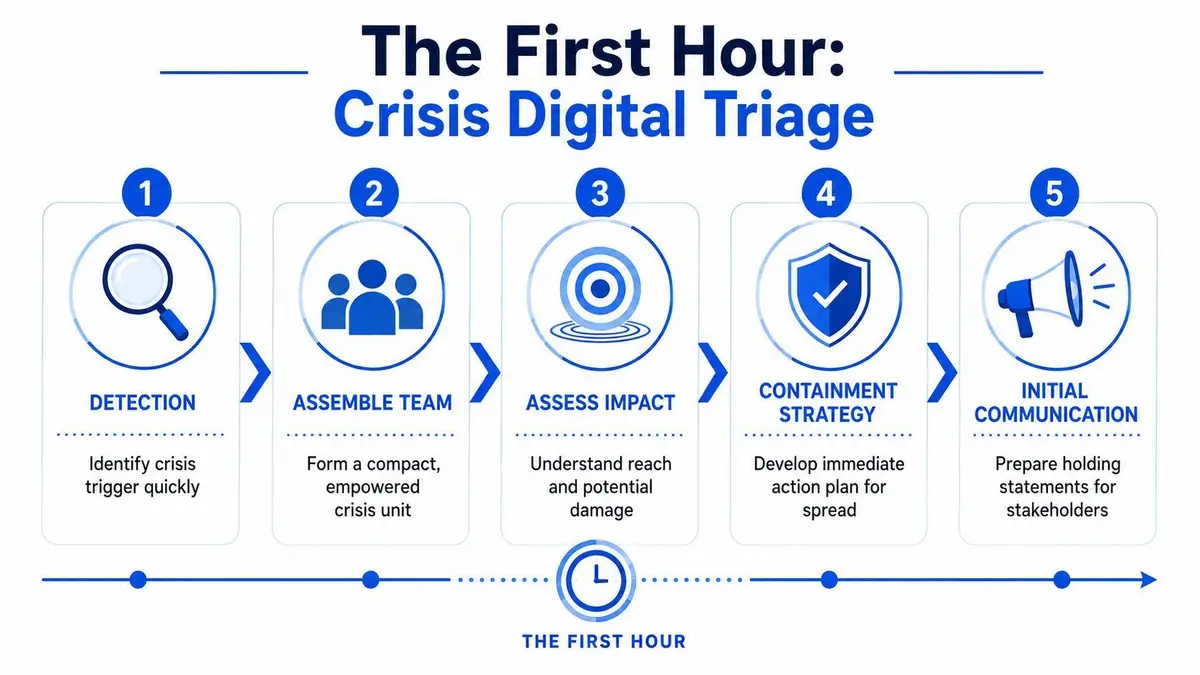
Build a compact decision unit
You do not need a large committee. You need a small, authorized response cell with named decision rights. Good crisis programs use a formal escalation framework with predefined activation triggers and role-specific decision rights so teams can move from detection to containment without waiting for ad hoc approvals, as outlined in this crisis management plan guidance.
At minimum, that response cell should include one decision-maker from leadership, one legal lead, one communications lead, one technical or security lead if systems or data are involved, and one operator responsible for evidence capture and task tracking.
Issue a stand-down instruction immediately. No employee should post, reply, speculate, reassure outsiders, or “correct the record” from a personal account. One undisciplined message can turn a containable issue into a discoverable record.
Separate facts from noise
Your first-hour assessment should answer four questions only:
- What exactly exists online right now
- Where is it hosted or posted
- What appears false, stolen, manipulated, or unauthorized
- Which audiences have already seen it
This is not the moment for broad narrative analysis. It’s triage. Capture URLs, screenshots, timestamps, account handles, search results, and any evidence of account impersonation or coordinated spread. Preserve before you report. Content often changes once the attacker realizes you’ve seen it.
A practical sequence helps:
- Freeze outbound messaging: stop unapproved internal and external responses
- Secure channels: move the core team to a controlled communications channel
- Preserve evidence: log every asset before platforms alter or remove it
- Classify the incident: separate impersonation, leak, defamation, and security elements
- Assign parallel workstreams: legal, technical, communications, and stakeholder management
If the crisis is affecting staff emotionally, practical support matters too. A team under stress makes poor decisions. For immediate human support resources during an overwhelming event, this Text Lauren guidance for overwhelming situations can be useful to have on hand.
Later in the same hour, leaders should review how public employee conduct can amplify a reputational event. This strategic guide on what to do when an employee’s online behaviour goes viral is relevant when the crisis involves internal personnel or executive-adjacent accounts.
Prepare a holding position, not a full defense
A rushed definitive statement is one of the most expensive errors in crisis response. If facts are incomplete, say so with discipline. Confirm awareness. Confirm active review. Confirm the channel for further updates. Don’t speculate about motive, scope, or authenticity before verification.
Clients often hurt themselves. They think speed means a complete explanation. It doesn’t. Speed means early control of process.
The video below is a useful reminder that crisis response needs command, not panic.
> **Practical rule:** In the first hour, your job is to reduce uncertainty inside the organization before you try to reduce uncertainty outside it.Executing Legal Takedowns and De-Indexing
Public relations can shape interpretation. It usually can’t remove the thing causing the crisis. If harmful content remains online, indexed, mirrored, and reposted, then your message is competing with a live contaminant.
That’s why source removal matters.
Remove at the source whenever possible
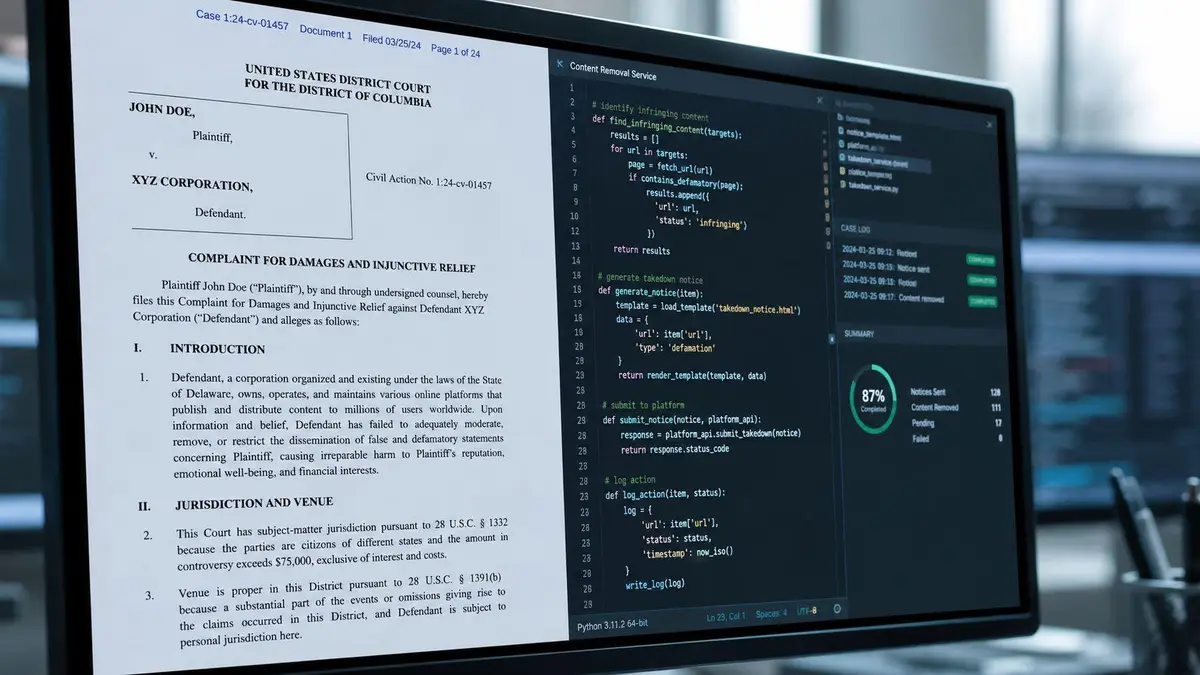
The strongest outcome is direct removal from the platform, publisher, host, or administrator controlling the content. That may involve impersonation complaints, privacy complaints, harassment reporting, copyright assertions where they legitimately apply, or direct legal notice tied to a platform’s own terms.
This work is highly technical in practice. Teams need to identify who controls the page, where the material is hosted, whether the account is violating impersonation or authenticity rules, and which argument fits the platform’s enforcement structure. A vague complaint gets ignored. A precise complaint tied to a clear violation gets reviewed.
Here’s the decision logic:
| Situation | Stronger first move | Why |
|---|---|---|
| Fake account or identity misuse | Platform impersonation report | Fastest route if identity abuse is clear |
| Leaked private material | Privacy complaint and host escalation | Targets unauthorized exposure |
| False search result from third-party page | Publisher challenge plus search strategy | You often need source and search action together |
| Coordinated reposting | Batch enforcement and monitoring | Single removals won’t hold |
De-indexing is not cosmetic
When source removal isn’t immediate, search strategy becomes critical. De-indexing limits discoverability and can break the path between a harmful page and broad public attention, especially when journalists, investors, clients, or counterparties are searching your name in real time. That doesn’t erase the underlying page, but it can materially reduce its visibility while broader action proceeds.
If you need a grounded explanation of how that process works, this strategic guide to search result removal through de-indexing covers the distinction between source removal and search suppression.
This is also the point where specialist providers can be useful. Some firms handle cross-platform takedowns, de-indexing requests, impersonation removals, and related monitoring. ContentRemoval.com is one example in that category.
Don’t confuse legal posture with legal victory
Clients often ask whether they need to “win” a defamation case before acting. Usually, no. The immediate objective in a digital crisis is containment, not courtroom closure. Court orders may become necessary in some matters, especially where platforms refuse action or search de-indexing requires stronger process, but many effective interventions happen before final litigation outcomes.
If harmful content remains searchable, shareable, and screen-capturable, then the crisis is still active no matter how polished your public statement sounds.
The right question isn’t “Can we sue?” The right question is “Which removal route is fastest, strongest, and most durable in this jurisdiction and on this platform?”
Coordinating Stakeholder and Public Communications
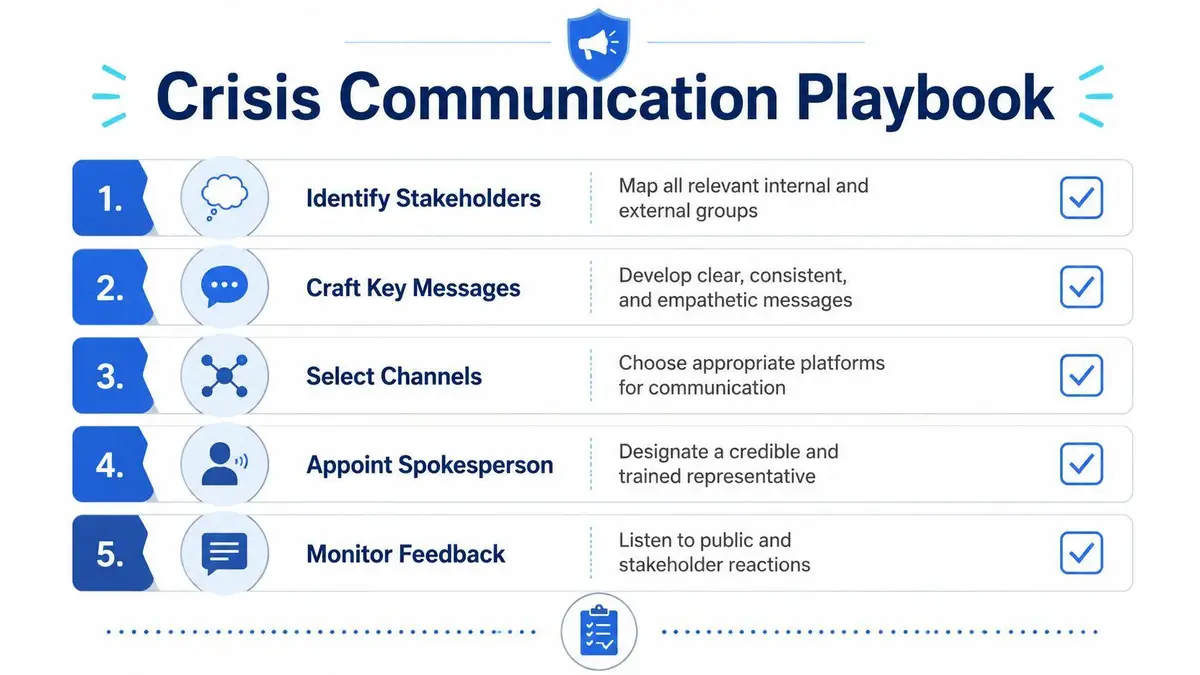
Once containment is underway, communication has one job: preserve trust while facts are still moving. Most organizations fail here because they treat the first statement as the main event. It isn’t. The defining test is whether your updates remain consistent as the picture changes.
Say what you know, and mark what you don’t
Strong crisis communications are built on speed plus transparency. Guidance from the University at Albany stresses preparing messages in advance, defining approval pathways, and maintaining disciplined updates throughout the event. It also notes a practical benchmark to refresh public-facing status updates every 4 to 6 hours during fast-moving disruptions when information is limited, as described in this crisis communication strategies guidance.
That update cadence matters because silence creates a vacuum. In digital incidents, vacuums get filled by screenshots, hostile interpretation, and fake certainty from third parties.
A disciplined message has three parts:
- Confirmed facts: what you can stand behind now
- Active workstream: what you’re investigating or doing
- Next update commitment: when people should expect more
Different audiences need different detail
Employees, investors, clients, regulators, partners, and the public should hear the same core truth, but not the same exact wording. Internal audiences need behavioral direction. External stakeholders need confidence that the issue is contained and managed. Media need a statement that doesn’t overstate unknowns.
A simple matrix helps:
| Audience | What they need first | What to avoid |
|---|---|---|
| Employees | Clear instruction and channel discipline | Rumor, internal debate, private theorizing |
| Clients and partners | Stability and scope | Excess legal jargon |
| Investors or principals | Decision-grade facts and exposure view | Reassurance without evidence |
| Public and media | Accurate acknowledgment and update cadence | Overconfident conclusions |
Correcting the record without looking evasive
This is the hard part. Many crisis playbooks are good on templates and weak on live correction. In real events, the first version of the story is often incomplete. Facts move. Evidence changes. If your opening statement becomes outdated, update it directly. Don’t pretend the earlier language never existed.
“We’re continuing to verify facts. Some early reports remain unconfirmed, and we’ll correct any inaccurate information as our review progresses.”
That kind of language works because it doesn’t fight uncertainty. It governs it.
One spokesperson should own external comment. One approval chain should govern written releases. If your legal team, executives, and communications lead are freelancing in parallel, your credibility will break before the facts do.
Monitoring and Preventing Re-Emergence
A takedown is not the finish line. It’s the first interruption. If the content matters to the attacker, it will often return as a screenshot, mirror post, stitched clip, compressed video, forum thread, or synthetic variation designed to evade the first enforcement route.
That’s why post-removal monitoring is not optional.
Re-emergence usually looks different from the original attack
Once a platform removes an account or post, the next wave often shifts format. A fake account becomes a fan account. A leaked file becomes cropped images. A defamatory article becomes a Reddit summary. A manipulated video becomes a commentary clip that embeds the original allegation without hosting the original asset.
Teams that monitor only the original URL miss the complete propagation.
A stronger monitoring posture tracks:
- Name variants and misspellings
- Account clones and handle permutations
- Screenshots and reposted derivatives
- Search result changes
- Forum references and niche platform discussion
- Synthetic media or AI-generated restatements of the claim
AI has changed the threat model
Crisis management now has to account for AI-driven misinformation such as deepfakes, fake accounts, manipulated screenshots, and synthetic impersonation. Guidance on modern crisis communications notes that these scenarios require rapid verification, takedown workflows, and continuous monitoring rather than relying only on traditional operational incident plans, as discussed in this crisis communications best practices article.
That shift matters because AI lowers the cost of plausible fabrication. You no longer need an advanced adversary to create something that looks real enough to travel. You need a response model that can authenticate media quickly, lock down official channels, and challenge false content before it hardens into public memory.
Monitoring has to combine automation with human judgment
Keyword alerts alone won’t protect a high-profile client. The signal is too messy. You need pattern recognition, platform knowledge, and escalation rules. An effective workflow pairs automated detection with analyst review and predefined enforcement actions.
For organizations building that posture, reputation monitoring tools and workflows are worth evaluating because the objective isn’t merely awareness. It’s early interception.
A digital crisis is stable only when repeat publication becomes harder, slower, and less visible than the original attack.
That’s the standard to aim for. Not silence. Control.
Post-Crisis Recovery and Strategic Fortification
The visible crisis ends before the reputational aftereffects do. Search results linger. Old screenshots resurface in diligence. Counterparties remember confusion more vividly than the corrective statement. If you stop at containment, you leave the reputational architecture damaged.
Recovery needs a deliberate rebuild.
Repair the digital record
Start with search. Review what now appears for the executive, brand, or principal names affected. Identify which assets should be suppressed, which pages need direct challenge, and which authoritative content should be strengthened so the public record isn’t dominated by crisis residue.
At the same time, run a proper post-mortem. Not a ceremonial debrief. A real one. Which trigger was missed first? Who had authority to escalate? Which account or system created the opening? Where did approval slow response? Which outside parties needed to be pre-briefed but weren’t?
That review should produce concrete changes:
- Refined escalation triggers: define what activates legal, technical, and executive response
- Updated message architecture: keep holding statements and audience-specific versions ready
- Evidence protocols: standardize capture, logging, and chain of custody
- Access controls: reduce the chance of leaks, compromise, or unmanaged posting
- Training drills: simulate the likely attack scenarios, not generic disasters
Preparedness is now an operating discipline
The organizations that handle crises well are rarely improvising for the first time. In a 2023 survey, 79% of crisis management professionals said they conduct crisis response drills for key risk areas, and 95% engage in some form of crisis planning, according to this summary of crisis management trends and best practices. That’s the clearest signal that serious institutions no longer treat crisis readiness as a binder on a shelf.
For high-profile individuals and companies, that standard should be even stricter. Your drill shouldn’t only cover a product issue or operational disruption. It should include a fake executive video, a leaked internal file, a coordinated impersonation campaign, and a hostile search event. If those scenarios aren’t in your playbook, your playbook is outdated.
The goal is resilience, not mere survival
The strongest clients don’t emerge from a crisis by “getting past it.” They emerge with tighter controls, faster decision rights, cleaner external messaging, and a stronger ability to remove harmful material before it spreads.
That’s what real crisis management best practices look like in a digital environment. Not broad reassurance. Not generic PR language. A tested system that identifies threats early, contains them across legal and technical channels, communicates with discipline, and keeps watch long after the first fire appears out.
When a reputational crisis is unfolding online, delay is expensive and amateur improvisation is dangerous. ContentRemoval.com works with executives, public figures, legal teams, and family offices to assess active digital threats, pursue takedowns and de-indexing, and build discreet response strategies for high-pressure cases. If the issue is already live, start with a confidential assessment and get the response structure in place before the narrative hardens.
Frequently asked questions
Do we need to win a defamation case before content can be removed?
Usually not. The immediate objective is containment, and many effective interventions through platform reporting, host escalation and de-indexing happen before any litigation outcome. Court orders may become necessary where platforms refuse or search removal needs stronger process.
What should employees do during an online crisis?
Nothing public. Issue a stand-down instruction so no one posts, replies, speculates or corrects the record from a personal account. One undisciplined message can turn a containable issue into a discoverable record.
Why does removed content keep coming back after a takedown?
A takedown is the first interruption, not the finish line. Attackers shift format to evade the first route, so monitoring must track name variants, account clones, screenshots, search changes, forum references and AI-generated restatements.