
A crisis alert system is a structured workflow that detects threatening signals such as leaks, impersonation, smear campaigns and coordinated review attacks, classifies them by severity, routes them to a named decision-maker over redundant channels, and attaches the evidence package and remediation playbook so legal can start takedown or de-indexing immediately rather than rebuilding the file.
Key facts
- Four layers: monitoring and detection, notification and routing, escalation with decision rights, playbooks and remediation triggers.
- A monitoring feed shows what is said; an alert system says who acts, on what basis, which playbook starts.
- The first-hour evidence package: screenshots, timestamps, URLs, account names, repost chains and proof of impersonation.
- Reassess at 24 hours and seven days, then run a quarterly tabletop exercise with the people who get called.
Where ContentRemoval.com comes in. ContentRemoval.com is the response path an alert should land on: content removal, de-indexing, impersonation and leaked media work run from a pre-built case file rather than an improvised inbox. Heads of communications, general counsel and family office security leads usually set this up before an incident, or call during one. A free 15-minute Exposure Scan maps what is live and removable today, and the report is yours to keep. Get a Free, Confidential Exposure Scan or read how our content removal work is done.
You wake up to a board text thread already moving faster than your team can read. A leaked internal video is spreading on Reddit, a fake quote is being copied into screenshots, and customer service is getting hit with the same hostile questions from accounts that were clearly organized before sunrise. By the time legal asks for context, the story has already jumped from one platform to three, and the people deciding whether to trust you are seeing fragments, not facts.
That’s the part most executives underestimate. A crisis rarely fails because nobody noticed it. It fails because no one noticed it fast enough, assigned ownership fast enough, or packaged the first response into something that could be acted on under pressure. A crisis alert system exists for that gap, the one between detection and disciplined action.
The First Forty-Eight Hours of a Reputation Crisis
At 6:10 a.m., the first signal is usually small. A social post with a clipped video. A one-star review cluster that looks coordinated. A “news” post on a low-authority site that uses your executive’s name and gets picked up by a few repost accounts before lunch. None of those events look fatal in isolation, but together they create the kind of pressure that drains executive attention and forces bad decisions.
At 12:00 p.m., the problem is no longer discovery, it’s routing. Someone in comms knows, someone in legal knows, and someone in security knows, but nobody has the same evidence bundle or the same decision rights. Messages get forwarded in screenshots, questions get answered in different Slack channels, and the response becomes a collection of reactions instead of a sequence. That’s when rumors harden into search results, and the damage starts sticking to the name instead of the event.
By 48 hours, the issue has usually split into three tracks. The public track is what customers, investors, or employees can see. The legal track is what can be removed, de-indexed, or challenged. The internal track is what leadership believes happened. If those three tracks aren’t aligned, the crisis doesn’t just linger, it compounds.
Practical rule: if the first hour produces more forwarding than action, the organization doesn’t have a crisis response. It has a communications problem with a timer on it.
That’s why teams that handle reputation under real pressure build alerting around ownership, evidence, and escalation rather than around volume. A working system doesn’t need to predict every incident. It needs to make sure the first credible signal lands with the right person, in the right format, with enough context to act before the narrative calcifies.
For a fuller operational view of how executives handle reputation pressure once an incident is live, see this strategic guide for executives.
What a Crisis Alert System Actually Is
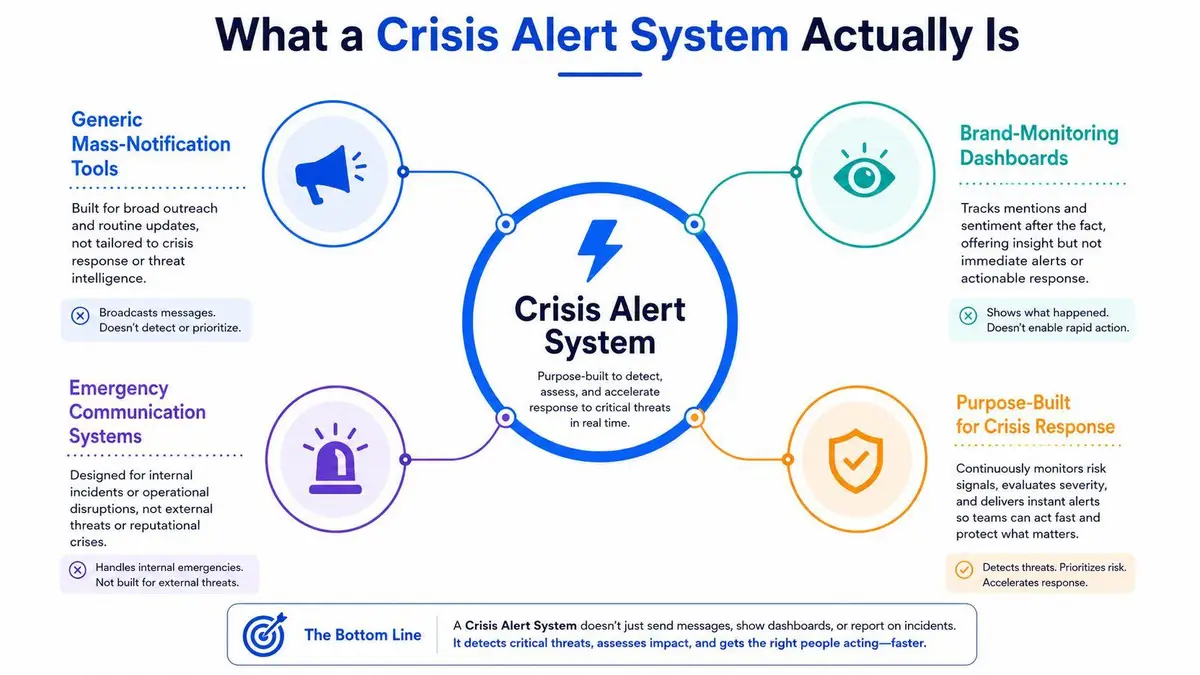
A crisis alert system is not a dashboard, and it’s not a broadcast tool with a nicer label. It’s a structured workflow that detects threatening signals, classifies them, routes them to the right decision-maker, and packages them for remediation. In executive reputation work, that means the system is built to catch leaks, impersonation, smear campaigns, coordinated review attacks, and dark-web exposure, then hand those signals to people who can remove, suppress, or neutralize them.
The public-sector lineage helps explain the architecture. The modern U.S. Emergency Alert System became operational on January 1, 1997, replacing the older EBS, and FEMA’s history ties the broader alerting lineage back to CONELRAD in 1951 and EBS in 1963 (Emergency Alert System history). That history matters because it shows alerting evolved through multiple generations before arriving at today’s layered model. A corporate crisis alert stack borrows that logic, but applies it to reputation, legal exposure, and source removal instead of weather or civil defense.
The biggest difference from generic tools is actionability. Brand-monitoring platforms may tell you that something is being said. A real crisis alert system tells you who needs to know, what channel they should receive it on, what legal basis might apply, and which playbook starts immediately. If the message doesn’t tell people what to do next, it’s only monitoring.
What it has to do in practice
A useful system separates signal detection, structured escalation, and remediation triggers. CAP v1.2 is useful here because it treats the top-level <alert> element as the required envelope and allows multiple <info> blocks for different audiences, languages, and timing windows (CAP v1.2 specification). That structure is exactly what high-stakes reputation work needs, one incident can produce different internal and external versions without forcing everyone into a single monolithic message.
A good alerting stack reduces translation mistakes, routing mistakes, and timing mistakes. Those are the errors that turn a manageable incident into a public mess.
The clearest shorthand is this. A notification app tells people something happened. A monitoring feed shows what’s being said. A crisis alert system drives decision-making and remediation under pressure. That’s a very different job.
Core Components of an Executive Crisis Alert System
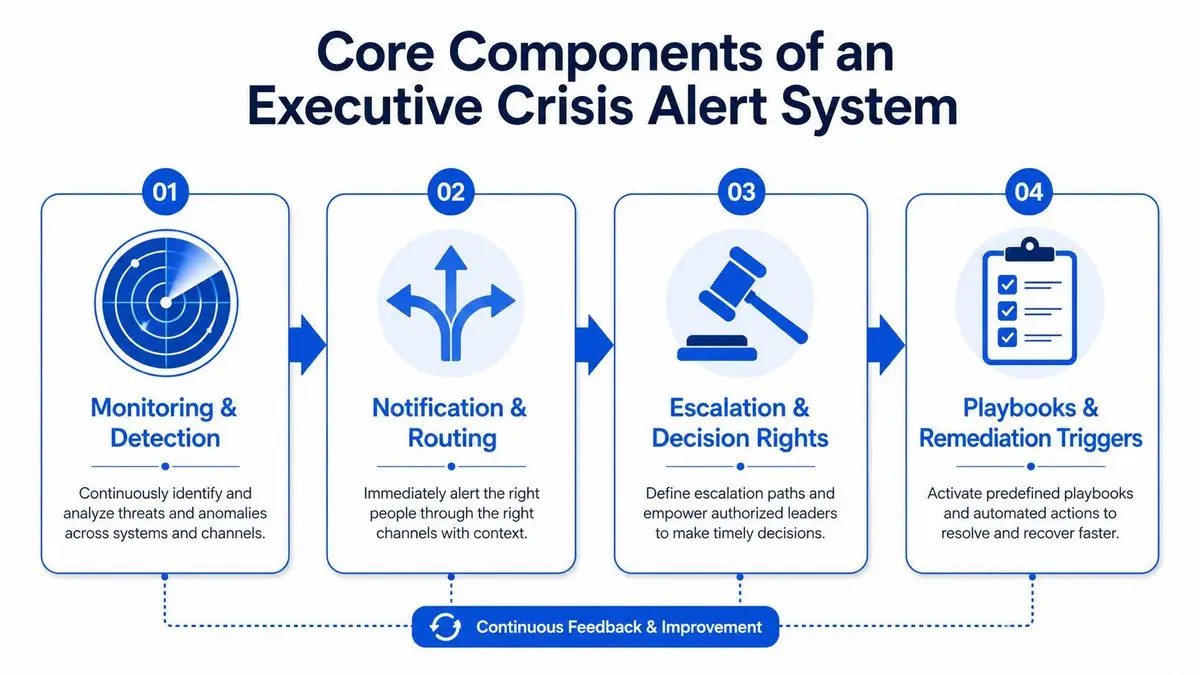
The architecture only works when each layer has a specific job. If one layer is missing, the failure is predictable. Monitoring without routing creates noise. Routing without authority creates delay. Playbooks without evidence create legal risk, and escalation without decision rights creates the most dangerous outcome of all, a team that knows there’s a fire but can’t agree on who can order the hose.
Monitoring and detection
This layer needs to watch the surfaces where executive harm starts, not just the obvious ones. That includes search results, social platforms, impersonation accounts, leaked data repositories, and dark-web references when those are relevant to the client. In practice, the value isn’t just that you see more. It’s that you see earlier, before the same content is mirrored across multiple channels.
Notification and routing
A strong notification layer uses geo-targeted, multi-channel fanout so one degraded channel doesn’t blind the response. Emergency-public-warning guidance and CAP-based systems are built around multi-channel dissemination, and CAP-integrated deployments are explicitly described as supporting near-real-time, multi-hazard, multi-media alerts in multiple languages (CAP-based multi-channel guidance). The executive version of that idea is simple. If one email thread stalls, the alert should still reach legal, comms, security, and outside counsel through redundant paths.
Escalation and decision rights
Many organizations fail here. They send a lot of alerts, but no one knows who can approve a takedown request, who can authorize public response, or who has the final word on escalation. A real crisis alert system defines the severity tiers in advance, then ties each tier to a named person with actual authority.
Playbooks and remediation triggers
The playbook layer is where alerting becomes removal. The system should trigger the correct path for defamation, impersonation, DMCA issues, NCII, source takedown, search de-indexing, or policy enforcement. If the playbook isn’t attached at the moment of alert, the team spends the first hour recreating the file the system should have built automatically.
For teams that need a monitored intake layer before the incident reaches full-scale response, this reputation monitoring resource is the kind of entry point that helps turn raw signals into operationally useful alerts.
Comparing Internal Platforms, SaaS Tools, and Specialist Firms
Different delivery models solve different parts of the problem, and none of them solves everything cleanly. The question is not whether a platform can detect a threat. It’s whether the organization can move from detection to action without waiting on a vendor, a ticket queue, or a legal review cycle that was designed for calmer circumstances.
| Criterion | Internal SOC | SaaS Monitoring | Specialist Firm |
|---|---|---|---|
| Signal coverage | Can be customized deeply, but only if the internal team builds and maintains it | Usually strong on broad listening, weaker on bespoke threat workflows | Focused on reputation-specific threats and remediation targets |
| Response speed | Fast inside the organization if staffing is available | Fast for alerts, slower for downstream action if the stack is fragmented | Often structured for rapid case intake and direct follow-through |
| Takedown authority | Depends on internal legal and external counsel | Usually limited, unless paired with legal support | Built around remediation workflows and jurisdiction-aware requests |
| Continuity under retaliation | Strong if the organization controls infrastructure | Vulnerable if the platform or account gets rate-limited or disrupted | More resilient when the firm uses multiple channels and proprietary processes |
| Best fit | Large organizations with mature security and legal teams | Teams that need broad monitoring more than hands-on removal | High-pressure executives, founders, and family offices that need both alerting and action |
The internal SOC model works when a company already has the staff, the legal bench, and the escalation discipline to run it. Without that, it becomes an expensive inbox. SaaS tools are useful for surveillance and triage, but they usually stop at the point where the hard work starts, which is legal coordination, platform policy analysis, and evidence packaging.
Specialist firms occupy the space most executives care about. They combine monitoring with takedown processes and reputation remediation, which matters when the threat is not a single post but a coordinated pattern. ContentRemoval.com is one example in that category, with services focused on content removal, de-indexing, impersonation, leaked media, and related reputation work. The value proposition is not novelty, it’s that the response path is already built.
What to compare before you buy
Look at signal coverage, jurisdictional reach, legal authority, and continuity under platform pressure. If a vendor can only notify you but can’t help you act, the gap will show up when the clock is running. In executive reputation cases, that gap is usually the difference between a contained incident and a story that stays searchable.
Connecting Alerts to Legal Takedown and Reputation Remediation
An alert only matters if it can become a case file immediately. The handoff should name the claim, preserve evidence, identify the platform or host, assign the owner, and specify the remedy path. If the alert doesn’t do that, the legal team wastes time rebuilding facts that should already be attached to the incident.
A clean workflow starts with the evidence package. Screenshots, timestamps, URLs, account names, repost chains, and any proof of impersonation or stolen content should be captured before the content moves again. From there, the team decides whether the removal path is search de-indexing, a DMCA notice, a platform policy complaint, a defamation demand, a privacy request, or a complaint for non-consensual intimate imagery. Each one lives or dies on precision.
The second failure point is ownership. Search de-indexing, platform takedowns, and source removal are not the same task, and they shouldn’t be assigned to the same vague inbox. One person or firm needs to own the legal basis, another needs to own communication timing, and someone needs to own follow-up if the content reappears elsewhere. That’s how you prevent an alert from becoming a shrug.
Practical rule: if the notice doesn’t say why the content is removable, who is sending it, and what happens next, the response will drag.
The cleanest legal and remediation workflows are built before the incident, not during it. For a practical takedown workflow that maps directly to that handoff, see this DMCA notice guide. The point isn’t to memorize form language, it’s to make sure the alert system creates a record that legal can use immediately.
Two Executive Scenarios Walked Through in Real Time
At 7:15 a.m., a founder’s internal product demo video appears on a niche forum. By 8:20 a.m., it’s been scraped to two adult platforms, and by 9:00 a.m. a coordinated set of social posts is pointing customers toward the leak with the company’s name in the caption. The alert fires on the original post, then again on the first scrape, then again when an impersonation account starts replying to reporters.
Reactive leak
The first move is containment, not commentary. Security preserves the evidence, comms drafts a holding statement if needed, and legal opens the takedown track on the original host and the mirrored copies. Because the alert system already tagged the content type and likely remedy, no one is debating whether this is a source-removal case, a platform-policy case, or both.
By noon, the conversation has shifted from “what is this?” to “where else did it go?” That’s the point where continuous monitoring matters. The system keeps watching for reuploads, reposts, and search indexing changes so the team can keep removing copies instead of discovering them one by one.
Coordinated smear
In the second scenario, the threat is slower and more strategic. Fake reviews appear first. Then an AI-generated quote starts circulating on a low-authority site. The timing is suspicious because it lands right before a funding announcement, which means the goal is to create just enough doubt that investors or analysts hesitate.
The alert system routes this differently. Legal looks at defamation and impersonation angles, comms prepares a correction path, and the monitoring layer watches for additional planted articles or review bursts. No single post has to be dramatic for the campaign to matter. The signal is the pattern.
The value of a good system is measured by what doesn’t become public theater.
Both scenarios use the same underlying stack. The difference is tempo. In the leak case, speed matters most. In the smear case, pattern recognition and repeat monitoring matter more. A competent crisis alert system handles both without forcing the team to invent a new process on the fly.
Implementation Checklist and Executive SOP Template
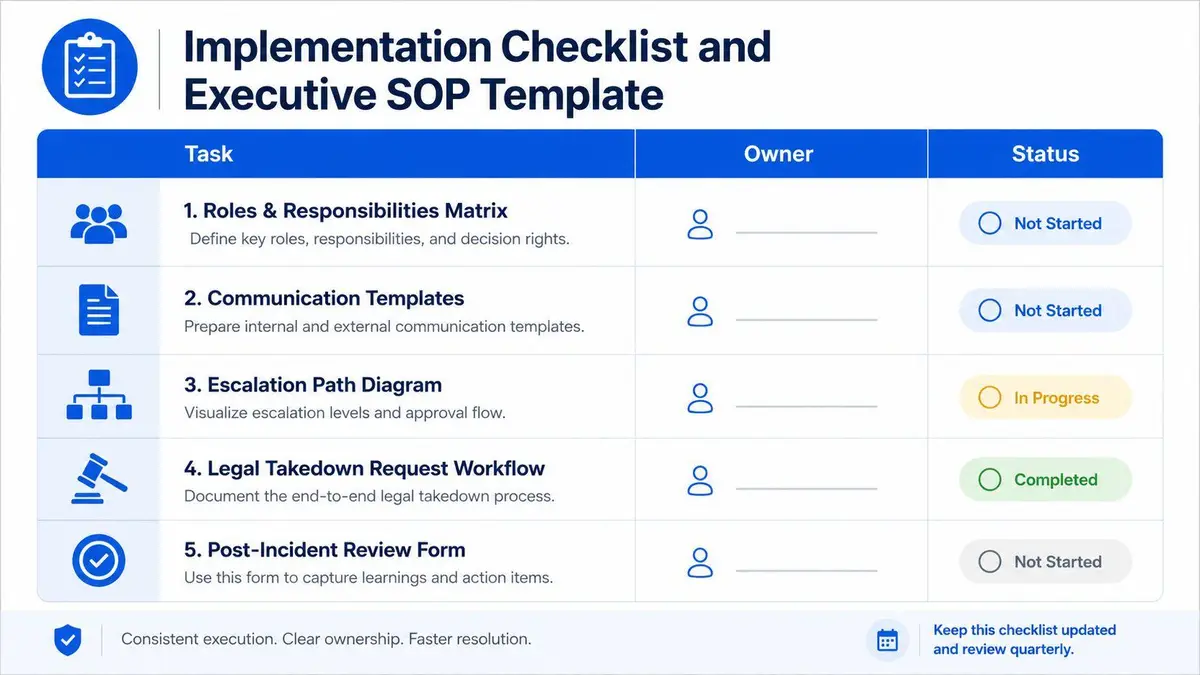
A serious program needs the paperwork that forces discipline before the incident. The roles matrix should name legal, comms, security, external counsel, and any specialist firm, with one owner for each severity tier. The channel matrix should map those tiers to specific notification paths so no one is guessing which thread to open.
The evidence checklist has to be usable in the first hour. That means capture instructions, account notes, platform details, and a place to store screenshots and URLs without losing chain of custody. The takedown skeleton should already contain the legal basis, the contact information, and the requested remedy, because nobody writes their best draft while the story is accelerating.
A useful SOP also sets review cadence. Reassess after 24 hours and again at seven days, then run a tabletop exercise each quarter so the team can test the stack under stress. Those exercises should include the people who will be called during a live event, not just the managers who approved the budget.
From Installed System to Continuous Protection
A crisis alert system only becomes valuable after it’s been tuned against real threat patterns. The first ninety days should be about refining severity thresholds, cleaning up routing gaps, and updating playbooks for new content types like AI impersonations and coordinated review attacks. After that, the goal is steady-state readiness, where new threats get folded into monitoring without forcing a rebuild.
The test is simple. When the next incident fires, does the team improvise, or does it execute? For executives and family offices, that answer determines whether the crisis stays contained or becomes a permanent search result.
ContentRemoval.com helps executives, founders, and family offices turn alerts into removal work, de-indexing, and discreet remediation across search engines, websites, and social platforms. If your current process stops at monitoring and never reaches takedown, visit ContentRemoval.com to start a confidential assessment and see what a real response path looks like.
Frequently asked questions
How is a crisis alert system different from brand monitoring software?
Monitoring tells you something is being said. A crisis alert system tells you who needs to know, which channel they get it on, what legal basis might apply and which playbook starts, so the first hour produces action rather than forwarded screenshots.
Who should have authority in a reputation crisis?
Severity tiers should be set in advance and each tied to a named person with real authority to approve takedown requests, authorize public response and escalate. Search de-indexing, platform takedowns and source removal should have separate owners rather than one vague inbox.
Should we build alerting in-house, buy a SaaS tool or use a specialist firm?
An internal SOC works with mature security and legal staffing, otherwise it becomes an expensive inbox. SaaS tools cover broad listening but stop before legal coordination and evidence packaging. Specialist firms combine monitoring with takedown and remediation for executives and family offices.