
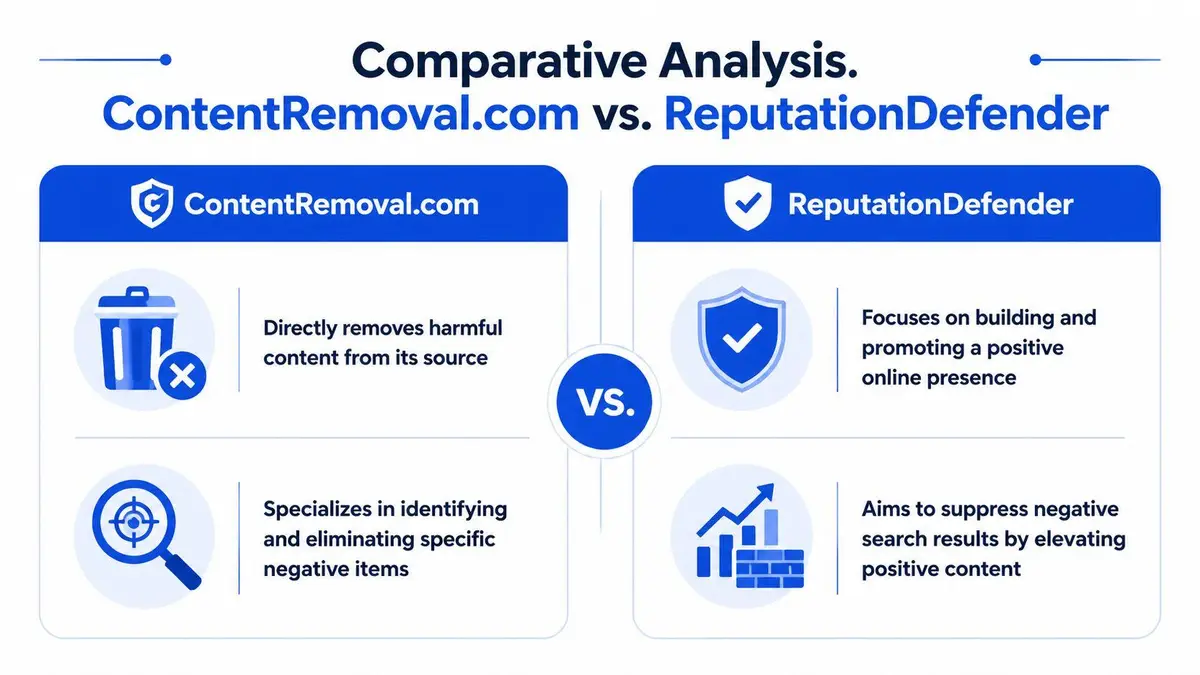
ContentRemoval vs ReputationDefender comes down to erasure versus suppression. ContentRemoval.com works removal-first: audit, legal and platform takedowns, de-indexing and re-upload monitoring, so the harmful asset leaves the source and search. ReputationDefender works suppression-first, pushing results down with content and SEO while the source stays live, which suits lawful but unhelpful material.
Key facts
- Removal-first fits fake reviews, defamation, leaks, impersonation, mugshots and dark web exposure; suppression fits lawful criticism.
- Consumer Reports’ 2023 test found 35% overall removal success; ReputationDefender removed 6%, manual opt-outs reached 70%.
- ReputationDefender pricing runs from Privacy Pro at $99 a year to executive packages of $3,000 to $25,000.
- Judge results by source status, search index status, reappearance protocol and a documented proof trail.
Where ContentRemoval.com comes in. ContentRemoval.com is the removal-first side of this comparison. The team tests removability before anything else, then pursues source takedown, de-indexing and monitoring on a success basis, quoted in writing after the scan. Founders, their counsel and family offices usually reach out when a live URL, not diffuse sentiment, is the problem. A free 15-minute Exposure Scan maps what can be erased, and the report is yours to keep. Get a Free, Confidential Exposure Scan or read how our reputation management work is done.
The call usually comes after midnight. A founder types their own name into Google and sees a false accusation, a mugshot page, a leaked image, or an old article revived by someone with an agenda. A spouse has already seen it. A board member will see it tomorrow. Counsel is asking whether this is a media issue, a legal issue, or both.
That framing is too soft. This is an incident response problem.
When clients ask me about contentremoval vs reputationdefender, I don’t treat it as a vendor beauty contest. I treat it as a strategic fork. One path tries to manage visibility over time. The other tries to remove the asset itself, de-index it, and monitor for reuploads. If you choose the wrong path at the start, you waste time, preserve the evidence against you, and often fund a longer crisis than you needed.
The comparison below is the fastest way to understand the difference.
| Issue | Removal-first approach | ReputationDefender approach |
|---|---|---|
| Core objective | Eliminate harmful content at the source when legal or platform grounds exist | Push negative results lower through SEO, content creation, and monitoring |
| Best suited for | Defamation, fake reviews, leaks, impersonation, privacy violations, mugshots, doxxing, copied content | Non-actionable criticism, broad reputation maintenance, long-term personal brand management |
| Technical method | Audit, legal takedowns, webmaster outreach, de-indexing, reupload monitoring | Positive content creation, suppression, search result management |
| End state | Content may be removed from source and search results | Content often remains live, just less visible |
| Risk profile | Better when permanence and confidentiality matter | Better when content can’t be removed but can be outranked |
| Commercial model | Often project-based or pay-for-results on qualifying matters | Commonly retainer-based for ongoing management |
Confronting a Digital Crisis The Moment of Discovery
You don’t discover harmful content in a calm state. You discover it while preparing for financing, litigation, a hiring process, a board review, a custody dispute, or a family event. The damage isn’t theoretical. It’s attached to your name, your company, and your search results now.

I’ve seen the same pattern repeat. The client initially wants reassurance. What they need is triage. Is the content false, private, stolen, defamatory, non-consensual, or merely unpleasant? Is it on a platform with a reporting mechanism, a publisher with legal exposure, a broker database, or a forum designed to resist complaints? Those answers determine whether the right move is takedown, de-indexing, suppression, or all three in sequence.
What the first hour should look like
The first hour shouldn’t be spent arguing with the poster or firing off emotional emails. It should be spent preserving evidence, mapping where the content lives, and identifying whether the publisher, host, search engine, or platform gives you a direct removal route.
A practical starting point is to follow a strategic defamation response framework for victims of online attacks. The key is speed with discipline. The wrong early move can tip off the offender, trigger reposts, or make later legal arguments harder.
Immediate rule: If the content is specific and harmful, ask first whether it can be removed. Don’t default to reputation management before you test removability.
Why this decision is bigger than vendor selection
It’s often perceived as buying a service. They’re really choosing a philosophy. One philosophy says, “We’ll build enough positive material to crowd out the bad.” The other says, “We’ll attack the bad asset directly and try to erase it where the law, policy, or platform rules allow.”
That difference matters more than brand recognition. In a high-stakes matter, your reputation is less threatened by abstract negativity than by a live URL that can be screenshotted, reshared, emailed, and rediscovered by anyone determined enough to look.
The Core Strategic Choice Suppression vs Erasure
The market likes to blur these approaches because ambiguity sells. It shouldn’t. Suppression and erasure are not variations of the same service. They are different architectures.
Suppression leaves the source intact
ReputationDefender uses a suppression-first model built on content creation and SEO. The aim is to push unwanted results off page one. That can help when the content is lawful, stubborn, or not removable on any clear legal or policy basis.
For low-intensity reputation issues, that model has a role. If someone wrote a critical but non-defamatory opinion piece, you may not be able to remove it. If a dated profile or awkward forum thread ranks for your name, suppression can reduce visibility. It is a management strategy.
It is not erasure.
Erasure targets the asset itself
Removal-focused providers use a different sequence. According to a technical comparison of ORM service models, specialized removal services start with harmful content identification, move into legal takedowns and webmaster outreach, then apply de-indexing methods so removed URLs no longer appear across search engines. The critical distinction is simple: removal-first work seeks elimination at the source, while suppression tries to displace visibility without deleting the underlying item.
That is the strategic divide in contentremoval vs reputationdefender.
Burying a result is not the same as removing it. If the URL still exists, the risk still exists.
Why executives should care about the distinction
For a high-net-worth client, the practical question is not “Can you improve search results?” It is “Will this specific item still exist six months from now?” If the answer is yes, then you are managing exposure, not resolving the threat.
A source-live strategy creates continuing vulnerability:
- Search rediscovery: A result pushed down today can return after algorithm changes or fresh engagement.
- Direct sharing: Counterparties, journalists, litigants, or adversaries can circulate the URL even if it’s no longer prominent.
- Reposting risk: Content left online can be copied, screenshotted, mirrored, or syndicated elsewhere.
- Escalation risk: Some publishers become more aggressive once they realize a subject is paying to outrank rather than contesting the content itself.
When suppression is still the right answer
This doesn’t make suppression useless. It makes it conditional.
Use suppression when the content is non-actionable, when the publisher is insulated, or when the platform won’t remove the material and the legal posture is weak. Use erasure when the content is false, stolen, invasive, policy-violating, or otherwise removable. Knowledgeable teams know the difference and don’t confuse a fallback strategy with a primary one.
A Comparative Analysis of Services and Methods
The cleanest way to evaluate contentremoval vs reputationdefender is to stop thinking in brand slogans and start thinking in threat categories. Different harms require different machinery.
Defamation and false reviews
False reviews and defamatory allegations are often the first place where clients waste money on the wrong strategy. If a review is fabricated, posted by a competitor, or violates platform rules, the intelligent response is to build an evidentiary record and pursue removal. If a statement is verifiably false and harmful, legal notices and platform procedures matter more than blog posts praising your brand.
ReputationDefender’s model is structurally weaker here because suppression leaves the accusation live. That means the statement can continue influencing anyone who reaches it directly. A removal-first provider is better aligned to this problem because the work begins with proof, policy triggers, publisher contact, and de-indexing where appropriate.
A useful benchmark appears in this guide for executives evaluating professional content removal services. The central question is always the same: can you attack the post, or are you only trying to outpublish it?
Leaked images and non-consensual content
For private images, intimate content, and coercive leaks, suppression is a weak answer. The issue is not merely ranking. The issue is ongoing possession, republication, and trauma. If the material remains live on a host, every delay compounds exposure.
In these matters, a removal-first strategy is the only serious strategy. The work usually involves platform reporting, host escalation, legal takedown arguments, and active monitoring for reposts. Search suppression can assist at the margin if mirrors survive, but it should not be the main event.
If the asset itself is abusive, privacy-invasive, or unlawfully posted, you should treat visibility management as secondary.
Mugshots and arrest-related records
Mugshot and arrest content sits in a complicated category. Some pages can be challenged directly. Some are protected by local law or publisher design. Some become removable only after the underlying case changes posture, records are updated, or a platform policy is triggered.
A removal-first specialist often outperforms a general ORM provider. The specialist will examine which version of the record is live, who controls the page, whether there are state-law arguments, whether the page is indexed beyond the publisher’s site, and whether de-indexing should be pursued in parallel.
ReputationDefender can reduce prominence through search management, but that doesn’t solve the core client problem if the record remains one click away.
News articles and legacy press
News content is the category where clients most often need disciplined judgment. Not every article is removable. Some are accurate and protected. Some are old, misleading by omission, or no longer proportionate to the subject’s present reality. Some can be challenged, updated, de-indexed in certain jurisdictions, or suppressed if removal fails.
Here the distinction isn’t ideological. It’s tactical. A removal-first team starts by testing whether the publisher, search engine, or jurisdiction provides an advantage. A suppression-first team tends to assume the article will remain and builds around it.
That assumption can become expensive. Sometimes it’s right. Often it’s premature.
Data broker exposure and privacy cleanup
This is one area where broad monitoring has clear value. ReputationDefender offers recurring scans of data brokers, and privacy-oriented services in this category can reduce public exposure of addresses, relatives, and other personal details. For clients facing harassment, stalking risk, or executive security concerns, that recurring hygiene layer matters.
But don’t confuse broker opt-outs with high-stakes reputation repair. They solve different problems. A broker listing is not the same as a defamatory page, a leak, or a hostile article. Privacy subscriptions can complement crisis work. They cannot replace source removal where the issue is a specific damaging publication.
Dark web monitoring and remediation
Dark web issues require a more forensic posture. The challenge is rarely solved by positive content. If credentials, private files, or leaked media circulate in hidden channels, the response requires identification, evidence capture, remediation, and monitoring for spread.
A suppression-first firm is not naturally built for that environment. A removal-first specialist with technical monitoring and jurisdiction-sensitive escalation is better suited because the problem is chain-of-custody and republication, not your page-one sentiment.
The practical split
The pattern is consistent across categories:
| Threat type | Better fit |
|---|---|
| Fake reviews | Removal-first |
| Defamation | Removal-first |
| Leaked private content | Removal-first |
| Mugshots and arrest pages | Usually removal-first |
| Dark web exposure | Removal-first |
| Old but lawful criticism | Suppression-first or hybrid |
| Broad personal branding work | Suppression-first |
For executives, that’s the key contentremoval vs reputationdefender distinction. One model is a direct response to a harmful object. The other is a long campaign to surround that object with better material.
Evaluating Success Metrics and Verifiable Outcomes
This industry has a measurement problem. Firms love to say they “improved visibility,” “repaired reputation,” or “reduced negative exposure.” Those phrases are slippery because they can describe almost anything.
A real win is either binary or it isn’t
If a harmful page is removed from the source and no longer appears in search, that’s a verifiable result. If the page is still live but now ranks lower, that may be useful, but it is not the same class of outcome.
That distinction matters because clients under pressure don’t need mood music. They need to know whether the item still exists, whether it’s indexed, and whether it can return.
A rare piece of independent evidence came from Consumer Reports’ 2023 investigation of data removal services. It tested seven services by trying to remove 332 pieces of personal information from 13 people-search sites for 28 volunteers over four months. Across all services, overall success was 35%. ReputationDefender performed worst, achieving only 6% removal. Manual opt-outs reached 70%.
Those figures don’t answer every reputation question, but they do expose a core issue. A company can be well known and still underperform on actual deletion.
Why suppression metrics can mislead
Suppression campaigns often report movement in rankings, sentiment distribution, or the quantity of positive assets published. Those outputs have value. They are not proof that the threat is gone.
Three questions cut through the fog:
- Is the original content still live on the source site?
- Is the URL still indexed by major search engines?
- What happens if the publisher reposts, syndicates, or updates the page?
If the answers remain uncertain, your “success” is conditional.
Test every claim against persistence: Ask whether the harmful item still exists anywhere a hostile party can use it.
Monitoring determines whether the result lasts
Even successful removals can fail if nobody watches for reuploads. It is at this point that serious operators separate themselves from generic ORM vendors. The first takedown matters. The follow-up matters just as much.
The challenge is straightforward. Harmful material gets copied. Old screenshots reappear. New accounts repost old lies. If your provider can’t detect resurfacing quickly, you may spend months paying for search management while the same content keeps returning in fresh wrappers.
That is why I tell clients to stop asking for “success rates” in the abstract. Ask instead for the provider’s definitions. What counts as removal? What counts as suppression? What counts as de-indexing? What triggers a new response if the same asset reappears?
The executive standard
For a high-stakes client, the right scorecard is tight:
- Source status: removed or still live
- Search status: indexed or de-indexed
- Reappearance protocol: monitored or ignored
- Proof trail: documented or merely asserted
If a firm can’t report at that level, it is selling reassurance, not control.
Global Reach and Jurisdictional Effectiveness
An executive with a cross-border profile can’t afford a purely domestic strategy. Search results are global. Publishers are global. Data hosts are global. So are your adversaries.

Jurisdiction changes the answer
The same article, image, or personal data listing can be practically untouchable in one jurisdiction and removable in another. That’s why generic ORM advice often fails discerning clients. The legal route isn’t abstract. It depends on where the publisher operates, where the search engine processes the request, where the subject resides, and which privacy regime applies.
According to this analysis of content removal services and international legal frameworks, EU GDPR enables 25-35% higher removal rates for right-to-be-forgotten requests than U.S. First Amendment constraints. The same source states that legal firms report 85% de-indexing from Google under EUPP. For international clients, those are not minor differences. They can determine whether you pursue legal-technical removal or settle for suppression.
Why a U.S.-centric suppression model can fall short
ReputationDefender’s model is most comfortable in a U.S.-style environment where lawful but harmful content is often difficult to remove outright. That can make sense for certain domestic matters. It is less compelling where stronger privacy rights or de-indexing rights exist.
If a client has exposure in Europe, parts of Asia, or other regions where privacy and intermediary obligations create an advantage, a suppression-first default leaves an advantage on the table. In markets where source removal is realistic, failing to pursue it is not prudence. It is underperformance.
A simple jurisdiction checklist
Before choosing your strategy, answer these questions:
- Where is the publisher located? Publisher location often affects takedown potential.
- Where do search requests belong? Search de-indexing options can vary by region.
- What category of content is involved? Privacy, defamation, leaked data, and copied media each trigger different frameworks.
- Whose rights are strongest? The answer may depend on whether you are an individual, a company, or a public figure.
International matters reward legal precision. Broad SEO campaigns don’t substitute for jurisdiction-specific rights.
The practical consequence
If your digital problem crosses borders, treat “global service” claims with skepticism. What matters is not whether a provider says it works internationally. What matters is whether it knows when law, platform policy, and search de-indexing can be coordinated across jurisdictions. That is where removal-first firms tend to separate from broad reputation managers.
Matching the Solution to the Client Scenario
A good strategy becomes obvious when you stop speaking in abstractions and force the problem into a real client scenario. That’s where contentremoval vs reputationdefender stops being theoretical.

Scenario one. A founder hit by fake reviews
If the reviews are fabricated, coordinated, or posted by non-customers, this is a removal-first matter. ReputationDefender’s own discussion of removal versus suppression acknowledges that sources often blur the difference between removal and suppression, while removal-focused firms report success rates upwards of 80% for verifiable defamation such as fake reviews using legal notices. The same source notes that AI-driven monitoring now addresses reuploads within 24-48 hours, and that an estimated 70% of suppressed content can resurface.
The recommendation is straightforward. Build the factual record, attack the reviews directly, and monitor for reposts. Suppression is only a backup if the platform refuses to act.
Scenario two. An executive facing an old but misleading article
This one requires judgment. If the article is false, unlawfully invasive, or removable under jurisdiction-specific rights, pursue erasure first. If it is lawful reporting that remains damaging, use a hybrid strategy: test legal and de-indexing routes, then suppress what survives.
The mistake is to assume all press is untouchable. Some of it is. Some of it isn’t. You don’t know until someone competent tests the removal path.
Scenario three. A public figure dealing with leaked private images
This is not a branding problem. It is a containment and eradication problem. Use a removal-first team, fast. The goals are source takedown, search de-indexing, escalation through platform abuse channels, and immediate monitoring for mirrors.
Any provider that starts by discussing your positive online presence is starting in the wrong place.
Scenario four. A family office seeking privacy and ongoing protection
A split model can make sense. If there is no active crisis but there is concern about personal data exposure, doxxing risk, or broad digital hygiene, ongoing privacy monitoring has value. A service like ReputationDefender may fit part of that need, especially for recurring broker scans and search monitoring.
If a specific harmful asset appears, switch from management mode to removal mode immediately. Don’t let a monitoring subscription become a substitute for decisive action.
The pattern across all four
Use this shorthand:
- Specific harmful asset with legal or policy vulnerability: choose erasure.
- Diffuse negative sentiment with no clear takedown basis: choose suppression.
- Cross-border or privacy-heavy issue: test removal rights first.
- Active reupload risk: require monitoring, not just initial cleanup.
That’s the only framework that keeps strategy aligned to the actual threat.
Engagement Models Pricing and Confidentiality
The commercial model tells you what a firm is built to do. If you understand the pricing structure, you can usually infer the strategy before the sales call ends.
Retainers favor management
ReputationDefender’s pricing spans from Privacy Pro at $99/year to executive packages costing $3,000-$25,000 for broader strategy work, typically on a retainer, as summarized in this competitor analysis comparing DeleteMe and ReputationDefender. That pricing logic fits an ongoing management model. You are funding monitoring, content creation, suppression, and long-horizon reputation work.
That can be sensible if your objective is broad online presence management. It is less appealing if your actual objective is to remove a finite set of harmful URLs as quickly as possible.
Project-based work fits crisis response better
Removal specialists often work on targeted engagements and, in qualifying matters, may offer pay-for-results structures. That model is better aligned with acute incidents because the mission is specific: identify the asset, establish grounds, remove it, de-index it, and monitor for recurrence.
For executives under pressure, that alignment matters. A retainer can drift. A tightly scoped removal engagement tends to stay tied to the problem that triggered the call.
Confidentiality is not a side issue
The more sensitive the matter, the more dangerous it is to treat confidentiality as a boilerplate term. Marketing-oriented ORM work and crisis-grade removal work create different exposure profiles. One often requires broader content production, outreach, and visibility tactics. The other may require discreet legal positioning, restricted communications, and tightly controlled evidence handling.
If your case touches extortion, intimate content, litigation exposure, family-office privacy, or executive succession risk, confidentiality should shape the engagement from the start. Before signing anything, read a professional pricing guide to content removal engagements and cost structure and ask how the provider handles sensitive files, escalation pathways, and need-to-know access.
Cheap retainers become expensive when they prolong a crisis that needed a surgical response.
What to ask before you sign
Don’t ask for a glossy package list. Ask these:
- What exactly are you trying to achieve? Source removal, de-indexing, suppression, or some mix.
- How will success be defined? Live URL status matters more than vanity reporting.
- Who will touch the file? Sensitive matters should have narrow internal access.
- What happens if the content reappears? If there is no answer, there is no real endpoint.
A high-stakes client should buy the engagement model that matches the threat, not the one with the cleanest brochure.
The Final Verdict A Framework for Your Decision
If you are deciding between contentremoval vs reputationdefender, stop asking which brand is “better.” Ask which strategic model fits the threat in front of you.
Choose based on the asset, not the advertisement
If the problem is a specific, harmful, removable asset, choose a removal-first strategy. That includes fake reviews, impersonation, leaked private content, many privacy violations, some mugshot matters, and certain forms of defamatory or unlawfully invasive publishing. In those cases, permanence matters more than page-one cosmetics.
If the problem is lawful but damaging material that cannot realistically be removed, choose suppression or a hybrid approach. That is where an ongoing reputation manager can add value. The goal becomes containment, not eradication.
Use this decision filter
| Decision factor | Better strategic fit |
|---|---|
| Content can be challenged on legal or platform grounds | Erasure |
| Content is lawful but unhelpful | Suppression |
| You need confidentiality and tight handling | Erasure-led engagement |
| You need long-term search presence management | Suppression |
| Matter crosses jurisdictions | Removal analysis first |
| Reupload risk is high | Erasure plus monitoring |
My recommendation
For high-stakes clients, start with the harder question first. Can this be removed? Too many people spend months funding suppression before anyone seriously tests removal. That is backwards.
Use ReputationDefender if your issue is broad digital reputation maintenance, privacy monitoring, or non-actionable negative material that needs to be pushed down over time. Use a removal-first specialist if your problem is a dangerous URL, a false claim, a leak, an attack campaign, or a privacy breach that should not remain online at all.
The wrong strategy buys delay. The right strategy buys control.
If you’re dealing with a live reputational threat and need a confidential assessment, ContentRemoval.com can evaluate whether the issue calls for source removal, de-indexing, suppression, or a combined response, then move quickly with a results-focused action plan.
Frequently asked questions
Is ReputationDefender worth it for removing a false article?
Its model is suppression-first, which leaves the article live and only pushes it lower. If the article is false, invasive or removable under jurisdiction-specific rights, a removal-first specialist that tests takedown and de-indexing routes is the better fit; suppression is the fallback.
Does pushing a search result down count as fixing the problem?
Only conditionally. A pushed-down result can return after algorithm changes, be shared directly by counterparties, or be copied elsewhere. A verifiable win is when the page is gone from the source and no longer indexed.
Which service is better for data broker cleanup?
Recurring broker scans and privacy monitoring have value for families concerned about addresses and relatives, and ReputationDefender offers that layer. It is a different problem from a defamatory page or a leak, and it cannot replace source removal when a specific damaging publication appears.