
A cease and desist letter harassment template puts the harasser on formal written notice, fixes the facts in a dated incident log, demands specific measurable action by a deadline and reserves your rights. Use the general version for unwanted texts and calls, and the online version when harassment includes posts, fake profiles and reposts. It is not a court order.
Key facts
- Online and cyber harassment made up 41 percent of harassment incidents reported in the United States in 2022.
- Core components: party identification and delivery protocol, chronological incident documentation, legal framing and demand, consequences with reservation of rights.
- A cited 2024 ABA study found 72 percent of recipients complied immediately on receipt.
- Certified mail, tracked email and a process server carry different evidentiary weight; layered delivery suits high-stakes cases.
Where ContentRemoval.com comes in. ContentRemoval.com steps in when the letter has done its job or been ignored and the content is still live: fake accounts reposting private photos, false allegations ranking in search, mirrors and cached copies a demand letter cannot reach. Executives, physicians, investors and public-facing families usually make contact through their counsel or a family office manager. A free 15-minute Exposure Scan maps what is removable, and the report is yours to keep. Get a Free, Confidential Exposure Scan or read how our content removal work is done.
When individuals search for a cease and desist letter harassment template, they are typically already past annoyance. They have tried ignoring the messages. They have blocked one account only to see another appear. They have watched a private dispute turn into a reputational problem, or a reputational problem turn into a safety issue.
That shift matters. Once harassment becomes persistent, the response has to become structured.
A cease and desist letter isn’t magic, and it isn’t a court order. Used properly, it does something more useful than venting or threatening. It fixes the facts in writing, puts the other side on formal notice, and starts building a record that can be used with platforms, law enforcement, or a court if the conduct continues. Used badly, it can be sloppy, emotional, and easy to ignore. Used well, it’s often the first move that changes the balance of control.
Regain Control with a Strategic First Step
The client scenario is usually the same even when the facts differ. An executive starts receiving hostile texts from a former associate. A founder sees false accusations repeated across LinkedIn, X, Reddit, or niche forums. A public-facing professional gets anonymous emails, escalating DMs, and reposted personal content. The first instinct is often reactive: fire back, post a rebuttal, threaten publicly, or send a furious late-night message.
That usually makes the evidence messier.
A strong cease and desist letter takes the heat out of the exchange and replaces it with a documented position. It tells the recipient, in precise terms, what conduct must stop, what content must be removed, what deadline applies, and what legal options remain open if they refuse. It also tells every later decision-maker that you acted reasonably and clearly.
The need for that kind of disciplined first response has grown as harassment has shifted online. Online and cyber harassment accounted for 41% of all harassment incidents reported in the United States in 2022, according to the Bureau of Justice Statistics data summarized at The Letter Pilot’s harassment letter overview. That figure tracks what practitioners already see: harassment now spreads faster, reaches wider audiences, and leaves behind searchable material that can damage both personal life and commercial reputation.
A good first letter isn’t written to sound angry. It’s written to be useful six weeks later, when a platform reviewer, judge, investigator, or opposing counsel reads it.
If the harassment is primarily digital, the response should also be digital-specific. Generic legal templates often miss account handles, post URLs, impersonation issues, repost patterns, and search indexing consequences. If that’s the problem you’re dealing with, this guide on what to do about cyberbullying as an adult is a worthwhile companion to the letter itself.
The Cease and Desist Letter Harassment Template
A template only helps if it fits the facts. For most readers, there are really two versions that matter. One is built for direct harassment in texts, calls, email, or in-person contact. The other is built for online harassment, cyberstalking, impersonation, and reputational attacks across platforms.
Use the first if the issue is repeated unwanted contact without a meaningful publication element. Use the second if the harassment includes posts, comments, videos, fake profiles, search results, or content hosted by third parties.
General harassment template
[Your Full Name]
[Your Address]
[Your Email]
[Your Phone Number][Date]
Via [Certified Mail / Email / Other Delivery Method]
[Recipient Full Name]
[Recipient Address]
[Recipient Email, if known]Re: Demand to Cease and Desist Harassing Conduct
Dear [Recipient Name],
This letter serves as formal notice that you must immediately cease and desist from all harassing, threatening, intimidating, or otherwise unwanted contact and conduct directed toward me.
Your conduct has included, among other things, the following:
- On [date], you [describe conduct briefly and factually].
- On [date], you [describe conduct briefly and factually].
- On [date], you [describe conduct briefly and factually].
These actions are unwelcome, have caused substantial distress, and must stop immediately. This demand applies to all forms of direct or indirect contact, including but not limited to phone calls, text messages, emails, letters, messages sent through third parties, and in-person communication.
You are hereby instructed to:
- Cease all direct and indirect contact with me.
- Refrain from approaching my home, workplace, or any other location where your presence would be unwelcome.
- Preserve all communications and materials relating to the conduct described above.
If you continue this conduct after receipt of this letter, I will consider all available remedies, including seeking law enforcement assistance, protective relief, and civil claims where appropriate. Nothing in this letter waives any rights, claims, or remedies, all of which are expressly reserved.
Please provide written confirmation by [date] that you will comply fully with these demands.
Sincerely,
[Your Full Name]
Online harassment and digital defamation template
[Your Full Name or Company Name]
[Your Address]
[Your Email]
[Your Phone Number][Date]
Via [Certified Mail / Email / Platform Message, if appropriate]
[Recipient Name or Username]
[Known Address or Email]
[Platform Names and Handles]Re: Demand to Cease and Desist Online Harassment, Defamatory Statements, and Unauthorized Digital Contact
Dear [Recipient Name],
This letter demands that you immediately cease and desist from your ongoing online harassment and related digital misconduct directed at me. Your conduct includes repeated unwanted digital contact, publication or republication of harmful content, and use of online platforms to target, intimidate, or damage my reputation.
The conduct includes, without limitation:
- Posts or comments published from the account(s) [list handles] on [platform] on [date(s)].
- Messages sent from [username / email / phone number] on [date(s)].
- Content available at the following URL(s): [insert URL(s)].
- Any reposts, edits, mirrors, or substantially similar republications of the same content.
You must immediately:
- Remove and cease publishing any posts, comments, videos, images, or statements concerning me at the listed URL(s) and any related accounts.
- Stop contacting me through social media, messaging apps, email, text, forums, or third parties.
- Stop creating, using, or directing any account intended to target, impersonate, or harass me.
- Confirm in writing that the content has been removed and will not be reposted.
Be advised that your receipt of this letter creates formal notice of the conduct described above. Continued activity after notice may be used as evidence in platform complaints, police reports, injunctive proceedings, and civil litigation.
Nothing in this letter waives any rights or remedies, including claims relating to harassment, defamation, privacy violations, or other applicable causes of action. All rights are expressly reserved.
Written confirmation of compliance is required by [date].
Sincerely,
[Your Full Name or Authorized Representative]
How to use the right version
The practical difference between these two templates is scope. The general letter tells a person to stop contacting you. The digital version tells a person to stop contacting you, stop publishing about you, stop reuploading, and stop using alternate accounts to continue the campaign.
That distinction matters. A lot of poor templates focus only on contact. They say nothing about URLs, copies, screenshots, account names, search visibility, or third-party reposts. That gap gives a determined harasser room to argue that they complied because they stopped emailing you while leaving the damaging content live.
Drafting rule: If content exists online, identify the exact account, exact post, and exact URL wherever possible. Ambiguity helps the sender feel better. Specificity helps the record.
Delivery details also vary by state and context. If service logistics are part of the problem, especially where formal mailing and proof issues matter, these legal serving tips for Florida offer a useful model for thinking about documented delivery even outside the eviction context.
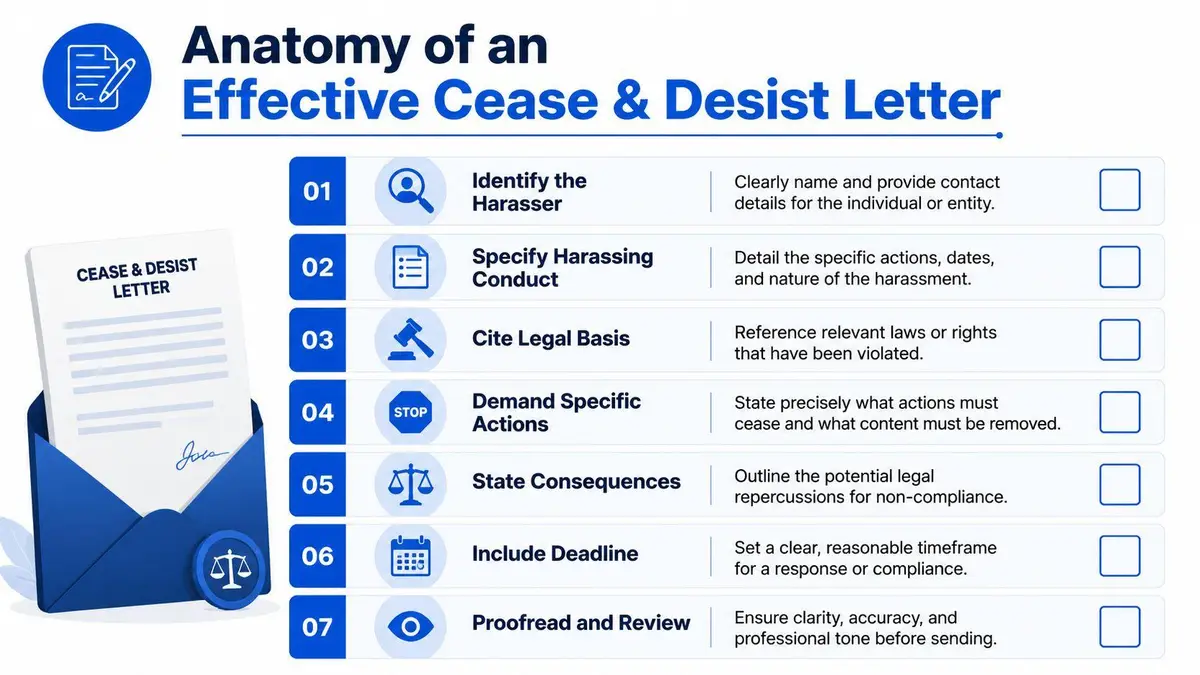
Anatomy of an Effective Letter Customization Is Key
The best cease and desist letter harassment template is still just a shell. What gives it force is disciplined customization. Most weak letters fail for one of three reasons: they don’t identify the right target, they don’t document the conduct with enough precision, or they overstate legal claims without enough factual support.
The better approach is methodical. The drafting framework summarized by AI Lawyer’s harassment cease and desist methodology identifies the core components practitioners rely on: party identification and delivery protocol, chronological incident documentation, legal framing and demand, and consequences with reservation of rights. That same summary states that templates following that methodology showed a 70% pre-litigation de-escalation rate, versus 30% for DIY versions lacking specifics.
Identify the person or account precisely
If you know the harasser’s legal name, use it. If you don’t, use every reliable identifier you do have: username, display name, email address, phone number, channel name, profile URL, or website ownership detail. In digital matters, this often means naming both the individual and the account.
A vague opening such as “to the person responsible” signals uncertainty. It also creates room for denial. If the recipient runs several accounts, list them. If the conduct appears across several platforms, separate them clearly.
Build a factual incident log
Many self-drafted letters collapse at this stage. The sender knows what happened, but the letter reads like outrage rather than evidence.
Use a short chronology. Dates matter. Times help. Platform names matter. Exact language matters when it’s central to the issue. Screenshots, message headers, voicemail files, and URLs should be preserved before the letter goes out.
A useful incident log usually includes:
- Date and time: When the message, post, call, or encounter occurred.
- What happened: A factual sentence, not an argument.
- Supporting proof: Screenshot filename, URL, witness name, or message export.
Keep the tone clinical. “On April 4, you sent three emails after prior requests to stop” is stronger than “you’ve been obsessively terrorizing me.”
Frame the legal issue without grandstanding
You don’t improve a letter by throwing in every legal term you’ve heard. Overclaiming invites a dismissive response and can create your own exposure if you accuse someone of crimes or liabilities you can’t support.
For most harassment letters, the legal framing should do three things:
- Identify the category of misconduct.
- Connect that category to the documented conduct.
- Demand specific corrective action.
That means “cease all direct and indirect contact” is better than “stop harassing me in every conceivable way.” It means “remove the posts located at the following URLs” is better than “take down everything.”
Demand what you can later measure
The demand section should be enforceable in practical terms. If a recipient claims compliance, you should be able to test that claim quickly.
Some demands are binary. Stop texting. Remove post A. Remove video B. Block contact through listed accounts. Others need tighter drafting. “Stop discussing me” may be too broad depending on the facts. “Stop publishing false statements that I engaged in misconduct, including the statements appearing at the URLs below” is much more workable.
Reserve rights without sounding performative
Threats usually weaken the document. Precision strengthens it.
A proper consequences section signals seriousness while preserving flexibility. It typically references platform reporting, law enforcement, protective relief, and civil remedies where appropriate. It also states that the letter doesn’t waive other rights.
Strategic Delivery and Documenting Receipt
A harassment letter that can’t be proved is often just correspondence. Delivery is part of the legal architecture. The right method depends on how quickly you need action, how much evidentiary weight you need later, and whether the recipient is likely to evade service or exploit ambiguity.
The classic mistake is sending the letter only through the same channel the harassment occurred on, then assuming the message itself proves receipt. Sometimes it will. Often it won’t. A cleaner approach is to choose a method that fits both the urgency of the problem and the record you may need later.
Certified mail, email, or process server
Certified mail remains the conventional choice because it creates a formal mailing trail and often carries the right level of seriousness without immediate escalation. It works well when you have a reliable physical address and want a standard record.
Email is faster and can be highly effective in digital harassment matters, especially where the recipient operates primarily online or the misconduct occurs through platform accounts tied to a known email address. But email alone can become a fight about authenticity, spam filtering, or whether the recipient opened it.
A process server is the most forceful option. It creates the least room for argument about notice, but it also raises the temperature. That may be exactly right in some cases and counterproductive in others.
| Method | Legal Weight | Cost | Best Use Case |
|---|---|---|---|
| Certified Mail with Return Receipt | Strong documentary value and conventional formality | Moderate | Known physical address, moderate urgency, desire for a standard evidentiary record |
| Email with Read Receipt or Tracking | Faster, but weight depends on metadata and surrounding proof | Low | Digital harassment, urgent notice, known working email, need to move quickly |
| Professional Process Server | Highest practical proof of service | Higher | Evasive recipient, high-stakes matter, expected litigation, need to eliminate notice disputes |
Use layered delivery when the stakes justify it
In high-friction matters, one method is often not enough. The more prudent approach is parallel notice: certified mail to the known address, email to the known account, and preservation of all delivery confirmations. If the conduct is platform-based, send platform reports separately rather than assuming the cease and desist letter substitutes for platform enforcement.
Operational point: The delivery file should include the final signed letter, mailing receipt, tracking history, email transmission record, attachments sent, and a log noting when each method was used.
There’s also a strategic tone question. A process server can convey seriousness, but it can also provoke a volatile recipient. Certified mail is less confrontational while still formal. Email is efficient, but if you use it, use a subject line that’s unmistakable and save the complete transmission record.
What not to do
Don’t send multiple inconsistent versions of the letter. Don’t keep revising the demands after sending unless counsel directs it. Don’t continue arguing by text once formal notice is delivered. That kind of post-letter back-and-forth undermines the point of putting boundaries in writing.
If you send the letter yourself, behave as though every later reader will examine both sides of the exchange. That discipline protects you.
After the Letter Documenting Compliance and Next Steps
The letter goes out. Then the actual evaluation begins.
Most matters branch one of two ways. Either the conduct stops, or it doesn’t. Your response should be calm in either scenario. The letter becomes more valuable after delivery because it marks the line between disputed conduct and conduct continued after formal notice.

If the recipient complies
Compliance doesn’t mean the matter never happened. It means you preserve the file and stop feeding the situation.
A useful compliance file should contain the sent letter, delivery proof, the harmful content as it existed before removal, and evidence showing what changed after notice. If posts came down, capture that. If contact stopped, note the last incident date. If fake profiles were removed, preserve the old profile URLs and any platform confirmations.
Don’t restart contact just because the silence feels unsatisfying. You’re not looking for an apology. You’re looking for cessation and defensible records.
If the recipient ignores the letter
Non-compliance sharpens the record. At that point, each new act can be framed as conduct continuing after formal notice. That often matters more than the original exchange.
The practical sequence usually looks like this:
- Continue documenting: Preserve every new message, repost, account, or reference.
- Separate channels: Keep your evidence log distinct from any emotional notes or personal commentary.
- Escalate where appropriate: Law enforcement, protective orders, civil counsel, and platform complaints may now carry more weight because the notice history is clear.
- Treat the letter as Exhibit A: It shows the recipient had a chance to stop and chose not to.
The available next step depends on the facts. In some cases, the strongest move is a police report. In others, it’s an injunction application, a civil filing, or an aggressive takedown campaign aimed at the platforms and hosts involved.
Why the first letter still matters after failure
Even when a cease and desist letter doesn’t end the problem, it often improves the quality of what comes next. According to the 2024 American Bar Association study summarized by LawDistrict’s cease and desist guide, 72% of recipients complied immediately upon receipt, and restraining orders were needed in 18% of cases, compared with 45% without prior notice. That doesn’t mean every case should start with a letter. It means formal notice frequently changes the terrain.
The letter isn’t wasted if the other side refuses to comply. In many matters, the refusal is what turns a diffuse problem into a provable one.
If the issue includes false publications on a website or other hosted content that remains live after notice, this guide on how to get a website taken down for slander is a practical next read because the post-letter phase often turns into a removal strategy rather than a correspondence strategy.
When a Template Is Not Enough Engaging Professionals
At 7:30 a.m., a CEO’s spouse finds a fake account reposting private photos, a search result starts surfacing a false allegation, and a “simple” harassment matter becomes a live reputational threat before the workday begins. In that situation, a template is not a solution. It is one tool inside a larger response plan.
A form letter loses value fast when the sender does not know who is behind the conduct, where the content is hosted, which claims are strongest, or how a platform is likely to react. The problem gets harder when the conduct spreads across multiple accounts, multiple countries, or multiple legal theories at once. Harassment often overlaps with defamation, privacy violations, impersonation, copyright misuse, doxxing, and coordinated review attacks. Each claim has different proof requirements, different remedies, and different risks.
Digital matters also require decisions that templates rarely address. Source removal and search suppression are different tasks. A demand that is too broad can trigger reposting, counterclaims, or platform inaction. A demand that is too narrow may remove one post while leaving copies, mirrors, cached pages, and indexed references untouched. Good counsel plans for the second and third move, not just the first.
Professional help also matters when damages are part of the strategy. Emotional distress can be real, compensable harm, but it needs to be framed carefully and supported with facts that fit the forum and the claim. This discussion of Olson & Sons landlord emotional distress shows how damages analysis can become more nuanced than a single cease and desist letter suggests.
For executives, founders, physicians, investors, and public-facing families, the margin for error is small. I have seen low-cost letters create avoidable problems by misstating facts, naming the wrong defendant, sending notice to the wrong entity, or making threats the client was not prepared to enforce. Once that happens, the other side learns your position, your timing, and sometimes your weak points.
Start with strategy if the matter touches search visibility, anonymous publishing, leaked content, board or investor exposure, or a target likely to fight back. An internet defamation attorney consultation for executives is often the better first move because it aligns the letter, takedown work, evidence preservation, and escalation path before notice goes out.
If you’re dealing with harassment that’s already affecting your name, business, family, or search results, ContentRemoval.com can assess the situation confidentially and help map the right response, from formal notice and takedown strategy to platform escalation and long-term monitoring.
Frequently asked questions
Is a cease and desist letter for harassment legally binding?
No. It is not a court order and the recipient is not compelled to comply on receipt. Its value is formal notice and a documented record that can be used with platforms, law enforcement or a court if the conduct continues, which is why the article stresses precise, clinical drafting.
How should I send a cease and desist letter so I can prove it was received?
Certified mail with return receipt gives a conventional documentary record, email with tracking is faster for digital harassment, and a process server offers the strongest proof of service for evasive recipients. In serious matters send through more than one channel and keep every receipt, tracking history and transmission record.
What should I do if the harasser ignores the cease and desist letter?
Keep documenting every new message, repost or account, keep the evidence log separate from personal notes, and escalate to law enforcement, protective orders, civil counsel or platform complaints. Continued conduct after formal notice sharpens the record and turns a diffuse problem into a provable one.