
Yes, you can sue someone for wrongly accusing you, most often through a defamation claim for libel or slander, and in some cases false light or malicious prosecution. You must prove a false statement, publication, fault and damages, with public figures required to show actual malice. Remedies include special and general damages, punitive damages, permanent injunctions and court-ordered retractions.
Key facts
- Libel covers written statements such as posts, reviews and emails; slander covers spoken statements and often relies on witnesses.
- Malicious prosecution requires first prevailing in the baseless case brought against you, then proving intent to harass.
- The UK and Australia are more plaintiff-friendly than the United States; the UK requires proof of serious harm.
- Statutes of limitation for defamation can be as short as one year from publication.
Where ContentRemoval.com comes in. ContentRemoval.com runs the digital remediation front of the two-front strategy this guide describes, pursuing source removal and search de-indexing while your lawyers send the cease and desist, file a John Doe action or build the damages case. Executives, family offices and their counsel typically make contact in the first 24 to 48 hours after an accusation surfaces. A free 15-minute Exposure Scan maps what is removable, and the report is yours to keep. Get a Free, Confidential Exposure Scan or read how our content removal work is done.
Yes, you can sue someone for wrongly accusing you. For a high-net-worth individual, executive, or family office, a false accusation is not a simple misunderstanding. It is a direct assault on your reputation, career, and personal security. This guide outlines the framework for decisive legal action.
The Strategic Reality of Suing for Wrongful Accusations
A false claim is often a calculated act intended to inflict maximum harm. What begins as a private dispute can escalate into a public crisis within hours, amplified by social media and online platforms. This reality necessitates a swift, strategic response grounded in a precise understanding of your legal options.
The ability to sue for a false accusation is a critical tool for vindication. The primary legal battleground is defamation, a civil claim designed to secure compensation for reputational damage caused by false statements. This provides a direct path to hold the accuser accountable, but it is not the only one. Depending on the specifics of the allegation, other legal claims can be leveraged to construct a more formidable case.
The Modern Battlefield for Reputation
A single malicious tweet, fabricated review, or defamatory blog post can spiral into a reputational catastrophe, threatening professional standing and incurring substantial costs for remediation. The global surge in defamation lawsuits tied directly to social media underscores the frequency and intensity of these conflicts.
A false accusation that might have once remained a localized rumor now achieves global reach instantaneously, magnifying the damage exponentially. High-profile court verdicts validate this. A 2025 defamation trial in Ireland, for example, resulted in a jury awarding €100,000 in damages to the victim, demonstrating that courts are prepared to award significant sums to counteract false claims.
A false accusation is an attack on your most valuable asset: your name. The objective is not just to correct the record but to dismantle the attack, hold the perpetrator accountable, and secure a definitive legal victory that vindicates your reputation.
The fallout from such accusations, particularly those involving allegations of serious criminal conduct, can be devastating. Understanding your rights and the immediate actions required is paramount. Resources on Navigating False Sexual Assault Allegations are vital for both civilian and military contexts.

This guide is structured to help you transition from a defensive posture to a proactive one, equipping you with the knowledge of specific legal actions available to counter damaging falsehoods.
Building Your Legal Case Against False Claims
To prevail against a wrongful accusation, to clear your name and recover damages, you must construct an unassailable legal case. This requires a precise understanding of the specific civil claims, or “torts,” designed to combat reputational and financial injury.
The cornerstone of most such cases is defamation. It is the primary legal instrument for holding an individual accountable for the real-world harm their false statements have caused. This is not a matter of subjective offense; it concerns the tangible damage to your career, business, and public standing.
The Two Forms of Defamation
Defamation is not a monolithic concept. It manifests in two distinct forms, and the distinction dictates the methodology for gathering and presenting evidence.
Libel is the written or otherwise permanent form of defamation. This includes newspaper articles, social media posts, blogs, negative online reviews, and emails. Because libel is recorded, it creates a clear, durable evidentiary record that is more readily preserved and presented in court.
Slander is the spoken form of defamation. Slander occurs when a false statement is made in a speech, during a broadcast, or in a conversation overheard by third parties. Proving slander is often more challenging, as it may rely on witness testimony rather than a physical record.
Regardless of the form, a successful defamation claim requires proof of four key elements: a false statement was made, it was “published” (communicated to a third party), the speaker was at fault, and you suffered quantifiable damages as a result. For a closer analysis of how these principles apply online, our firm provides a detailed guide on what constitutes online defamation for executives and founders.
Beyond Defamation: Additional Legal Claims
While defamation is the most common cause of action, a proficient legal team will explore ancillary claims to fortify your case, particularly when the false accusation has unique or far-reaching consequences.
A powerful alternative is false light invasion of privacy. This tort applies when someone publishes information that creates a highly misleading and offensive impression of you, even if the statements are not technically false. For instance, using your photograph in an article about corporate malfeasance, without naming you, can place you in a false light and cause immense reputational harm.
In more extreme circumstances, a claim for malicious prosecution may be warranted. This action arises when an individual initiates a baseless criminal charge or lawsuit against you with malicious intent. To pursue this, you must first prevail in the unfounded case brought against you. Subsequently, you must prove the filer’s intent was to harass, not to seek legitimate justice. When confronting a claim of this gravity, meticulous evidence documentation is non-negotiable. Utilizing a chain of custody template ensures that every piece of evidence is properly tracked and admissible.
Building a successful case is like assembling a precision engine. Each component (the specific legal claim, the preserved evidence, and the calculated damages) must fit together perfectly to generate the power needed for a decisive legal victory.
By integrating these legal strategies, your counsel can launch a multi-pronged assault. Whether confronting an anonymous online detractor or a well-funded media entity, this comprehensive approach ensures that every facet of the wrongful accusation is challenged, leaving no room for doubt as you pursue vindication.
How to Win a Defamation Lawsuit
Winning a defamation lawsuit is not about being right; it is about proving you are right. Justified outrage over a false accusation is insufficient for a legal victory. Success hinges on hard evidence, a precise legal strategy, and a sophisticated understanding of the court where the battle will be fought.
The burden of proof rests entirely on you, the plaintiff. You must construct a case that proves every element of defamation. This is a difficult undertaking for any individual, but the standard becomes significantly higher if you are classified as a public figure, a designation that can apply to executives, prominent professionals, or anyone with a degree of public influence.
The “Actual Malice” Hurdle for Public Figures
In the United States, First Amendment free speech protections establish a formidable standard for public figures. Proving a statement was false is merely the initial step. You must also prove actual malice, a rigorous legal standard that derails many cases.
Actual malice is a legal term of art. It does not refer to spite or ill will. In a legal context, it means you must demonstrate that the publisher knew the statement was false or acted with a reckless disregard for the truth.
This is where the challenge intensifies. Proving a defendant’s state of mind requires discovery of their communications, notes, and research, or a complete lack thereof. It is a substantial hurdle but not an insurmountable one, particularly when evidence of a calculated smear campaign exists. This standard is examined in greater detail in our comprehensive online defamation guide.
Defamation Proof Standards by Jurisdiction
The strategy for suing over a false accusation is dictated by the jurisdiction where you file suit. A successful approach in one country may fail in another. The following table compares the proof requirements in key jurisdictions.
| Jurisdiction | Standard of Proof for Public Figures | Key Strategic Considerations |
|---|---|---|
| United States | Must prove actual malice: the defendant knew the statement was false or acted with reckless disregard for the truth. | The most defendant-friendly jurisdiction. The burden is entirely on the plaintiff to prove falsity, harm, and malice. Very high bar. |
| United Kingdom | Plaintiff must show the statement caused or is likely to cause “serious harm” to their reputation. The “public interest” defense is a major factor. | More plaintiff-friendly than the U.S. The focus is on reputational harm, and historically, the defendant often had to prove the statement was true. |
| Australia | Focuses on proving the statement was published and defamatory. The defendant then has several defenses, such as truth or honest opinion. | Generally seen as plaintiff-friendly. Recent laws have introduced a “serious harm” element, but large damage awards are still common for reputational damage. |
Understanding these jurisdictional nuances is critical to positioning your case for a successful outcome. A strategy effective in London may be untenable in Los Angeles.
How Your Location Changes the Game
These jurisdictional differences have profound real-world consequences. The courtroom is now a primary front in the battle against online falsehoods, and recent trends underscore the importance of location.
As highlighted in Inforrm’s annual review of major legal actions, plaintiffs from England to Australia are securing significant victories. A landmark UK case against the operator of Tattle Life in June 2025 is illustrative. The court not only stripped the publisher of anonymity but also froze assets worth over £1.8 million due to a relentless harassment campaign. This demonstrates a growing judicial willingness to hold malicious actors accountable, a trend also observed in recent Australian cases. You can read more about these milestone defamation cases and their outcomes.
Assembling Your Evidence Arsenal
Regardless of where you file, your case will succeed or fail based on the quality of your evidence. You cannot merely assert harm; you must demonstrate it with irrefutable proof. Your evidentiary arsenal must include:
- Digital Footprints: This requires meticulous preservation. Screenshots, PDFs, and archives of every defamatory post, comment, or article must be maintained. Digital forensics can authenticate this content and prove its existence, even after deletion.
- Behind-the-Scenes Communications: Collect every email, text message, or direct message from the individual who made the false claim. These communications can be invaluable for proving intent, knowledge, or malice.
- Witnesses: Identify individuals willing to provide sworn statements. They can corroborate the falsity of the claims or testify to the real-world damage your reputation has suffered within your community or industry.
- Proof of Financial Damage: You must directly link the defamatory statements to your financial bottom line. This requires documentation of lost income, canceled contracts, a decline in sales, or a decrease in your company’s stock value.
Assembling this volume of evidence requires a coordinated effort with legal counsel and digital forensic experts to ensure every item is unassailable and admissible in court. This is the foundation upon which you will reclaim your reputation.
Securing Damages and Definitive Remedies
A favorable court judgment is a significant milestone, but it is not the final objective. A verdict alone does not automatically repair the damage to your life and reputation. The ultimate goal is to secure remedies that make you whole, both financially and by correcting the public record.
This entails a two-pronged strategy: obtaining compensation for all harm suffered and securing a court order to permanently silence the accuser.
Quantifying the Harm: Special and General Damages
When you sue for defamation, courts assess the harm you have suffered in two distinct categories. This accounts for both quantifiable financial losses and the profound personal impact.
- Special Damages: These are the tangible, monetary losses that can be proven with financial records. If you lost a major client, were terminated from a position, or had to retain a crisis communications firm, these are special damages. Proving them requires meticulous documentation that directly connects the false statement to your financial injury.
- General Damages: This is compensation for harm that lacks a clear invoice. It addresses the damage to your good name, the loss of standing in your community, personal humiliation, and emotional distress. Courts recognize that the core injury in a wrongful accusation is often reputational and award general damages to compensate for this very real, albeit less tangible, suffering.
The path to securing these damages is often determined by your public status, whether you are a private citizen or a public figure. This decision tree illustrates the primary legal hurdles you will face.
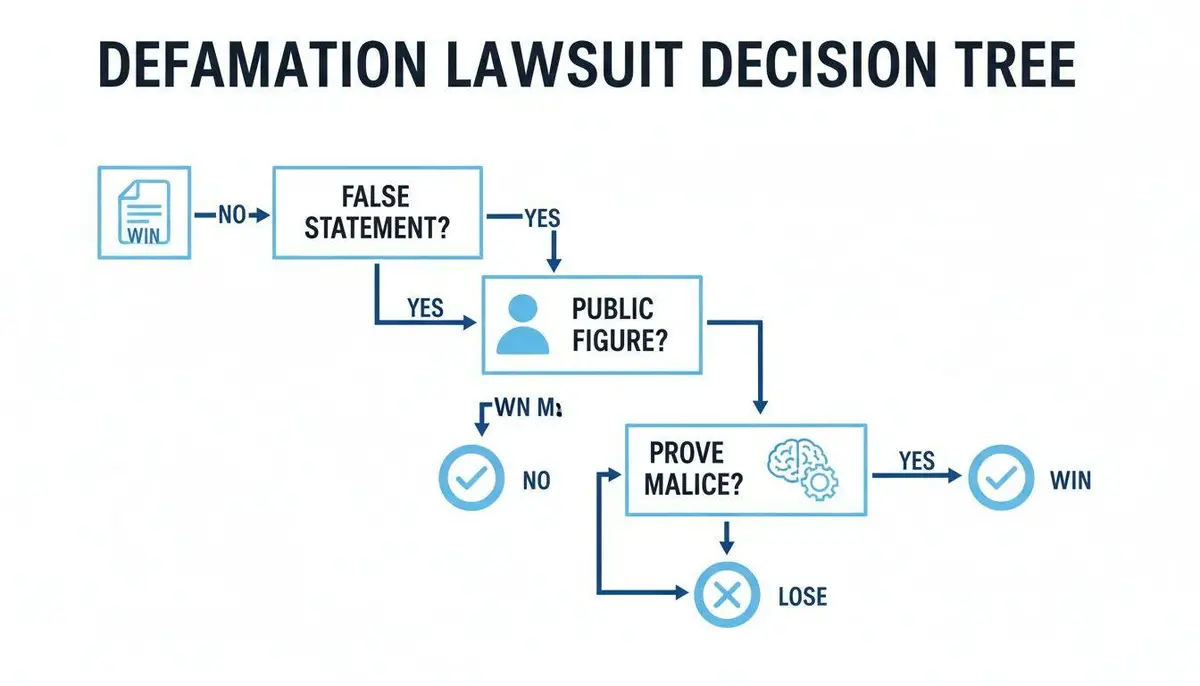
As shown, the burden of proof shifts dramatically. For most private individuals, demonstrating the statement was false and damaging is sufficient. For public figures, the standard is much higher; you must typically prove the accuser acted with actual malice.
Punitive Damages and Powerful Injunctions
In certain cases, compensation alone is insufficient. When an accuser’s conduct has been particularly egregious or reckless, the court can take further measures to punish them and prevent future misconduct.
If the defendant’s behavior was outrageous, driven by malice or a complete disregard for the truth, a court may award punitive damages. This is not to compensate for your losses. It is a financial penalty designed to punish the wrongdoer and signal that such destructive conduct carries a severe price.
The ultimate remedy isn’t just about money. It’s about achieving finality, a court-ordered directive that silences the accuser and officially corrects the public record, providing complete vindication.
Perhaps the most critical non-financial remedy is a permanent injunction. This is a court order that legally prohibits the defendant from repeating the false statements. A violation of the injunction can result in serious penalties, including fines or imprisonment. It is a highly effective tool for halting a smear campaign permanently.
Finally, your counsel can petition the court to order a retraction. This compels the accuser to issue a public correction, often in the same forum where the original falsehood was published. A court-ordered retraction is a powerful instrument for dismantling the false narrative and formally restoring your reputation.
Your Immediate Defense Plan
When confronted with a false accusation online, time is of the essence. You do not have weeks to formulate a response; the opportunity to control the narrative is within the first 24-48 hours. While a lawsuit may be the ultimate course of action, the immediate steps you take are critical to mitigating damage. A proactive, two-part strategy, legal and digital, is required.
The first imperative is to preserve the evidence. Defamatory posts, comments, and social media profiles can be deleted instantly, destroying your proof. You must capture everything immediately. This involves more than a simple screenshot; you need forensically sound copies that will be admissible in court, complete with all URLs, timestamps, and metadata.

Do not attempt this yourself. The risk of spoliation, the improper alteration or failure to preserve evidence, is significant and can jeopardize your entire legal claim. You require a professional who understands the digital chain of custody.
Firing the First Shot: The Cease and Desist
Concurrently with evidence preservation, you must send an unequivocal message that you will not tolerate the attack. The most effective method is a cease and desist letter issued by legal counsel. This formal legal document achieves several critical objectives:
- It puts the accuser on formal notice that their conduct is unlawful.
- It demands the immediate removal of all false statements and a halt to their attacks.
- It creates a documented record that the accuser was aware their statements were disputed, which is instrumental in proving malice later.
An effective cease and desist letter is not an invitation for debate; it is a declaration. The appearance of a law firm’s letterhead is often sufficient to compel an attacker to retreat, as they recognize the prospect of imminent legal consequences.
Wiping the Slate Clean With Rapid Takedowns
While your legal team engages the individual responsible for the attack, the false statements remain online, inflicting reputational damage with every view. This necessitates a parallel plan: rapid content removal. Nearly every social media platform, forum, and review site has terms of service that prohibit harassment and defamation.
A winning strategy fights on two fronts. You go after the person responsible legally while, at the same time, you systematically tear down the attack they built online. Doing one without the other is like trying to fight with one hand tied behind your back.
This is where a specialist firm like ContentRemoval.com provides critical support. We do not merely submit standard complaints; we leverage direct platform contacts and proven methodologies to achieve expedited content removal. Our process includes:
- Source Removal: We target the website or social media profile where the content originated, utilizing our knowledge of each platform’s policies to secure removal at the source.
- De-indexing from Search Engines: We then petition search engines like Google to remove the toxic URLs from their search results. If the content cannot be found, its capacity for harm is neutralized.
This dual approach contains the damage while your legal team advances its case. By combining decisive legal action with swift digital remediation, you regain control, silence your accuser, and begin the work of restoring your reputation.
Combating AI-Driven and Anonymous Attacks
The nature of false accusations has been fundamentally altered. We have moved from simple rumors to a new era where generative AI and online anonymity create a potent, dangerous combination. These are no longer just falsehoods; they are sophisticated, coordinated attacks, and defending against them requires a new playbook.
The emergence of “AI defamation” is an alarming development. Malicious actors can now use AI tools to generate convincing falsehoods that appear authoritative. An AI could fabricate a criminal record or invent details of a non-existent lawsuit. As these tools become more accessible, the ability to sue for wrongful accusations is more vital than ever.
Courts are only beginning to address this phenomenon. While some early rulings have favored technology developers, the legal landscape is shifting as plaintiffs mount challenges. A landmark case, LTL LED, LLC v. Google LLC, seeks over $100 million for damages caused by AI-generated falsehoods, signaling a new wave of high-stakes litigation. For a deeper analysis of this legal frontier, you can read more about defamation in the AI era.
Unmasking Anonymous Attackers
Anonymity emboldens accusers, but it does not make them legally invisible. A well-established legal process exists to unmask them: the “John Doe” lawsuit.
The process is straightforward. Your attorney files a lawsuit against an “unknown” defendant, designated by a placeholder like “John Doe 1.” Once the suit is filed, your legal team can petition the court for a subpoena. This is a court order compelling platforms, web hosts, or internet service providers to disclose the real identity associated with the anonymous account or IP address.
Anonymity is not a legal shield. A “John Doe” lawsuit transforms a nameless online phantom into a defendant with a real name and address, making them fully accountable for the damage they have caused.
This is not a simple request; it is a combination of digital forensics and sharp legal maneuvering. It requires an experienced team to trace the digital trail and leverage the power of the courts to compel an attacker’s identification.
The Need for Specialized Expertise
In the face of an AI-powered or anonymous smear campaign, traditional methods are too slow. A conventional lawsuit can take months to initiate, while a viral lie can destroy a reputation in hours. For any individual with a public profile, a specialized, rapid-response capability is essential.
The most effective strategy attacks the problem on two fronts simultaneously: immediate digital remediation and aggressive legal action. While a specialized firm works to remove the damaging content, your lawyers can focus on unmasking the responsible party and building a robust case for damages. You can learn more about how to remove cyber abuse and begin protecting your name online. This dual approach is the only way to both stop the damage and hold the attacker accountable.
Frequently Asked Questions
When blindsided by a false accusation, you need clear, direct answers from professionals with experience in these matters. Here are some of the most common questions we receive from clients.
How Long Do I Have to Sue for a Wrongful Accusation?
The clock starts ticking the moment a false statement about you is published. This deadline is the statute of limitations, and for defamation claims, it can be as short as one year.
This is not a flexible guideline; it is a hard deadline. If you miss this window, your right to sue is extinguished, regardless of the strength of your case. It is therefore critical to consult with an attorney immediately to determine the precise timeline applicable in your jurisdiction. Do not allow a procedural technicality to foreclose your opportunity for justice.
Can I Sue an Anonymous Online Accuser?
Yes. Hiding behind a fictitious username does not grant immunity from legal accountability. The legal system provides a well-established process for this scenario.
Your attorney will file a “John Doe” lawsuit against the unknown individual. Subsequently, they can issue subpoenas to the relevant social media platform, web host, or internet service provider, compelling them to disclose the identity of the person behind the account. This is a technical but standard procedure for unmasking and holding anonymous attackers accountable.
A wrongful accusation requires a dual-front war. You must simultaneously dismantle the public lie while pursuing the source. One action contains the damage; the other delivers justice.
Is It Better to Sue or Remove the Content?
This is a false choice. The optimal approach is not to select one over the other but to execute both concurrently. A two-pronged strategy is necessary.
Content removal is your immediate defensive measure. It is triage. A specialist firm can act swiftly to contain the damage and prevent the falsehood from spreading. Simultaneously, filing a lawsuit is your offensive action. It is how you hold the perpetrator accountable, recover financial damages, and secure a court order to prevent recurrence. The two efforts are complementary and should be pursued in parallel.
When your reputation is on the line, you require a definitive solution. ContentRemoval.com specializes in rapid, discreet, and permanent removal of damaging online content. We combine legal expertise with proprietary technology to protect high-profile individuals from defamatory attacks. Contact us for a confidential assessment and take the first step toward restoring your name.