
Business defamation online removal follows a disciplined sequence: preserve layered evidence first, identify who controls publication, then choose the fastest route among platform policy enforcement, a targeted legal demand and search visibility mitigation. Litigation is a selective tool, used when subpoena power, injunctive relief or a refusing publisher justify the cost and documented damages exist.
Key facts
- Capture full-page screenshots, PDFs, HTML copies, search result captures, poster profiles and amplification evidence, plus a dated damages log.
- Xiuling Wei v Jingping Long drew the line between a website operator that publishes and a registrar that only registers.
- On social platforms, impersonation, harassment, privacy and fraud policies are stronger levers than the word defamation.
- Vorys notes many states require tangible evidence of lost business, such as a cancelled contract, to prove damages.
Where ContentRemoval.com comes in. ContentRemoval.com runs the removal track for companies facing defamatory reviews, fabricated blog articles and hostile forum threads: mapping who controls publication, preparing platform-specific submissions, pursuing de-indexing and monitoring for reposts while counsel weighs legal options. General counsel, a senior risk executive or the company’s outside lawyer usually makes the first contact. A free 15-minute Exposure Scan maps what is removable, and the report is yours to keep. Get a Free, Confidential Exposure Scan or read how our defamation removal work is done.
A false review, a fabricated allegation on a niche blog, or a hostile thread on an industry forum can become the first thing a customer, investor, lender, or acquisition counsel sees when they search your company name. That is not a branding inconvenience. It is a live commercial threat.
When defamatory content sits on page one, it distorts diligence, slows deals, poisons sales conversations, and forces your team into defensive explanations. Executives usually waste the first critical days doing the wrong things. They argue in public, send emotional emails, or target the wrong intermediary. The result is predictable. The post stays up, the record gets messier, and the attacker gains an advantage.
Business defamation online removal requires a disciplined sequence. First preserve evidence. Then identify the party with actual control over publication. Then choose the fastest removal path that fits the facts, platform, and risk profile. Litigation has a place, but it should be selected for strategic value, not as a reflex.
The Executive Response to Online Defamation
Treat online defamation like a breach event. Assign ownership, lock down the facts, and control external communications. If your leadership team treats it as a PR flare-up, you’ll burn time while the content entrenches itself in search and stakeholder conversations.
The first executive mistake is fragmentation. Legal reviews one issue, marketing handles another, and an operations lead starts replying to customers ad hoc. That creates inconsistency and admissions risk. One person should coordinate the response. Usually that is general counsel, outside counsel, or a senior risk executive.
What to do in the first hours
Start with containment.
- Freeze public responses: Don’t let staff debate the author online, threaten them in comments, or post emotional denials.
- Centralize the record: Use one internal file for screenshots, URLs, dates, account handles, search result captures, and inbound stakeholder reactions.
- Separate fact from outrage: Identify the exact statements that are false assertions of fact. Not every ugly post is removable.
- Assess visibility: Search your company name, executive names, product names, and high-intent terms a buyer would use.
- Prepare a stakeholder script: Sales, investor relations, and client-facing teams need one approved explanation if the issue is raised.
A company under pressure also needs message discipline outside the legal process. If a founder or spokesperson may face press questions, good media training for executives can prevent reactive statements that worsen exposure.
Practical rule: The objective isn’t to “fight back.” The objective is to regain control over publication, search visibility, and evidentiary position.
The right objective
Most executives frame the problem too narrowly. They ask, “Can we get this post deleted?” That matters, but it is only one part of the file.
A serious response has four goals:
| Goal | Why it matters |
|---|---|
| Preserve evidence | You may need it for platform appeals, host complaints, or court relief |
| Remove or reduce visibility | Search presence drives commercial harm |
| Document business impact | You may need this if the matter escalates |
| Prevent repeat publication | Attackers often repost after an initial takedown |
Here, professional process matters more than panic. A structured executive playbook, like the one outlined in this guide to <https://www.contentremoval.com/online-reputation-management-for-executives-a-strategic-guide-to-content-removal>, is far more useful than improvised reputation management.
What not to do
Some reactions almost always backfire.
Publicly accusing the poster without proof can trigger counterclaims. Contacting the domain registrar instead of the host often goes nowhere. Threatening a platform with legal jargon unsupported by evidence tends to be ignored, and handing the matter to a generalist PR firm usually produces visibility management, not removal.
Online defamation is operational. Treat it that way from the start.
Immediate Triage and Evidence Preservation
At 8:15 a.m., your sales lead forwards a screenshot of a post accusing your company of fraud. By 9:00, the post has comments, a branded search result, and a copy on a second account. If your team starts arguing with the poster before preserving the record, you lose the one asset that matters at this stage: usable evidence.
Speed matters because platforms edit, suspend, and purge data on their own schedules. Anonymous posters do the same. If you may need to identify the publisher later, every hour of delay reduces your chances of getting account data, post history, and publication context through platform channels or later legal process.

Build an evidentiary file that can survive scrutiny
A cropped screenshot is weak evidence. It may help an internal discussion. It often fails in a platform appeal, a host complaint, or a legal demand because it strips out timing, URL data, and context.
Capture the record in layers:
- Full-page screenshots showing the full post, visible URL, date, time, and surrounding page context.
- PDF captures of the page in the form a reviewer or moderator would see it.
- Saved source files or HTML copies where practical, especially for posts likely to be edited.
- Search result screenshots for branded and executive-name queries that show ranking and snippet text.
- Poster profile captures including username, profile URL, avatar, bio, join date, and linked accounts.
- Amplification evidence such as comments, replies, reposts, ratings, and quote posts.
- Internal business records that tie publication to harm, including lost deals, investor questions, customer complaints, recruiter feedback, and support tickets.
Use a public archiving tool for any page that is openly accessible. It gives you a timestamped third-party record if the author edits the language after notice.
Assume the poster will deny the post existed. Build your file for that fight.
Preserve publication context
A single sentence rarely decides the issue. Context often determines whether the statement reads as factual accusation, implied allegation, or opinion wrapped around a factual claim.
Capture the full frame around the statement:
- Page context: headline, deck, tags, images, captions, and adjacent text
- Distribution path: author page, category page, forum thread, review listing, and linked reposts
- Search context: where it appears for branded searches, map listings, or executive-name queries
- Narrative repetition: copies on other platforms, burner accounts, or review profiles using the same language
This is also where the anonymous-perpetrator problem starts to become manageable. Before you ask whether to sue, ask whether the same writing pattern, account details, linked profiles, timing, and cross-post behavior can identify the actor without court intervention. In many cases, that analysis gives you enough to target the right platform, host, or intermediary first.
If your team needs a clearer framework for what qualifies as libel versus protected opinion, review this explanation of written defamation and the path to content removal before sending demands that overstate the claim.
Start quantifying damages now
Do not wait for litigation to begin measuring harm. By then, the best evidence is often scattered across sales, support, HR, and investor relations.
Create a live damages log with dated entries. Track canceled meetings, paused procurement, refund requests, inbound questions referencing the allegation, employee attrition concerns, and unusual drops in conversion on branded traffic. Separate direct losses from probable losses. That distinction matters later when you decide whether the cost and risk of litigation make sense.
A simple log works if it is disciplined:
| Item | Record |
|---|---|
| URL | Exact page address |
| Date captured | Local time and timezone |
| Platform or site | Google, Yelp, blog, forum, LinkedIn, etc. |
| Account name | Poster or reviewer handle |
| Content summary | Short note on the false statement |
| Business impact | Lost lead, customer concern, employee issue, investor contact |
| Status | Live, edited, deleted, archived, reported |
Control internal handling
Evidence collection fails when five people start saving files in five different places. Put one person in charge. Use a single folder structure by platform and date. Record who captured each item and when. Preserve originals. Do not mark them up. Keep any annotations in a separate memo.
Do not contact the poster until the record is complete. Early contact often triggers deletion, account migration, or sanitized reposting that is harder to challenge. Your first move should follow the evidence, not emotion.
Mapping Your Removal Strategy
A bad post goes live at 8:15 a.m. By noon, your sales team has already seen prospects reference it, and someone inside the company wants to send an angry email to the poster. Stop that instinct. Your next move should be based on control, speed, and business impact.
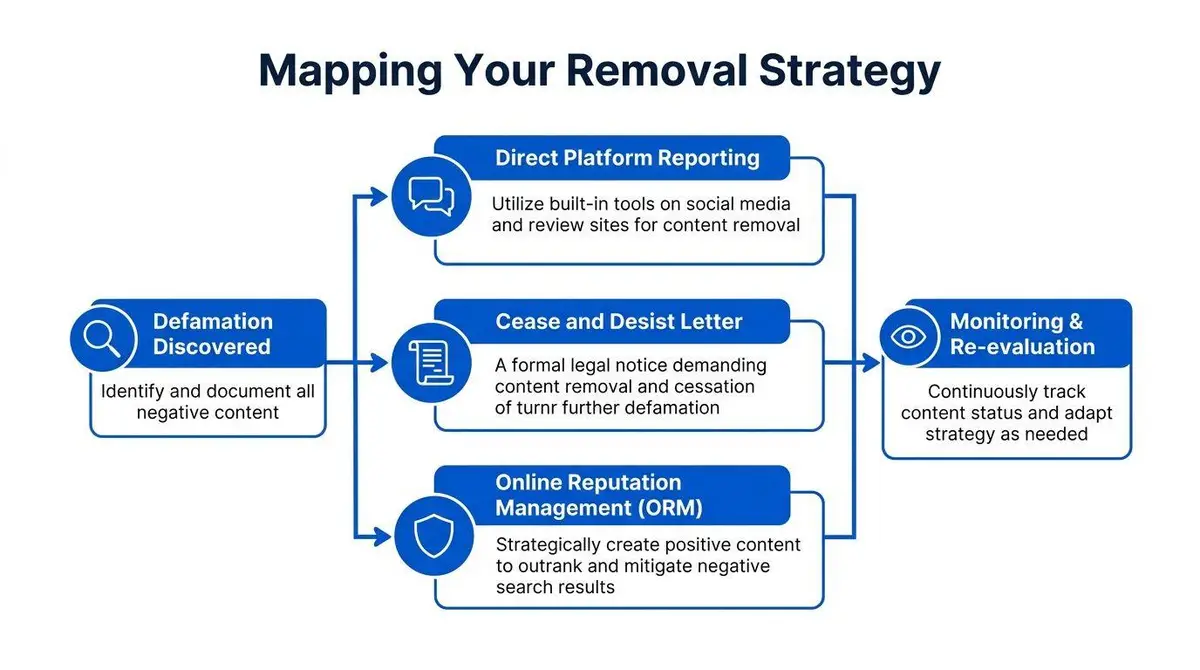
The right strategy starts with one question. Who can remove, restrict, edit, or bury the content? If you target the wrong actor first, you waste time and show your hand.
Start with control, not labels
“Defamation” is a legal conclusion. Removal depends on something more practical. Which party controls publication, hosting, indexing, or account enforcement?
The UK High Court case Xiuling Wei & Others v Jingping Long & Others EWHC 158 (KB) illustrates the point. The court drew a clear line between a website operator that publishes content and a domain registrar that only handles registration. If your team sends demands to the registrar while the site operator still controls the page, you are spending money on the wrong pressure point.
Treat every matter as a control map:
- Publisher. The person or entity posting the statement
- Platform or site operator. The party that can delete the post or suspend the account
- Host or infrastructure provider. Sometimes relevant for clear policy abuse, often irrelevant for ordinary defamation disputes
- Search engine. Important when visibility is causing immediate commercial harm
- Author. Helpful to identify, but not always necessary for early action
That last point matters. Anonymous attackers create delay, but anonymity does not eliminate your options. In many cases, you can still get traction through platform rules, account authenticity issues, impersonation policies, or search-level requests while you assess whether identifying the speaker is worth the cost.
Choose the channel that matches the objective
A removal strategy usually runs on three tracks. The mistake is treating them as interchangeable.
1. Platform enforcement
Use platform reporting when the post violates site rules on fake engagement, impersonation, harassment, privacy, manipulated content, or fabricated customer experiences. This is often the fastest path because the platform does not need a court to enforce its own policies.
Use it if:
- the content is on Google, LinkedIn, Yelp, Meta, X, Reddit, or another major platform
- the post breaks a written policy you can cite directly
- speed matters more than proving every legal element of defamation
- the poster may delete or repost if challenged too early
If the issue appears in Google surfaces, review the process for a Google legal removal request before deciding whether to submit a policy report, a legal request, or both.
2. Targeted legal demand
Use a legal demand when a site owner, editor, or identifiable poster has enough exposure to care. A good demand is narrow, factual, and built to force a decision. It identifies the exact statements, states why they are false, attaches proof, requests a defined remedy, and sets a record for later escalation.
Use it if:
- the publisher can be identified or reached
- the statements assert facts, not loose opinion
- voluntary removal, correction, or retraction is realistic
- the publication is on an independent site, industry blog, or smaller forum where operator discretion matters
Do not send a generic cease-and-desist letter copied from the internet. Weak letters get ignored and make the next step harder.
3. Search and visibility mitigation
Use this track when the page is harming you because people can find it, even if source removal will take time. That can include search de-indexing requests where available, suppression through stronger branded assets, or technical work that reduces the prominence of the false content in branded results.
Use it if:
- the page ranks for your company name, executives, or flagship products
- the publication is slow to respond
- the source is offshore, abandoned, or structurally difficult to remove
- your immediate problem is lost trust during search, not the existence of the page alone
The point is simple. Source removal and visibility control are different objectives. Handle them separately.
Match the tactic to the publication type
Different environments call for different first moves.
| Publication type | Best initial move | Wrong initial move |
|---|---|---|
| Google review | Policy-based report supported by transaction records or proof of no customer relationship | Threatening a lawsuit before using Google’s review channels |
| Major social platform post | Terms-based complaint with URLs, screenshots, and account identifiers | Complaining to the domain registrar |
| Independent blog or forum | Identify operator and host, then send a precise legal request | Fighting in the comments |
| News-style article | Demand correction, update, or legal review based on factual error | Treating protected opinion as if it were automatically removable |
Decide what success means before you act
If your standard is “full deletion everywhere,” you will make bad decisions. Set the objective based on business harm and cost.
Success may mean:
- source removal
- account suspension
- review deletion or edit
- a correction or editor’s note
- search de-indexing
- suppression in branded search results
- preserving a clean record for later litigation
Tie that outcome to your damages log. If the content is causing isolated annoyance, aggressive litigation may be a poor trade. If it is disrupting revenue, financing, hiring, or a transaction, your tolerance for delay should drop fast.
The correct question is not whether the content is offensive. The correct question is which pressure point reduces measurable harm fastest, while preserving your ability to escalate if the first move fails.
Executing Platform-Specific Takedown Procedures
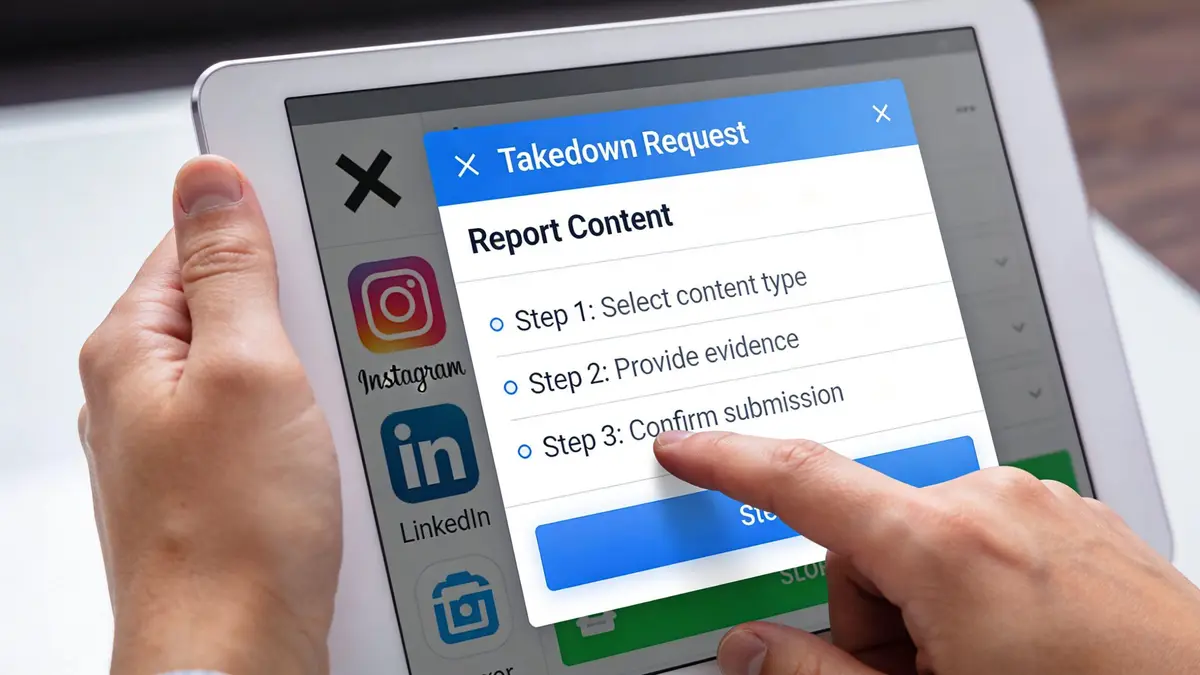
The anonymous poster problem freezes a lot of companies. It shouldn’t. You often don’t need to identify the author to get traction. CSH Law’s analysis of internet defamation notes that anonymity makes identification harder, but it also points to a more practical route: use platform Terms of Service violations and pressure points against the host or platform operator when available, instead of waiting through a months-long unmasking effort (CSH Law on how the internet transforms defamation harm).
Google and Google Business Profile
Google reviews are a high-volume threat because buyers trust them and they surface prominently. Don’t write a long emotional complaint. Build a factual submission.
For a false review, focus on policy language and evidence. Ask whether the review shows signs of impersonation, a non-customer relationship, coordinated abuse, conflict of interest, or fabricated events. If you know the reviewer has never been a customer, say that clearly and support it with records. If the review alleges specific criminal, financial, or professional misconduct, isolate the factual assertion and rebut it with attached documentation.
A practical sequence often works better than a single leap:
- Voluntary correction or removal request to the reviewer, if the person is identifiable and contact is low risk.
- A formal demand attaching evidence of falsehood and asking for removal or revision.
- Escalation through Google’s support and legal channels with a concise evidentiary package.
If your issue is in Google Search rather than reviews, use the correct legal process rather than random support forms. This guide on <https://www.contentremoval.com/blog/how-to-submit-a-google-legal-request> is useful for structuring that submission.
Social platforms
Social networks are inconsistent, but not random. Moderators respond better when you frame the complaint in their language rather than yours.
On Facebook, X, and LinkedIn, your strongest levers usually aren’t “this is defamatory.” They are:
- Impersonation
- Harassment or bullying
- Targeted abuse
- Privacy violations
- Fraud or deceptive behavior
- Manipulated identity or account misuse
If a post accuses your company of criminal conduct without basis, you may still need to fit the complaint into a policy category the platform already enforces. Attach screenshots, profile details, and any corroborating evidence that the account is fake, coordinated, or engaged in repeated abuse.
Use one disciplined narrative. Don’t upload contradictory reports from multiple employees. Platforms treat inconsistency as a credibility problem.
Short, documented reports outperform angry legal essays on social platforms.
Review sites and employment platforms
Yelp and Glassdoor require a different mindset. They are built to host criticism, so the threshold for removal is often tied to authenticity, conflict, and rule violations, not your view of fairness.
On these platforms, ask:
| Question | Why it matters |
|---|---|
| Was the reviewer a real customer or employee? | Authenticity is often the central issue |
| Does the post contain specific false factual claims? | Broad dislike is harder to remove |
| Is there evidence of coordination or bad faith? | Repeated patterns can support escalation |
| Does the account look fabricated? | Thin profiles and timing patterns can matter |
A common executive error is responding point-by-point in public. That may satisfy internal frustration, but it can validate the visibility of the allegation and create fresh statements that are searchable. Keep public replies narrow, factual, and brief if you reply at all.
Independent blogs, niche forums, and hostile websites
Precision matters most here. You need to identify the actual operator, hosting environment, contact details, and abuse channels. Some sites respond to direct legal pressure. Others don’t. In those cases, your influence may come from host complaints, search suppression, or evidence-building for later injunction relief.
One option among several in this category is a specialist service such as ContentRemoval.com, which handles source removal, de-indexing, false review takedowns, and ongoing monitoring across websites, search engines, and social platforms. That kind of support is useful when the publication chain spans multiple hosts, copied pages, and search surfaces.
Don’t wait for certainty about the attacker
If a pseudonymous account is publishing falsehoods, don’t let uncertainty about identity become paralysis. Move against the publication channel first. Identity can be pursued later if the economics justify it.
For high-stakes matters, speed beats indignation. The business goal is remediation.
The Decision to Escalate to Litigation
Litigation is a tool. It is not a strategy by itself.
Too many companies file or threaten suit because they want to “send a message.” That usually means they are about to spend heavily without a clear plan for removal, damages proof, or anonymity challenges. If your real objective is to stop commercial harm, you need to ask whether a lawsuit will do that faster than direct removal work.

The damages problem
Vorys makes the point directly. In many states, proving defamation requires damages, and it is traditionally hard to prove them without tangible evidence of loss of business, such as someone cancelling a contract or stating in writing that they will not do business with the company because of what they read online (Vorys on why removal is often the best solution for online defamation).
That is the central weakness in many business cases. Executives know the content is hurting them. Their lawyers may even agree. But knowing and proving are different things.
What to document before filing
If litigation is on the table, build the damages record before you spend on pleadings.
Track:
- Cancelled or paused deals where the prospect referenced the content
- Written customer concerns mentioning the allegation
- Sales-cycle disruption tied to branded search exposure
- Recruiting fallout if candidates withdraw after seeing the content
- Investor or lender questions directly linked to the publication
- Traffic and inquiry pattern changes that line up with publication dates
This doesn’t guarantee a winning damages case. It gives your counsel something better than intuition.
A company that can’t document harm often uses litigation to express anger. Courts don’t award damages for anger.
When litigation makes sense
There are situations where escalation is justified.
First, use litigation when you need subpoena power to identify a pseudonymous actor and the likely upside justifies the time and cost. Second, use it when a publisher refuses correction despite clear falsity and meaningful commercial harm. Third, use it when injunctive relief is realistic and source-level removal matters more than damages.
There is also precedent showing that internet defamation cases can produce large awards when the facts and proof line up. Verified examples include a $38.3 million Nevada federal jury award and $8.51 million plus permanent injunctive relief in Rombom v. Weberman. Those results show what is possible in extreme cases. They should not lull executives into assuming that every strong grievance becomes a high-value judgment.
When litigation is a distraction
Don’t litigate because the post is offensive. Don’t litigate when the author is judgment-proof and the platform route is still viable, and don’t litigate before fixing search exposure if your commercial losses are happening in real time.
A measured approach is usually better:
| Situation | Better first move |
|---|---|
| Anonymous account on a major platform | Policy-based takedown and preservation |
| False review from a likely non-customer | Reviewer challenge, platform escalation, evidence package |
| Defamatory niche blog post ranking for your name | Operator or host pressure plus search mitigation |
| Coordinated smear with identifiable actors | Parallel removal work and legal evaluation |
The strongest operators in this space don’t romanticize court. They use it selectively, when it improves influence or secures a remedy that platform channels won’t provide.
Building a Proactive Digital Defense
At 8:15 a.m., your sales team spots a false accusation ranking on page one for your company name. By noon, prospects are asking about it. If your response starts that day, you are already late. Digital defense has to exist before the next hit appears.
Build a standing system, not a one-off reaction. The core question is operational. Which threats need monitoring, which ones can be pushed through platform channels, and which ones justify legal spend because the likely damage is measurable and serious?
Build for early detection
Passive monitoring fails because online attacks spread faster than internal reporting. Set up recurring checks for your company name, executive names, flagship products, and predictable smear terms tied to fraud, scam, lawsuit, or unsafe conduct. Track search results, review sites, social platforms, niche forums, video platforms, and image search.
Speed matters, but classification matters more. Your team should know, within minutes, whether a new post is a review dispute, impersonation, doxxing, reposted material, or a false factual claim that could support a defamation case. That classification determines the next move.
A practical monitoring stack should include:
- Search result checks for branded, executive, and product queries
- Review monitoring across major customer-facing platforms
- Social listening for coordinated reposting and pile-ons
- Reupload detection for removed images, videos, and copied text
- A clear escalation rule that routes issues to legal, communications, HR, or security without delay
Strengthen your owned footprint
Search exposure is a risk-control issue. If your brand controls only a thin set of pages, one hostile article or fake review thread can dominate branded results and stay there.
Fix that before the next incident. Maintain accurate executive bios, leadership pages, newsroom updates, investor or company background pages, authoritative profile listings, and other assets you control. The goal is simple. Give search engines more credible, relevant material to rank for your name.
If you want an outside checklist for maintaining that baseline, these online reputation management tips are a useful complement to removal and legal strategy.
Build a repeatable removal process
Generic PR does not solve repeat defamation problems. You need an intake and response process that adapts to the target, preserves consistency, and produces usable records if platform requests fail.
That process should screen each incident the same way. Identify the statement, the speaker, the platform, the likely rule violation, the evidence available now, and the commercial harm already visible in sales, hiring, investor diligence, or partner relationships. Then prepare one file that can serve three functions. A platform report, a host or publisher outreach package, and, if needed, a litigation-ready evidence set.
This is also where many companies waste money. They escalate too early without quantifying harm, or they wait too long because the speaker is anonymous. Anonymous actors do not always require a court order at the start. You can often learn enough from platform metadata, posting patterns, copied language, linked accounts, review timing, and internal business context to choose the right pressure point before filing suit.
Make recurrence harder
Removal is not the finish line. Watch for reposts, mirrored pages, screenshots, clipped videos, and recycled allegations published under new accounts. Build protocols for former employee disputes, customer review escalations, vendor conflicts, and founder visibility risks. These are common sources of repeat attacks.
A mature defense posture does four things well. It detects early, classifies accurately, chooses the right channel before spending on litigation, and tracks recurrence after removal. That is how you reduce the odds that one false post turns into a lasting business problem.
If your company is facing a live defamation issue, don’t improvise. Start with a confidential assessment at ContentRemoval.com. The goal is to preserve evidence, choose the best removal path, and reduce commercial damage before the narrative hardens.
Frequently asked questions
How do I get a defamatory post about my business removed?
Preserve the full record first, then identify who controls publication: the poster, the platform, the host or the search engine. Use platform policy reporting where the post breaks a written rule, a precise legal demand where the publisher can be reached, and de-indexing or suppression where the page ranks and the source is slow to act.
Can I remove defamatory content if the poster is anonymous?
Often yes, without ever identifying them. Platform terms of service on fake engagement, impersonation, harassment and fabricated customer experiences can get traction while identity is pursued later only if the economics justify it. Writing patterns, account details and cross-post timing may also reveal the actor without a court order.
When should a business sue for online defamation?
When you need subpoena power to unmask a pseudonymous actor, a publisher refuses correction despite clear falsity and real commercial harm, or injunctive relief is realistic. The article warns against suing because a post is offensive or before fixing search exposure while losses are happening in real time.