
Ashley Madison scams are extortion campaigns that reuse data from the 2015 breach of roughly 36 million accounts, mixing old passwords, addresses and account details with fresh intimidation to demand Bitcoin. The right response is to preserve the message, secure your email and devices, refuse to pay or reply, and then reduce the searchable personal data the attacker relies on.
Key facts
- The 2015 breach exposed names, emails, postal codes, GPS data and messages for about 36 million accounts.
- The FTC logged 282 sextortion reports tied to Ashley Madison between 2019 and 2024.
- Four scam types: direct extortion, credential phishing, reputation attacks and impersonation with fake evidence.
- Messages dressed as security notices or login alerts are the most dangerous because they lead to account compromise.
Where ContentRemoval.com comes in. ContentRemoval.com works with executives, investors and family office principals when an Ashley Madison threat has moved beyond one email into impersonation profiles, leaked material or people-search listings that feed the extortionist. The person targeted, or their general counsel, typically makes the first call. A free 15-minute Exposure Scan maps what is removable, and the report is yours to keep. Get a Free, Confidential Exposure Scan or read how our content removal work is done.
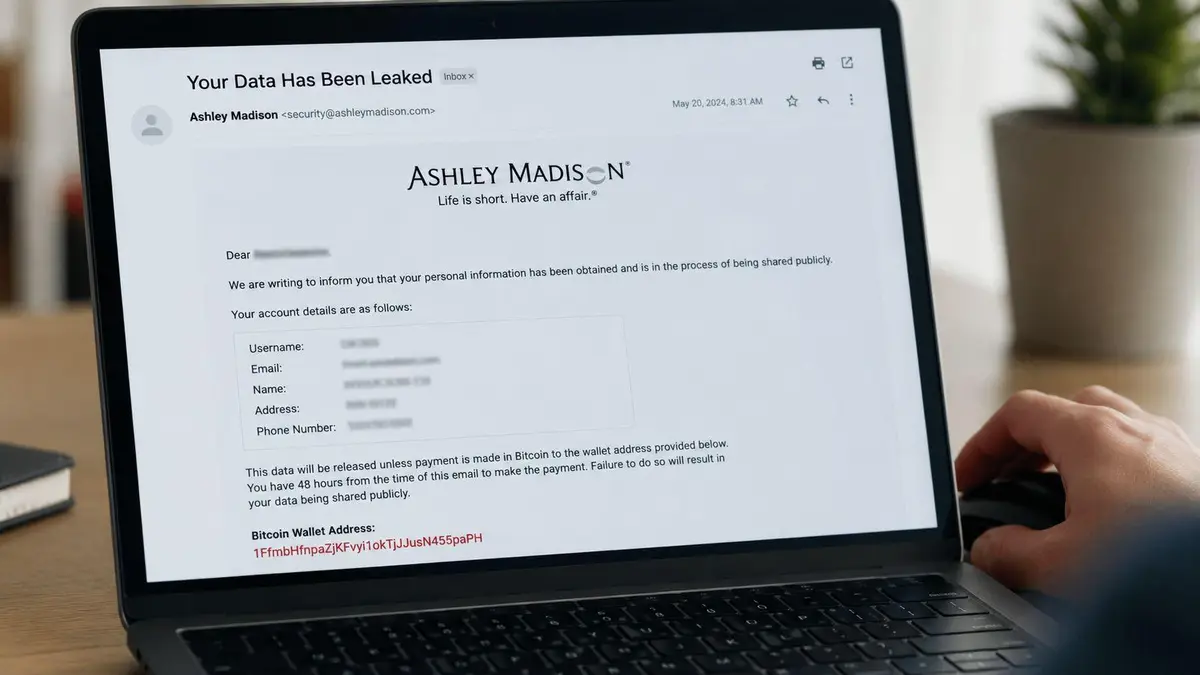
You open your inbox and see a subject line that lands like a punch to the chest. The sender claims they have proof of your Ashley Madison activity. They mention a password you recognize, an address you used years ago, or fragments of personal details that are close enough to feel real. Then comes the demand. Pay in Bitcoin, stay silent, act fast.
If you’re a public figure, executive, investor, or anyone with a name worth targeting, treat that message as a live reputation threat. Not because every claim is true, but because Ashley Madison scams still work precisely by mixing old breach data, recycled personal information, and modern intimidation tactics. This isn’t a history lesson. It’s an active extortion market built on durable embarrassment, searchable identity data, and the assumption that high-value people will pay to make panic stop.
The Threat of an Ashley Madison Scam Today
A well-executed Ashley Madison scam rarely begins with a crude demand. It starts with credibility. The attacker wants you to believe they know who you are, what you did, and who in your life would care if the allegation became public.
That’s why these messages are so effective against high-profile targets. The extortionist doesn’t need a perfect file. They need enough truth to trigger fear and enough pressure to force a mistake. In practice, that often means an email that references a real name, an old phone number, a corporate domain, or a password exposed somewhere else and repurposed to imply deeper access.
Why high-value people get hit differently
A celebrity can be threatened with press exposure. A founder can be threatened with investor fallout. A family office principal can be threatened with private circulation among staff, relatives, or counterparties. The scam changes shape around the victim’s pressure points.
That’s the first point you need to accept. This is a customized coercion problem, not just a spam problem.
Practical rule: If an extortion email names Ashley Madison and includes even a small amount of recognizable information, treat it as a managed incident. Don’t dismiss it as harmless. Don’t assume it’s fully credible either.
The common mistake is emotional reaction. People reply in anger. They pay quickly. They start deleting messages, accounts, or devices. That usually helps the attacker and weakens your position.
What the threat really is
Ashley Madison scams now operate as an ecosystem. Old breach material gets reused. Fresh phishing emails piggyback on the brand. New attackers inherit old narratives and update them for current targets. If you’re visible online, wealthy, or professionally exposed, you’re attractive because the attacker believes silence has value to you.
The right mindset is simple. This is a coercion campaign that touches cybersecurity, privacy, legal exposure, and reputation management at the same time. Handle it that way from the start.
Understanding the Breach and Its Legacy
The 2015 Ashley Madison breach remains dangerous because of what was exposed, not just because it happened. Reporting described it as one of the largest dating-site data exposures ever reported. The site had about 37 million users, and exposed information covered roughly 36 million accounts, including names, email addresses, postal codes, GPS data, and dating preferences. Attackers associated with “The Impact Team” leaked email addresses first and later account contents, including messages, according to reporting on the breach and exposed account data.
Why old data still has force
People assume stale data loses power. That’s the wrong assumption. Old personal data becomes useful again when it can be matched against current assets: your present employer, a new board seat, a spouse’s visible social profile, a child’s school connection, or a company website listing your biography and city.
That’s why the breach still feeds extortion. A scammer doesn’t need current romantic evidence to create risk. They need a plausible narrative and enough identity detail to make you fear distribution.
The real weapon isn’t only the leaked account. It’s the attacker’s ability to connect that account to your current life.
The exposed data types matter
Some data points create embarrassment. Others create operational danger. Names and email addresses make contact easy. Postal codes and GPS data narrow identity. Preferences and messages increase their influence because they can be framed as intimate proof. Once those elements exist together, the attacker can build an email that feels personally informed even when it is partly assembled from old leaks and public records.
For high-profile clients, that means the issue is broader than a single threatening message. It raises questions about search visibility, personal information discoverability, and what else appears when someone starts digging. If you need a structured approach to reducing public exposure after a breach, this guide on removing personal information from Google after a data breach is worth reading.
What the legacy actually means
The legacy of the breach is permanence. Once a large dataset escapes into circulation, it stops being a contained event and becomes raw material. Different criminals reuse it for different objectives. One wants Bitcoin. Another wants account credentials. Another wants to impersonate you, contact your associates, or plant fake evidence around a true historical breach.
That’s why “it happened years ago” is not a defense. In reputation terms, age doesn’t neutralize data. It often gives attackers more time to repurpose it.
Anatomy of Modern Ashley Madison Scams
A common understanding is that “Ashley Madison scam” refers only to sextortion. That’s too narrow. The current situation includes direct blackmail, credential theft disguised as verification, and reputation attacks that don’t depend on the original platform at all.
The technically important point is this. Attackers used breach data for credential-linked extortion, including email and text threats that referenced account activity and demanded payment in Bitcoin. Reporting also noted a published 9.7 GB data dump and seven years of payment records, which increased the credibility of scams because real names, addresses, phone numbers, and transaction traces could be correlated from leaked files, as described in reporting on the data dump and payment-record exposure.
Ashley Madison scam vectors at a glance
| Scam Type | Methodology | Key Red Flags |
|---|---|---|
| Direct extortion | The attacker claims to possess evidence of Ashley Madison use and threatens disclosure unless payment is sent, often in Bitcoin | References to secrecy, countdown pressure, cryptocurrency demand, personal details meant to shock you into compliance |
| Credential phishing | The message claims your account, email, or payment information needs verification and pushes you to a login page or attachment | Urgent login request, unexpected attachment, spoofed sender display name, mismatched reply behavior |
| Reputation attack | The attacker contacts a spouse, employer, journalist, or colleague, or threatens to do so, using real or fabricated material to force action | Mention of specific recipients, draft messages attached, screenshots without verifiable origin, demands tied to silence |
| Impersonation and fake evidence | A scammer creates profiles, screenshots, or message threads that blend real details with false content | Inconsistent dates, edited images, unfamiliar usernames, material that looks plausible but lacks provenance |
How the attacker manufactures urgency
The language is usually simple because panic is the product. “I know who you are.” “I’ll contact your wife.” “I have access to your device.” “Pay within hours.” None of that needs to be elegant. It only needs to force quick compliance before you verify anything.
Attackers also exploit status. They assume an executive fears board scrutiny more than a private citizen would. They assume a politician fears press contact. They assume a wealthy individual fears family disruption and gossip among staff. So the threat often names exactly the audience you most want to keep out of the matter.
The most dangerous variation
The most dangerous Ashley Madison scams are the ones that don’t look like extortion at first. They look administrative. A security notice. A login alert. A message claiming someone attempted to access old account records. That kind of email can pull you into a phishing flow that compromises your current mailbox, cloud drive, or work account.
If an attacker can move from embarrassment to account access, your problem changes from reputational risk to operational compromise.
That is where high-profile victims often lose control. A single panicked click can give the attacker a live mailbox, contact list, or stored documents. Once that happens, they no longer rely on a decade-old breach. They have fresh material.
What to look for before you act
Use a disciplined screening lens:
- Recognizable but dated details: Attackers often use information that is real, but old. That mix is a warning sign, not proof of active surveillance.
- Payment pressure: A demand for Bitcoin, urgency, or a threat window is classic coercion behavior.
- Claims of total compromise: If the message says they control all devices, all accounts, and all contacts, assume exaggeration unless proven otherwise.
- Escalation threats: Mentions of your spouse, employer, assistant, board, or media contacts are designed to shut down rational thinking.
A credible-looking message can still be mostly theater. Your job in the first hours is not to win an argument with the sender. It’s to preserve evidence, secure access, and control the blast radius.
Your First 24 Hours What to Do Immediately
You receive the message at 6:40 a.m. It names Ashley Madison, includes an old detail that feels real, and threatens to contact your spouse, office, or board before the day ends. Treat that moment as an active incident. The 2015 breach is still being mined, repackaged, and weaponized against people with money, visibility, or something to lose in public.
Speed matters, but discipline matters more.
Secure the record before you do anything else
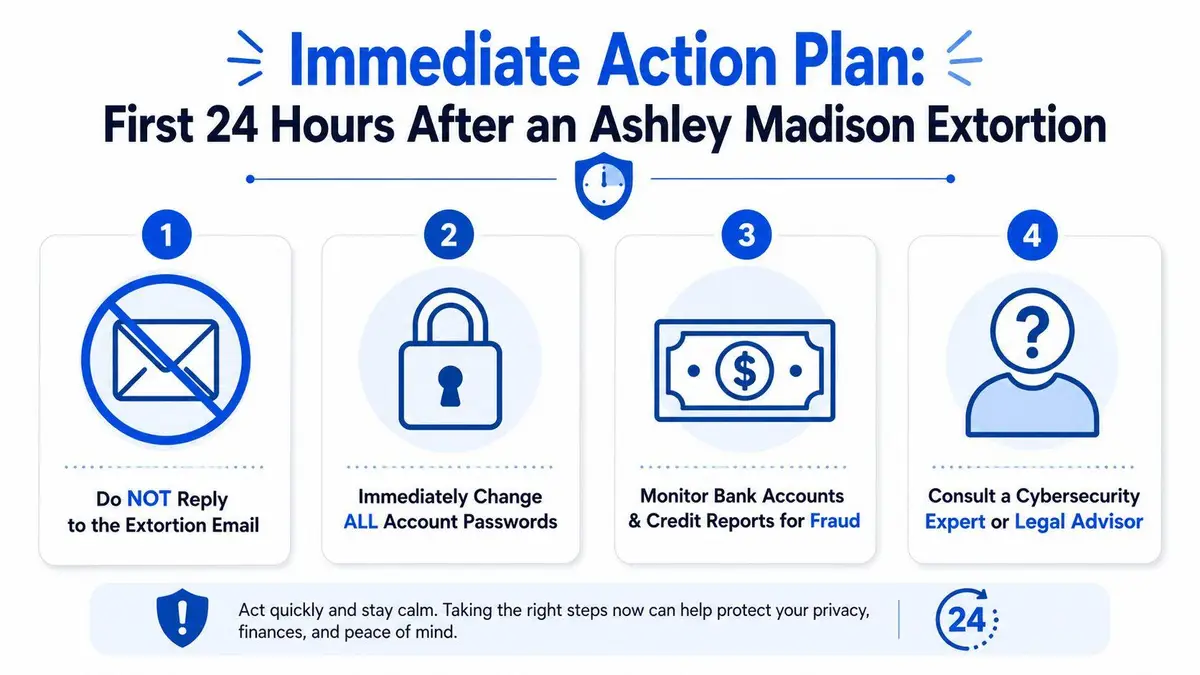
Freeze the evidence. Do not delete the email, text, attachment, voicemail, or social message. Capture screenshots. Save full email headers if available. If the threat arrived through a platform, preserve the username, profile URL, timestamps, payment instructions, and every attached file.
Then write a clean timeline. Note when the message arrived, what it claimed, whether you clicked anything, whether you replied, and which personal or professional contacts were mentioned. That record will shape every legal, technical, and reputational decision that follows.
A sloppy first hour creates avoidable problems later.
Shut down access points fast
Start with your primary email account. Change the password, review recovery methods, revoke unfamiliar sessions, and turn on the strongest authentication option available. Then move to cloud storage, password managers, banking access, messaging apps, and any work systems tied to that inbox.
If you clicked a link or opened a file, assume the threat may now include account compromise. Stop using that device for sensitive work until it has been checked. Extortion tied to Ashley Madison often starts with recycled breach data and then escalates into fresh compromise if the target reacts carelessly.
For a broader executive-focused incident response framework, read this guide on what to do if someone is blackmailing you online.
Three critical decisions
- Do not pay. Payment marks you as responsive, frightened, and worth approaching again.
- Do not communicate without a plan. Every reply gives the attacker information about your emotional state, availability, relationships, and pressure points.
- Do not broadcast the incident. Limit disclosure to the people handling legal exposure, device security, family coordination, or reputation response.
Pressure like this can destabilize judgment. If the harassment starts affecting sleep, concentration, or your ability to function, some people find practical support in advice about help when bullied as an adult.
A short explainer may also help you orient yourself before taking further action:
What to tell your assistant, spouse, or general counsel
Use a script. Keep it short and factual.
“I received an extortion message referencing Ashley Madison. I am preserving evidence, securing accounts, and restricting contact. If anyone reaches out about me, forward it to me and do not engage.”
That language prevents freelancing. It also helps contain the reputation risk that follows these scams. Attackers rarely stop at one message. They test secondary contacts, probe for weak responses, and repurpose the same old data into new pressure campaigns. Your first 24 hours should deny them access, information, and momentum.
Strategic Remediation for Long-Term Protection
Short-term containment is not the end of this problem. It’s the beginning of a structured remediation process. If your name, family, or business interests are exposed, you need a plan that treats Ashley Madison scams as a recurring digital risk, not a one-off scare.

A cybersecurity report cited 282 FTC reports of sextortion tied to Ashley Madison between 2019 and 2024, showing that the brand remains a recurring target for blackmail and social-engineering fraud. The same source reports that Ashley Madison paid $1.6 million to the FTC and $11.2 million to affected users in settlements related to the 2015 breach, which underscores the seriousness of the fallout, according to reporting on continued scam activity and related settlements.
Remediation means reducing leverage
The attacker’s power comes from your perceived vulnerability. The more exposed data, searchable references, cached pages, impersonation assets, and discoverable personal details exist online, the easier it is for them to keep pressure alive.
That’s why long-term protection usually requires several tracks running at once:
- Legal positioning: Counsel can assess extortion, harassment, impersonation, privacy violations, and preservation issues. The point isn’t theatrical litigation. It’s establishing control and documenting options.
- Technical review: A proper review checks whether the threat is only reputational or whether credentials, inboxes, or devices were also compromised.
- Content removal and de-indexing: If harmful material, impersonation pages, leaked images, or defamatory posts appear, removal from the source and de-indexing from search are often central to risk reduction.
- Monitoring: If you stop at takedowns, you leave yourself open to re-upload campaigns and lookalike abuse.
Search results are part of the threat surface
High-profile clients often focus on the extortion email and ignore discoverability. That’s a mistake. Search engines, people-search sites, old directory entries, cached biographies, and data broker profiles all help an attacker enrich a target file.
Long-term protection is about shrinking the public data layer the attacker can mine, correlate, and weaponize.
That doesn’t mean trying to erase your existence. It means removing unnecessary exposure, tightening what appears under your name, and making it harder for a criminal to build a convincing threat package.
Why DIY rarely holds up
A personal assistant can file a few reports. A lawyer can send a letter. An IT manager can reset passwords. Useful steps, but fragmented action leaves gaps. Ashley Madison scams sit at the intersection of privacy, content abuse, impersonation, and reputation pressure. If one part is ignored, the attacker often shifts there.
I advise clients to think in terms of durability. Can the threat resurface under another email account? Can a fake profile reappear? Can an old page rank for your name? Can a spouse, investor, or journalist be reached through publicly visible channels? If the answer is yes, the risk hasn’t been resolved. It has only gone quiet.
Proactive Defense for High-Value Targets
The best response to Ashley Madison scams is to become a difficult target before the next message arrives. High-value people should treat digital privacy as governance, not housekeeping.
A frequently missed fact is that Ashley Madison-related fraud isn’t limited to classic sextortion. The breach has repeatedly been repurposed into broader phishing and credential-theft campaigns. Symantec-referenced reporting noted a spike in spam and phishing emails explicitly mentioning Ashley Madison, and later reporting described a fresh wave of extortion scams years after the breach, showing the threat has persisted well beyond the original incident, as covered in reporting on phishing and ongoing Ashley Madison fraud.
What serious prevention looks like
For executives, investors, and ultra-high-net-worth families, prevention is operational:
- Use separation: Keep sensitive personal activity off primary devices and primary email identities.
- Audit exposure regularly: Review what appears in search, data broker listings, cached results, and social metadata.
- Control household risk: Staff, assistants, and domestic employees can unintentionally widen exposure. Families that rely on private staff should think carefully about confidentiality frameworks, including practical guidance like Superstar Nannies’ NDA advice for UHNW families.
- Monitor for reuse: Watch for new phishing attempts, impersonation accounts, and reposted material tied to your name or known identifiers.
Reputation security is now an ongoing function
The old model was reactive. Wait for a leak, then scramble. That model fails people with visible names and meaningful assets. A better model is continuous reduction of digital attack surface combined with standing remediation capability.
If you’re responsible for a family, a company, or a public profile, this broader framework for online privacy for high-net-worth individuals is the right place to start. It reflects the reality that privacy, reputation, and personal security now overlap.
Ashley Madison scams persist because criminals understand something many targets don’t. Shame is reusable. Data is reusable. Fear is reusable. Your defense has to be equally deliberate.
If you’re facing an Ashley Madison-related threat, ContentRemoval.com can assess the exposure confidentially and map a clear response across takedowns, de-indexing, impersonation removal, and long-term monitoring. For high-profile clients, speed and discretion matter as much as technical execution.
Frequently asked questions
Is an Ashley Madison extortion email real or a scam?
Usually it is assembled from old breach data and public records rather than live surveillance. Recognizable but dated details, Bitcoin demands, countdown pressure and claims of total device control are the warning signs the article lists. Treat it as a managed incident without assuming the sender has what they claim.
What should I do in the first 24 hours after an Ashley Madison blackmail message?
Freeze the evidence, including full email headers and screenshots, then change your primary email password, revoke unfamiliar sessions and enable the strongest authentication available. Do not pay, do not reply without a plan, and limit disclosure to the people handling legal, security and reputation response.
Why are Ashley Madison scams still happening years after the breach?
Because leaked data becomes reusable raw material. Attackers match old account details against your current employer, board seat or family profiles to build a credible threat, and the same dataset has been repurposed for phishing and credential theft as well as sextortion.