
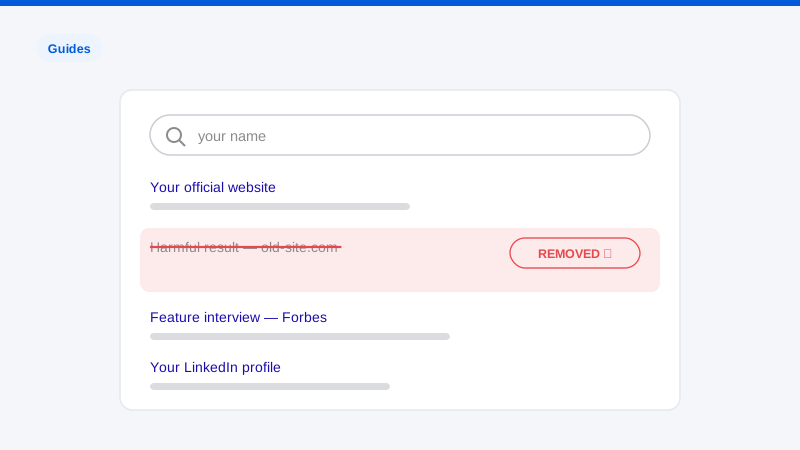
If you’ve started researching the cost to remove Google search results, you’ve probably found two kinds of answers: vague “it depends” hand-waving, or suspiciously confident flat rates from firms that haven’t seen your links yet. Both should make you cautious. The honest answer is that removal pricing is driven by a small number of concrete factors (what the content is, where it’s published, and which removal method actually applies to it) and until someone has analyzed your specific links against those factors, any number they quote is a guess.
We file removals every day, so we’ll give you the framework we actually use to price this work. By the end of this article you should be able to look at a damaging search result and make a reasonable estimate of whether it’s a free-tool fix, a mid-range professional engagement, or a hard target that justifies serious investment. As a benchmark: professional removal is priced per link, quoted in writing after assessment, with genuinely easy cases at the modest end and hostile, high-authority targets well above it.
One caveat before we begin: nobody, including us, controls Google, a webmaster, or a hosting company. Any firm that “guarantees” a removal outcome on a third-party decision is either taking on cases so easy you could do them yourself, or writing a guarantee they don’t intend to honor. Pricing should reflect probability and effort, honestly assessed.
Why there’s no single price for removing a search result
A search result is the visible tip of a chain: a piece of content, hosted on a server, published on a website, indexed by Google. A “removal” can happen at any link in that chain, and the cost varies enormously depending on which link you attack.
- Source removal: the content comes off the website itself. This is the gold standard, because when the page dies, the search result dies with it everywhere, along with the social shares, the AI training snapshots, and the copies people link to. It’s also usually the most labor-intensive route.
- De-indexing: Google removes the URL from search results, but the page stays live on the web. Cheaper and sometimes faster, but incomplete: anyone with the direct link, or using another search engine, can still find it. We cover the distinction in depth on our search result removal service page.
- Suppression: the content stays indexed but gets pushed down by stronger assets. This is a marketing exercise, not a removal, and it’s priced like an ongoing campaign rather than a project. We treat it as a fallback, never a first resort.
Whenever removal is realistically achievable, source removal is what you should be paying for. De-indexing is a legitimate tool, Google’s own removal processes exist for good reasons, but it treats the symptom, not the disease.
The four factors that actually drive cost
1. Content type
The single biggest pricing variable is what the content is, because content type determines which removal mechanisms legally and procedurally apply.
Cheapest tier: clear policy violations. Non-consensual intimate images, doxxing (exposed home address, phone number, financial details), and explicit impersonation violate the written policies of Google and virtually every major platform. The path is well-marked; the work is in documentation and follow-through. If your personal photos or videos have been posted without consent, our image and video removal practice handles these cases routinely.
Middle tier, copyright and contractual leverage. If you own the content, a stolen product photo, a scraped article, a pirated course, copyright law gives you a takedown mechanism with real teeth. Copyright infringement removal via DMCA is procedural rather than discretionary: hosts and search engines have strong legal incentives to comply with valid notices. Cost scales with the number of infringing copies, not the difficulty of any single one.
Expensive tier: reputational content with no policy hook. Negative news coverage, critical blog posts, forum threads, and review-site complaints are the hardest category, because truthful negative opinion is generally lawful and no platform is obligated to remove it. Success here depends on finding an angle: a terms-of-service violation, factual inaccuracies the publisher will correct, an outdated-content argument, or direct negotiated resolution with the poster or publisher. This is skilled, unpredictable work, and pricing reflects that.
2. Site authority and hostility
Where the content lives matters as much as what it says.
A small blog with a contact form and a reasonable owner might resolve in a week. A major newspaper has editorial policies, legal review, and institutional resistance to unpublishing. Complaint boards and “shame sites” occupy the worst position: some are built around a business model of charging for removal or simply never responding, and a few actively republish content when they detect removal attempts.
Practitioner shorthand: the more a site profits from the content staying up, the more the removal costs. High-authority sites are hard because they’re careful; predatory sites are hard because they’re hostile. Both cost more than the average, sometimes multiples of it.
3. Removal method required
- Policy-based removals (platform rules, Google’s PII and image policies) are the most cost-efficient when they apply. The expense is in building an evidence package that passes review the first time, because sloppy submissions get denied and denials complicate refiling.
- Legal-process removals (defamation findings, court orders, DMCA with contested ownership) involve attorneys, and attorney time is the most expensive input in this industry. We are not a law firm and don’t provide legal advice; when a case genuinely needs a lawyer, the budget conversation changes accordingly, and we’ll tell you so before you spend anything.
- De-index-only actions sit at the low end when they’re appropriate, for instance, when a page’s content has changed but Google’s cached result still shows the old version, or when the source site is unreachable and abandoned.
4. One-time removal versus ongoing protection
Some problems are a single event: one article, one post, one image. Remove it and you’re done. Others are chronic, content that gets rescraped by aggregator sites, a determined individual who reposts, mugshot-style networks that syndicate across dozens of domains, or executives whose public profile makes them a recurring target.
For chronic cases, paying per-link forever is the expensive way to solve the problem. Ongoing protection plans bundle monitoring, rapid takedown of reappearing content, and escalation into a predictable recurring cost. The financial logic is the same as any insurance-versus-incident calculation: if you expect more than two or three incidents a year, monitoring almost always costs less than reactive per-link engagements.
Real-world pricing tiers: what to expect
With those factors in mind, here’s how engagements typically shake out. These are ranges, not quotes, your links determine your number.
Free (your time only). Google’s own tools cost nothing: the outdated content tool, results-about-you removals for personal contact info, and policy reporting forms. They’re genuinely free and genuinely work for the narrow cases they cover. The catch is that they’re evidence-hungry, unforgiving of mistakes, and only address Google, not the source site. If your case fits, use them. Our guide to removing yourself from Google walks through the DIY paths honestly, including where they dead-end.
The professional per-link engagement, quoted in writing per URL. This is where most paid removal work lands: a defamatory blog post, a complaint-board entry, a scraped article on a mid-authority site, an old news item with a viable removal angle. A serious firm assesses each link first, then puts an exact price beside it before you commit. The fee covers investigation, evidence assembly, the correct sequencing of source and search-engine actions, follow-through on denials, and verification that the result actually disappears. Reputable firms at this tier typically work on a success-fee or partial-success-fee basis for the removal component. Ask.
The hard-target premium. High-authority publications, hostile or extortionate sites, content requiring legal process, and multi-jurisdiction hosting all push quotes past the standard tier. So does urgency: compressing a 60-day process into two weeks costs more.
Recurring protection: monthly or annual. Monitoring-plus-response plans vary widely by scope: an individual executive’s plan costs a fraction of a brand-wide anti-piracy program. The pricing question to ask is what’s included when something is found: a plan that only alerts you, then charges full per-link rates for every removal, is an alarm system, not protection.
How to estimate your own case: a step-by-step assessment
Before you talk to any vendor, including us, run this assessment. It takes an hour and will save you from both overpaying and under-scoping.
- Inventory every damaging URL. Search your name or brand in an incognito window, check images and news tabs, and go at least five pages deep. Log each URL, the site it’s on, and what the content claims. Most people find more than they expected; scrapers multiply single incidents.
- Classify each URL by content type. Is it your copyrighted material? Personal identifying information? Impersonation? Or negative opinion/reporting? This single classification predicts cost better than anything else.
- Assess each host site. Does the site have a functioning contact channel, a legal/abuse address, a removal policy? Search the site’s name plus “removal” to learn its reputation. No contact info and a history of ignoring requests are cost multipliers.
- Check for free-tool eligibility. If a URL exposes your phone number, home address, or similar PII, or shows outdated content, Google’s free processes may resolve it. Route those out of your paid budget first.
- Count the recurrence risk. Has this content been reposted before? Is the poster still active? Is the content the kind that scraper networks syndicate? One-time removal budgets fail against recurring threats.
- Prioritize by damage, not by ease. The link on page one of your name search matters more than five links on page six. Spend where the visibility is.
If you’d rather not do this manually, our free exposure scan does the inventory and classification for you, and our process page explains exactly what happens after that.
Red flags when comparing removal vendors
The removal industry has excellent practitioners and outright scammers, and their websites look similar. Watch for:
- Guaranteed outcomes on third-party decisions. Nobody can guarantee what Google, a court, or a webmaster will decide. Guarantees tied to refunds (“removed or you don’t pay”) are legitimate; guarantees of outcomes are not.
- Prices quoted before link analysis. A flat rate offered before anyone has looked at your URLs means the price is calibrated to the easiest cases, and you’ll be upsold when yours isn’t one.
- Suppression sold as removal. “We’ll make it disappear from page one” often means burying, not removing. Burying can be a valid strategy, but it should be described and priced as what it is.
- Fabricated urgency or fabricated legal threats. Firms that immediately propose sending aggressive pseudo-legal letters to publishers can convert a removable problem into a Streisand-effect story.
- No discussion of the source site. Any proposal that only mentions Google is solving half your problem. Ask specifically how they’ll pursue source removal.
Frequently asked questions
Can I remove Google search results for free?
Sometimes. Google’s outdated content tool, its results-about-you process for personal contact information, and its policy-violation reporting forms are all free, and for the specific situations they cover they work. What they don’t do is remove content from the source website, handle discretionary reputational content, or forgive poorly documented submissions. Expect to invest real time in evidence, and expect denials if the case doesn’t cleanly fit a policy.
Why does professional removal cost real money when Google’s forms are free?
Because the form is the smallest part of the work. Professional fees pay for correctly diagnosing which of several removal mechanisms applies, building an evidence package that survives review, pursuing the source site in parallel so the content actually dies rather than just de-indexing, handling denials and refilings, and verifying results. It’s the difference between the cost of a court filing fee and the cost of someone who knows how to win the case.
Is de-indexing cheaper than full removal?
Usually, yes, and it’s usually worth paying the difference for full removal anyway. A de-indexed page still exists: it appears in other search engines, circulates by direct link, and can be re-indexed under a new URL. De-indexing is the right standalone choice mainly when the source site is abandoned or genuinely unreachable, or as an interim measure while source removal is in progress.
Do removal companies offer payment based on success?
Many reputable firms, ours included, tie fees for the removal component to results, if a specific link doesn’t come down, you don’t pay for that link, or you pay a reduced investigation fee. Distinguish this from guaranteed outcomes, which no honest firm offers. Ask any vendor to put their success-fee terms in writing before you engage.
Every number in this article is a range, because every case is different, and the only way to turn ranges into a real figure is to analyze your actual links. Start with our free exposure scan: we’ll inventory what’s out there, classify each item by removal difficulty, and give you a straight answer about what’s worth paying for and what you can handle yourself.