
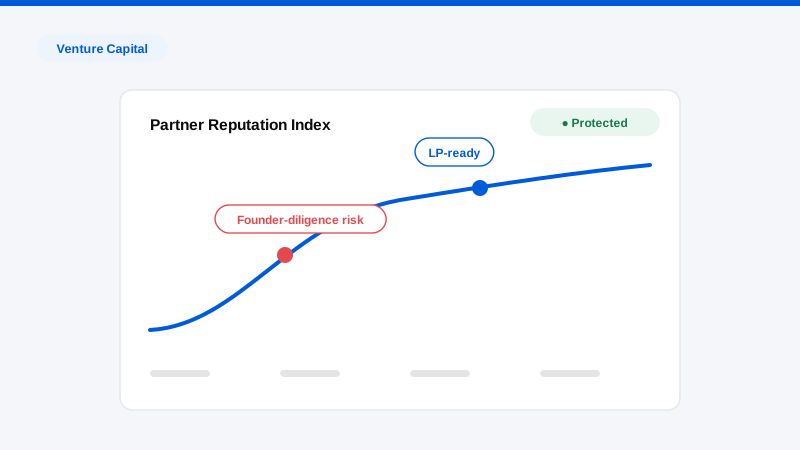
Reputation management for venture capitalists protects the one asset a fund cannot buy, borrow, or engineer: the standing of its partners. Venture capital is a reputation business in the most literal sense. Deal flow arrives because founders have heard a partner is worth working with; allocations arrive because limited partners have concluded the partners are worth trusting for a decade; co-investment arrives because peers consider the firm a credible signal. Every one of those judgments now begins with search, and continues into channels the partner never sees: founder group chats, anonymous forums, LP back-channel references, and the AI-generated summaries that increasingly answer “who is this investor?” before any human source does.
What makes the venture context distinctive is how much of a VC’s reputation is written by other people, in venues built for candor rather than accuracy. Founders compare notes on investors the way employees compare notes on employers, in communities, threads, and whisper networks where a single soured relationship can harden into a durable characterization. Portfolio failures generate coverage that names the board. A partner’s decade-old tweet resurfaces mid-fundraise, and because venture firms are small, there is no institutional buffer: the fund’s brand is the partners’ names, and anything attached to a partner attaches to the fund, its portfolio, and its next raise.
This guide maps the venture capitalist’s real exposure surface (founder-community sentiment, LP diligence, partner personal exposure, fund-brand spillover) explains how each converts into economic consequence, and describes what professional, discreet reputation and exposure management looks like for investors whose name is the product.
Where a venture capitalist’s reputation actually lives
A VC’s search results are only the visible layer of a reputation that resides across several distinct ecosystems, each with its own dynamics.
Founder-community forums and whisper networks. Founders research investors as intensively as investors research founders: through community platforms, anonymous discussion boards, private Slack and WhatsApp groups, investor-review threads, and direct back-channels to portfolio CEOs. These venues reward vivid negative anecdotes: a rough board meeting, a pulled term sheet, a hard down-round becomes a story that travels for years, stripped of context and immune to rebuttal. A partner can be losing competitive deals to a characterization they have never read.
The public web and press. Funding announcements, portfolio coverage, conference panels, podcast appearances, and, inevitably, the harder stories: a portfolio company’s collapse, a lawsuit naming the board, an ethics controversy in the sector, a critical profile. Because journalists covering startups name investors reflexively, a partner accumulates coverage they neither sought nor shaped.
The partner’s personal history. Years of tweets, blog posts, hot takes, and threads, the visibility that built the brand, age unpredictably. Positions taken casually in one funding environment read differently in the next; jokes read differently in litigation; old feuds are screenshot-preserved. Venture is unusual among financial professions in how much unfiltered partner commentary exists on the record.
The personal-data layer. Beneath the professional reputation sits the same exposure any wealthy, visible individual carries: home addresses and family members on people-search sites, phone numbers and emails in leaked databases, property records, and the family’s own footprints. For investors who are publicly wealthy and frequently controversial by role, every passed deal and board decision disappoints someone, this layer is where professional friction converts into personal risk: harassment, doxxing, threats after a portfolio company’s layoffs, and social-engineering attempts against the fund built from partners’ personal details. Our data broker removal work exists for exactly this layer.
The AI layer. Founders and LPs increasingly ask AI systems about investors before they ever open a search page. Those systems synthesize everything above, forums included, into confident summaries. How a partner reads in generated answers is now part of the reputation, and it is addressable, which is the subject of our AI reputation practice.
Key takeaway: A venture capitalist’s reputation is distributed across founder communities, press archives, personal history, data brokers, and AI summaries, and most of it was authored by others. Managing only the visible search layer means managing a fraction of the asset.
LP diligence: the search that prices the next fund
Nowhere does a VC’s exposure carry more direct economic weight than in fundraising. Institutional LPs (endowments, pensions, fund-of-funds, family offices) run reputational diligence on general partners with the seriousness of underwriters, because they are committing to an illiquid, decade-long relationship with the individuals themselves.
That diligence is broader than most GPs assume. It includes deep search across each partner’s full history; litigation and regulatory checks; media review including the unflattering coverage; back-channel references with founders, including founders the firm passed on or parted with badly; review of partners’ public commentary for judgment and temperament; and, increasingly, attention to how the partners surface in the same forums founders use. Operational due diligence teams also examine the firm’s information hygiene: partners whose personal data is scattered across broker sites and leaked databases represent key-person security risk and wire-fraud surface, which sophisticated LPs now understand well.
The consequential feature of LP diligence is its silence. LPs rarely present adverse findings for rebuttal; they simply size down or pass, citing portfolio construction. A characterization from a forum thread or an ambiguous old lawsuit can cost basis points of allocation across a raise without a single conversation about it. This is why the professional standard for GPs approaching a raise is to run the diligence on themselves first (a complete audit of what LPs will find, across every layer, months before the data room opens) and to resolve what is resolvable while there is still time for changes to settle. The same preparation logic applies to partners approaching board fights, public disputes, or media attention, and it is the foundation of our executive-protection engagements for investors.
Know exactly what's exposed, before someone else finds it.Free confidential Exposure Scan, live results on a 15-minute call, covered by strict confidentiality.
Book Your Confidential ScanFund-brand spillover: when one partner’s problem becomes everyone’s
Venture firms concentrate brand equity in named individuals to a degree unusual even in professional services, and the concentration cuts both ways.
Partner-to-fund transmission. A partner’s personal controversy (a resurfaced thread, a contentious divorce filing, a public feud, an allegation) attaches within hours to the fund’s name, then to searches for its other partners, then to its portfolio companies’ fundraising narratives. Founders weighing competing term sheets, and the talent their companies recruit, all read the same results.
Portfolio-to-partner transmission. The reverse flow is just as strong. A portfolio company’s fraud scandal, collapse, or founder meltdown generates coverage that names the board members and lead investors, often more durably than it names the operators. Years later, a partner’s top search results can be dominated by a company they neither ran nor controlled, with “investor in [failed company]” functioning as an unearned epithet in every future diligence process.
Partner transitions. Departures, succession disputes, and GP splits generate their own coverage and forum speculation, and the reputational assets (the personal followings, the named track records) leave with the individuals. Firms discover during transitions how little of their brand they institutionally own.
The implication is structural: a venture firm’s reputation risk is the joint personal exposure of its partners, and it must be managed jointly. The mature arrangement, increasingly common among firms that have watched a peer absorb a spillover event, is a firm-level program covering each partner’s full stack: personal data and family exposure, historical content review, search-layer health, forum and press monitoring, and coordinated readiness for the day one partner’s issue becomes everyone’s. Partners’ families belong in scope for the same reason principals’ families do everywhere in private-client work: adversaries and journalists route around hardened individuals to reachable relatives.
Key takeaway: In venture, there is no meaningful boundary between partner reputation, fund brand, and portfolio narrative, exposure flows freely among all three. Protecting them separately is protecting none of them.
What professional reputation management looks like for investors
The venture community is fluent in marketing (content, podcasts, brand studios) and often mistakes that fluency for reputation management. They are different disciplines. Marketing builds visibility; reputation and exposure management controls what visibility costs. The professional version, run by a specialist firm, has a specific shape.
A full-stack exposure audit per partner. Everything findable, in the order LPs, founders, journalists, and adversaries would find it: search results in the markets that matter, press archive, litigation and records footprint, historical social content flagged by risk, forum and community sentiment where accessible, broker and leaked-data exposure, family exposure, and AI-summary review. Delivered as a candid document, partner by partner, with the firm-level aggregate.
Removal of the removable. Broker profiles, leaked personal data, doxxed material, policy-violating content, and certain dated items are worked at the source through the appropriate mechanisms: the persistent, unglamorous work of personal data removal, which for public-facing investors also directly reduces harassment and fraud surface.
Search-layer and AI-layer management for the rest. Legitimate press and archived commentary generally cannot be unpublished, and no reputable firm claims otherwise. What can be managed is proportion: ensuring accurate, substantive material leads each partner’s results, that a single portfolio failure or resurfaced controversy does not function as the partner’s introduction, and that AI-generated summaries reflect the record rather than its loudest fragment. This is the disciplined territory of search-result suppression: slow, methodical, and effective when sustained.
Standing monitoring across the ecosystem. Partners’ names, the fund, and key family members under continuous watch: new coverage, forum threads gathering momentum, broker repopulation, impersonation accounts, leak appearances, and sentiment shifts around portfolio events. In venture’s velocity, reputation monitoring is what turns a bad Tuesday into a managed afternoon rather than a discovered crisis.
Incident readiness. When the acute event arrives (the viral thread, the portfolio scandal naming the board, the doxxing of a partner after a controversial decision) firms with a standing program respond from an established baseline, with a specialist that already knows their terrain, under strict confidentiality. That readiness, structured through ongoing protection plans, is the difference between shaping the first 48 hours and spending them assembling vendors.
Two boundaries define a reputable specialist in this space. First, no astroturf: manufacturing founder reviews, seeding forums, or manipulating sentiment is both discoverable and, in a community this networked, catastrophic when discovered; the credible path is removing what is removable, building what is true, and monitoring the rest. Second, no guarantees: outcomes on platforms, publishers, and search engines are not in any vendor’s control, and investors, professional evaluators of overpromising, should apply their own diligence standards to anyone selling certainty.
Know exactly what's exposed, before someone else finds it.Free confidential Exposure Scan, live results on a 15-minute call, covered by strict confidentiality.
Book Your Confidential ScanWhy specialists, and why discretion is non-negotiable
A general partner’s instinct is often to handle reputational matters personally or through the firm’s platform team. Both fail for the same reasons. The mechanics (broker suppression cycles, platform escalation paths, de-indexing eligibility, archive policies, AI-summary correction) are niche, current-knowledge disciplines that no marketing hire maintains. The work is continuous, while internal attention is episodic and fundraise-driven, and self-directed action is visible: a partner personally requesting removals, disputing forum posts, or engaging critics converts quiet items into stories, in a community that watches investors closely. A specialist firm operates without the partner’s fingerprints, under confidentiality that covers the engagement itself, which matters in an industry where even hiring a reputation firm can be spun as an admission.
The venture capitalist’s position is unusual: publicly wealthy, professionally obligated to be visible, structurally guaranteed to disappoint people, and evaluated continuously by the most search-literate counterparties in finance. That position deserves the same professional infrastructure the partner’s capital and companies enjoy: a named specialist, a standing program, and a baseline someone is accountable for defending.
Key takeaway: VCs underwrite key-person risk in every deal they price. The partner’s own findable exposure is the fund’s key-person risk, and it is the one risk in the portfolio that responds directly to professional management.
Frequently asked questions
Can negative posts about me in founder forums or anonymous communities be removed?
Sometimes, and honestly: it depends on the platform and the content. Material that violates a platform’s policies (harassment, doxxing, impersonation, defamatory fabrications) can often be addressed through the platform’s own mechanisms, pursued properly and persistently. Candid negative opinion generally cannot be removed, and a firm promising to scrub forums should not be trusted. The professional approach combines removal where grounds exist, search-layer management so isolated threads do not define the partner, and monitoring so emerging sentiment is seen early, when quiet, human-level resolution is still possible.
When should a GP start this work relative to a fundraise?
Ideally two funds ago; practically, at least six to twelve months before the data room opens. Broker suppression, search-layer changes, and AI-summary corrections take time to propagate and settle, and remediation completed on the eve of diligence can itself look like recent scrambling. Partners who run their own exposure audit early enter LP diligence knowing what will be found and having resolved what could be, which also changes how confidently the raise is conducted.
A portfolio company’s failure dominates my search results. What can actually be done?
The coverage itself is typically legitimate press and will not be unpublished. What professional work changes is proportion and context: strengthening the substantive record of the partner’s fuller track record so the failure reads as one chapter rather than the title, addressing follow-on exposure the episode created (broker records, harassment, misattributed claims), and correcting AI summaries that overweight the event. Over sustained effort, the practical goal is achievable and worth stating precisely: not erasure, but a first page, and a generated answer, that reflects the whole record.
Does this involve creating positive content or reviews about me?
No. A reputable firm does not manufacture reviews, seed forums, or fabricate sentiment, practices that are discoverable and uniquely destructive in a community as networked as venture. Where building is appropriate, it means ensuring the partner’s genuine record (real investments, real writing, real institutional material) is well-represented and correctly weighted in search and AI layers. The removal side of the practice is equally real: personal data, doxxed material, policy-violating content. Everything in between is managed through proportion and monitoring, reported to you plainly.
Founders, LPs, and critics are searching your name this week, and forming conclusions you will never hear. A confidential Exposure Scan shows you, live on a 15-minute call, exactly what they find: the results, the forums, the broker files, the AI summaries, and where the risk to your next raise actually sits. It is free and covered by strict confidentiality. Book the scan before diligence season does it for you.