
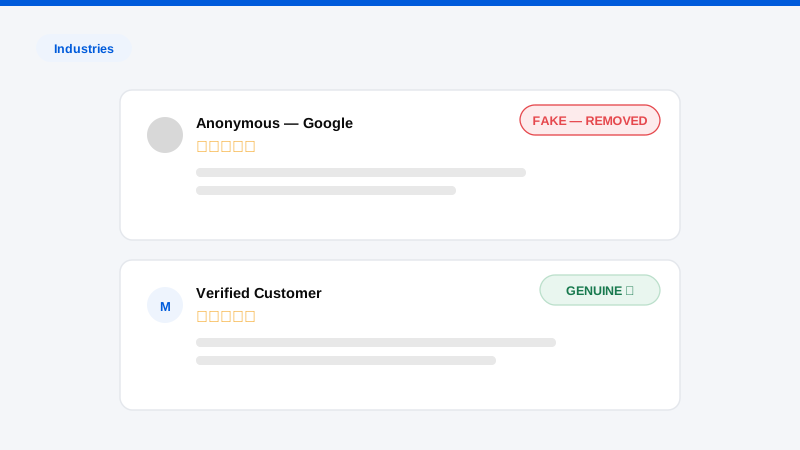
Reputation management for therapists and psychologists is the practice of protecting what prospective clients find when they search a clinician’s name: removing false, harmful, and privacy-violating content where platforms allow it, suppressing what cannot come down, and monitoring the clinician’s digital footprint continuously. For mental health professionals, this work carries a constraint that exists nowhere else in medicine: therapists are largely unable to defend themselves in public. Confidentiality obligations mean a therapist cannot confirm that a reviewer was ever a client, cannot correct a false account of treatment, and cannot tell their side of any story. The review platform gives the reviewer a megaphone and hands the clinician a gag.
That asymmetry defines the entire threat landscape. A surgeon attacked online can at least respond generically; a therapist responding at all walks a line where a single misjudged sentence can breach confidentiality, violate professional ethics codes, and create licensing exposure. Meanwhile the attacks themselves are uniquely charged: they emerge from treatment relationships that are intimate, emotionally volatile, and sometimes end badly through no fault of the clinician, including terminations the clinician was ethically required to make.
This guide defines the specific threats mental health professionals face, what is at stake for a practice built almost entirely on trust, and what professional, removal-first protection looks like for clinicians who cannot fight this fight in public, and shouldn’t have to fight it alone.
Why therapists are targeted
The therapeutic relationship produces reputation risk that is structurally different from the rest of healthcare.
The work itself generates strong feelings, in both directions. Therapy involves transference, rupture, confrontation of painful material, and boundaries that clients sometimes experience as rejection. A clinically appropriate decision (declining to write a disability letter, ending treatment that isn’t working, maintaining a boundary, testifying honestly in a custody evaluation) can produce a level of anger no dentist ever encounters. Some fraction of that anger becomes public content: one-star reviews, forum posts, social media accusations. The clinician may have done everything right; the review says otherwise, and only one side gets to publish.
Reviews the clinician ethically can’t answer. This is the signature vulnerability of the profession. Confidentiality survives the end of treatment, and in most frameworks, even acknowledging that someone was a client is a disclosure. So when a false or distorted review appears, the therapist cannot correct the record, cannot add context, and in many cases concludes (rightly) that they cannot respond at all. Prospective clients reading the review see an accusation met with silence and draw the natural, wrong inference. The standard advice given to other providers, “respond professionally without PHI”, barely functions here; for therapists, even boilerplate replies must be constructed so they neither confirm nor deny any treatment relationship, and often the safest response is none. That makes removal not one option among several, but frequently the only meaningful remedy.
Defamation by former clients, and by people who were never clients. High-conflict situations follow therapists: custody disputes where a clinician’s evaluation angered one parent, family members hostile to a relative’s treatment, ex-partners of clients, and individuals in crisis who fixate on a provider. These parties post accusations (of incompetence, bias, ethical violations, or worse) on review platforms, complaint boards, and social media. Some are grossly distorted accounts of real treatment; some come from people the therapist never treated at all. Both look identical to a prospective client.
Privacy exposure runs both ways. Therapists face doxxing-style content: home addresses posted by aggrieved parties, personal social media dredged into professional contexts, family members named in complaint threads. Clinicians who work with high-conflict populations (forensic evaluators, custody experts, therapists treating personality disorders) carry meaningfully elevated risk, and the content that targets them is often as much about intimidation as reputation.
Solo practices have zero institutional buffer. Most therapists practice alone or in small groups. There is no communications department, no legal team on retainer, no colleague whose ratings dilute the damage. The clinician’s name is the practice, and everything posted about it lands undiluted.
Key takeaway: Therapists are the only providers in healthcare who face public attacks they are ethically barred from answering. When response is off the table, removal is the remedy, and that changes the entire strategy.
What’s at stake for a mental health practice
Trust is the entire product. A prospective therapy client is preparing to tell a stranger the things they tell no one. The search that precedes a first appointment is not comparison shopping. It is a safety check. Content suggesting a therapist is unethical, harmful, or unstable doesn’t just cost a booking; it fails the safety check, and there is no recovering a client who has decided a therapist feels unsafe. The bar for damage is lower in mental health than anywhere else in medicine because the trust being evaluated is deeper.
A silent profile amplifies every attack. Because many therapists rightly refrain from cultivating reviews (soliciting testimonials from clients raises its own ethical problems), their online profiles are thin. A clinician with three lifetime reviews takes catastrophic ratings damage from a single attack, and the sparse profile means there’s no surrounding context to signal that the attack is an outlier. The ethics that keep therapists from playing the reviews game leave them defenseless within it.
Licensing and referral ecosystems both watch. Referring physicians, EAP networks, insurance panels, and attorneys who retain forensic evaluators all search a clinician’s name. Public accusations, even demonstrably false ones, chill referrals long before anyone raises them directly, and accusatory content that mimics regulatory language (“reported to the board,” “under investigation”) can trigger real scrutiny regardless of its truth.
Personal safety can be on the line. When content crosses from criticism into fixation (posted addresses, threats, campaign-style posting across platforms) the stakes stop being commercial. Getting that content down quickly is a safety measure, not a marketing one.
AI systems repeat what they find. Prospective clients increasingly ask AI assistants about therapists by name. Those systems summarize whatever is prominent, including false accusations, into fluent, confident answers, stripped of the context that might lead a human reader to skepticism. For a profession that cannot publicly rebut anything, what AI says about a clinician is an exposure surface that compounds silently.
See what patients find before they book.Free confidential Exposure Scan: live results on a 15-minute call, yours to keep either way.
Book Your Free ScanWhy reputation management for therapists must be removal-first
For most businesses, reputation strategy is a portfolio: respond, generate positive content, suppress, remove. For therapists, the portfolio collapses. Public response is ethically constrained to near-uselessness. Review generation is ethically fraught. What remains, and what actually works, is removal, backed by suppression for the residue.
Removal is the only remedy that doesn’t require the therapist to speak. Challenging a review as fake, policy-violating, or defamatory happens through platform channels, not public threads. A properly built case (documenting that content violates a platform’s rules on harassment, false information, conflicts of interest, or non-client reviews) asks the platform to act, and requires no disclosure from the clinician about any treatment relationship. It is the one path that fully honors confidentiality while actually addressing the harm. This is the center of professional review removal work for mental health clients.
Defamation channels exist for the serious cases. False statements of fact (invented ethical violations, fabricated events, accusations from people who were never clients) can be pursued through platform legal-request processes and, where warranted, through formal legal action by the clinician’s own attorney. Content Removal is not a law firm and does not provide legal advice; we build and execute the platform-side casework and coordinate with counsel when matters escalate. Our defamation removal practice is built for exactly these fact-pattern cases.
Privacy-violating content has its own takedown paths. Posted addresses, personal photos, and doxxing content violate dedicated platform policies that are often more enforceable than defamation claims. Content threatening a clinician’s safety is triaged first, always.
Suppression protects the residue. Where content survives removal efforts (an old news mention, a non-removable forum thread) building out the clinician’s authoritative professional presence pushes accurate material to where prospective clients actually look. Search suppression is legitimate second-line defense; it is simply never the first move when removal is available, because suppressed content is still live, still discoverable by anyone who digs, and still feeding AI summaries.
Key takeaway: Every other profession can talk back. Therapists can’t. That single constraint makes removal-first the only coherent strategy for mental health professionals. Everything else either leaves the attack standing or asks the clinician to breach the ethics that define their license.
What professional reputation management for therapists looks like
A professional engagement for a mental health clinician is quiet, methodical, and built around the profession’s constraints.
A confidential exposure audit. Everything findable, mapped: search results on the clinician’s name and credentials, therapy directories, review platforms, complaint boards, social media, forums, and AI assistant outputs. For forensic and custody-adjacent clinicians, the audit extends to the litigation-adjacent web where these attacks concentrate. Many therapists have never systematically searched themselves; the audit replaces dread with a prioritized inventory.
Removal casework, run without disclosure. Each piece of harmful content is assessed against the hosting platform’s policies, and removal cases are built on platform-rule violations and documented falsity, never on clinical information. The clinician is never asked to confirm or deny a treatment relationship in any public forum, and nothing in our process discloses one. Where a limited public response is appropriate at all, we advise on language that discloses nothing, consistent with the principle that providers respond, if ever, without any patient information whatsoever.
Defamation and safety escalation. False factual accusations are escalated through platform legal channels; content implicating personal safety is prioritized and pursued on the dedicated policy paths platforms maintain for it. Where formal legal action is warranted, we coordinate with the clinician’s counsel and handle execution on the platform side.
Cleanup of outdated and stray content. Old directory profiles, listings at former practices, stale contact details, and superseded pages, the outdated content that misdirects clients and occasionally resurfaces old disputes, are corrected or removed.
Authoritative presence, ethically built. We strengthen the professional footprint that search engines and AI systems draw from (credentials, directories, professional publications) without ever soliciting client testimonials or brushing against the profession’s advertising ethics.
Monitoring under a Protection Plan. For clinicians in high-conflict niches especially, the question is not whether new content appears but when. Protection Plans keep the clinician’s name under continuous monitoring, so new attacks are flagged within days, when platforms are most responsive and before content ranks, spreads, or reaches referral sources.
See what patients find before they book.Free confidential Exposure Scan: live results on a 15-minute call, yours to keep either way.
Book Your Free ScanWhy therapists choose Content Removal
We specialize in the remedy therapists actually have. Marketing agencies sell visibility; therapists need removal. Content Removal’s core practice is takedown casework (reviews, defamation, privacy content, outdated pages) which happens to be the one lever mental health professionals can pull without compromising their ethics.
Confidentiality is built into our process, not bolted on. Every case we build for a mental health client is constructed so that no treatment relationship is confirmed, denied, or implied, to platforms, in public, anywhere. We work with providers across medicine (see our healthcare practice), and the discipline of never touching patient information is standard in every engagement; for therapists it is absolute.
We know the platforms and the escalation paths. Which arguments move which platforms, what evidence each requires, when to escalate past the automated denial, and how legal-request channels actually behave. This is accumulated casework knowledge, not something a solo practitioner should have to learn during the worst month of their career.
We are candid about limits. No firm can guarantee removal of any specific piece of content, and we will not pretend otherwise. What we provide is an honest assessment, grounded in pattern experience across engagements like the ones in our case studies, of what is likely removable, what should be suppressed, and what to monitor. Clinicians deserve straight answers before they spend anything.
We carry the fight so the clinician doesn’t have to. Practically, an engagement means the therapist stops checking the review page at midnight. The casework, the platform correspondence, the monitoring. All of it moves to us, and the clinician goes back to seeing clients.
Key takeaway: Therapists choose Content Removal because we fight the fight they’re ethically barred from fighting themselves: through platform channels, without disclosure, with honest expectations set up front.
Frequently asked questions
Can a therapist get a false review removed without confirming the person was a client?
Yes: that is precisely how professional removal casework is designed. Challenges are built on platform policy violations: fake or inauthentic content, harassment, conflicts of interest, reviews from individuals with no service relationship. None of these arguments requires the clinician to disclose or confirm anything about treatment. The platform evaluates the content against its own rules; confidentiality stays intact throughout.
Someone who was never my client posted an accusatory review. Does that matter?
It matters a great deal. Most platforms restrict reviews to genuine customer experiences, and content from non-clients (angry relatives, opposing parties in litigation, strangers) violates those rules on its face. These are often among the stronger removal cases, though outcomes always depend on evidence and platform, and no specific removal can be guaranteed.
Should I respond to negative reviews at all as a therapist?
In most cases, minimal or no public response is the prudent course, and any response must be written so it neither confirms nor denies a treatment relationship and contains no client information of any kind. This is a genuinely harder constraint than other providers face, and it is why removal through platform channels, which requires no public statement, is the primary remedy for mental health professionals. We advise clients on response posture case by case.
An ex-client is posting about me across multiple platforms. What are my options?
Multi-platform campaigns are addressed platform by platform (each has its own harassment, defamation, and inauthentic-behavior policies) while the pattern itself is documented, because campaign behavior often strengthens individual cases and matters if formal legal action becomes appropriate. Content touching your personal safety or home address is triaged first. Where counsel gets involved, we coordinate with them and run the platform-side execution.
You cannot answer what’s being said about you, but you don’t have to leave it standing. Request a free, confidential Exposure Scan: on a 15-minute call we’ll show you everything prospective clients find on your name, tell you honestly what’s likely removable, and map what protection would look like. The findings are yours to keep, whatever you decide.