
Reputation management for technology companies is the practice of controlling what customers, enterprise buyers, investors, regulators, and journalists find when they research a company, its products, or its founders, and removing the damaging content that would otherwise decide trials, procurement outcomes, and funding rounds before the first conversation happens. Technology companies live and die on adoption curves, and adoption is a trust decision made at the search bar: before a user installs the app, before a CISO shortlists the vendor, before a partner signs the integration, someone searches the name. What that search returns is not the company’s story; it is whatever the internet has accumulated about the company, and the internet’s accumulation process is adversarial.
The exposure is structural. Tech companies are covered by a press corps that rewards skepticism, discussed by user communities that reward outrage, rated on app stores and review platforms that anyone can write into, and led by founders whose personal brands are inseparable from their companies’ valuations. A review-bombing wave, a privacy scare framed as scandal, an ex-employee’s viral exposé, a competitor-seeded hit piece, each becomes part of the permanent search record for the company name, surfacing in every enterprise diligence process and every AI-generated summary thereafter. This guide describes how these attacks operate against technology companies, what they cost, why the industry’s default responses fail, and what professional, removal-first protection looks like. It is written for founders, CMOs, general counsel, and heads of communications, the people who know that in tech, the narrative is part of the product.
Why technology companies are targeted
Technology companies concentrate several properties that attract motivated adversaries: winner-take-most markets that make sabotage rational, passionate user bases that can turn on a product overnight, and founder-centric brands that give attackers a human target.
App-store and platform review bombing is a coordination weapon. A pricing change, a feature removal, a moderation decision, or a political controversy can trigger organized waves of one-star reviews across the App Store, Google Play, G2, Capterra, and Trustpilot within hours. Some campaigns are genuine user anger; many are brigaded from communities with no relationship to the product, and some are manufactured outright. Either way, the rating collapse is permanent in screenshots, visible in every “best tools for X” comparison, and read by enterprise buyers as a signal of product risk.
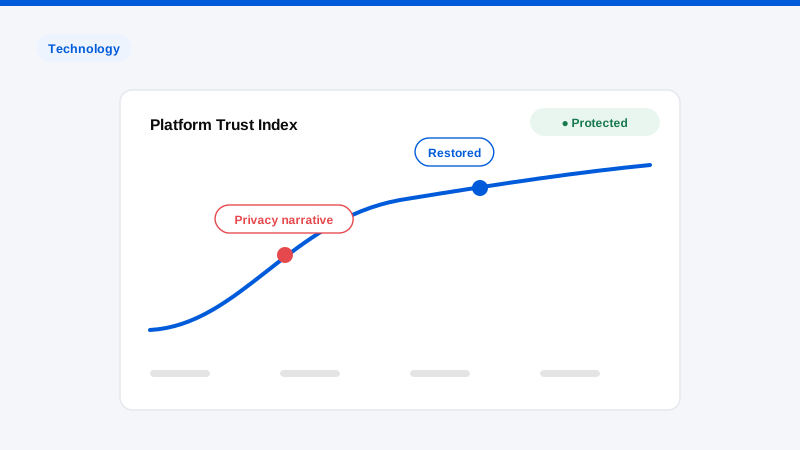
Privacy and security narratives escalate faster than facts. Any data-handling story (a researcher’s finding, a misread permission request, a vendor breach two steps removed) can be framed as “company X is spying on you” and go viral in that form. The technical correction never catches the emotional headline, and the scandal framing joins the company’s permanent search record, resurfacing in every subsequent story and every security questionnaire the sales team touches for years.
Founder cancellation campaigns target the company through the person. Tech founders are public by design: their credibility raises the rounds and closes the enterprise logos. That same visibility makes them the attack surface: old tweets excavated and reframed, conference remarks clipped out of context, personal disputes turned into threads, anonymous allegations amplified by accounts with agendas. Because the founder’s name and the company’s are searched together, damage to one is damage to both, and the personal content is often the more durable of the two.
Ex-employee exposés carry insider authority. Layoffs, contested departures, and equity disputes generate former employees with credibility, receipts, and platforms. A viral resignation post, a “what it was really like at [company]” thread, or a coordinated Glassdoor pile-on speaks with an authority outside critics lack, and lands directly in the diligence path of every candidate, investor, and enterprise buyer who researches the company.
Competitor-seeded stories launder sabotage through legitimate channels. In markets where one lost enterprise deal is worth millions, some competitors do not stop at comparison pages. Anonymous tip-driven articles, astroturfed forum threads, strategically placed “concerns” in analyst conversations, and fake review clusters are seeded so the damage appears organic. By the time the content ranks, its origin is invisible, and irrelevant to the buyer reading it.
Communities keep permanent, searchable records. Hacker News threads, Reddit posts, and Discord screenshots outrank official pages for many company queries. A single hostile thread from a product’s worst week can remain a top result for years, greeting every new evaluator with the company’s lowest moment presented as its current state.
What damaging content costs technology companies
The costs are concentrated in the industry’s most valuation-sensitive mechanisms.
Enterprise procurement is a search for reasons to say no. B2B buying committees run vendor risk reviews that include adverse-media screens, review-platform checks, and increasingly AI-assisted research summaries. A privacy-scandal narrative, a review-bomb crater, or an unresolved allegation becomes a line in a procurement memo, and in competitive evaluations, a line in a memo is a lost deal. The vendor never hears the real reason; the deal simply goes to the alternative with the cleaner file.
Consumer adoption converts search damage into churn at the top of the funnel. For consumer products, the install decision takes seconds and the research step is a glance at ratings and top results. Review bombing and scandal framing suppress conversion at the exact moment paid acquisition spend is trying to drive it, meaning the company pays twice: once for the click, again for the content that kills it.
Investor diligence reads the whole record. Venture and growth investors screen founders and companies before term sheets, and acquirers run deeper versions of the same search. Founder-targeting content, employee-revolt narratives, and unresolved controversies surface in every data room discussion, affecting valuation, terms, and occasionally the deal itself. For public tech companies, the same content is tracked by analysts and priced by the market before any filing addresses it.
Regulators are downstream of coverage. Privacy scandals and safety narratives, accurate or not, draw the attention of data-protection authorities, consumer-protection agencies, and legislators looking for hearing subjects. The inquiry then becomes its own searchable story, fusing with the original narrative into what reads, to any future searcher, like an established pattern.
Talent is the quietest casualty. Senior engineers and executives research companies as carefully as investors do, and a search page dominated by exposé threads and culture allegations removes the best candidates before the first recruiter email is answered. In a market where the product is built by the people the content scared away, this cost compounds silently.
Why generic PR and SEO approaches fail
Tech companies typically respond with the tools they know (comms statements, content marketing, SEO) and each fails against this threat model in a specific way.
Rebuttals feed the algorithm they are fighting. A public response to an exposé or scandal narrative generates a second wave of coverage, fresh links to the original, and a “company denies” framing that entrenches the story. The correction ranks below the allegation, permanently.
Content marketing buries nothing that matters. Publishing more blog posts does not displace a hostile Hacker News thread, an app-store rating crater, or a privacy headline with years of accumulated authority. Suppression campaigns rearrange page two; diligence teams and AI assistants read the whole record. A chatbot asked “is [product] safe” will synthesize from the scandal coverage a suppression campaign merely demoted, and deliver it as neutral fact to a buyer who never sees a search page at all.
PR firms manage narratives; they do not execute takedowns. Narrative work is necessary, but it does not remove the fake review cluster, the impersonation account, the defamatory thread, or the doxxed founder’s home address. Those outcomes require platform-by-platform removal work argued in each venue’s own policy terms, a specialist discipline that communications agencies neither perform nor staff, which is why “reputation management” retainers so often produce reports instead of removals.
The effective sequence is the reverse of the default: shrink the hostile record at the source first, de-index what remains, and only then build positive visibility on cleared ground, the sequencing at the core of our brand protection practice.
What removal-first protection looks like
Removal-first protection for a technology company runs a disciplined sequence (assessment, removal, de-indexing, monitoring) because each stage handles what the previous one cannot.
Assessment. The engagement begins with a complete exposure audit: search results for the company, each product, and each named founder and executive; app-store and B2B review surfaces; community threads; employer-review platforms; impersonation and clone surfaces; and the AI-answer layer. Every damaging item is mapped and graded by severity, reach, and, critically, removability, because scandal coverage, fake reviews, and doxxing content each follow entirely different paths. We run this as a free, confidential Exposure Scan, reviewed live with your team.
Removal at the source. Fabricated and brigaded reviews, defamatory posts, impersonation accounts, cloned apps and sites, leaked personal data, and harassment content frequently violate the hosting platforms’ own policies (inauthentic behavior, impersonation, privacy, harassment) creating removal mechanisms that specialists argue in each platform’s own terms, at volume, with escalation paths learned across thousands of matters. The honest caveat, stated up front: platforms and publishers control removal decisions, and no credible firm guarantees a specific item will come down. What specialists change is the probability, the speed, and how much of the target set falls.
De-indexing from search. Content that cannot be removed from its host can often be removed from search results (the layer where buyers, investors, and candidates actually encounter it) under search engines’ own policies covering specific categories of personal and harmful content. For founders whose personal information circulates on grudge sites, de-indexing closes the discovery path even when the page persists.
Monitoring and standing response. Tech attacks cluster around catalysts: launches, pricing changes, funding announcements, layoffs. Continuous monitoring across search, review platforms, communities, and AI answers catches the brigade when it is forty reviews, not four thousand, and the thread when it is one post, not a movement. Our Protection Plans pair that monitoring with reserved removal capacity so response begins within hours, which, in a news cycle measured in hours, is the entire game.
Protecting founders and executives as individuals
In technology, the founder’s search results are a company asset with a company-sized blast radius. Investors underwrite the person; enterprise buyers reference-check the person; journalists profile the person, and attackers know that the person is softer than the company: personal history, family, homes, old statements, and litigation records are all reachable in ways corporate infrastructure is not.
The personal exposure surface has its own geography, data-broker profiles listing home addresses and family members, doxxing posts, resurfaced personal records, impersonation accounts issuing statements in the founder’s name, deepfaked endorsements attached to scam projects, and AI-generated biographies that repeat every allegation as fact. This content endangers families, contaminates fundraising and M&A diligence, and follows founders across every company they ever start. It is why our digital executive protection practice exists as a distinct discipline, and why, for technology companies, we typically protect the founders and the brand in a single engagement: the attackers already treat them as one target.
Frequently asked questions
Our product was review-bombed after a controversial change. Can those reviews be removed?
Often, in meaningful volume. Coordinated and brigaded reviews from accounts with no genuine product experience violate the inauthentic-content policies of the major app stores and review platforms, and documented campaigns are removable in many cases. The work is evidence-driven, establishing the coordination pattern and arguing it in each platform’s own terms, and speed matters, because ratings damage compounds while the campaign runs.
An ex-employee published a viral piece about our company. What are the options?
The piece gets decomposed into items, and each item gets the strongest available treatment. False statements of fact, confidentiality breaches, and platform-policy violations can be attacked directly; protected opinion and accurate accounts generally cannot, and the work shifts to de-indexing where eligible and containment at the search layer. A realistic item-by-item assessment comes before any effort is spent, and before any response that might amplify the piece.
We suspect a competitor is behind negative content about us. Does that change anything?
Attribution changes the available levers. Coordinated inauthentic campaigns violate platform policies regardless of who runs them, and evidence of competitor involvement strengthens removal arguments and can open legal options your counsel may pursue in parallel. We work alongside counsel in those situations; our lane is making the content itself disappear from the surfaces where buyers encounter it.
How does AI-generated search change this for tech companies?
Substantially: enterprise buyers and investors increasingly get their first impression from an AI assistant’s summary rather than a results page, and those summaries synthesize from the full indexed record, including content a suppression campaign buried years ago. Removal and de-indexing are now the only interventions that actually change what the models can draw on. Auditing what AI assistants currently say about your company is part of our standard assessment.
We’re pre-crisis: nothing bad has happened yet. Why engage now?
Because the companies that survive their first viral moment are the ones whose historical exposure was already cleaned and whose monitoring caught the first post rather than the millionth impression. Pre-crisis engagement is also when founders’ personal surfaces (data brokers, old records, impersonation) can be quietly hardened. The practical first step is an exposure scan: see what a motivated adversary, or a diligence team, finds today.
Every buyer, investor, and senior candidate who considers your company this year will search it, and your founders, before they talk to you, and increasingly they will ask an AI assistant instead of reading the results themselves. Find out what those searches return before the next launch, round, or news cycle depends on it. Our free, confidential Exposure Scan maps every damaging item attached to your company, products, and leadership, reviewed live on a 15-minute call, with the findings yours to keep either way.