
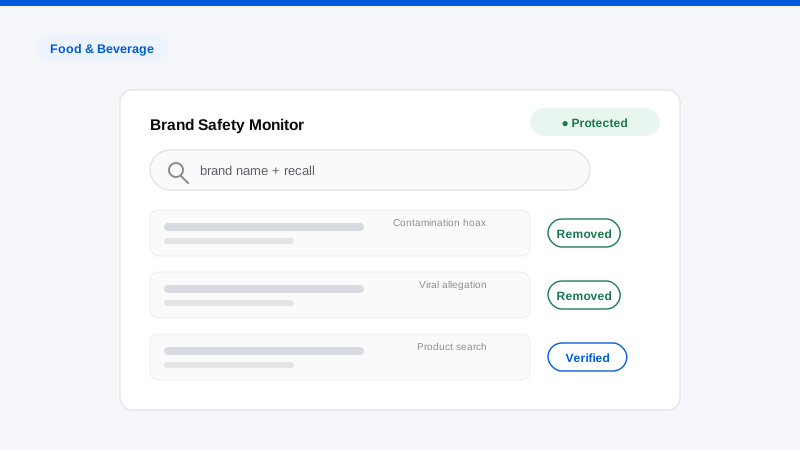
Reputation management for food and beverage companies is the practice of controlling what consumers, retailers, distributors, and journalists find when they research a brand or its products, and removing the damaging content that would otherwise convert a single unverified allegation into a category-wide crisis of trust. No industry converts online content into purchasing behavior faster, because no purchase decision is more instinctive: people do not weigh evidence about what they put in their bodies, they react to it. A contamination rumor does not need to be true to empty a shelf; it only needs to be findable.
That is the structural problem food and beverage brands face. The industry sells trust in an invisible supply chain, and the internet is optimized to distribute doubt about invisible things. A grainy video claiming to show a foreign object in a product, a viral post alleging an illness, a decade-old recall resurfacing without context, a coordinated review-bombing campaign. Each of these can outrank years of brand-building within days, and each stays in the search record long after the news cycle moves on. This guide describes how these attacks actually operate against food and beverage companies, what they cost, why conventional PR and SEO responses fall short, and what professional, removal-first protection looks like. It is written for CMOs, general counsel, heads of communications, and the executives whose names appear beside the brand when things go wrong.
Why food and beverage companies are targeted
Food and beverage brands combine three properties attackers prize: household name recognition, visceral subject matter, and a consumer base primed to believe the worst about what it eats. The threat landscape that results is unusually varied.
Contamination rumors travel faster than facts can follow. An allegation that a product made someone sick (posted to a local Facebook group, a parenting forum, or a viral thread) requires no evidence to spread and no correction ever catches up with it. The claim is emotionally sticky in a way the rebuttal can never be, and once it is indexed against the brand name, every future searcher encounters the accusation before any context. Even claims that were investigated and disproven persist online as if they were live, because the platforms that hosted them have no incentive to update them.
Foreign-object hoaxes are a repeatable playbook. Staged photos and videos claiming to show objects, insects, or worse in packaged products have become a recurring extortion and attention-farming tactic across the industry. The content is cheap to fabricate, devastating to view, and algorithmically rewarded: disgust is among the most shareable emotions on every platform. The brand is left disputing an image that has already been seen by millions, while the original post continues ranking for the product name indefinitely.
TikTok and short-form video reward the allegation, not the outcome. A single creator’s video alleging mistreatment, unsanitary conditions, or a bad experience with a product can accumulate millions of views before the company is even aware it exists. Follow-up videos, stitches, and duets multiply the footprint, and the platform’s search and recommendation systems begin surfacing the allegation to anyone who looks up the brand. When the claim later collapses, the correction, if one is ever posted, reaches a fraction of the original audience.
Review bombing punishes the brand across every location and listing at once. Whether triggered by a viral incident, a political controversy, or a coordinated campaign, waves of one-star reviews can hit a brand’s Google profiles, delivery-app listings, and retail product pages simultaneously. The reviews are written by people who never bought the product, but the star ratings they drag down are read by people who were about to.
Boycott campaigns attach permanent content to the brand name. Activist campaigns (over sourcing, labor, environmental practices, or the political statements of an executive) generate petitions, hashtags, explainer threads, and press coverage engineered to rank for the brand’s name. Some of this content is protected expression about genuine disputes; much of it is exaggerated, outdated, or flatly false, yet all of it is treated equally by a search engine. Long after a campaign ends, its artifacts remain the brand’s search results.
Former employees and franchise disputes generate insider-flavored attacks. Kitchen-floor videos, employer-review pile-ons, and disgruntled-distributor posts carry a credibility that outside criticism lacks, and they surface in the diligence of every retailer, partner, and job candidate who researches the company.
What damaging content costs food and beverage companies
The costs run through several distinct mechanisms, and most of them operate without the company ever seeing the decision being made.
Consumer trust converts to revenue with almost no lag. Food purchasing is habitual until the moment it isn’t. A shopper who encounters a contamination claim while searching a product name does not investigate; they buy the adjacent brand, often permanently. Because the category is crowded and switching costs are zero, the gap between “saw something disturbing” and “lost the customer” is a single shopping trip, and the content that caused it keeps working on every subsequent searcher.
Retail and foodservice buyers run their own diligence. Category managers at grocery chains, distributors, and foodservice operators screen brands before allocating shelf space or renewing contracts, and adverse content is exactly what those screens surface. A buyer who finds a viral hygiene allegation or an active boycott campaign does not call to ask for context; the brand simply loses the reset, the end-cap, or the renewal, and hears only that the category went another direction.
Regulators read the same internet everyone else does. Viral allegations of contamination or mislabeling can prompt inquiries from food-safety authorities even when the underlying claim is fabricated, and the existence of an inquiry then becomes its own searchable story. The original hoax and the coverage of the response fuse into a single narrative that reads, to a casual searcher, like a confirmed safety problem.
Public companies wear the damage in the share price. For listed food and beverage companies, viral safety allegations and boycott momentum are tracked by analysts and shorted by traders. The market does not wait for lab results; it prices the headline. Even for private brands, hostile content surfaces in the diligence of every lender, acquirer, and investor who looks at the company, and it appears on the risk-factor page of every deal memo.
Talent reads the search results too. Food and beverage companies hire at every level from plant floor to C-suite, and candidates at all of them search the company first. A search page dominated by hoax videos, boycott hashtags, and employer-review pile-ons raises the cost of every hire and quietly removes the best candidates from the funnel before a recruiter ever reaches them.
Why generic PR and SEO approaches fail
The standard corporate response (issue a statement, brief friendly press, commission an SEO campaign to “push it down”) fails against this threat model for structural reasons.
Statements amplify what they answer. A formal denial of a viral hoax gives newsrooms a second story (“Brand responds to contamination claims”) and gives the original content a fresh wave of links and engagement. The rebuttal ranks below the allegation and is read by a fraction of its audience.
Suppression-only SEO leaves the weapon loaded. Burying a damaging result under new content does not remove it; it relocates it. The allegation resurfaces the moment news volume spikes, an activist recirculates it, or a searcher adds one qualifying word to the query. Worse, AI assistants now synthesize answers from the whole indexed record, not just page one, a hoax “suppressed” to page three is still quoted verbatim when a shopper asks a chatbot whether the brand is safe.
PR agencies are built for narratives, not for takedowns. Managing the story is genuinely necessary work, but it does not make the fabricated video come down, the fake reviews come off the listing, or the doxxed executive’s home address leave the activist site. Those outcomes require platform-by-platform removal work, a specialist discipline that most communications firms neither perform nor staff.
The correct order of operations is the opposite of the standard one: first shrink the hostile record at the source, then de-index what remains, and only then build positive visibility on ground that has actually been cleared. This removal-first sequencing is the core of our brand protection practice.
What removal-first protection looks like
Professional protection for a food and beverage brand runs a disciplined sequence (assessment, removal, de-indexing, monitoring) because each stage handles what the previous one cannot.
Assessment. The engagement begins with a full exposure audit: every damaging item indexed against the brand, its products, its locations, and its named executives, mapped and graded by severity, removability, and reach. Hoax content, fake reviews, impersonation accounts, boycott artifacts, resurfaced recalls, and executive-targeting content each follow different removal paths, and knowing which path each item is eligible for, before any effort is spent, is what separates a strategy from a flail. We run this as a free, confidential Exposure Scan, reviewed live with your team.
Removal at the source. The best outcome for a fabricated contamination video, a defamatory post, a fake review wave, or an impersonation account is nonexistence. Much of this content violates the hosting platform’s own policies (manufactured claims, coordinated inauthentic reviews, impersonation, harassment) which creates removal mechanisms that specialists argue in the platform’s own terms, at volume, with knowledge of which escalation paths actually move each venue. We state the honest caveat up front: removal decisions belong to platforms and publishers, and no credible firm guarantees a specific item will come down. What specialists change is the probability, the speed, and how much of the target set falls.
De-indexing from search. Content that cannot be removed from its host can often be removed from the search results where consumers and buyers actually encounter it, under search engines’ own policies covering specific categories of harmful and personal content. For a brand, de-indexing closes the discovery path: the page may persist somewhere, but it stops being the answer to a search for your product.
Monitoring and standing response. Attacks on food and beverage brands cluster around catalysts: product launches, seasonal peaks, activist campaigns, news events. Continuous monitoring across search, social platforms, review surfaces, and AI-generated answers catches the hoax when it is one post with forty views, not a trend with four million. Our Protection Plans keep monitoring and reserved removal capacity on a standing footing, so response begins within hours of detection. In this industry, the difference between hour-one and week-one response is the difference between a deleted post and a national story.
Protecting the executives behind the brand
Food and beverage attacks rarely stop at the logo. CEOs, founders, and family owners are named in boycott campaigns, tagged in viral videos, and targeted personally when the brand becomes controversial, and for founder-led and family-owned brands, the person and the product are inseparable in the public mind.
The personal exposure surface is distinct from the corporate one: data-broker profiles listing home addresses and family members, doxxing posts on activist channels, old litigation and divorce filings resurfaced out of context, impersonation accounts issuing fake statements in the executive’s name, and AI-generated summaries that repeat all of it as fact. This content endangers families, follows executives into every board seat and investment they pursue afterward, and hands activists a permanent pressure point against the company.
Protecting leaders as individuals is a separate discipline with its own removal paths (data-broker deletion, doxxing takedowns, impersonation removal, personal-content de-indexing) and it is the core of our digital executive protection practice. For food and beverage companies, we typically run brand and executive protection as one engagement, because attackers treat them as one target.
Frequently asked questions
Can a viral video making false claims about our product actually be removed?
Frequently, yes, fabricated contamination and foreign-object content often violates the hosting platform’s policies on harmful misinformation, harassment, or fraud, which creates removal paths that do not depend on suing the poster. The assessment is item-specific: some videos come down, some are de-indexed, and some are contained through other means. A specialist’s value is knowing which outcome each item is realistically eligible for before effort is spent.
We were hit with hundreds of one-star reviews after a viral incident. Is that fixable?
Coordinated review attacks violate the inauthentic-content policies of every major review platform, and reviews from people with no genuine customer experience are removable in many cases. The work is platform-by-platform and evidence-driven, documenting the coordination pattern and arguing it in each platform’s own terms. Results vary by venue, but review bombing is among the more addressable attack types when handled quickly and systematically.
The allegation about our brand is years old and was disproven. Why does it still rank?
Because nothing about being disproven removes content from the internet or from the index. The original posts, the coverage of the scare, and the forum threads all remain live and continue ranking on relevance signals earned during the crisis. Old, resolved allegations are often strong removal and de-indexing candidates precisely because they are outdated, but someone has to actually do that work.
Should we wait until something happens before engaging a firm like yours?
The brands best positioned in a crisis are the ones that engaged before it: their historical exposure is already cleaned up, their monitoring catches the first post rather than the millionth view, and their response starts within hours. A pre-crisis engagement is also cheaper and calmer than a mid-crisis one. The practical first step either way is an exposure scan, which shows you what a motivated attacker, or a curious buyer, currently finds.
Do you guarantee removals?
No, and you should be wary of anyone who does, removal decisions are made by platforms, publishers, and search engines, not by any vendor. What we bring is specialist knowledge of each venue’s removal mechanisms, accumulated across thousands of engagements, which materially changes the probability and speed of takedowns. We scope every engagement item by item and tell you honestly what is achievable before you commit.
Every shopper, buyer, and journalist who researches your brand this year will see the search results before they see anything you publish. Find out what those results say now, before the next viral post decides it for you. Our free, confidential Exposure Scan maps every damaging item attached to your brand and its leadership, reviewed live on a 15-minute call, with the findings yours to keep either way.