
Ask ten providers what online reputation management costs and you’ll get ten confident answers spanning two orders of magnitude (from a $99-a-month software subscription to a $50,000-a-month enterprise retainer) often for what sounds like the same service. The spread isn’t (entirely) dishonesty. It reflects a market where “reputation management” describes half a dozen genuinely different products, where the difficulty of individual cases varies enormously, and where some pricing is engineered to be compared and some is engineered to be concealed.
This guide breaks the whole online reputation management cost structure down the way we’d explain it to a friend: what each price tier actually buys, the four factors that drive removal pricing specifically, how per-link, retainer, and contingency billing really work, the hidden costs of the cheap options, and why waiting is the most expensive decision most buyers make. We’ll use our own real prices as anchors throughout, not because they’re the only legitimate prices in the market, but because a firm that won’t publish its ranges shouldn’t be lecturing you about anyone else’s.
One note on method: you will find no invented statistics or “average ROI multiplier” charts here. This industry has enough fabricated numbers. What we can give you is the real price architecture and the mechanisms that determine whether any given spend is worth it.
The full market price spectrum, tier by tier
Tier 1: DIY tools, roughly $99 to $500 per year
Software subscriptions that automate data-broker opt-outs and monitor for new mentions of your name. What you’re buying is automation of public, free processes at a scale you wouldn’t sustain manually.
What it genuinely buys: a smaller data footprint and early warning. What it can’t do: remove or suppress any specific harmful item: a defamatory post, an article, a mugshot. If you have a specific problem, this tier cannot see it. Worth having anyway, for most people, as hygiene.
Tier 2: Productized services, roughly $100 to $1,000 per month
Review-management platforms, low-cost “reputation packages,” offshore content mills. You’re buying templates and volume: standardized profiles, bulk review requests, boilerplate takedown attempts.
What it genuinely buys: adequate results for low-stakes, high-volume needs, a local business tending its review presence, for instance. The trap: this tier is heavily marketed to people with serious problems it cannot solve, because the price is easy to say yes to. Six months and $4,000 later, the harmful article is still ranking and you’ve lost the most valuable removal window (more on that below).
Tier 3: Professional project work, defined scope, quoted per engagement
Defined-scope engagements against specific content: removals, de-indexing, targeted suppression campaigns. This is where our core work sits: every removal is quoted per link, in writing, after a free assessment, the exact price sits beside each URL before you commit; complex cases, major news outlets, litigated matters, multi-site clusters, are quoted individually. Our content removal service is scoped as a project with an end, not a subscription.
What it genuinely buys: the actual elimination of specific harmful items, with success criteria you can verify in a search box. Its limit: it addresses the problem you have today, not the one that arrives next quarter, which is what Tier 4 exists for.
Tier 4: Ongoing professional retainers, four to five figures monthly
Continuous management: monitoring, rapid-response removal, suppression maintenance, and strategy for people with standing exposure: executives, physicians, attorneys, public figures, anyone with an adversary who keeps posting. Our Protection Plans are scoped to the exposure and quoted at member rates after the free scan, with removal applications built in. General-market ORM retainers commonly run $1,000 to $10,000+ monthly, with wide variance in what a month actually contains.
What it genuinely buys: someone accountable, already briefed, and already positioned when the next incident starts, the difference between a same-week response and starting from zero. The buyer’s test: ask what the monthly deliverable is. A retainer with no defined deliverable is a subscription to reassurance.
Tier 5: Enterprise and crisis programs, five figures monthly and up
Multi-workstream programs combining legal coordination, PR, suppression at scale, executive protection, and litigation support, for organizations where reputation exposure is measured in market cap or regulatory consequences. Priced like the bespoke consulting it is.
Key takeaway: The tiers aren’t better and worse versions of one product. They’re different products. The costliest mistake in this market is buying Tier 2 pricing for a Tier 3 problem and losing months while the content entrenches.
What actually drives removal pricing
When buyers ask why one link is quoted at the modest end and another at multiples of it, the answer comes down to four factors. Any firm should be able to explain its quote in these terms. Treat it as a test.
Authority of the source
A scraper site with a published removal process and a national newspaper are different jobs. Low-authority hosts often respond to a well-founded first request. High-authority publishers have editorial policies, legal departments, and institutional resistance to unpublishing; those cases involve negotiation, escalation, sometimes months of correspondence, and honest uncertainty. Authority also determines value: the high-authority link is the one ranking first for your name, which is why the hard removals and the valuable removals are usually the same removals.
Volume and spread
One article rarely stays one URL. Syndication, scraping, and reposting turn a single story into a cluster, and clusters need sequencing. Take down copies in the wrong order and you can prolong the job. Volume raises total cost but usually lowers per-item cost; scoping the entire cluster at once is cheaper than paying to rediscover it twice. This mapping is the first thing a real assessment produces. It’s step one of our process.
Legal and factual complexity
A clear policy violation is execution work. A defamation matter requires building a factual record; anonymous posters may need to be identified; intimate-image and privacy-statute cases cross jurisdictions; some matters need coordination with your attorney. Complexity is the biggest single multiplier in removal pricing, and the factor cheap providers handle by simply not handling it.
Urgency
Content spreading right now (a post going viral, a story about to syndicate) justifies compressed, prioritized response, and firms price that acceleration. What urgency pricing should never be: manufactured. A countdown clock on a sales call is a red flag; a candid explanation of what happens to spread over the next two weeks is diagnosis.
Stop guessing what your case would cost.The free confidential Exposure Scan maps everything published about you, tells you what's removable, and quotes it honestly, whether or not you hire us.
Book Your Free ScanThe three billing models, and how each one can go wrong
Per-link / per-project. A defined fee per item or engagement, quoted after assessment, the model we lead with, because it aligns payment with a finite outcome you can verify. Questions to ask: What counts as one “link” when copies exist? What does “removed” mean: deleted at the host, de-indexed from search results, or both? What’s the policy if content reappears? Get all three in writing.
Monthly retainer. Recurring fees for continuous work: the right structure for ongoing threats and for suppression, which requires maintenance by nature. The failure mode is mismatch: a finite problem financed as an infinite one. If a provider proposes a retainer, ask them to separate the quote, “what would it cost to just remove items 1 through 4?”, and watch whether the analysis exists.
Contingency (“pay after removal”). You pay only on success. Genuinely client-protective when honest, with three caveats: contingency prices are the market’s highest per item (you’re subsidizing the firm’s failed cases); acceptance is cherry-picked, so qualifying tells you your case was likely easy; and everything hinges on the contractual definition of “removed”. Some agreements pay out on temporary de-indexing while the content lives on. None of these caveats make the model illegitimate. They make the contract worth reading twice.
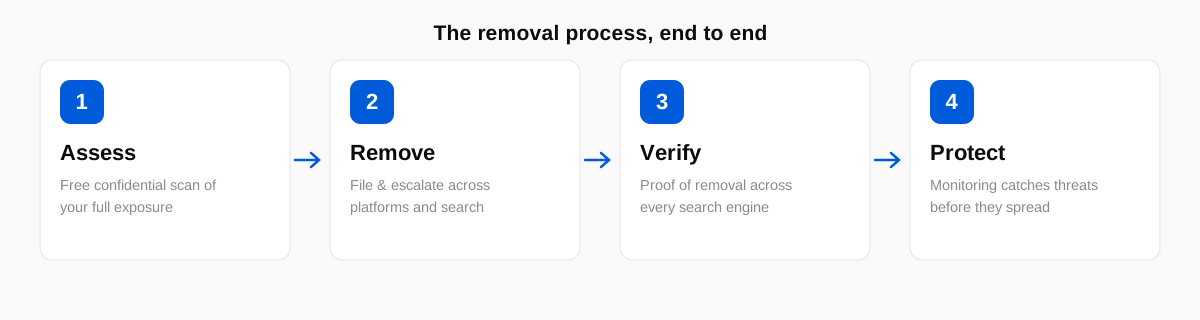
Whatever the billing model, the underlying work should follow the same professional arc (assessment, strategy, execution, verification) and you should be able to see where you are in it at any time.
Key takeaway: Per-link pays for outcomes, retainers pay for vigilance, contingency pays for certainty. Each is fair when matched to the problem, and each has a fine-print clause (link definition, monthly deliverable, “removed” definition) that decides whether you got what you paid for.
The hidden costs of cheap options
The sticker price of budget reputation services is rarely the real price. Four costs hide underneath:
The cost of the months. Cheap providers are slow by design: templates, queues, no escalation paths. While a $300/month service cycles through boilerplate, the content ages, accumulates links, and hardens in search results. You pay in entrenchment.
The cost of burned paths. Takedown requests leave a record. A sloppy, template, or legally wrong first request gets denied, and makes the well-argued second request harder, because platforms and publishers remember. The cheapest attempt can foreclose the good one; we regularly inherit cases that are harder than they were before anyone touched them.
The cost of gray-hat blowback. At the bottom of the market, prices are low because methods are fraudulent: fake DMCA claims, impersonation, forged court orders. When these unravel, and they unravel publicly, the original content returns with a new story about the fraudulent removal attempt attached to your name. You paid to enlarge the problem.
The cost of the wrong product. Suppression retainers applied to removable content bill monthly, forever, for a problem a one-time fee could have deleted. Reversed, cheap “removal” attempts against unremovable content burn months that competent suppression could have used. The wrong category at any price costs more than the right one at a fair price. (Our case studies include more than one engagement that began as someone else’s Tier 2 subscription.)
The cost of waiting: why exposure compounds
Doing nothing has a price, and it compounds in specific, mechanical ways:
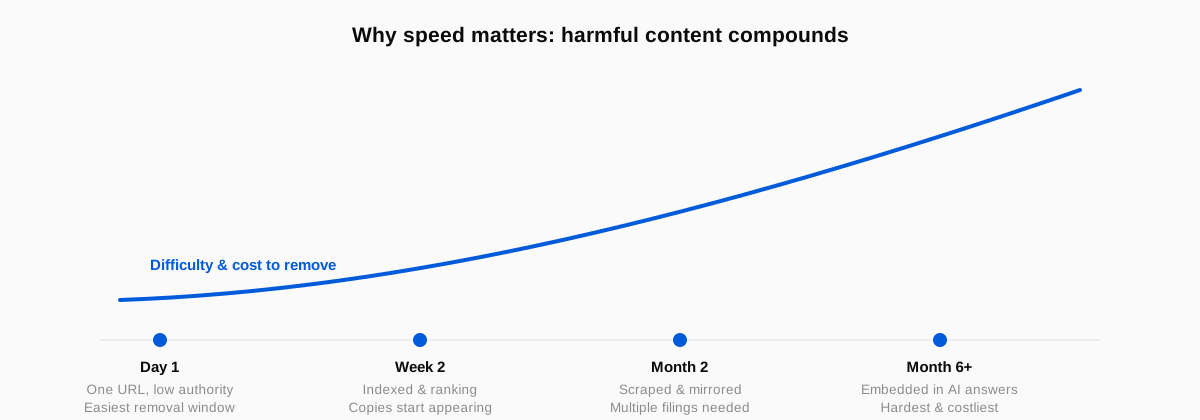
- Link accumulation. The longer a page ranks, the more it gets cited, shared, and linked, and each link makes it rank more durably. Search authority is a feedback loop.
- Syndication and scraping. One URL becomes eight. Every week of delay adds copies, and cost scales with copies.
- Indexing depth. Fresh content sits lightly in search indexes; old content sits deep: cached, archived, image-indexed, autocomplete-associated with your name.
- The permanent record problem. Archive services and datasets capture pages over time. Early removal can precede capture; late removal often can’t.
- Compounding audience. Every recruiter, client, lender, and date who searches you in the meantime is a cost that no later removal refunds.
None of this means panic-buying from the first vendor who answers the phone. It means the assessment should happen now, even if the engagement happens later, because the facts of your case are getting worse on a schedule, and knowing them is free.
Find out what waiting is costing you.Book a free, confidential Exposure Scan, a complete map of your current exposure and an honest quote, with zero obligation to go further.
Book Your Free ScanHow to think about ROI (without the invented multipliers)
Plenty of vendors will show you a chart claiming reputation spend returns some precise multiple. Ignore the charts, no honest firm can know your multiplier. Instead, reason through the mechanisms by which this spend pays back, and price them against your own numbers:
Search is the front door. Nearly everyone who matters to your outcome (employers, clients, patients, investors, partners, dates) searches your name and forms a first impression from page one before you’re in the room. The ROI question is concrete: what does one lost client, one rescinded offer, one dead deal cost you? For a professional whose average engagement is five or six figures, a single conversion saved can repay a removal several times over. Run your own arithmetic; don’t borrow a vendor’s.
Removal is an asset; suppression is an expense. A removed item is permanent: you buy the outcome once and keep it. Suppression delivers real value but requires maintenance to hold, which makes it recurring by nature. Neither is wrong; they simply belong in different mental ledgers, and removal-first sequencing puts as much of your spend as possible into the permanent column.
Prevention is cheaper than response. The engagements with the worst economics are crisis engagements: maximum urgency, maximum spread, minimum leverage. Monitoring exists because catching an item in week one, before the compounding described above, is the cheapest removal you’ll ever buy. That’s the actual financial logic of a protection retainer, and it’s also its limit: if you have no recurring threat, you don’t need one.
The counterfactual is not zero. The alternative to professional spend isn’t “free”: it’s your hours, your stress, your denied DIY requests, and the compounding cost of delay. Sometimes DIY still wins; for straightforward cases, we’ll tell you so at assessment (our FAQ covers which cases those are). The point is to compare real alternatives, not a fantasy in which doing nothing costs nothing.
Key takeaway: Ignore invented ROI multipliers. Price the mechanisms instead: what one lost opportunity costs you, what permanence is worth versus maintenance, and what delay is compounding in the background.
Frequently asked questions
What does online reputation management cost per month?
Across the market: DIY monitoring tools run roughly $99 to $500 per year; productized services $100 to $1,000 per month; professional ORM retainers commonly $1,000 to $10,000+ per month; our Protection Plans are quoted at member rates, scoped to the exposure after a free scan; enterprise programs run five figures and up. Monthly pricing only makes sense for ongoing needs: monitoring, suppression maintenance, standing threats. For a finite problem, project pricing is usually the better structure.
How much does it cost to remove a single negative link?
Professional removal of a standard item typically runs four figures; ours is quoted per link, in writing, after a free assessment. You see the exact price beside each URL before committing. The price moves with the four drivers: source authority, number of copies, legal complexity, and urgency. High-authority news content is quoted individually and honestly, including the possibility that removal isn’t achievable, which you should hear before paying anyone, not after.
Is cheap reputation management ever worth it?
Yes: when the product matches the problem. A $99 data-broker tool is the right buy for footprint hygiene; a modest review platform is right for a local business tending reviews. Cheap options fail when pointed at serious, specific content (defamation, news coverage, leaked images) where templates get denied, delay compounds the damage, and bottom-market methods can add fraud blowback to your original problem. Price the tier to the stakes, not to the budget’s comfort.
Do reputation companies offer refunds or pay-for-performance pricing?
Some do. Contingency (“pay after removal”) pricing is established in the removal niche and legitimate when transparent. Expect higher per-item prices and selective case acceptance, and read the definition of “removed” carefully. Refund terms vary widely; what matters is that success criteria are written, verifiable, and tied to something you can check in a search box. Blanket “guaranteed results” marketing, by contrast, is a red flag everywhere in this industry, and no serious practitioner uses it.
Know your number before you spend a dollar
Every figure in this guide is a market anchor; your actual cost depends on your actual exposure, and that can be established for free. Our confidential Exposure Scan inventories everything harmful that’s published about you, separates the removable from the unremovable, and puts an honest, itemized quote on the removable, no retainer pitch, no countdown clock, no obligation. Book your free Exposure Scan and make your reputation budget decisions with real numbers instead of a stranger’s chart.