
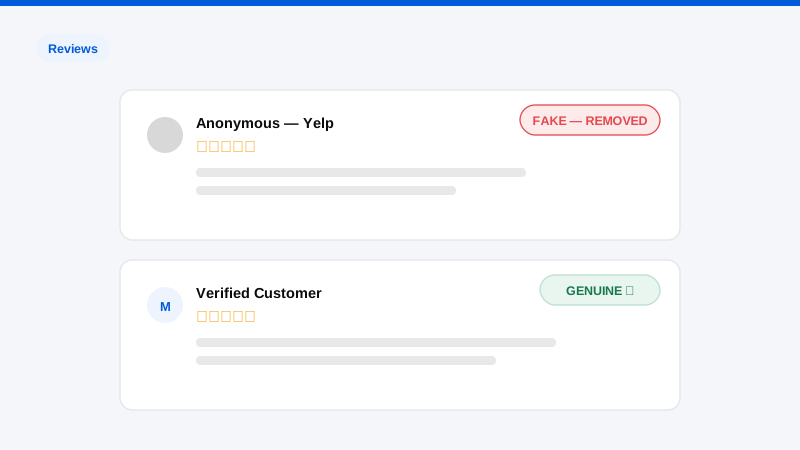
Yelp is the platform business owners ask us about with the most frustration in their voice — and for good reason. If you want to remove Yelp reviews, you’re dealing with the review site most openly committed to not removing reviews at a business’s request, layered with an automated recommendation system that decides which reviews people actually see, using criteria Yelp doesn’t fully disclose. Owners routinely watch glowing five-star reviews vanish into the “not recommended” section while a scathing one-star review sits at the top of the page, and conclude the whole system is rigged against them.
It isn’t rigged — but it is opinionated, and you can’t work it without understanding its logic. Yelp does remove reviews: ones that violate its content guidelines, ones written by people with conflicts of interest, ones that are extortion attempts or hearsay from non-customers. What Yelp won’t do is remove a genuine customer’s honest negative experience, and it treats aggressive attempts to make that happen as a signal about your business. Meanwhile the recommendation filter — not removal — quietly determines most of what your Yelp page actually shows the world.
This guide covers the whole board: what Yelp’s guidelines actually prohibit, how to flag effectively, how the recommendation software works and what legitimately influences it, why buying or incentivizing reviews is the single most self-destructive move available, and how to decide between removal, response, and rebuilding.
What Yelp’s content guidelines actually prohibit
Yelp’s content guidelines are the rulebook its moderators enforce, and every successful flag maps to them. The categories that matter for removal:
- Conflicts of interest. Reviews of your own business, a competitor’s business, or an employer’s business are prohibited. A competitor posing as a customer, a fired employee reviewing you as a “patron,” a rival’s family member — all removable when the conflict can be shown.
- No firsthand experience. Yelp requires reviews to reflect the reviewer’s own genuine consumer experience. Secondhand accounts (“my friend told me…”), reviews of businesses the person never patronized, and rants from people who only interacted with you in a news cycle or social media pile-on violate this rule.
- Extortion and leverage. Reviews used as a threat — “refund me or this stays up,” posted after a demand for compensation — violate guidelines, and documented extortion attempts are among the strongest removal cases you can bring.
- Off-topic content. Political commentary about your industry, complaints about parking meters outside, media-driven pile-ons unrelated to any actual customer experience.
- Privacy violations and harassment. Posting employees’ personal information, threats, hate speech, and content targeting individuals rather than the business experience.
- Plagiarized or duplicated content. Copy-pasted reviews across multiple businesses, recycled content from other users or sites.
And the category that isn’t there: honest negative experiences. A real customer who had a bad meal, a rough service call, or a billing dispute and wrote about it angrily is exactly what Yelp exists to publish. No flagging strategy removes it, and we tell every client that plainly before taking any engagement — the honest scoping is why our review removal work starts with an audit rather than a promise.
The flagging process, done properly
Any business owner with a claimed Yelp Business Page can report a review — and flagging is the only front door there is to remove Yelp reviews. The mechanics are simple; the strategy is in the execution.
Flag from a claimed, complete business account. Claim your page first. Reports from verified business owners with complete profiles are the expected channel.
Choose the precise violation, not the emotional one. Yelp’s reporting flow asks why the review violates guidelines. “This review is false” is not a category and not an argument. “This reviewer is a direct competitor — they own [business] in the same market” is. “This reviewer never visited us; we have no record of this transaction, and the review describes services we don’t offer” is.
Make the moderator’s job trivial. Yelp moderators review reports against guidelines, and concise, factual, evidence-anchored reports get traction: quote the violating language, state the specific guideline, summarize the proof in two or three sentences. Long emotional narratives bury the violation.
Document before you flag. Screenshot the review with date and URL. Reviews get edited, and if the matter ever escalates — to Yelp support channels or to counsel — the original language matters.
Expect one decision, then escalate with substance. If moderators decline removal, repeated identical flags accomplish nothing. Escalation is warranted when you have genuinely new evidence: proof of the reviewer’s identity and conflict, documentation of extortion messages, or a pattern of coordinated targeting. For provably false statements of fact, a legal track through an actual attorney exists — Yelp responds to valid court orders — but the bar is high, the cost is real, and opinions, however harsh, don’t qualify. That path belongs to defamation removal territory, not routine review disputes.
The recommendation filter: the system that matters more than removal
Here’s the strategic reality most guides miss: on Yelp, visibility is decided less by what gets removed than by what gets recommended. Yelp’s automated recommendation software evaluates every review and sorts it into “recommended” (displayed by default, counted in your star rating) or “not recommended” (tucked behind a link, excluded from your rating). Yelp has said the software weighs signals of quality, reliability, and user activity — established accounts with real activity histories tend to be recommended; brand-new, empty, or suspicious accounts tend not to be.
Three practical consequences:
Some attacks filter themselves. A wave of one-star reviews from freshly created accounts often lands in “not recommended” automatically, never touching your rating. Before panicking about an attack, check what’s actually recommended and rating-visible.
Your best reviews may be filtered — and you can’t appeal it. The five-star review from a delighted first-time Yelp user frequently gets filtered because the account looks thin, not because anything’s wrong with the review. There is no process to force a review into “recommended,” and anyone selling that service is selling smoke.
The filter re-evaluates continuously. Reviews move between sections as account signals change. This is why the only legitimate lever on the filter is the composition of your reviewer base: real customers with real Yelp habits, accumulated over time. Which brings us to the tactic that destroys businesses trying to game exactly this.
Why buying reviews backfires — every time
The temptation is obvious: if the filter rewards volume and the bad reviews won’t come down, why not buy some five-star ballast? Because Yelp treats compensated and incentivized reviews as a first-order threat to its business, and it responds accordingly:
- The filter eats purchased reviews. Bought reviews come from exactly the account profiles the recommendation software distrusts. Most never display. You’re buying content that gets filtered on arrival.
- Consumer Alerts turn cheating into a public scarlet letter. Yelp investigates review solicitation and purchase schemes and has a practice of placing public warning banners — Consumer Alerts — on business pages caught buying reviews or offering incentives, sometimes displaying the evidence. The alert is vastly more damaging than the negative reviews you were trying to bury: it tells every prospective customer, in Yelp’s voice, that you tried to deceive them.
- It’s legally dangerous, not just risky. Fake and undisclosed-incentive reviews are deceptive practices in the FTC’s view, and regulators have pursued businesses and review brokers over them. This isn’t a gray area anymore.
- Even “review gating” backfires. Softer versions — surveying customers and steering only the happy ones to Yelp, offering discounts for reviews — violate Yelp’s rules against soliciting reviews and can trigger the same scrutiny. Yelp’s position is stricter than most platforms’: don’t solicit reviews at all; let service generate them.
The pattern we’ve seen repeatedly: a business with a fixable review problem buys its way into an unfixable trust problem. Whatever else you take from this guide, don’t do it.
Step-by-step: how to remove Yelp reviews (and manage what you can’t)
- Claim and complete your Yelp Business Page. Everything else requires it.
- Audit every negative review against the guidelines. Sort into: clear violation, possible violation needing evidence, and genuine customer criticism. Check the “not recommended” section too — some of what worries you may already be filtered and rating-invisible.
- Build evidence for the violators. Transaction-record searches showing no matching customer, proof of competitor identity, screenshots of extortion demands, documentation that described events couldn’t have occurred.
- Flag precisely — one review at a time, exact guideline, quoted language, evidence summary. Never carpet-flag everything negative; it reads as suppression and costs you credibility on every future report.
- Escalate declined flags only with new substance, and route provably false factual claims through a defamation attorney rather than Yelp’s queue.
- Respond publicly to genuine criticism — briefly, specifically, without defensiveness: acknowledge, correct facts, state the fix, invite direct contact. Prospects read your responses as a preview of being your customer.
- Generate reviews the only safe way: deliver service worth writing about and make your Yelp presence easy to find. No asks, no incentives, no gating.
- Watch the page continuously. New reviews, filter shifts, and rating changes should surface in days — stale problems are harder problems. Standing reputation monitoring exists for exactly this.
- Fix the search layer separately. If a bad Yelp page ranks for your brand name, that’s a search visibility problem with its own toolbox — see removing content from search results — and it often matters more than the individual reviews.
Removal, response, or rebuild: choosing the right lever
A simple decision rule serves executives well here. Remove when a review violates written guidelines and you can prove it — fake, conflicted, extortionate, off-topic. Respond when the review is genuine — a real customer’s real experience — because your audience is future customers, not the reviewer. Rebuild when the page’s overall picture is the problem: thin review volume, outdated content, a rating that reflects a bad year you’ve since fixed. Rebuilding is the slowest lever and the most durable one, and it’s where review strategy merges into full-spectrum reputation management — the review page is one battlefield in how your business appears everywhere decisions about you get made.
The worst strategy is the most common one: treating all three situations as removal problems, flagging everything, losing every flag, and then reaching for shortcuts that make it worse.
Frequently asked questions
Can I pay Yelp to remove bad reviews or improve my rating?
No — and this misconception damages real decisions, so it’s worth being precise. Yelp advertising buys visibility placement, not moderation outcomes; Yelp is explicit that ad spend doesn’t influence which reviews are recommended or removed. No legitimate third party can pay Yelp on your behalf either. Removal happens through guideline-based flags, Yelp’s own enforcement, or valid legal orders. Budget accordingly: money spent on evidence-building and honest response beats money spent chasing a purchase path that doesn’t exist.
Why did my real customers’ five-star reviews disappear while the one-star reviews stayed?
The recommendation filter, almost certainly. Reviews from new or low-activity Yelp accounts — which describes many happy customers who signed up just to praise you — get sorted into “not recommended” and hidden from your rating. Negative reviewers, statistically, are often more active Yelp users whose accounts the software trusts. It feels backwards, but it isn’t targeted at you, and there’s no appeal mechanism. The only real countermeasure is time and a broad base of genuine customers, some of whom will be established Yelpers.
A customer threatened a bad review unless we gave a refund. What do I do?
Preserve everything immediately — the messages, timestamps, the eventual review. Review extortion violates Yelp’s guidelines, and a documented demand-then-review sequence is one of the strongest removal cases available. Report it with the evidence summarized factually. Separately, decide the refund question on its merits, never as ransom: businesses that pay extortionate demands reliably get repeat demands. If threats escalate or the sums are meaningful, involve an attorney — extortion can be a legal matter, not just a platform one.
How long does Yelp review removal take?
Simple guideline flags are typically decided within days to a couple of weeks. Evidence-heavy escalations — conflict-of-interest cases, coordinated attacks — take longer. Legal routes run months. Plan around that reality: flag the clear violations immediately, post responses to what will survive, and don’t put a product launch or funding announcement on hold waiting for a moderation queue.
If your Yelp page is costing you customers, get an honest map before you act. Our free exposure scan shows which reviews are realistically removable, what the recommendation filter is actually displaying, and how your Yelp presence ranks in search — real answers before you spend anything.