
No reliable, lawful consumer tool exists to show who is searching your name. Google states it does not disclose who searches for you, and its Results about you alerts only flag your data appearing in results. What you can monitor are the signals: new or rising search results, LinkedIn profile views, unusual traffic and mentions spreading across platforms.
Key facts
- Google’s own support guidance says it does not reveal who searched for you or looked up your details.
- LinkedIn is the closest mainstream platform to naming viewers, with Premium showing profile views from the last 90 days.
- A monitoring stack has four layers: search results, owned-surface analytics, mentions and conversation, and dark web.
- Watch for a new result, an old result climbing, strange traffic on quiet pages and lateral spread.
Where ContentRemoval.com comes in. ContentRemoval.com works on the question behind this one: what are they finding, and how fast can that change. For executives, founders and families under scrutiny, that means removing exposed personal data, impersonation and harmful pages, then monitoring for their return. A chief of staff or family office security lead is often the one who calls. A free 15-minute Exposure Scan maps what is visible and what can be removed, and the report is yours to keep. Get a Free, Confidential Exposure Scan or read how our content removal work is done.
You notice it before breakfast. A former board colleague suddenly views your profile. A reporter asks a narrow question they shouldn’t know to ask yet. A client mentions an old article you assumed had vanished into page six of Google. None of this feels random.
For executives, founders, public figures, and families with assets to protect, the question isn’t neurotic. It’s operational. Who’s searching me is really shorthand for something more serious: who is building a file on me, what are they finding, and do I have any warning before that interest turns into pressure, manipulation, or reputational damage?
Most of the internet gives false comfort here. It promises a tool that will reveal every person who searched your name. That tool doesn’t exist in any reliable, lawful, consumer-facing form. Serious people waste time looking for it anyway, because the anxiety is real and the stakes are real.
The professional answer is less satisfying, but far more useful. You usually cannot identify the searcher directly. You can, however, monitor the signals that search activity leaves behind. That means watching public search results, your own profiles, new mentions, unusual traffic, and the spread of private data across platforms. If you’re under scrutiny, the evidence rarely appears as a neat list of names. It appears as movement.
An Unsettling Question Who Is Searching For Me Online
A high-profile client usually asks this question after something shifts.
Sometimes it’s subtle. Their name starts appearing in conversations with people outside the usual circle. A niche personal detail shows up in a negotiation. A private residence begins receiving mail from entities they’ve never dealt with. Other times the trigger is sharper: an ex-partner becomes hostile, a journalist starts calling contacts, a competitor circles an acquisition, or a disgruntled former associate starts probing online.
The instinct is to find the person behind the screen. That instinct is understandable, but it can send you in the wrong direction. The immediate issue isn’t curiosity. It’s exposure.
What the question actually means
When clients say, “Who’s searching me?” they usually mean one of three things:
- Reputational scrutiny. Someone is vetting them for a deal, appointment, hire, investment, or public attack.
- Personal exposure. Private details such as a phone number, home address, or family connection may be easier to find than expected.
- Threat assessment. They want early warning that attention is building before it becomes harassment, doxxing, extortion, or a coordinated smear effort.
You’re not looking for gossip. You’re looking for indicators that someone is assembling enough public information to use against you.
That distinction matters. If you treat this as a simple search query problem, you’ll chase the wrong tools. If you treat it as a digital risk problem, your actions become clearer. You monitor discoverability. You track what has become visible. You reduce what can be weaponized. You prepare a response before a hostile actor forces one.
The right objective
The objective is not to identify every individual searcher. In most environments, you can’t.
The objective is to know when your digital footprint changes, when interest spikes around your name or brand, and when a routine lookup becomes a pattern that deserves intervention. That is how professionals handle this. Systematically, and without illusions.
The Technical Reality of Online Search Anonymity
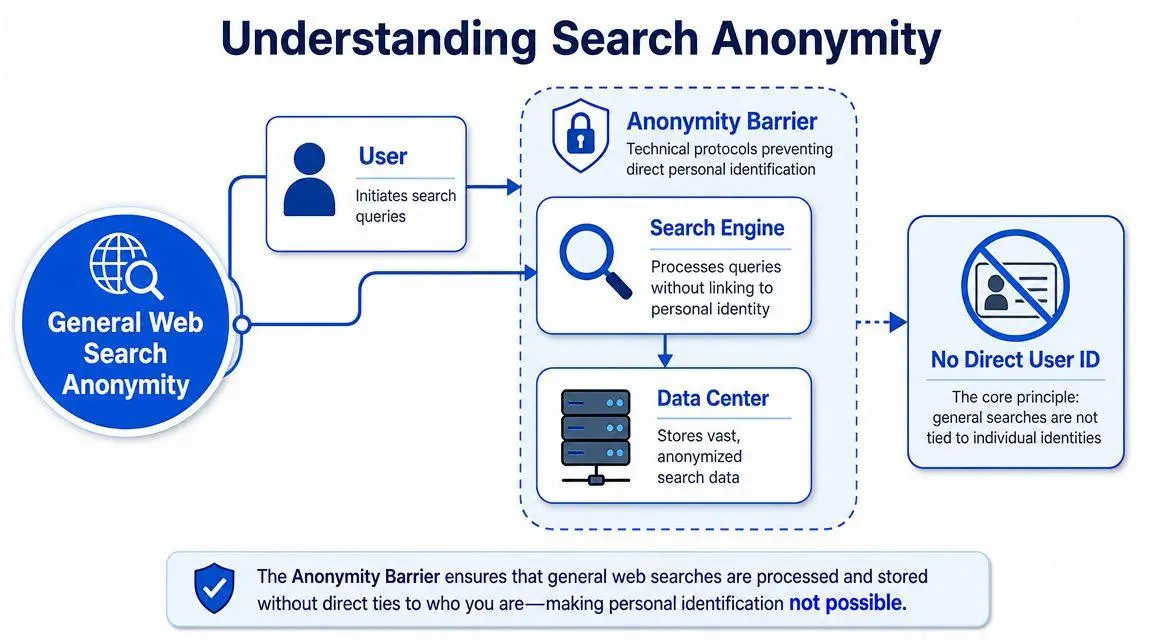
Start with the hard truth. Google will not tell you who searched for you. Google’s own support guidance says it does not provide information about who searches for you or looks up your personal details, and that “Results about you” alerts are about your data appearing in public search results, not about identifying the searcher, according to Google’s support documentation on searches and personal information.
That should end a great deal of bad advice.
Google Search is built around discovering and returning information at scale. Google explains search in three stages: crawling, indexing, and serving results, as described in Google’s explanation of how Search works. That architecture tells you something important. Search engines are designed to find and rank content, not to provide named lookup logs to the people being searched.
Why the myth persists
People confuse three different things.
First, they assume that because platforms collect data, that data must be available to them. It usually isn’t. Second, they confuse search visibility with searcher identity. You can often see what is ranking for your name. That does not mean you can see who entered the query. Third, they mistake marketing analytics for personal surveillance. Website owners can observe traffic patterns and referral behavior in limited ways, but that is not the same as receiving a list of people who searched your name on Google.
Here is the cleaner way to think about it.
| What you want to know | What major search engines typically allow |
|---|---|
| Who typed your name into search | Not disclosed |
| Whether your phone number, address, or name appears publicly | Sometimes detectable through alerts |
| Whether a page about you has been indexed or is ranking | Monitorable |
| Whether interest is showing up on your owned profiles | Sometimes visible on specific platforms |
What you can detect instead
You can detect appearance, ranking, and exposure.
If your home address becomes indexable, if a new profile starts ranking for your name, if a forum thread begins surfacing, or if sensitive personal details appear in public results, those are actionable signals. They tell you your exposure has changed. They do not identify the person behind the query.
Practical rule: Stop asking whether Google will reveal the searcher. It won’t. Ask whether your name, data, or narrative has become easier to find.
That is also why executive privacy work starts upstream. If your details are already distributed across broker networks and public records aggregators, search is only the final delivery mechanism. The strategic problem sits beneath it. A useful starting point is understanding what data brokers are and how they affect executive privacy.
Platforms That Offer Direct Viewer Identification
There is one category where you can get closer to a real answer. Closed platforms with profile-view analytics.
The strongest mainstream example is LinkedIn. According to NetReputation’s summary of profile-view visibility and search limitations, Google does not disclose who searched for you, while LinkedIn is the closest widely used consumer-facing platform to identifying individual viewers. A basic account shows partial viewer data, and Premium can surface all profile views from the last 90 days.
That doesn’t make LinkedIn a surveillance console. It makes it a useful signal source.

What LinkedIn can tell you
If someone views your profile in a non-private mode, LinkedIn may show their name, role, and employer. That is valuable because it ties interest to an identifiable actor in a way general search engines do not.
For a principal under scrutiny, this matters in predictable situations:
- Pre-transaction diligence. Investors, counterparties, recruiters, and journalists often touch LinkedIn before they make direct contact.
- Competitive intelligence. A rival executive or corporate development contact may reveal themselves through repeated profile views.
- Narrative change. A cluster of views from media, legal, or regulatory circles can indicate that a story is moving before it is public.
What LinkedIn cannot tell you
It cannot tell you whether that person found you through Google, through a referral, through a shared article, or through a private conversation. It cannot identify viewers who use private mode. It also cannot replace broader monitoring.
Use it as one input, not the answer.
A practical way to handle this is to review profile-view data with context:
- Check timing. Did the views appear after a press inquiry, legal dispute, funding discussion, or board issue?
- Check clustering. One view is often noise. A sequence from the same industry, firm type, or geography is not.
- Check proximity. If the viewer has a direct connection to a competitor, media outlet, litigant, or former associate, note its importance.
A named profile view is useful because it gives you a human actor. It is limited because it doesn’t tell you the full route they took to get there.
Other environments with direct visibility
Some private member portals, gated communities, and custom web applications log authenticated user activity in ways that can identify viewers. That can matter for associations, investor portals, alumni networks, or internal company systems. The rule is simple: if the platform requires a signed-in identity and was built to expose visit data, you may have a record. If it is open web search, you usually won’t.
Implementing a Proactive Digital Monitoring System
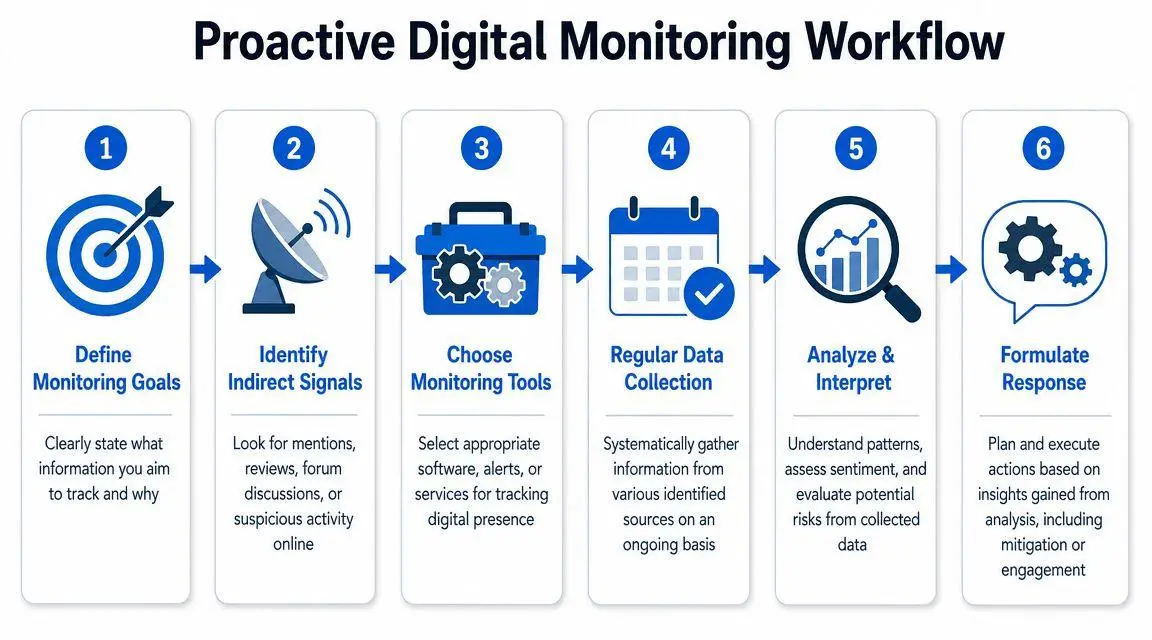
Serious monitoring starts when you stop trying to unmask a searcher and start tracking evidence of interest.
That shift is overdue. Google handles more than 5 trillion search queries per year, or about 9.5 million searches per minute, according to Semrush’s compilation of Google search scale. At that volume, your problem is not access to a secret list of names. Your problem is whether the right or wrong material appears when someone checks you.
Build the monitoring stack around your name
Most clients need four layers.
Search-result monitoring
Track your full name, common name variations, your company, your spouse or family office if relevant, and any legacy businesses or litigation references likely to surface. Google Alerts remains a basic entry point. It is not sufficient on its own, but it is still useful for catching new indexed mentions.
Set alerts for names in quotation marks, then separate alerts for unquoted variations and combinations with terms such as “lawsuit,” “review,” “address,” or your sector. You are not trying to catch everything. You are trying to catch the first meaningful appearance.
Owned-surface analytics
Watch what happens on properties you control or partially control. LinkedIn profile views belong here. So do spikes in direct traffic to your biography page, professional website, portfolio, or media page, if those surfaces exist.
If you maintain executive sites or family-office portals, pair monitoring with security review. Interest often arrives alongside probing activity. That is where technical validation matters, and in some cases a review of external pentesting services is sensible because a reputation issue and an exposure issue often sit side by side.
Mention and conversation monitoring
Search doesn’t create risk on its own. Public evidence does. You need visibility into mentions on news pages, blogs, forums, review sites, video platforms, and social platforms. For higher-stakes cases, that extends to impersonation surfaces and dark web monitoring.
Purpose-built services become more useful than piecemeal alerts. A structured reputation monitoring program can centralize those inputs so you see patterns rather than isolated incidents.
What to look for
The useful signals are rarely dramatic at first.
- A new result appears for your name that contains private data, allegations, or recycled old reporting.
- An old result climbs because someone has linked to it, reposted it, or revived it.
- Traffic behaves strangely on a profile or biography page that usually sits quiet.
- Mentions spread laterally across a forum, social thread, or copied blog network.
A disciplined monitoring system turns these from surprises into early warnings. That is the point. Not omniscience. Not fantasy. Early warning.
Responding to Unwanted Discoveries and Threats
Once you detect movement, speed matters. Delay allows search engines, platform recommendation systems, and AI-assisted discovery layers to absorb the material and spread it further.
The environment is also broader now. The shift in AI search and social search means people increasingly look across Google, TikTok, and YouTube, and recent guidance highlights that Google’s AI-driven context recognition can surface people or brands without a traditional query footprint, as discussed in this analysis of AI-driven and cross-platform discovery behavior. That changes the response standard. You are not only fixing one search result. You are containing a narrative across multiple surfaces.
First response within hours
Start with containment.
Lock down social privacy settings, remove unnecessary personal details from public bios, and review every high-authority profile you control. If your phone number, home area, family names, or predictable travel patterns are publicly exposed, reduce that exposure immediately.
Then preserve evidence. Save URLs, screenshots, timestamps, and page source copies where appropriate. If the matter escalates into legal action or platform enforcement, a clean record of what appeared and when will matter.
If harmful material is live, don’t start by arguing with it in public. Preserve it, classify it, and choose the shortest removal path.
Triage the issue correctly
Not every result deserves the same response. Treat it like incident handling.
| Issue type | First move | Escalation path |
|---|---|---|
| Private personal data | Submit platform or search-related privacy removal requests | Broader data removal and safety planning |
| Impersonation or fake accounts | Report through platform impersonation channels | Counsel or specialist intervention if ignored |
| Copyrighted images, video, or text | Use copyright complaint mechanisms | Repeat-infringer enforcement if reposted |
| False factual allegations | Preserve evidence and assess defamation standard | Counsel and specialist removal strategy |
| Coordinated harassment or doxxing | Safety response and rapid takedown requests | Legal, platform, and security escalation |
Choose the right remedy
Platform rules often give you a faster route than a legal threat. If the material involves impersonation, exposed contact details, or obvious policy violations, use the platform process first. If it involves false statements that damage reputation, harassment, extortion, or cross-border publication, legal counsel should review before you act publicly.
For personal data exposure and targeted harassment, the response must be broader than a single takedown request. You may need search de-indexing requests, source-page removal, profile hardening, and re-upload monitoring. If the issue has crossed into publication of home address, family details, or threats, review a structured professional mitigation guide for doxxing incidents.
Don’t feed the cycle
Many clients make the same mistake. They engage emotionally with the material, contact the poster directly, or trigger a Streisand effect by broadcasting the issue before a removal plan is ready.
A better rule is narrow, documented action. Remove what you can. Suppress what you can’t remove. Publish accurate counterweight only when it serves a strategy, not your nerves.
Engaging Specialists for Complex Digital Risk
There is a clear line between manageable nuisance and strategic threat. Once you cross it, self-help stops being efficient.
If a matter involves coordinated publication, entrenched negative search results, repeated reuploads, anonymous operators, AI-amplified summaries, or material spread across several jurisdictions, you are no longer dealing with a simple visibility problem. You are dealing with an adversarial record. That requires specialist handling.
When to escalate
Most search engines and social platforms do not let users see a reliable list of individual people who searched for them. The more useful question is how to detect signals of interest such as profile views, mention alerts, and unusual traffic patterns, because searching is usually inferred rather than directly observable, as noted in this discussion of indirect signals and privacy limits.
That reality creates a threshold. You escalate when the signals point to organized interest and the consequences are material.
A few examples are enough:
- A defamatory article starts appearing across mirrored sites and AI-generated summaries.
- A private image, address, or phone number reappears after each removal.
- A journalist, litigant, activist network, or anonymous account cluster is building momentum around an accusation.
- Search results for your name no longer reflect reality, and standard platform forms have stalled.
What specialists do differently
Specialists don’t chase the fantasy of naming every searcher. They reduce the attack surface, remove or suppress harmful content, document violations properly, and manage recurrence.
That work usually combines platform process, search-result strategy, privacy remediation, legal coordination, and monitoring discipline. It also requires discretion. High-profile matters deteriorate quickly when too many people touch them, too early, with no command structure.
If the question in your head is still “Who’s searching me?”, you are already one step behind the better question: what are they finding, and how fast can I change that?
If your name, company, or family is drawing the wrong kind of attention, ContentRemoval.com can assess the exposure, identify the reachable removal paths, and help structure a discreet response plan. This is the point where guesswork becomes expensive. A confidential review gives you a clearer picture of what is visible, what is actionable, and what needs immediate containment.
Frequently asked questions
Is there an app that shows who Googled my name?
No. Google does not provide that information, and any service claiming to reveal individual searchers is unreliable or unlawful. The article explains that search engines are built to find and rank content, not to hand named lookup logs to the people being searched.
Can I see who viewed my LinkedIn profile?
Partly. A basic account shows some viewer data and Premium can surface all profile views from the last 90 days, unless the viewer used private mode. The article suggests reading views by timing, clustering and proximity to competitors, media or litigants rather than treating one view as meaningful.
What should I do if I think someone is building a file on me?
Shift from identifying the searcher to reducing what they can find. Lock down social privacy settings, strip unnecessary personal details from public bios, preserve evidence of anything harmful that has appeared, and triage it by type: privacy removal, impersonation report, copyright complaint, defamation assessment or doxxing response.