
Synthetic media is content partially or entirely generated or modified by AI across text, images, audio and video, built to mimic reality. Deepfakes are the video subset that falsely depict a real person’s appearance, speech or conduct. For executives it is a live reputational and legal risk, handled through evidence preservation, parallel takedown and legal review, and reupload tracking.
Key facts
- Four attack surfaces: synthetic text shapes the story, images the belief, audio the urgency, video the proof.
- Detection tools flag facial inconsistencies and mouth-sound mismatches into a risk score, not a verdict.
- The US TAKE IT DOWN Act requires removal of non-consensual intimate deepfakes within 48 hours of a valid request.
- Deepfakes online increased tenfold from 2022 to 2023 according to the Center for News, Technology and Innovation.
Where ContentRemoval.com comes in. ContentRemoval.com handles the containment side of a synthetic media attack: platform escalation, source removal, de-indexing and tracking of recut and reposted copies, while counsel handles defamation analysis and preservation for litigation. The communications lead or general counsel usually makes the first call while the clip is still spreading. A free 15-minute Exposure Scan maps where the content sits and what can be removed, and the report is yours to keep. Get a Free, Confidential Exposure Scan or read how our content removal work is done.
Synthetic media is AI-generated or AI-modified content that mimics reality, and the global market was USD 5.063 billion in 2024, with a projection to USD 21.7016 billion by 2033 at an 18.10% CAGR from 2025 to 2033. For an executive, that means a fabricated board clip, a fake apology video, or a voice clone used for fraud is no longer a novelty, it’s a live reputational and legal risk.
You’re probably dealing with one of three pressures right now. A piece of synthetic content is already circulating, someone on your team is asking whether it’s real, or your legal and communications leads are arguing over whether to respond publicly, privately, or at all.
Treat this as an operational problem, not a curiosity. Synthetic media is a dual-use capability, useful for content production, dangerous when turned against a person, a brand, or a transaction flow.
Defining the New Digital Reality
A fabricated video of a board meeting does not need to be perfect to do damage. If the clip suggests a CEO approved a transfer, insulted an investor, or admitted to misconduct, the reputational blast radius begins before anyone verifies the file. That is why synthetic media belongs in the same risk category as impersonation, defamation, and social engineering.
Synthetic media is content partially or entirely generated with AI or machine learning across text, images, video, and audio. The distinction matters. Ordinary editing changes an original file, while synthetic media can manufacture a file that looks like it came from a genuine source in the first place. The UK ICO notes that as the technology has advanced, separating synthetic from authentic media has become harder, which is exactly why executives can’t rely on visual instinct alone. Their guidance also points to detection methods that look for facial-expression inconsistencies, mouth-sound mismatches, and blended boundaries, then aggregate those checks into a risk score. ICO synthetic media and detection
Practical rule: If content can change how a reasonable viewer interprets a person’s words or conduct, you should treat it as a high-risk synthetic media event until verified otherwise.
A useful legal benchmark comes from the Montana legislative archive, which describes deceptive synthetic media as content created with GANs or similar tools that gives a reasonable viewer a different impression from the unaltered original. That framing is blunt for a reason. The threat is not technical cleverness, it’s the ability to create a false business reality fast enough to trigger human reactions. Montana legislative definition examples
The scale explains why boards should care. A category that was once treated as a media oddity now sits inside a multi-billion-dollar market and a broader trust infrastructure problem. The wrong response is to dismiss it as internet noise. The correct response is to assume a hostile actor may already know how your organization handles reputational shocks.
The Four Categories of Synthetic Media
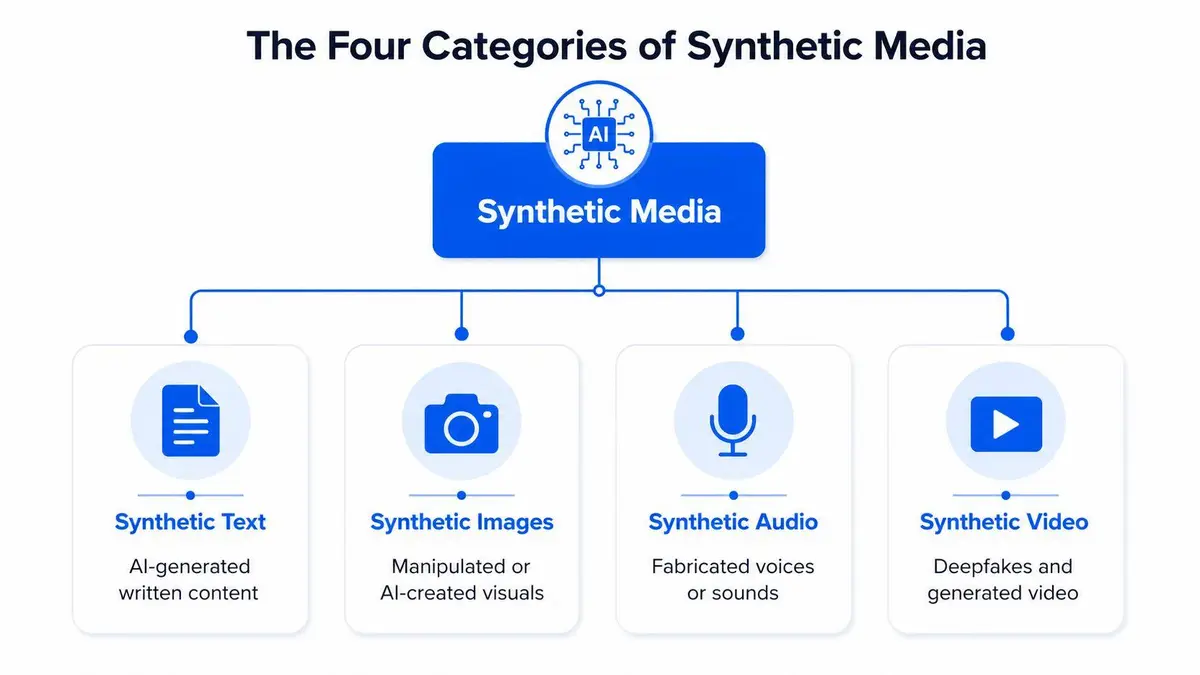
Synthetic media does not arrive in one form. It comes in four operationally different attack surfaces, and each one requires a different response path. If you collapse them into the single phrase “deepfake,” you will miss the true risk.
Synthetic text
Synthetic text is the easiest to deploy and the easiest to underestimate. A hostile actor can use it to publish defamatory blog posts, fake leaked memos, forged shareholder comments, or manufactured “quotes” that appear to come from an executive. The damage lands because text is frictionless to share and simple to remix across forums, newsletters, and social channels.
Synthetic images
Synthetic images can place a person at a compromising location, show them alongside the wrong people, or imply conduct that never happened. For public figures, image manipulation often spreads faster than corrections because the visual cue feels immediate. A single fabricated image can support an entire false narrative before the source is traced.
Synthetic audio
Synthetic audio is especially dangerous in corporate environments because it targets trust in voice. A fake voicemail can be used to authorize action, inflame internal conflict, or push staff toward a fraudulent transfer. The medium feels private, which makes people lower their guard.
Synthetic video
Synthetic video is where most executives first hear the term deepfake. Deepfakes are a subset of synthetic media designed to create a realistic but false depiction of a real person’s appearance, speech, or conduct. That includes a false public statement, a manipulated interview, or a staged admission that never took place. Deepfake and synthetic media definition examples
One useful way to think about this is simple. Text attacks shape the story, image attacks shape the belief, audio attacks shape the urgency, and video attacks shape the supposed proof. Once you understand that distinction, you stop asking whether something is “real enough” and start asking what the content is trying to make people do.
The Technology Powering Digital Impersonation
The machinery behind synthetic media is not mysterious, but it is powerful enough to overwhelm casual verification. GANs, or Generative Adversarial Networks, work like a forger and an internal critic locked in competition. One model creates, the other challenges, and the output keeps improving until the synthetic result starts to look convincing to the human eye.
That dynamic matters because it removes the old comfort that bad forgeries will “look fake.” Modern models can generate content fast, adjust it repeatedly, and tailor it to a target audience. In practice, that means the person attacking you does not need film studio resources or an advanced media lab. They need a convincing prompt, access to public-facing material, and enough patience to iterate.
Why executives should care about the toolchain
Large language models can draft the text that frames a fake event. Image systems can generate the visual falsehood. Audio tools can clone a voice. Video tools can stitch the whole package together into something that appears coherent. The point is not that every output is perfect. The point is that a single imperfect artifact can still force a response, trigger a media inquiry, or spook a business partner.
Detection has become harder because the technology is improving and because platforms move faster than human review. That is why the right question is not whether the synthetic content was generated by an “advanced” model. The right question is whether the content has enough credibility to cause operational harm before you can contain it.
A forged clip only needs to be plausible long enough to move through one meeting cycle, one journalist call, or one internal approval chain.
You should also separate novelty from maturity. Synthetic media is not a toy phase anymore. It sits inside a broader content production stack that can be used for marketing, fraud, harassment, and impersonation with very little visible friction. That makes it a governance issue, not an IT side project.
Reputational and Financial Risks for Public Figures
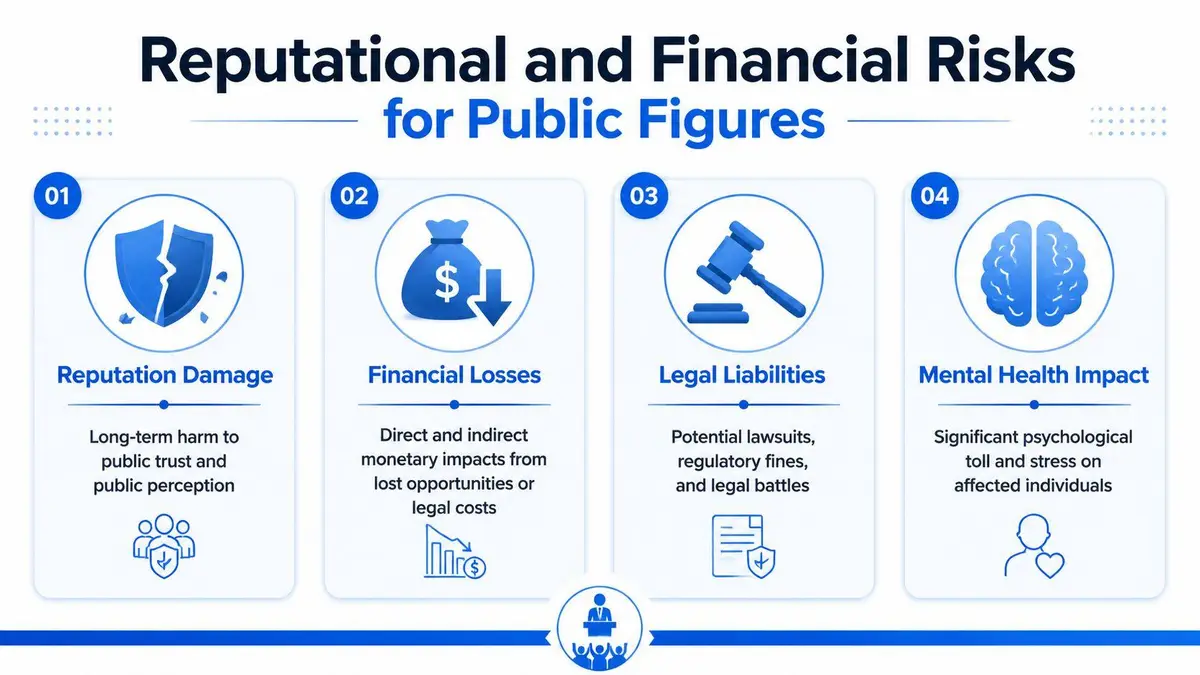
The biggest mistake high-profile people make is assuming a fake clip only creates embarrassment. It can also trigger legal exposure, disrupt financing, poison negotiations, and force a costly public defense. The harm often lands in layers, not one clean blow.
The threat is scaling, too. The Center for News, Technology & Innovation reported that the number of deepfakes online increased tenfold from 2022 to 2023, which shows how quickly manipulated content can spread across platforms. That growth turns synthetic media into a trust problem that travels through search, social feeds, private chats, and news coverage at the same time. CNTI synthetic media and deepfakes
How the damage compounds
A false statement can spook investors before the correction appears. A fabricated intimate image can drive harassment, extortion, and long-term personal distress. A fake audio clip can cause employees to question whether a leader is stable, available, or compromised. None of those effects stops automatically when the original post is removed.
That is why reputational harm from synthetic media is rarely confined to the first headline. It creates secondary consequences, including legal fees, internal inquiry costs, reputation management spend, and time diverted from actual leadership work. The most damaging part is often uncertainty, because uncertainty makes outside parties hesitate.
For public figures, the risk is sharper because attention itself is a multiplier. The more visible the person, the faster the fake content gets reframed as evidence. If you wait for organic truth to win, you may already have lost the narrative window.
For a more detailed response posture around public visibility, the operational logic overlaps with the guidance in ContentRemoval.com’s reputation management approach for celebrities and public figures.
The business reality
A hostile actor doesn’t need to destroy the truth. They only need to interrupt confidence in it. Once that happens, your communications team is no longer just correcting a post, it’s defending the credibility of the person, the company, and every prior statement attached to them.
Detecting Forgeries in a Post Truth World
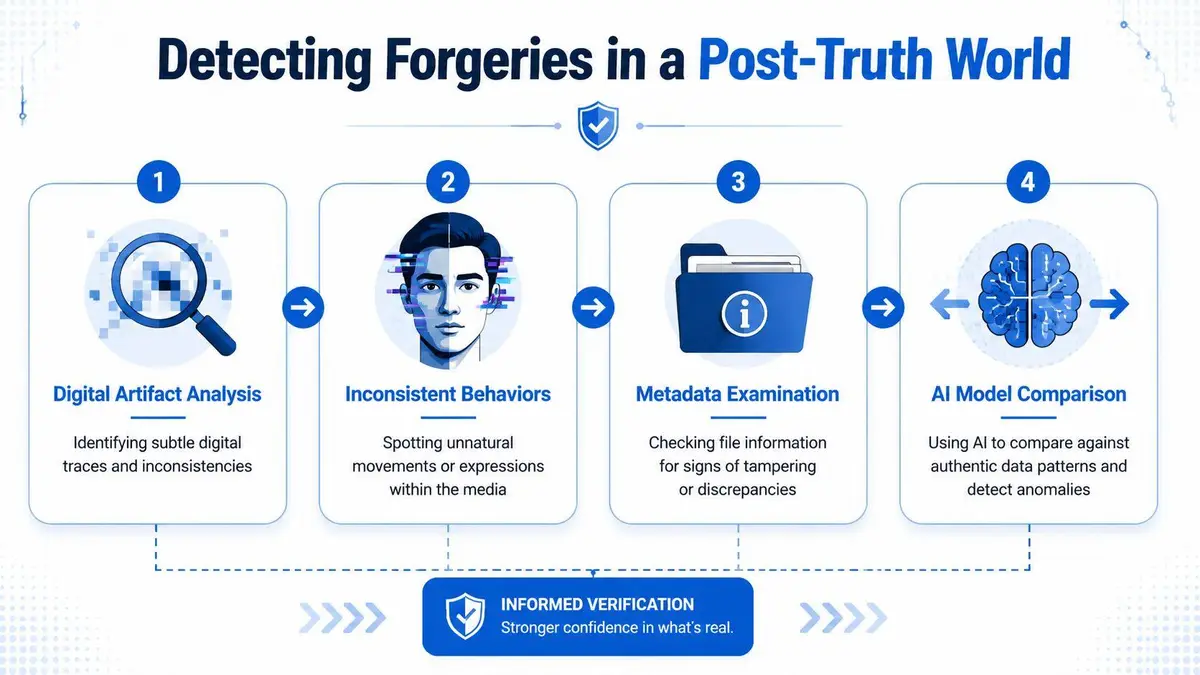
Detection works, but not as a silver bullet. The smarter posture is to use it as one layer in a response stack, not the entire defense. If you’re waiting for a tool to give you absolute certainty, you’re already asking it the wrong question.
The ICO’s current guidance is clear that modern systems inspect multiple signals at once. Those signals include facial-expression inconsistencies, viseme-phoneme gaps where mouth movement does not match sound, and blended boundaries that can expose manipulated media. Detection systems then combine those checks into a single risk score rather than pretending every file can be proven true or false with complete certainty. ICO synthetic media and detection
What detection can and cannot do
Artifact analysis can catch sloppy fabrication. Behavioral analysis can spot odd timing, expression drift, or movement that doesn’t track naturally. Metadata review can reveal tampering or a suspicious file history. AI comparison can flag anomalies by matching the content against known authentic patterns.
But each method has a ceiling. Better forgeries reduce obvious artifacts. Platform compression can erase clues. Reposts can strip metadata, and once a clip has been recut, captioned, and shared by third parties, the original signal gets buried under distribution.
Operational rule: Treat a detection score as a trigger for escalation, not as a verdict you can safely brief to the board.
That’s why executive teams should not buy into the fantasy that a single software product solves the issue. Detection tells you what to investigate. It doesn’t remove the content, preserve the evidence, contact platforms, or manage the reputational response. Those are separate jobs, and they need separate owners.
A Strategic Response Framework for Synthetic Media Attacks
Speed decides the outcome more often than people admit. If the fake content has already moved across platforms, your first goal is containment, not perfection. The second goal is to make sure every action you take is documented and defensible.
Start with proactive monitoring
A monitoring program should watch for impersonation accounts, false press mentions, manipulated video uploads, voice clone misuse, and search persistence. The point is to catch attacks early enough that a private correction or platform report can still be effective. If you only monitor after a crisis begins, you are already behind the person posting the fake.
A response plan is only useful if someone can execute it without waiting for a committee vote.
Then move to immediate containment
When a synthetic media attack breaks, preserve the evidence first. Save URLs, timestamps, screenshots, hashes if available, and any surrounding context that shows how the content spread. Then route the case for takedown, platform escalation, and legal review in parallel, not one after another.
The legal environment is moving toward hard deadlines. The United States’ TAKE IT DOWN Act 2025 requires platforms to remove non-consensual intimate deepfakes within 48 hours of a valid request, while India’s framework can mandate takedowns within three hours of a court order. Those timelines tell you exactly what the market now expects, rapid response, not passive moderation. Legal responses to synthetic media and deepfakes
How executives handle a negative video on YouTube
If you need outside support, use a specialist removal firm that can pursue source removal, de-indexing, impersonation takedowns, and reupload tracking across platforms. In practice, ContentRemoval.com is one option in that category, with services aimed at harmful content removal and ongoing monitoring. Use that kind of support when the issue is already moving faster than internal legal and communications teams can contain it.
When a platform refuses to move fast enough, escalation has to continue. The wrong instinct is to wait for the system to self-correct. The right instinct is to keep pushing until the content is down, the copies are tracked, and the evidence is ready for whatever comes next.
Building Your Personal and Corporate Defense Playbook
Your defense starts before the first fake clip appears. High-profile people need written protocols for authenticating urgent requests, especially anything involving payments, credential resets, or legal instructions. If a request arrives by audio, video, or text and bypasses the usual chain, it should be treated as suspicious until confirmed through an independent channel.
A corporate policy on synthetic media should name a single incident owner, define escalation thresholds, and establish who approves public statements. It should also train assistants, finance teams, IR staff, and executive support teams to recognize impersonation attempts. If those people don’t know the protocol, the protocol doesn’t exist.
Put governance around the obvious weak points
The first weak point is internal verification. The second is message discipline. The third is stale monitoring, where the team learns about the problem from the public instead of from its own alerts.
- Verification controls: Require out-of-band confirmation for sensitive requests, especially transfers, legal approvals, and urgent media comments.
- Crisis communications: Pre-write holding language so the first public statement doesn’t sound improvised.
- Ownership: Assign legal, comms, and security contacts in advance, with one person accountable for decisions.
- Monitoring: Keep active watch over search, social, and video platforms for impersonation, reuploads, and false attribution.
For persistent surveillance of impersonation and harmful content, ContentRemoval.com’s reputation monitoring is a relevant reference point for the kind of continuous tracking program that helps reduce time-to-detection.
Know when to use legal counsel versus removal support
Use legal counsel when you need defamation analysis, preservation for litigation, or pressure through formal demand. Use a removal specialist when the immediate problem is spread, search visibility, reuploads, or platform persistence. In real incidents, you usually need both, but they do different jobs.
The goal is not to eliminate every fake file in the universe. The goal is to stop the specific attack from becoming accepted fact. If your team can’t move from detection to containment to legal escalation without confusion, the attacker has already exploited your delay.
A CTA for ContentRemoval.com.
Frequently asked questions
What is the difference between synthetic media and a deepfake?
Synthetic media is the broad category of AI-generated or AI-modified text, images, audio and video. A deepfake is the video and image subset designed to create a realistic but false depiction of a real person’s appearance, speech or conduct. Collapsing everything into deepfake misses text and audio attacks.
Can software prove whether a video of me is fake?
Not with certainty. Detection systems combine signals such as facial-expression inconsistencies, mouth-sound gaps and blended boundaries into a risk score, but compression, reposts and recuts erase clues. The article says to treat a score as a trigger for escalation, not a verdict to brief to the board.
What should a company do first when a deepfake of an executive appears?
Preserve the evidence: URLs, timestamps, screenshots, hashes where available and the spread path. Then route takedown, platform escalation and legal review in parallel rather than one after another, with a single named incident owner deciding on any public statement.